Which Mural Wallpaper Suits an Art Deco Interior?
Explore geometric rhythm, tonal contrast, metallic-looking colour relationships and balanced symmetry without inventing material finishes.
Article focus: pricing and measurement
What to settle before pricing
Start with accurate wall measurements; the final custom mural price depends on area, material and any finishing options.
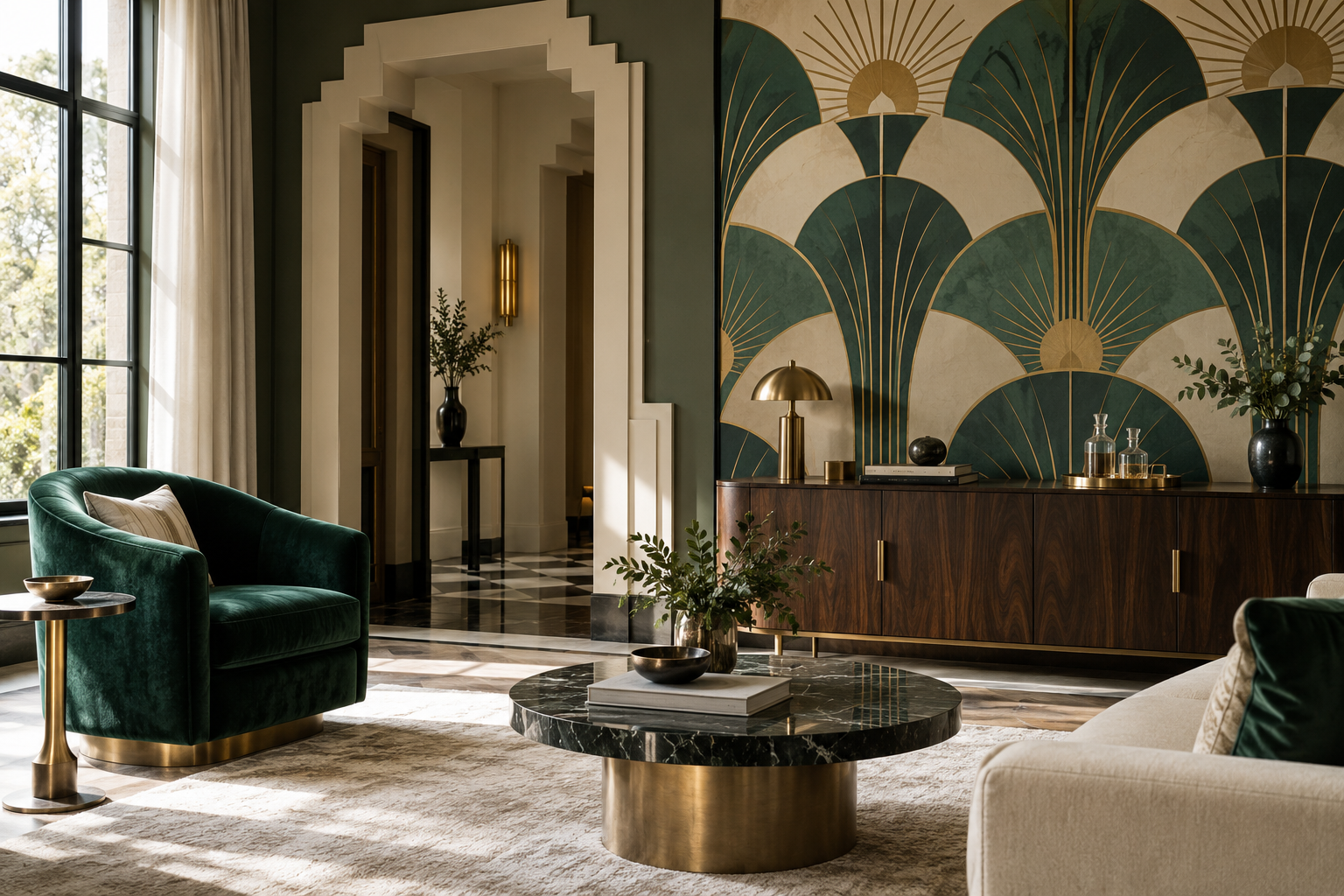
Example application: Bedroom · pricing and measurement
An Art Deco interior can support a striking mural, but the most convincing choice is not simply the one with the most gold. Look for a clear relationship between the wall's geometry and the room's architecture, furniture and lighting. Fan shapes, stepped outlines, sunbursts and stylised botanicals can all work; they do different jobs. A mural with disciplined spacing can reinforce a curved chair or a symmetrical doorway without turning the room into a costume set.
What does Art Deco mean for a mural?
Art Deco was varied rather than a single set of motifs. The Metropolitan Museum of Art describes its decorative richness and eclectic influences, while surviving designs show geometric combinations such as semicircles, rectangles and striped triangles. That history is useful as a starting point, not a licence to label every gold fan pattern historically accurate. A current printed mural is an interpretation unless its source and reproduction rights are documented.
For a contemporary living room, choose one strong visual idea. A repeated fan can give rhythm; a central stepped arch can emphasise a sofa; a stylised floral can soften hard stone and metal. Combining fans, sunbursts, palms, chevrons and metallic-looking lines on one wall often becomes visual noise. Decide which feature the mural should support and let other objects provide the remaining detail.
The historical range is wider than the current shorthand of black-and-gold geometry. The Met's examples include decorative treatments of plants, flowers, animals and figures as well as abstraction; its Serge Gladky plate describes semicircles, rectangles and striped triangles in red and blue on grey. A contemporary stylised leaf can therefore be Deco-inspired without posing as a reproduction. Judge the artwork's actual composition and any claimed historical origin separately.
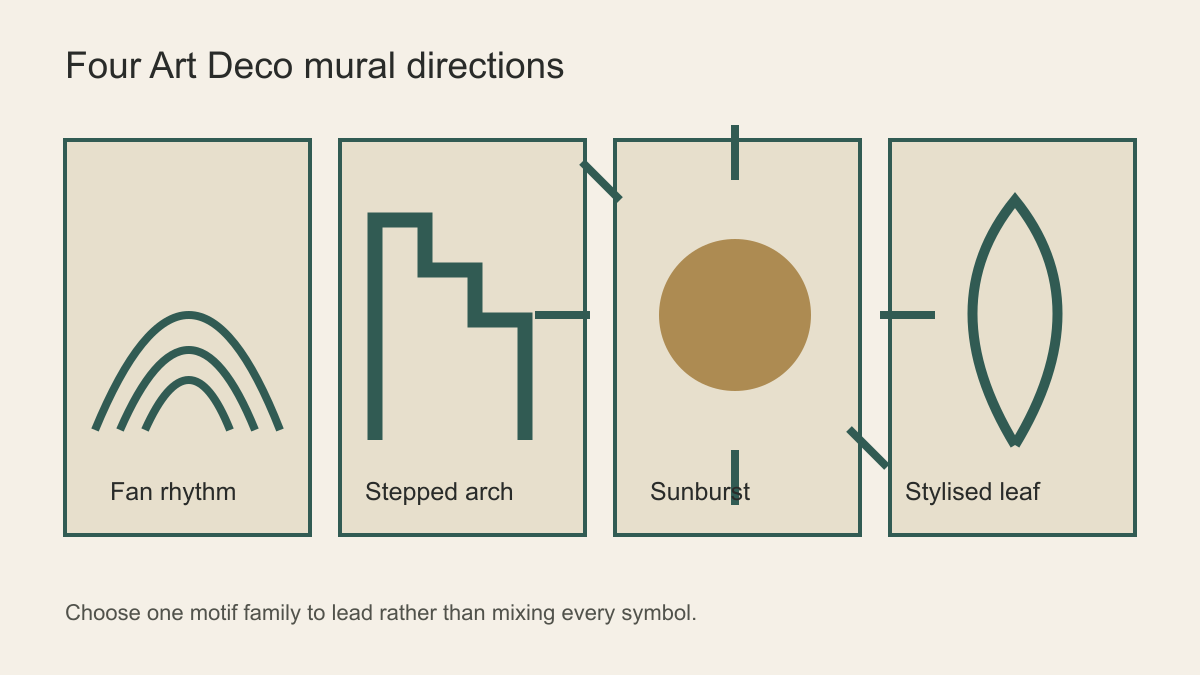 Four motif families produce different kinds of rhythm.
Match the geometry to the architecture
First decide what the geometry should do. A repeated fan supplies rhythm across a long wall; a stepped border frames an alcove; one large sunburst becomes a focal object. These roles are not interchangeable at mural scale. The fan repeat can tolerate a sideboard interrupting its lower portion, whereas a single sunburst may lose its centre behind the same furniture. Compare each candidate on a wall elevation showing the sofa, doors, mirror and pendant.
Architectural echoes work best when they change scale. A broad fan can respond to an arched doorway without copying its curve many times; a few vertical lines can counterbalance rounded upholstery. If a room already contains fluted cabinets, an arch and a circular mirror, another set of equally strong arcs may read as a catalogue of motifs rather than a composition. Test a more spacious geometry or a stylised botanical that lets the built shapes keep their definition.
For a central motif, mark the centre of the visible furnished field, not only the mathematical centre of the wall. A curtain, television or off-centre sofa may shift where the eye reads that axis. If the sunburst's hub lands behind a pendant, moving the print slightly might help, but check whether its rays are then clipped at the opposite edge. An asymmetrical composition may be more convincing than forcing a nominally symmetrical design onto an uneven room.
For a repeat or border, inspect what happens at corners, alcoves and panel joins. A stepped line that stops halfway through a visible bay can look accidental; a dense fan repeat may become restless when cropped into a narrow strip. Ask for the actual numbered panel layout if high-contrast lines cross seams. That is a different check from centring a single motif: its concern is continuity and a deliberate endpoint, not one focal axis.
Choose colour by its role, not by a Deco cliché
Emerald, navy, black, ivory, coral and warm gold are familiar Art Deco associations, but no room needs all of them. If the furniture is dark walnut and the floor is patterned, an ivory ground with restrained green lines may be enough. If the furnishings are pale and plain, a deeper mural can establish the room's centre of gravity. The main decision is contrast: do you want the mural to be the first thing seen, or a refined background for a distinctive chair or mirror?
A printed gold-coloured line is still ink. Unless a particular product explicitly offers a metallic finish, do not expect it to reflect light like brass. This distinction matters when matching a mural to a brass lamp or mirrored console. The two can harmonise in hue without behaving alike. Order a sample and check it beside the real metals under daylight and evening light.
Black grounds can be dramatic in a dining room, but they can also absorb light and make the boundaries of a compact room feel closer. A cream ground with dark outlines can carry the same geometry with a lighter effect. A coloured ceiling, heavy curtain or dark floor may already provide enough depth. Think of the wall as one part of the lighting and material composition.
Test the strongest contrast from the doorway. Fine pale lines on navy may merge into a darker field at distance, while broad ivory and green forms remain legible. Up close, the opposite may be true: a dense repeat can feel detailed and lively, while a giant isolated motif feels very large. A physical sample answers colour and surface questions; a wall-size preview answers scale and placement. Use both if the distinction matters to your decision.
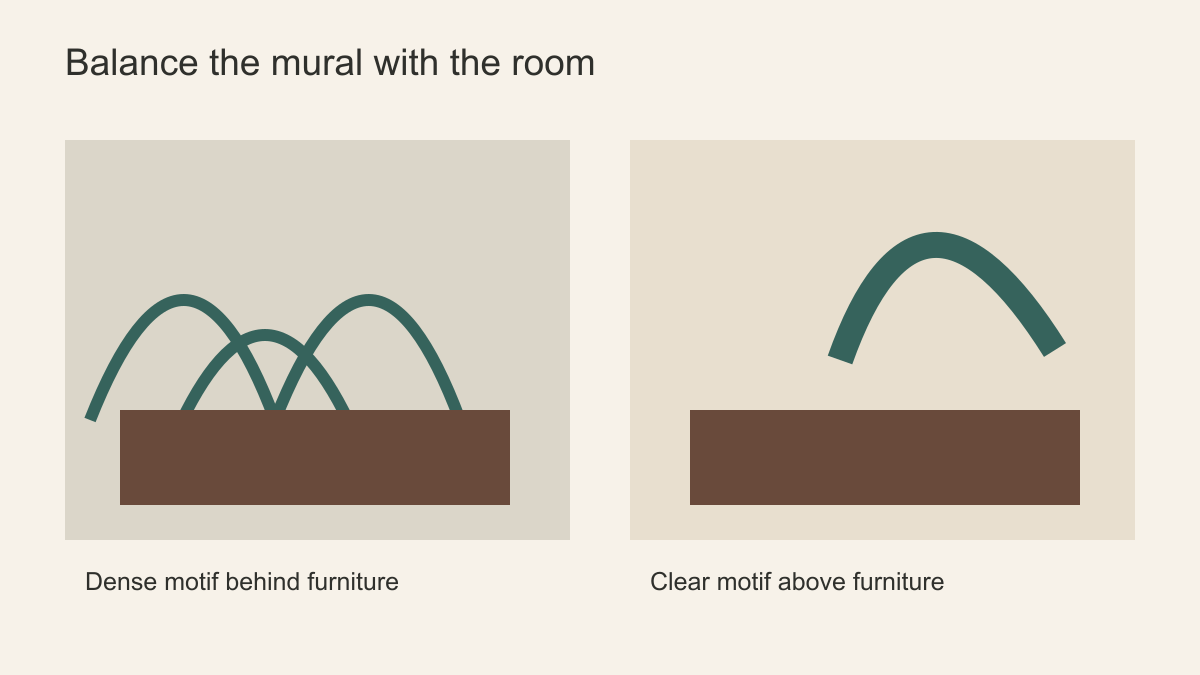 Assess the mural with the furniture and lighting in place.
Which room can carry the most pattern?
A dining room often offers a long view of one wall and relatively simple furniture placement, making it a good candidate for a measured geometric mural. A bedroom benefits from a less restless design behind the bed: broad fans or a single radiating form can be more restful than a dense zigzag repeat. In a hallway, a strong vertical pattern can animate movement, but tight contrast may feel overwhelming at close range.
For a living room, account for framed art and television screens. A mural with a large central medallion is awkward if the screen occupies the same position. Place the most detailed section to one side, or choose a repeat with sufficient quiet ground. If the room already contains a patterned rug and fluted furniture, keep the wall simpler. Art Deco richness comes from orchestration, not from covering every element with ornament.
How should you assess a candidate mural?
Use a wall-size mock-up for composition and a physical sample, if available, for colour and printed surface. Do not ask a small swatch to establish whether a sunburst sits correctly behind a bed, or a backlit preview to prove that a printed gold line reflects light like brass. Test the mock-up from the doorway and main seat with the actual furniture and lighting drawn over it. Then view the sample beside the mirror frame, lamp or upholstery it is meant to accompany.
Reject a central motif if its hub must hide behind a fixed object, a border if it ends awkwardly at a visible edge, or a repeat if its scale fights the room's existing pattern. These are role-specific failures. A calmer botanical or spacious geometric design can still be recognisably Deco-inspired when the architecture and furniture already carry the stronger symmetry. The final choice should keep both the printed motif and the real objects legible without promising metallic effects or historical authenticity the product does not provide.