What Mural Wallpaper Works in an Apartment Living Room?
Use scale, crop, light and furniture placement to give an apartment living room character without crowding it.
Article focus: pricing and measurement
Budgeting this wall with confidence
Start with accurate wall measurements; the final custom mural price depends on area, material and any finishing options.
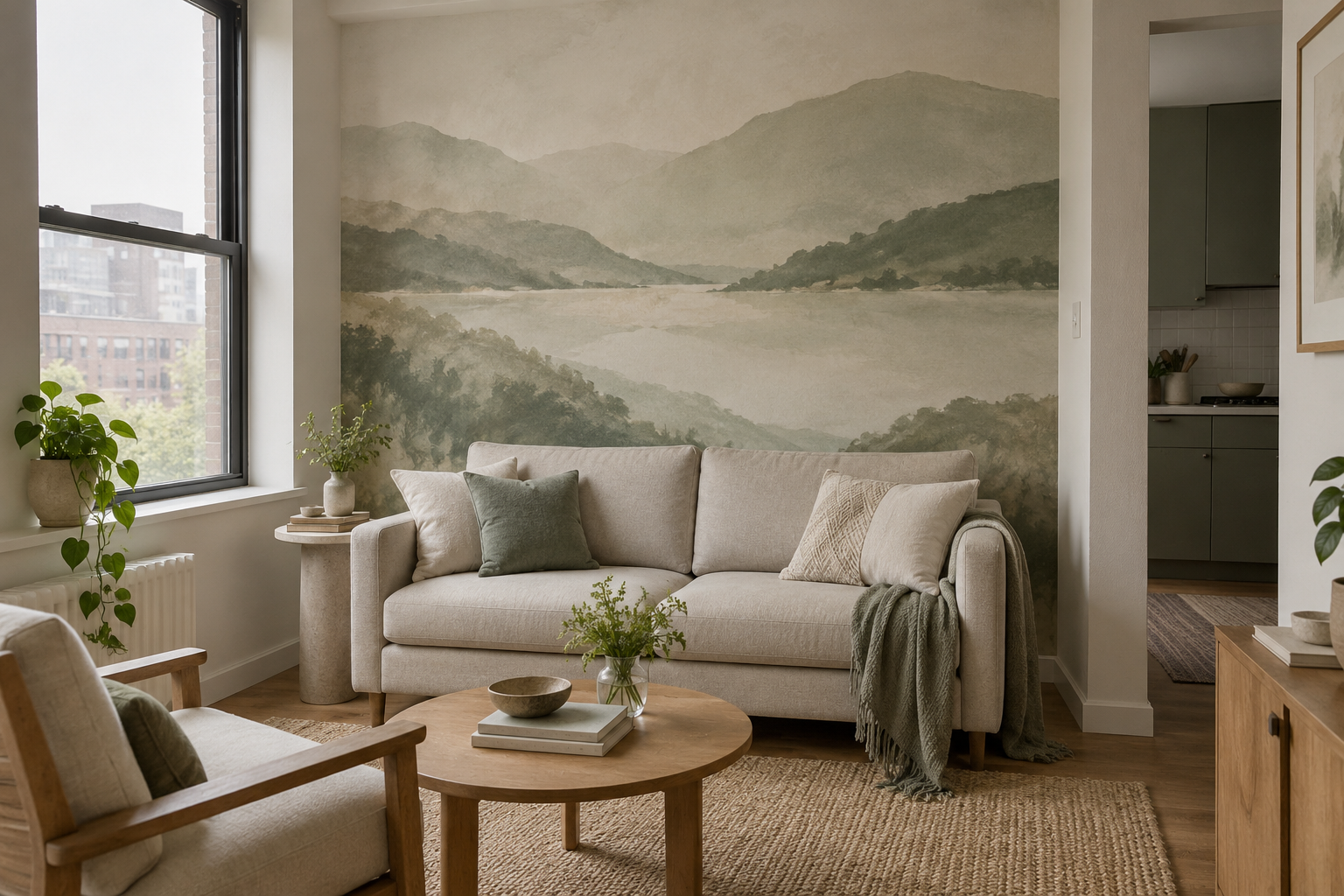
Example application: Living room · pricing and measurement
In an apartment living room, the most useful mural is one that reads clearly on a limited wall while the room serves several purposes. A broad landscape, loose botanical or restrained abstract can stay coherent above a sofa and beside an opening; a tightly centred subject needs more precise placement. Start with the walls visible from everyday seats and routes, then test the image against furniture in both its usual and alternate positions. If you rent, permission and wall condition come before material choice.
Find the wall that survives an open-plan layout
A compact living room may share sightlines with a kitchen, dining table and work corner. Stand at the entrance, sit on the sofa and look back from any dining or desk position. Which wall is visible from more than one of those places? Which is broken by a television, window, radiator or kitchen opening? The best mural wall is not automatically the longest: it is the wall with enough visible area to preserve the image's main idea.
In the accompanying apartment photograph, a misty lake and hills occupy the wall behind a cream sofa. The horizon remains visible over the cushions, while the kitchen opening cuts off one side of the wall. The scene still has depth because the lake and layered ridges extend across the exposed area. A single tree or face placed close to the opening would be more vulnerable to that interruption.
Photograph two candidate walls from the routes actually used each day. Draw the furniture, lamps, outlets and openings at their real size over each photograph. A sofa wall may make the strongest impression on entry but be behind people while they sit. An opposite wall may be seen more often yet have a screen at its centre. Choose the role you want the mural to play rather than insisting every view show the entire artwork.
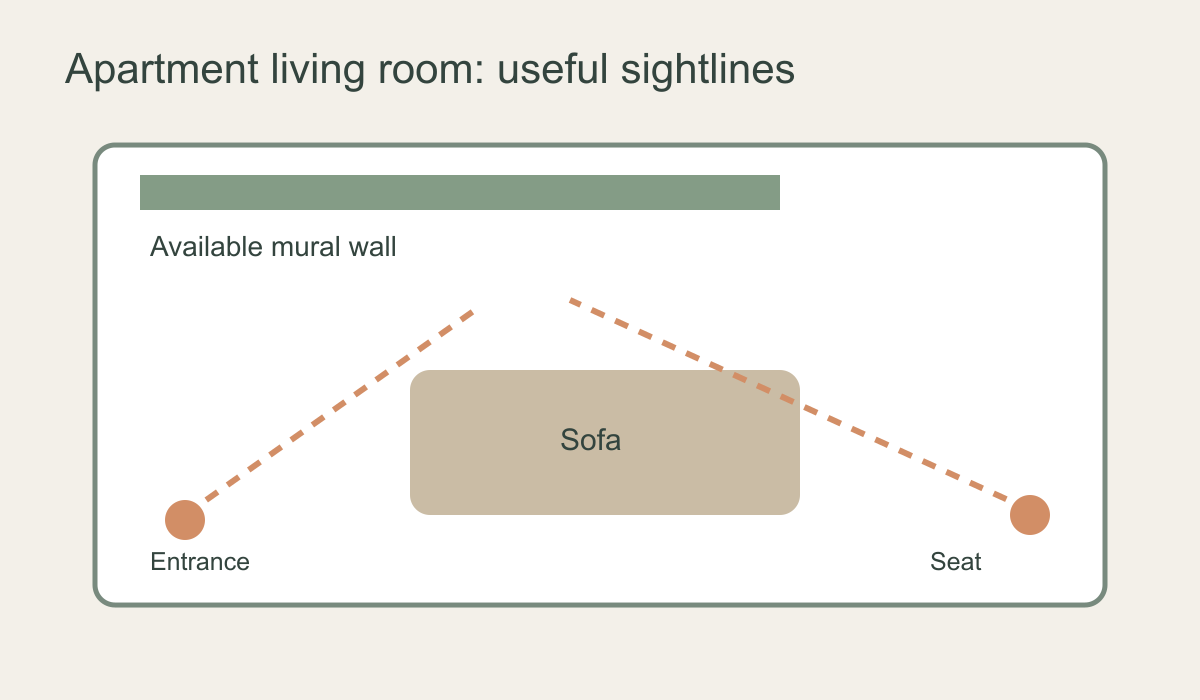 Compare the entrance view with the view from the places people actually sit.
Crop the image around the sofa and openings
Measure the full wall and mark the sofa-back height, door returns, sockets and any permanent shelving on the proof. If the lower third is usually hidden, a focal flower or the only recognisable part of a landscape should not sit there. Move the crop within the available artwork before printing. Do not move numbered panels separately during installation to compensate for a poor crop; that would break the composition.
The alignment question is not always “centre on the wall or centre on the sofa?” An offset sofa may leave a necessary route to the kitchen. Try both alignments in a room photograph. A broad landscape can often tolerate the difference; a single arch intended to frame the seat may look accidental when its centre falls over one arm. Keep the functional furniture plan, and choose a less position-dependent design if the available crop cannot reconcile the two.
Check the image's scale at normal viewing distance. A fine illustration may look detailed up close but become indistinct from the entrance. Conversely, one very large high-contrast shape may dominate a short wall viewed from an armchair a few feet away. A physical print sample helps assess colour and linework; a full-wall crop proof shows what remains visible around the furniture.
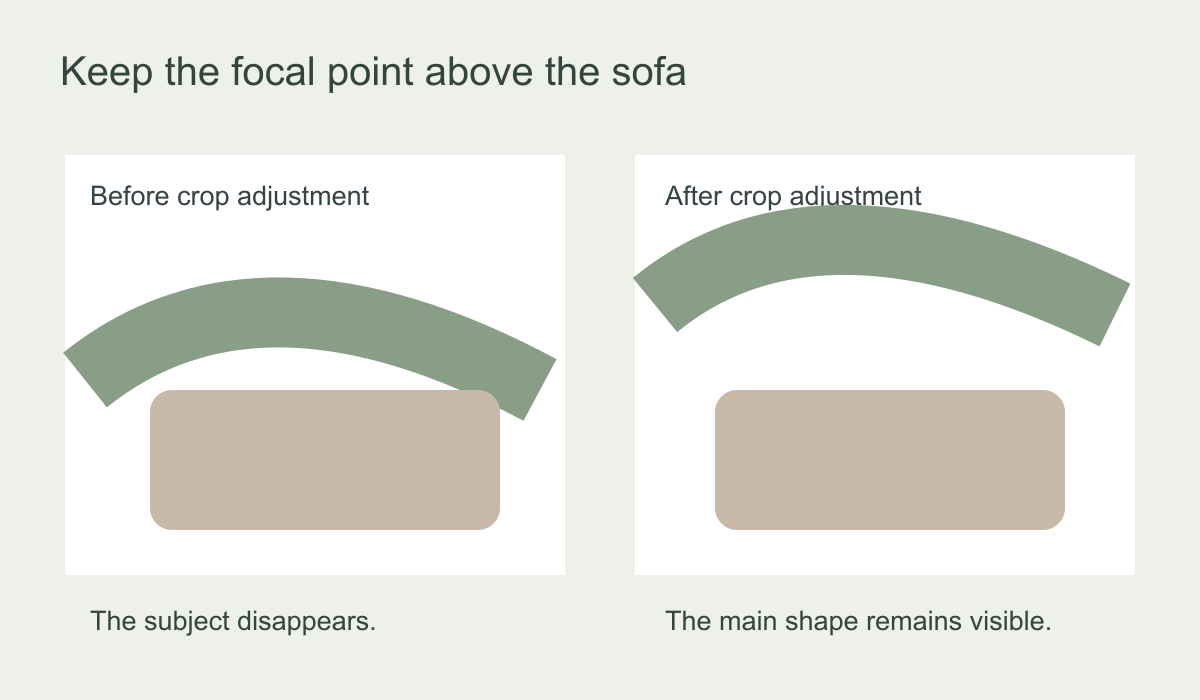 Position the principal shape above the furniture that will stay in front of the wall.
Test the room in its second configuration
Many apartments use the same space for dining, work, guests or an occasional sofa bed. Draw the ordinary layout and the most demanding alternate one. Pull out the dining chairs, open the bed or place the work table where it normally goes. Does the mural remain a coherent scene, or does one object hide its only subject? Artwork with distributed interest across the exposed upper wall is often more forgiving than a composition dependent on one small central motif.
Do not rearrange a chair into the circulation route simply to reveal more print. The mural should accommodate the living arrangement, not dictate an awkward one. The open-plan mural guide looks at defining zones across a larger shared room; in a compact apartment, the immediate test is whether the same wall still works when those zones temporarily overlap.
Consider lighting in each use as well. A window may brighten the sofa wall by day while the dining end is lit mostly by lamps at night. Hold a sample on the intended wall under both conditions. A colour that separates the mural from kitchen cabinetry in daylight may blend into it after dark. That is a room-specific visual check, not a universal rule about warm or cool colours.
Give the television and working corner space
A screen can obscure the main subject of a mural and make fine, high-contrast detail nearby distracting. If television viewing dominates the room, test a quieter crop behind it or use an adjacent wall for the stronger image. Look for reflections from the usual sofa position under the lamps you actually use. The general living-room guide covers broader style directions; this apartment decision is about sharing a small number of walls among competing functions.
If a desk occupies part of the living room, check how the mural appears immediately behind the screen and in video calls. A detailed focal point that gives the sofa area depth may become a visually busy work backdrop. An open area of the artwork behind the desk can let the room serve both uses without needing a second feature wall.
Treat rental permission as a separate gate
If the apartment is rented, check the tenancy terms and ask what wall preparation, adhesive application and reinstatement are permitted before ordering a made-to-measure print. “Peel-and-stick” or “removable” does not guarantee that every painted wall will be unchanged on removal. Wall condition, paint cure, preparation and the specific product's removal method all matter. A small test, if permitted, and written supplier instructions are more useful than a blanket promise about the deposit.
The Wallcoverings Association's surface preparation guidance calls for a clean, dry and sound substrate. Older apartment walls may have patched paint, texture or previous coatings; any damp or loose finish should be addressed before installation. The rental mural guide covers permission and removal in more depth. If wallpapering is not allowed, a large framed print may carry the same visual idea without claiming that an adhesive installation is risk-free.
Make the final wall plan installable
Once the wall, layout and permissions are settled, confirm measurements with fixed features shown on the crop. Mark switches, outlets, access panels and the edges of the kitchen opening. Ask for the panel layout if the mural has a distinct horizon or geometric line; a seam through a prominent feature may deserve adjustment at the proof stage. Follow the selected product's preparation and hanging instructions rather than relying on the image preview alone.
A successful apartment mural does not need to fill every visible surface. It needs a coherent subject above real furniture, a clear relationship to the adjoining zones and a wall that can legally and technically take the chosen material. When those conditions hold, even one carefully chosen landscape or abstract wall can give a multifunctional living room a distinct focal point.