What Is Chinoiserie Mural Wallpaper?
Understand its decorative language, painted scenery, botanical detail and considered use in bedrooms, dining rooms and living spaces.
Article focus: pricing and measurement
The cost and measurement decision
Start with accurate wall measurements; the final custom mural price depends on area, material and any finishing options.
Example application: Bedroom · pricing and measurement
Chinoiserie mural wallpaper is a modern wallcovering drawing on a European decorative style that adapted motifs associated with China and other Asian traditions. The label describes an influence, not the origin, age or manufacturing method of a particular print. Flowering branches, birds, garden rocks and imagined architecture may form a continuous scene, but their presence alone does not make the mural a historic Chinese wallpaper or a hand-painted original.
In a current product listing, the term usually describes an ornamental garden-inspired look rather than a manufacturing technique. Branches may travel across a broad ground, with birds, blossoms or rocks spaced as part of one scene. The design may be newly made and reproduced as a flat print. To understand the product, separate what the picture shows from any documented claim about its artist, source artwork or production.
Where the term comes from
Chinoiserie developed in Europe through trade, collecting and the adaptation of imported objects. The Victoria and Albert Museum explains that eighteenth-century European designers combined motifs from different Asian traditions, often without distinguishing their origins. Some resulting imagery was an imaginative European fantasy, not an accurate record of Chinese life or art. That distinction matters when a product is described today.
There is another history alongside it: Chinese makers produced painted wallpapers for export to European buyers. The V&A's account of Chinese wallpapers describes hand-painted sets made for rooms and designs adapted to the export market. The Metropolitan Museum's record of a painted silk wall panel discusses both painted paper and silk wall coverings exported from China. That object is silk, not a paper wallpaper; its record helps show why a material label matters. An antique Chinese export wallpaper, a European Chinoiserie object and a modern printed mural inspired by either are related but not identical things.
These histories explain why style, origin and method must not be collapsed into one label. A newly printed branch-and-bird mural can be Chinoiserie-inspired without being an antique Chinese export paper or a hand-painted wall. The V&A's examples include continuous Chinese painted decoration as well as European imitations with regular repeats. They help explain visual references; they do not identify the maker or technique of any present-day product. Attribute a specific period or source only when that individual artwork is documented.
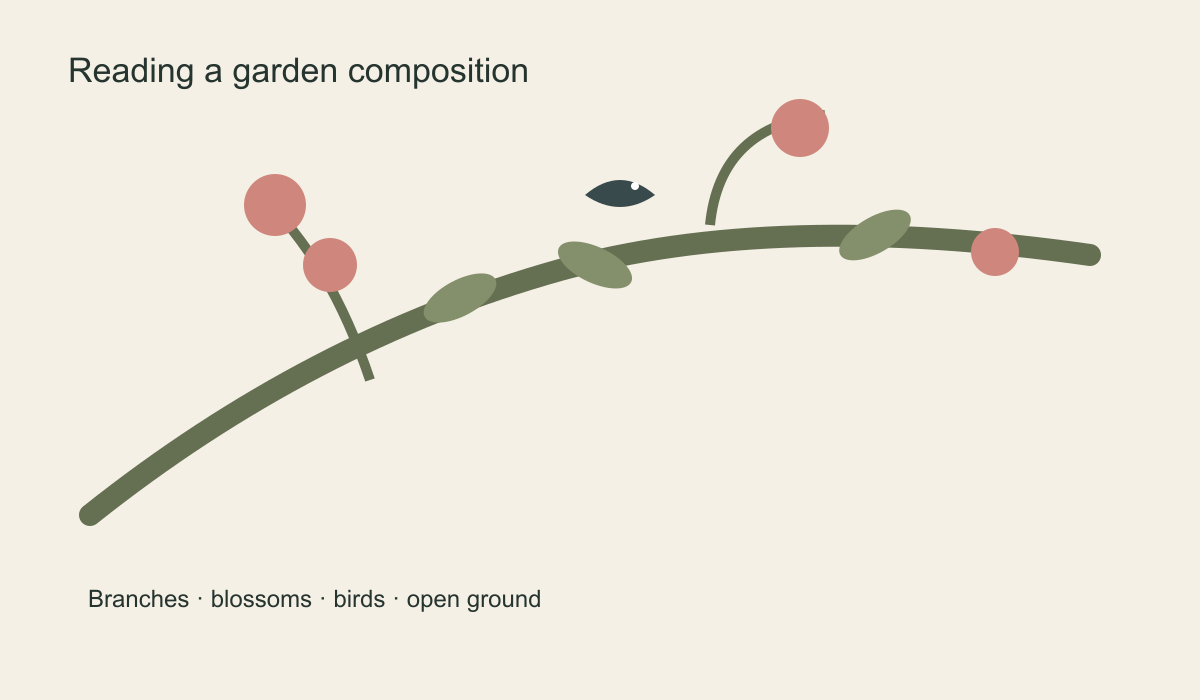 Motifs vary by design; no single branch or bird makes a mural historically authentic.
What a Chinoiserie-inspired mural can look like
Many contemporary designs use branches that travel across a pale ground, with small birds, blossoms and leaves providing points of interest. Others are denser landscapes with rocks, water, pavilions and layered planting. Some echo the delicate spacing of historic export wallpapers; others use larger forms or a distinctly modern palette. A label alone will not tell you how busy the wall will feel.
Look at how motifs are arranged. Are branches distributed evenly, or is there one main tree? Is the image a continuous scene spanning the wall, or a repeating panel? Does the design leave open ground behind furniture and framed objects? These choices have a stronger effect in a room than a broad style name. A sparse branch design may suit a quiet bedroom; a detailed garden panorama may become the focal point of a dining room.
Examine the representation as well as the ornament. Some historic European Chinoiserie relied on imagined or caricatured figures; a modern product need not repeat that framing. Describe visible subjects precisely and avoid assigning a real place, dynasty or cultural identity to a decorative garden without evidence. A flowering branch on a wall is not automatically a historically specific Chinese landscape.
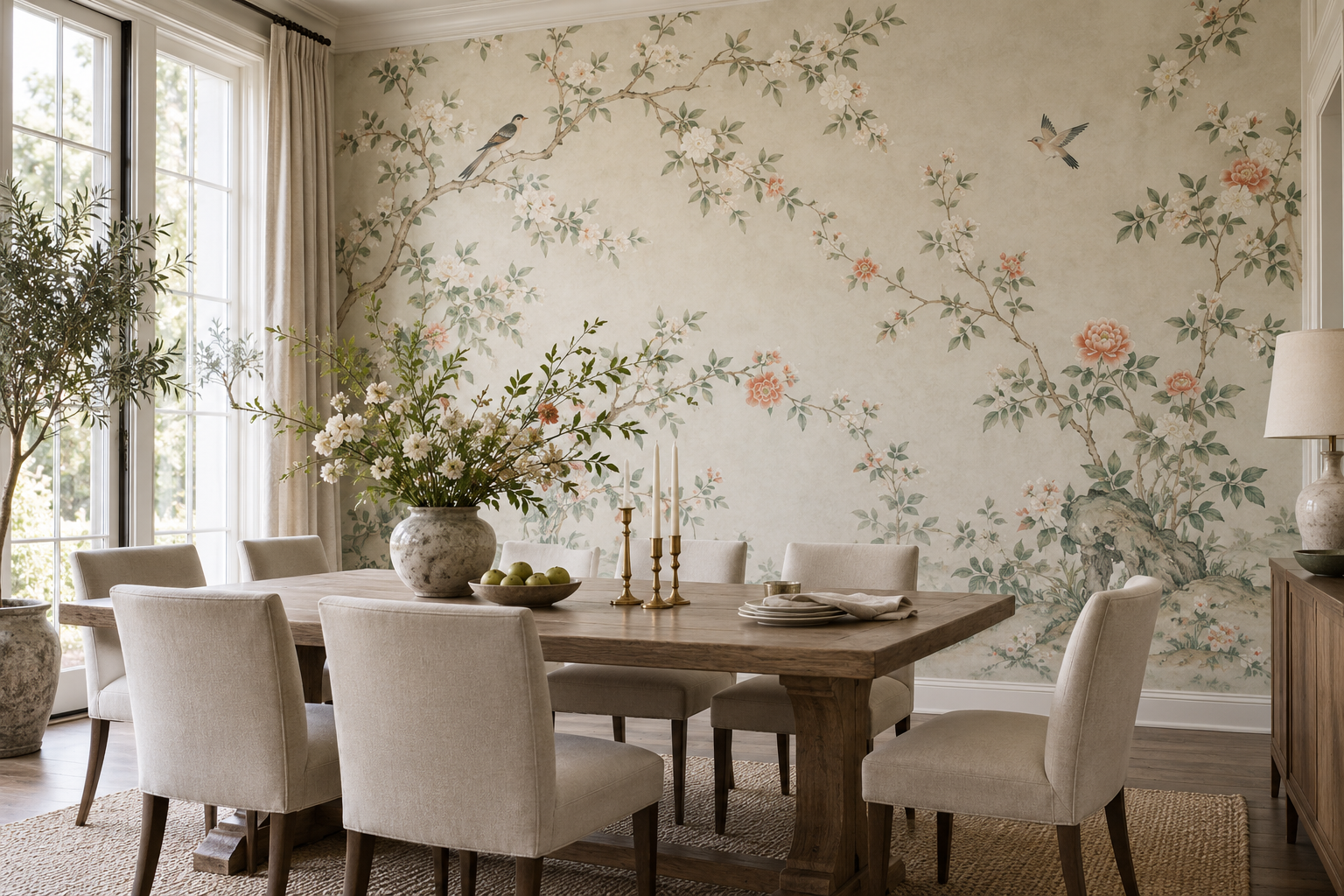
The dining-room image here is a useful example of what to describe directly: slender flowering branches spread across a warm pale ground, small birds punctuate the upper wall, and a garden rock appears at the right. Nothing in the picture establishes the species of every flower, the name of a real garden or the artist's cultural background. Saying what is visible gives a shopper a more accurate understanding than assigning a specific dynasty, location or hand-painting technique without documentation. The wide quiet areas also explain why the scene can sit behind furniture without every detail being lost.
How is this different from an ordinary floral mural?
A floral mural can be almost anything: a close-up bouquet, a scattered repeat, a botanical study or a field of painterly colour. Chinoiserie-inspired imagery is more often discussed in terms of an ornamental garden composition, with branches, birds and sometimes architecture or rocks interacting across the wall. This is a description of visual organisation, not a checklist. A mural with one flower does not become Chinoiserie automatically, and a design without a bird may still draw on the tradition. Compare the overall scene, its spacing and any stated artistic source rather than relying on a single motif.
Scale and placement matter more than the label
A small preview can make a fine-line garden appear airy, but the printed branches may be far larger on a three-metre wall. Compare the height of a bird or blossom cluster with the table, headboard or sideboard it will sit behind. If a large branch emerges from the lower corner, check whether furniture will hide its starting point. If the main bird is centred above a headboard, check that a wall light will not cover it.
For a dining room, consider both seated and standing views. A mural with detail concentrated at eye level may disappear behind chairs or a tall buffet. A gentle canopy above the furniture can remain visible, while open background keeps the table setting from competing with the wall. In a bedroom, an asymmetrical tree can make the bed placement feel intentional, but only if the crop preserves enough branch structure on either side.
In the pictured dining room, the table and chair backs mask the low planting, but branches continue across the upper wall and birds remain visible. The pale ground gives the pendant, vase and table setting room to read. The important crop question is whether the left-hand branch still has a visible point of entry and whether the rock and flowering stems on the right remain connected to the scene. A tall cabinet could remove that relationship even if individual blossoms survive.
Plot wall lights, windows and storage on the measured-wall preview. A bird hidden by a sconce or a branch divided by two unequal windows can make a carefully spaced composition feel accidental. The placement diagram tests an obstruction, not a requirement for symmetry. An off-centre garden may fit the real wall better than a centrally placed tree whose trunk disappears behind furniture.
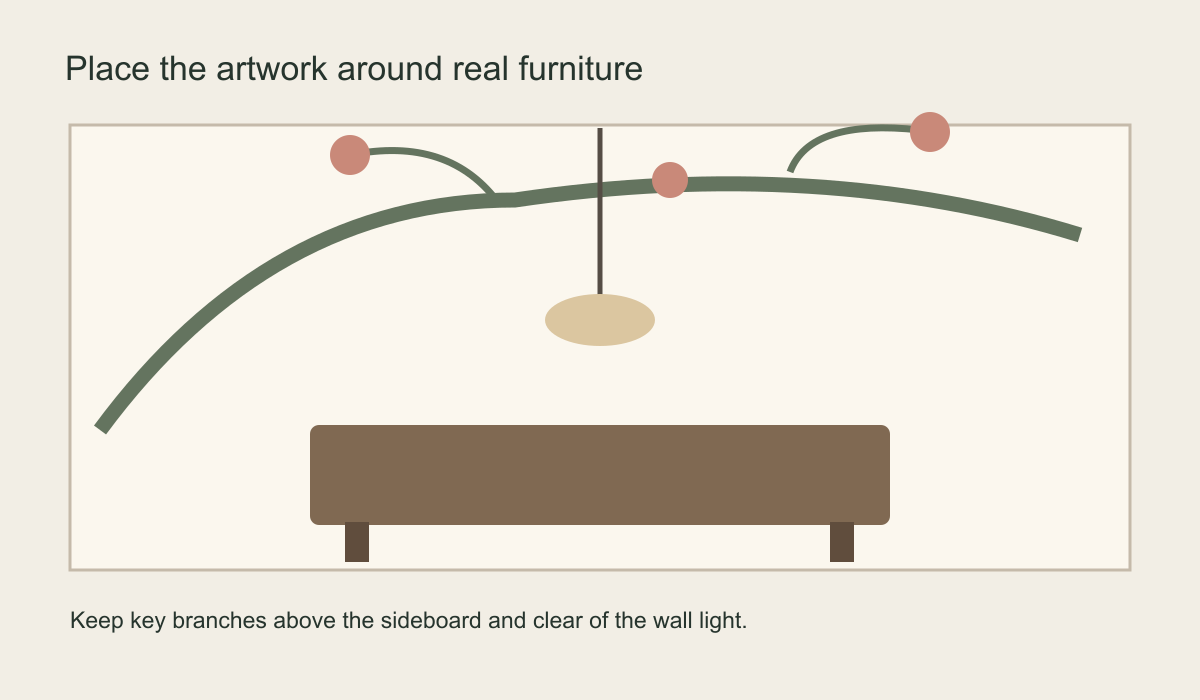 Preview the artwork with real furniture and wall lights, not on an empty wall.
Colour gives the mural its mood
Chinoiserie-inspired prints range from pale ivory grounds with muted sage and coral to dark blue, green or charcoal scenes with stronger contrast. Neither palette is more authentic simply because it looks older. Choose colours against your room's daylight, floor and upholstery. A cool celadon leaf can shift next to warm timber; a cream ground may look pink or yellow beside existing paint.
Decide whether the mural should connect with the room or intentionally contrast it. A painted cabinet in a related green can pick up foliage without matching every leaf. Natural timber and plain linen often allow intricate branches to remain the main detail. If the mural includes strong birds, flowers and architecture, adding several more patterned fabrics can make the room feel crowded. It is usually enough to repeat one small colour or material note.
A physical sample is useful for judging line sharpness and ground colour in your own light. It will not show the full composition, so use it alongside a scaled preview. Read product specifications carefully: a flat printed image that looks like watercolour or silk does not necessarily have either physical finish.
The ground often covers more wall than any bird or blossom, so judge it beside the actual ceiling, skirting, curtains and timber. A warm cream can look more yellow next to cool white paint than it does on a phone. Use the sample under the room's usual daylight and evening lamps. This tests appearance, not durability or any material property suggested by the image.
Choosing between continuous scenery and repeat
A continuous mural is planned as a single wall composition. It can place a branch, bird or garden structure where you want it, but cropping a doorway or angled ceiling needs attention. A repeating Chinoiserie-inspired pattern extends more flexibly around several walls, though its repeated birds or flowers may become obvious on a large surface. Neither approach is automatically more sophisticated. Pick according to the wall layout and how much visual continuity you need.
Ask to see the complete artwork rather than only a styled room photograph. A room image may hide where a branch begins or whether the same bird appears twice. With a repeat, check what happens at both horizontal and vertical joins; with a continuous scene, check which motifs fall near the left and right trim edges. If you plan to wrap the design around a corner, establish whether the supplier can provide a deliberate continuation or whether a separate wall composition would be clearer. That choice affects how the story reads, even when the palette is identical.