How to Scale Geometric Mural Wallpaper
Coordinate geometry with wall dimensions, furniture, viewing distance, line direction and the architecture of the room.
Article focus: pricing and measurement
The cost and measurement decision
Start with accurate wall measurements; the final custom mural price depends on area, material and any finishing options.
Example application: Bedroom · pricing and measurement
Scaling a geometric mural is not the same as choosing whether you like its colours. A rectangle that looks small on a phone can become wider than a sofa; a pleasingly bold curve in a room photograph can shrink into a busy repeat on your own wall. Start with the finished wall, the furniture in front of it and the distance from which you will actually see it. Then judge the design at that scale.
First distinguish a repeat from a single composition
A repeating geometric wallpaper uses a motif that appears again across the wall. A mural may instead be one composition, with an arc, circle or arrangement of blocks positioned for a particular wall size. The two are not interchangeable. Enlarging a repeating motif changes how often it appears; enlarging a single composition changes the relative size and position of every shape. Ask which type you are viewing before requesting a crop or scale change.
For a repeat, find the physical repeat width and height if the supplier provides them, then estimate how many full units will fit across the measured wall. For one composition, locate its focal shape and the surrounding open ground. A circle cropped at an edge can still be deliberate, but it should not become an unexplained sliver after the wall's dimensions and openings are applied.
Do not mistake panel width for motif width. A mural may be supplied in several printed panels, while its circles or blocks run across panel boundaries as one continuous composition. Likewise, a repeat may have a wide printed panel but a much smaller repeated unit within it. Ask for the dimensions of the actual motif or request a wall-scale preview with a ruler. The number of panels is an installation detail; the number and size of visible motifs are design decisions.
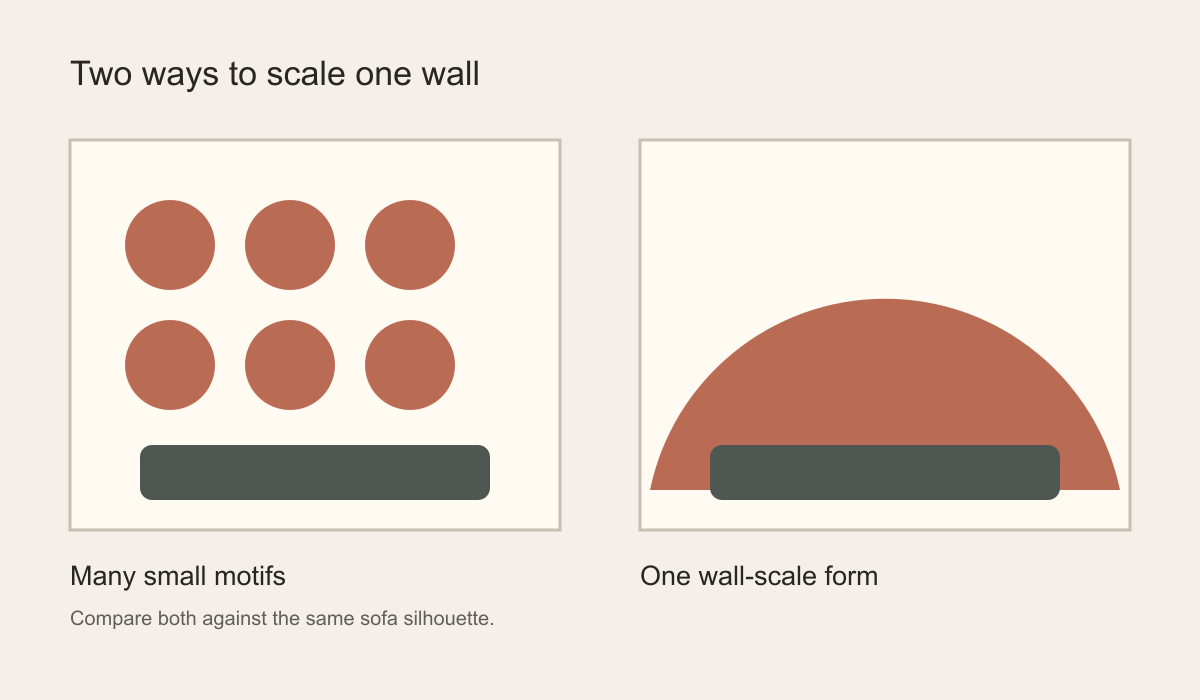 The same wall area can carry many small motifs or one broad geometric gesture.
Use a familiar object as the scale reference
A useful comparison is the sofa, headboard or dining table that will stand against the wall. If a circle is wider than the sofa, it will behave like an architectural backdrop. If several circles fit behind one cushion, the design reads more like a patterned surface. Neither is automatically better. The question is whether you want a distinct focal shape or a quieter rhythm.
Place the actual sofa, cabinet or headboard silhouette on a straight-on wall view. A broad arc may remain recognisable above a low sofa but turn into disconnected pieces behind open shelving. In a bedroom, check whether the curve continues visibly around the headboard rather than ending at its top edge. The scale must be judged against objects that will remain, not against an empty rendering.
Calculate motif size from the approved wall crop, not the original image thumbnail. On a 3-metre wall, four equal circle-and-gap units each occupy about 75 centimetres; a single circle spanning half the wall is about 1.5 metres wide. The former reads as rhythm, the latter as a focal form. Put those dimensions beside the sofa and door outlines on the preview. A print sample can check edge quality and colour, but only this scaled view shows whether furniture interrupts the intended geometry.
Compare the form with furniture height as well as width. A semicircle that barely clears a sideboard may disappear once lamps and vases are added. A larger arc can remain legible above those objects, but if it runs into a cornice or ceiling, a smaller one may preserve more of its outline. Scale is therefore a range bounded by the furniture below and the real architecture above, not a rule that bigger is always bolder.
Stand where the mural will be seen
Viewers rarely stand squarely in front of a feature wall all day. A mural behind a sofa might first be seen from the doorway across the room. At that distance, narrow stripes and tiny chevrons can merge visually, while broad blocks remain readable. A hallway gives a closer, angled view; one giant circle may be impossible to take in at once. A dining wall is viewed while standing, moving and sitting at the table.
Mark two or three ordinary sightlines on a plan or in photographs. Include the door, the main seat and the point where a visitor turns into the space. Does the pattern make sense from those places? Sharp black-and-cream edges may feel graphic at every distance, while several close tonal shades can settle into a softer field. Scale and contrast work together.
At close range, a corridor viewer may only see a fragment of a circle whose whole outline is obvious from across a living room. In a dining room, a pendant or chair can interrupt the centre even when the wall is wide enough. Compare the same scale from the doorway and the normal seat, rather than resizing the artwork separately to flatter each photograph. If it works only in the straight-on supplier view, the wall or motif size may be wrong for the room's actual sightlines.
Keep the wall's proportions in mind
A wide low wall and a narrow tall wall can use the same artwork very differently. A horizontal sequence of blocks may unfold naturally behind a long sideboard but become compressed on a narrow wall. A vertical arch can emphasise height, though it may be cut short by a sloping ceiling. The solution is not a universal motif size; it is a crop that retains the artwork's intended relationships.
Look closely at openings. A door can remove one third of a giant circle, leaving an unexplained crescent on each side. A window may divide a stripe at an awkward height. For a repeat, these interruptions are often tolerable because the rhythm continues elsewhere. For a single mural, position the strongest form on the longest uninterrupted section. Ask for a crop preview showing the actual doors, windows and ceiling line.
The doorway diagram shows why shifting the composition can be more effective than simply shrinking it. On the left, the vertical opening splits the circle into pieces. On the right, the circle remains readable beside that interruption while the low furniture still overlaps its lower edge. A full circle does not have to be visible, but enough of its outline should remain for the eye to recognise the intended form. Check this in the final crop, not in a generic room photograph.
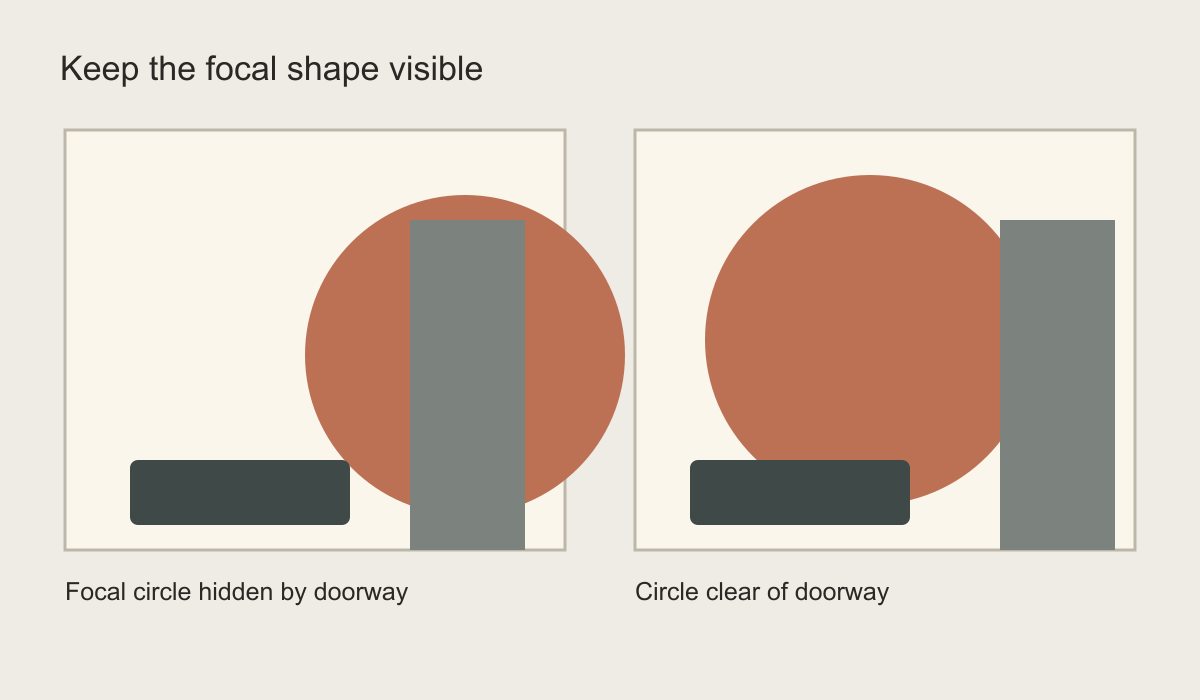 Moving the focal shape can matter more than changing the entire mural's scale.
Decide how much pattern the room already has
Scale is also a question of competition. A room with striped upholstery, a gridded rug and open bookshelves already contains many small edges. A mural with large, simple fields may give those details a background. In a sparse room, a smaller repeat can add rhythm without needing a large focal form. Compare the mural with the furniture you own, not with an empty catalogue interior.
Colour can amplify the effect of scale. A pale ochre semicircle on an ivory ground may read gently even when it is large. The same semicircle in black against white may dominate. Conversely, tiny high-contrast tiles can feel busier than a huge quiet arch. When you compare options, keep the palette and edge contrast in the comparison; do not treat motif dimensions as the only variable.
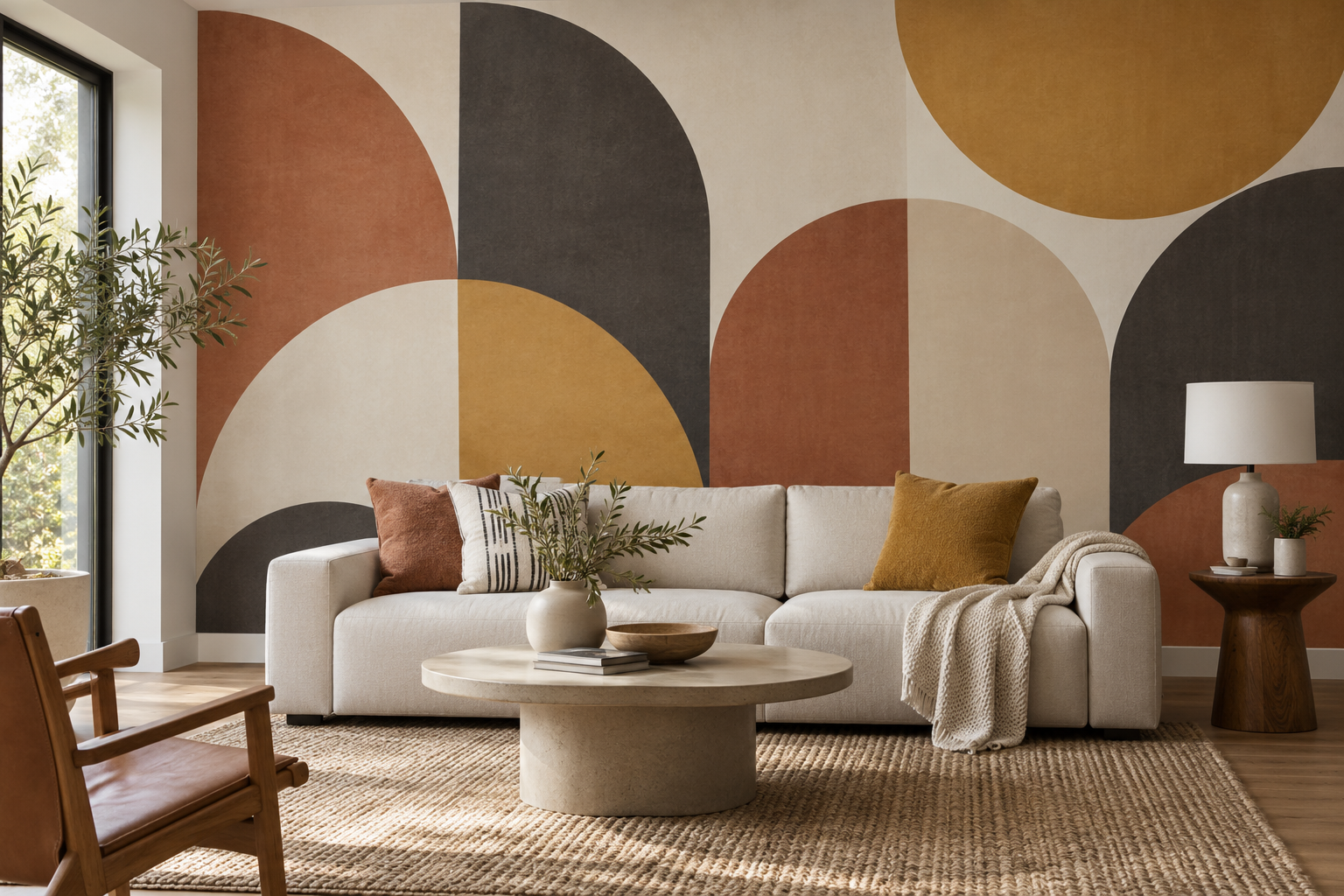
The pictured living room uses terracotta arches, a charcoal form, an ochre circle and pale ground at wall scale. The sofa covers some lower edges, but the upper forms still establish a broad rhythm. Compress the same vocabulary into many small repeats and the room would gain surface texture instead of large visual architecture. Enlarge the shapes further and dark and ochre might dominate the strip above the sofa. The number of visible units changes the effect as much as the palette does.
Confirm what made-to-measure sizing changes
Made-to-measure printing fits a wall, but it does not always enlarge every shape. One supplier may crop or reposition a single image; a repeat may keep its motif size and add more units across extra panels. Ask which operation the preview shows. Otherwise a wider wall can unexpectedly produce either more circles of the same size or the same circle enlarged, two very different designs.
Provide wall width and height using the supplier's measurement and trim instructions. If a focal form must clear a sideboard or avoid a door, give its position from a wall edge in measurements, then inspect the final preview. Note where a crisp diagonal or circle crosses a panel join so alignment receives particular attention during installation. Panel width does not define motif width, but panel placement can affect how precisely a strong line must meet.
Use the digital view for number of motifs, placement and furniture overlap; use a physical sample, where available, for printed colour and edge quality under the room's light. A sample cannot show the complete rhythm across three metres, and a screen cannot settle the final warm off-white. Together they answer the scale and print questions separately.