How to Plan Mural Wallpaper Around a Future Renovation
Consider timing, removable sections, furniture changes, electrical work and whether the wall will remain in the same layout.
Article focus: pricing and measurement
The cost and measurement decision
Start with accurate wall measurements; the final custom mural price depends on area, material and any finishing options.
Example application: Any room with a suitable, prepared wall · pricing and measurement
If a renovation may change the mural wall, do not order a made-to-measure print from today's dimensions. First establish whether the future work is scheduled, merely possible or already under way. A new doorway, taller cabinet or altered ceiling can change not only the wall size but where the printed subject appears. When the shape is still moving, delay the final mural order or choose a genuinely temporary decoration you would be willing to replace.
Decide how certain the renovation really is
Write down the proposed work rather than treating “we may renovate” as one condition. Will a doorway be cut into the mural wall? Will built-in storage cover part of it? Are the ceiling, floor level, window trim or light positions changing? A new door can remove the image's focal point; a taller cabinet may conceal its lower half. Repainting trim on an adjacent wall presents a very different level of risk.
Sort each change into three groups. Confirmed work has approved drawings, a budget and a likely construction date. Probable work has a coherent plan but details may change. A distant idea has no committed design or timetable. For confirmed structural changes to the proposed wall, wait for the new shape. For a distant idea, decide whether several years of enjoyment justify a print that may eventually be replaced. Do not let an undefined plan either rush or indefinitely freeze the room.
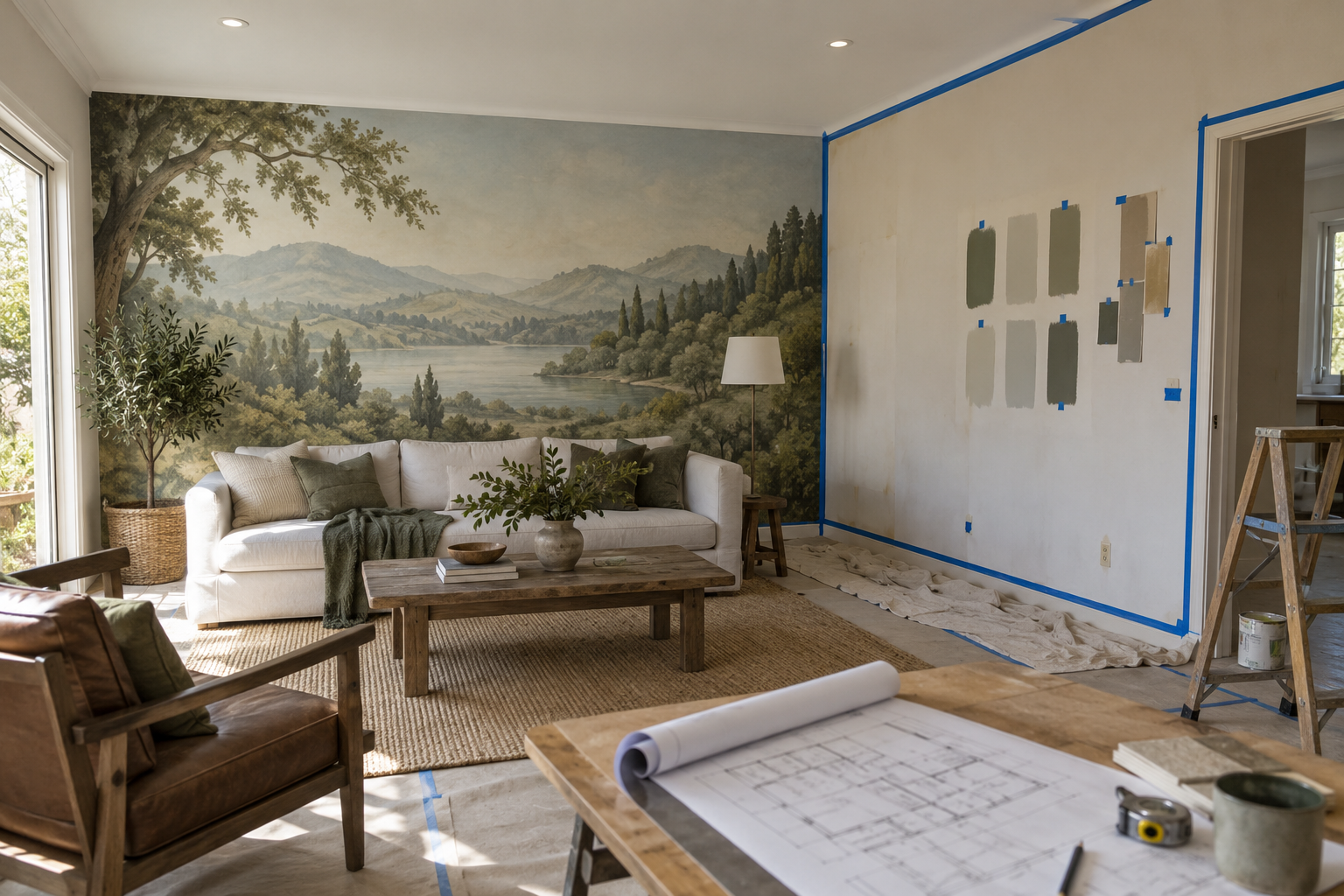
The wall in the feature photograph shows the issue clearly: a landscape mural is already installed, while the adjoining wall is masked for paint, with a ladder and drop cloth still present. That may be unavoidable in a phased project, but it exposes the print to more work in the room. It is easier to protect an unprinted wall during construction than a finished image.
Use the finished wall as the ordering document
Renovation drawings are useful for planning but are not the final order measurement. Confirm the as-built wall once openings, plaster, skirting and fixed joinery have reached their final positions. Measure width and height at the points requested by the mural supplier, and report irregularities rather than assuming a perfectly square rectangle. A drawing can contain precise figures and still differ from the completed surface.
Make a final wall elevation showing doors, windows, sockets, radiators and furniture that will stand in front of the print. Place the proposed mural crop behind those outlines. If the main tree sits behind a new bookshelf or the horizon disappears through a doorway, revise the crop or choose another image. Enlarging the same print will not reveal a subject physically blocked by a cabinet.
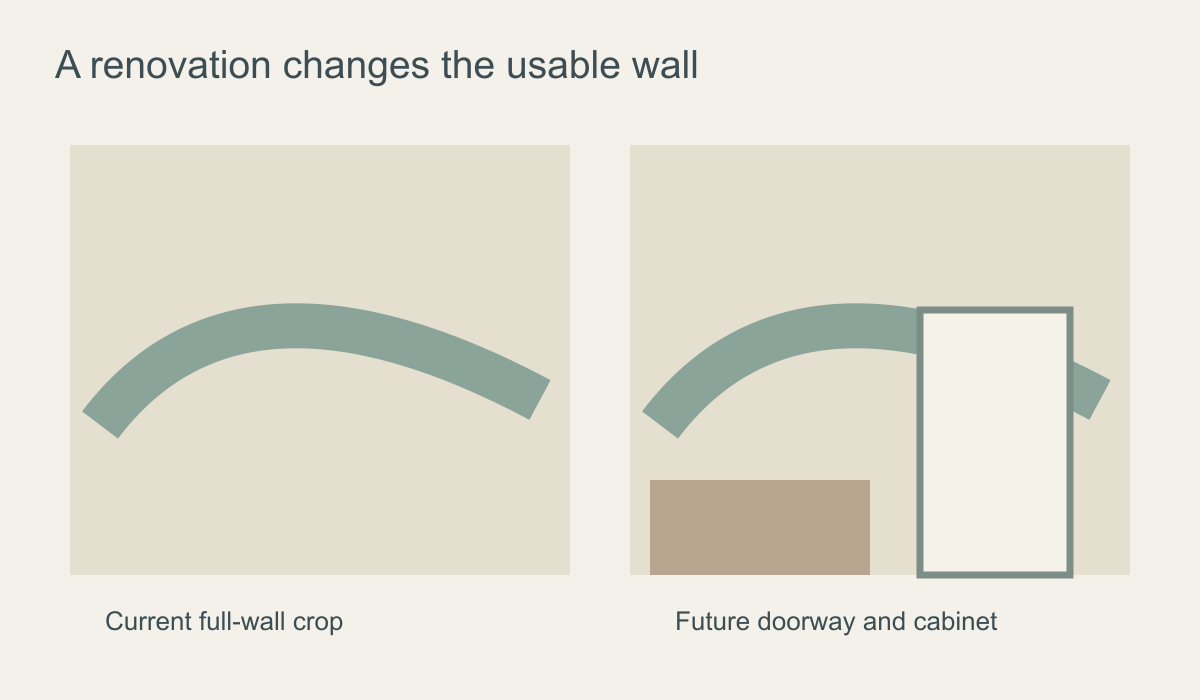 Overlay future openings and built-ins before approving the artwork.
Keep a dated copy of the approved dimensions, crop proof, selected material and panel layout. These records help the installer and make later discussions with the supplier clearer. They do not guarantee that a replacement panel from another print run will match invisibly, so ask about that possibility before treating the records as an insurance policy.
Put wet, dusty and structural work before installation
Demolition, sanding, plaster repairs and painting should normally precede the mural. Resolve leaks or persistent dampness first. The Wallcoverings Association's surface-preparation guidance calls for a clean, dry and sound wall and directs users to the particular product's instructions. A mural does not conceal a moisture source or make loose paint a suitable substrate.
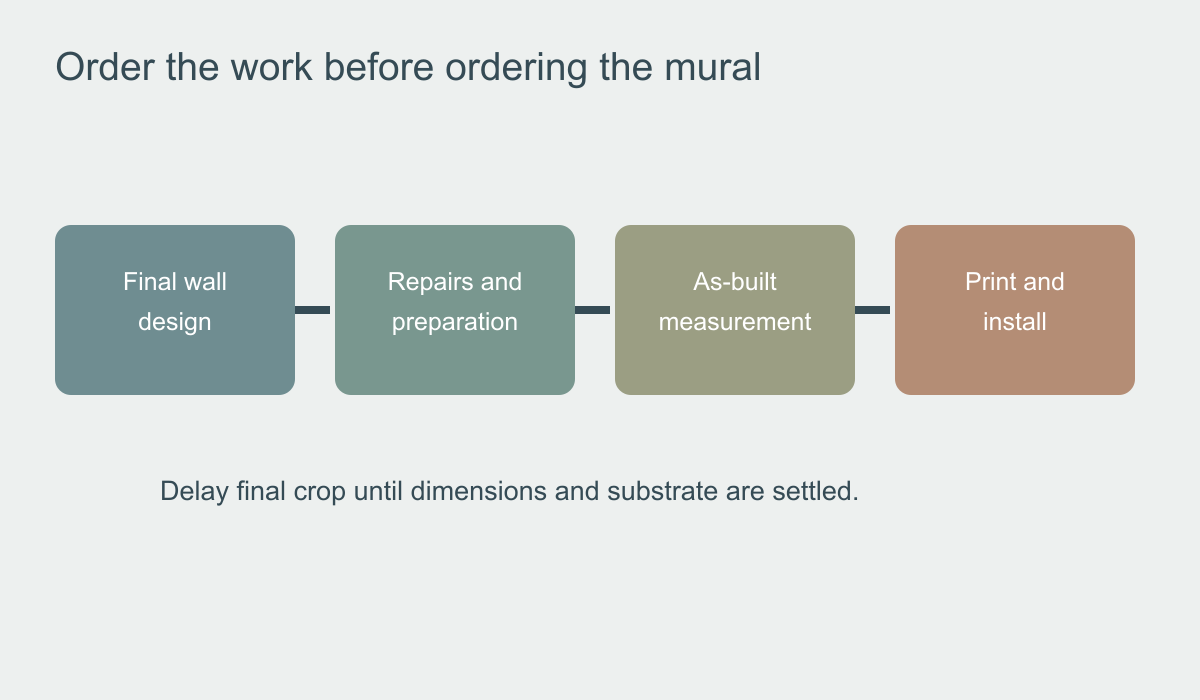 Confirm the final wall shape and substrate before the print is sized.
Coordinate the handover among builder, decorator, supplier and installer. Someone must confirm when wall repairs and coatings are ready under their product instructions. Someone must take and sign off the final measurement. Someone must approve the crop that corresponds to that measurement. Only then should the made-to-measure image be printed and installed. This sequence is more useful than a vague instruction to “hang it at the end”.
Other trades may still return for final fittings or furniture. Agree which wall is finished and where ladders, tools and paint are allowed. Avoid applying masking tape directly to the printed surface unless its maker explicitly permits it. Product care and abrasion resistance vary; a completed mural should not be treated as protective construction sheeting.
Choose interim decoration with its likely end in mind
A long wait for building work does not require an empty room. A framed print, fabric panel or freestanding screen can add scale and colour without being manufactured for a wall that will change. Each uses space or support in a different way, so choose one that works for daily use during the interim period.
Peel-and-stick mural wallpaper may be another temporary choice, but “removable” does not mean the panels will detach without affecting every paint surface, nor that they will reattach to a differently sized wall. Ask about the exact product, paint condition, installation and removal guidance. Budget as though an interim custom print may be replaced. The new room may need a different crop even if the old panels survive removal.
If the room is rented or shared, check permissions for wallcoverings and other alterations. A future renovation does not override those requirements. The temporary solution should also be easy to live with while builders need access; an elaborate installation behind stored materials may offer little enjoyment.
Recheck light, furniture and sightlines after the work
Even where the wall's dimensions remain unchanged, a new window or light fitting can alter the way the print appears. Review a physical sample under the finished lighting if possible. Graham & Brown's sampling guidance notes the influence of light and surrounding furnishings on wallcovering colour. A choice made under temporary construction lamps may read differently after the final fittings are installed.
Draw new furniture on the elevation too. A sectional sofa, media unit or taller shelf can hide a subject that was visible above the old pieces. Changing the entry doorway may create a new first view of the mural; an open-plan connection can expose it from another room. Check the crop from those future positions, not only from today's sofa. Sometimes a different wall becomes the better candidate once the room plan is complete.
If a print has been ordered but not produced, send the revised dimensions and opening positions to the supplier promptly and request a fresh crop proof. Ask what changes are still possible and whether the order terms or price are affected. Do not assume a supplier can stretch the approved image to suit the new measurements without altering its composition.
If the panels are printed or already installed
Compare the numbered panel layout with the actual post-renovation wall before trimming anything. A difference confined to the outer installation allowance may be manageable under the supplier's instructions; a doorway through the only tree is a different image, not a trimming detail. Send the original approved proof and the new elevation to the supplier for a realistic assessment.
If the mural is already on the wall, agree a protection plan before adjacent work begins. Move tools and ladders away from it, control dust and paint, and brief every trade that the printed wall is finished. If the planned renovation will cut through or rebuild that same wall, acknowledge that replacement may be the sensible outcome. Neither removable backing nor careful masking can turn a custom image into a portable panel that automatically fits new architecture.
The final decision is a timing one. When the wall is settled, measure and crop for that finished space. When the work remains uncertain, choose how long you realistically expect to use the current wall and price an interim option accordingly. That keeps the mural aligned with the room you will have, not only the room in a preliminary drawing.