Can You Place Artwork in Front of Mural Wallpaper?
Balance framed art, wall detail, focal points and negative space so the layered wall does not feel crowded.
Article focus: pricing and measurement
Budgeting this wall with confidence
Start with accurate wall measurements; the final custom mural price depends on area, material and any finishing options.
Example application: Nursery or children’s room · pricing and measurement
Yes, framed artwork can hang in front of a mural wallpaper. The strongest arrangements give the frame a clear place in the printed composition rather than covering the part that makes the mural worth having. Position is only half the decision, however: the frame must be supported by suitable hardware in the underlying wall, never by the wallpaper's adhesive bond. Plan the composition and the fixing separately before making a hole.
Decide whether the mural can spare the space
An all-over pattern and a single panoramic scene behave differently behind a picture. Covering a little of a repeated leaf print may barely interrupt its rhythm. Placing the same frame over the horizon of a landscape can hide the distant view or split a mountain in two. Study the mural's quiet and active areas before choosing a hanging position. Open sky, a pale wash or a low-detail margin can give the framed work room to read.
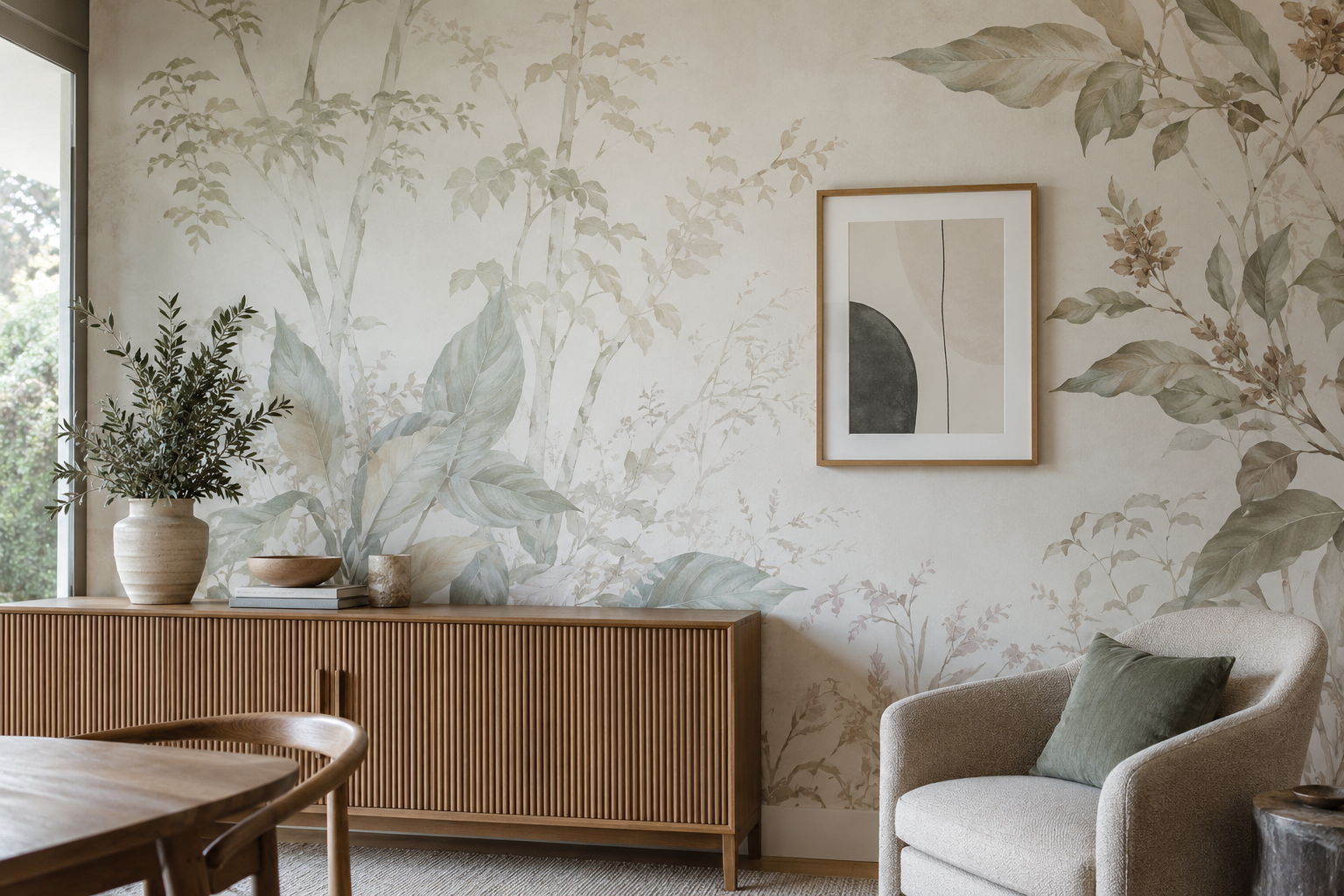
The room pictured here illustrates the principle. A modest abstract piece sits on a relatively pale opening of a soft botanical mural. The larger leaves and fine branches continue around it, so the framed image has an outline while the wall still reads as a garden-like whole. Move that frame over the densest cluster of foliage and the picture would be less legible; enlarge it too much and the mural would become incidental.
If the mural has not yet been ordered, place the proposed frame outline on the wall-size crop preview. Do not judge from the uncut catalogue image: custom sizing may shift the quiet area towards a corner or behind furniture. If the wall is already installed, make a straight-on photograph and place a scaled rectangle over it digitally. This lets you test positions without attaching templates to the print.
Choose which artwork is the focal point
A large framed painting may be the subject of the wall, with the mural acting as atmosphere. A small line drawing may instead be an accent within a stronger printed scene. Neither hierarchy is inherently better. Problems arise when both works use the same contrast, density and central position, so the eye has no clear destination.
Try looking at the arrangement from the doorway, then from the main seat. If the frame disappears against detailed foliage, increase separation through a mount or a clearer frame outline before making the artwork bigger. If the mural's central subject disappears behind the frame, move the picture to a quieter region or to a neighbouring plain wall. Keeping the artwork recognisable is more important than centring a frame by habit.
The framed image need not copy the mural's theme. A tree photograph over a forest scene can feel literal; a simple abstract or spare drawing may give the eye a rest. A shared muted colour, a similar softness of line or a frame finish that relates to nearby furniture is often a subtler link. Hold real frame and mount samples near the wall if possible; screen mock-ups do not show their true edge or depth.
Size and place the frame with the furniture present
A picture that seems well placed on an empty wall can float awkwardly after a sideboard or sofa is added. Put the furniture in position first, or mark its height on the mural proof. Then test the frame's outside dimensions, not only the image inside it. A wide mount and substantial moulding can change the apparent size considerably.
Check what the frame conceals at both near and far viewing distances. A small rectangle over an open patch may be barely noticeable across a room but give a pleasant close-up detail. A larger piece above a console may anchor the furniture while allowing the mural to continue at its sides. These are useful effects when they are intentional, not when the layout accidentally covers a printed face, branch junction or important line of perspective.
For a gallery group, establish one organising relationship: a common lower edge above the sofa, aligned centres, or a measured grid. Lay the pieces on the floor and transfer their outlines to a photograph of the mural. Resist filling every pale patch. The unoccupied space helps both the gallery and the wall image retain their shapes. Several small frames scattered through a complex mural often look less deliberate than one compact group.
Fix the weight to the underlying wall
Wallpaper is a decorative finish, not a structural support. A frame's complete weight, including glazing, needs a fixing chosen for the wall behind the mural. Solid masonry, plasterboard and other substrates call for different hardware. Identify the substrate, check the fixing's rated load and installation instructions, and ask a qualified installer if the construction or weight is uncertain.
Do not assume an adhesive strip sold for painted walls is safe on wallpaper. Command's own FAQ says its products are not recommended for wallpaper and advises using only products that list the relevant surface. Adding more strips does not turn an unapproved surface into a suitable one. A lightweight frame can still pull on the printed finish or fall.
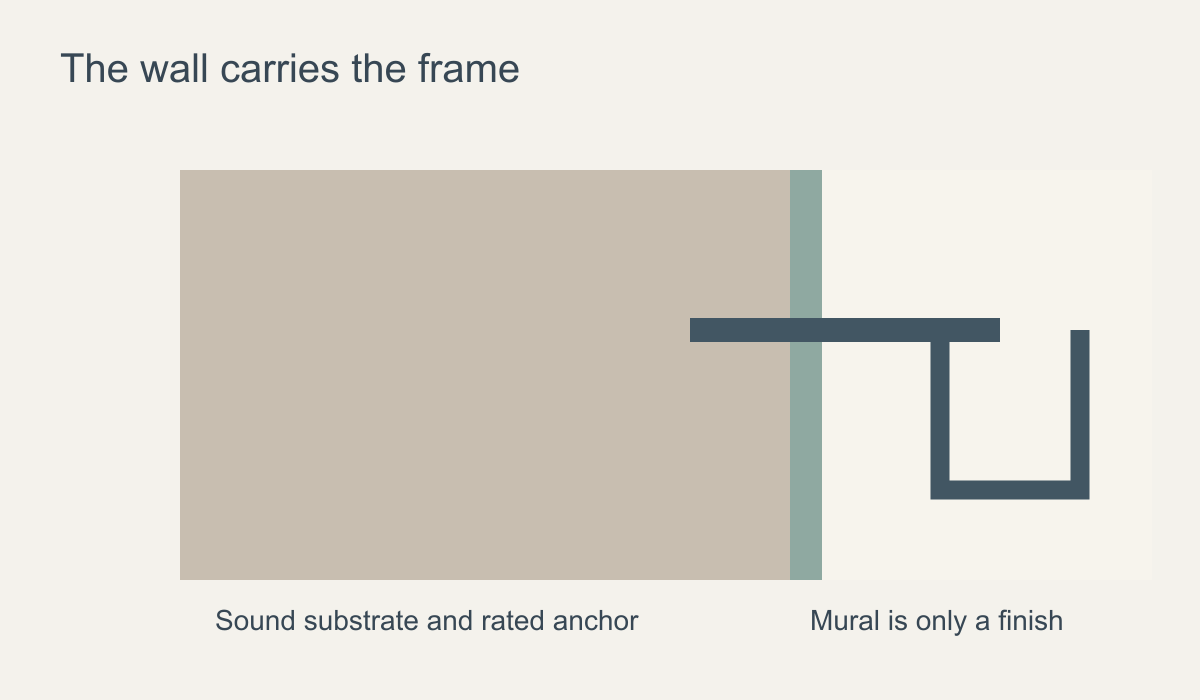 The wall carries the frame; the mural remains a surface finish.
Plan the fixing points before the mural goes up if you can, while recognising that the final anchor still has to suit the actual wall and frame. A hole through an installed mural may remain visible if the picture is moved later. Before drilling, check for concealed cables and pipes and follow safe installation practice. Renters should obtain permission for holes even when the wallcovering itself is described as removable.
Consider alternatives if you do not want to pierce the print
An existing, appropriately rated picture rail may allow art to be suspended without new holes through the mural. The rail and its fixings still need to support the full load. An artwork resting on a console can create a layered look without drilling at that spot, but a leaning frame needs a suitable anti-tip arrangement where children or pets could reach it. Neither option is a reason to disregard weight or stability.
Another option is to hang the collection on an adjacent plain wall. This is especially sensible when the mural tells a single story across the whole surface or when pictures change frequently. The two walls can still relate through a shared frame material or colour. Leaving the mural unobstructed is not a failure to decorate it; the printed image may already be doing the work of art.
Check contact, shadow and future changes
Hold the actual frame at the proposed height while the room's usual lights are on. A deep box frame can cast a broader shadow than a slim moulding. Glazing may reflect a window or lamp from a seated viewpoint, obscuring the art and pulling attention from the mural. Test daylight and evening light before drilling. If a reflection is troublesome, shifting the position or light source may be simpler than changing the wallcovering.
Protect the print during installation. Keep tools and the frame's corners away from the surface, and use help for a heavy piece. Avoid improvised pads or spacers pressed against wallpaper without checking the product's care guidance. Different wallcoverings tolerate contact differently; a matte appearance alone does not establish abrasion resistance.
Finally, imagine the frame removed. If an exposed fixing would interrupt a pale mural field, think about whether the chosen location is likely to remain useful as your collection changes. A gallery that is rearranged every season may be better served by a picture rail or an unpapered wall. The answer to “Can I hang art over a mural?” is yes, provided the layering improves the composition and the mounting method respects the wall beneath it.