Can Mural Wallpaper Be Used in a Restaurant Interior?
Consider atmosphere, cleaning, traffic, lighting, brand direction and wall protection when planning a restaurant mural.
Article focus: installation and removal
What the installer needs to know
The right installation method depends on the chosen material and wall condition, so prepare the wall before ordering and follow the material-specific instructions.
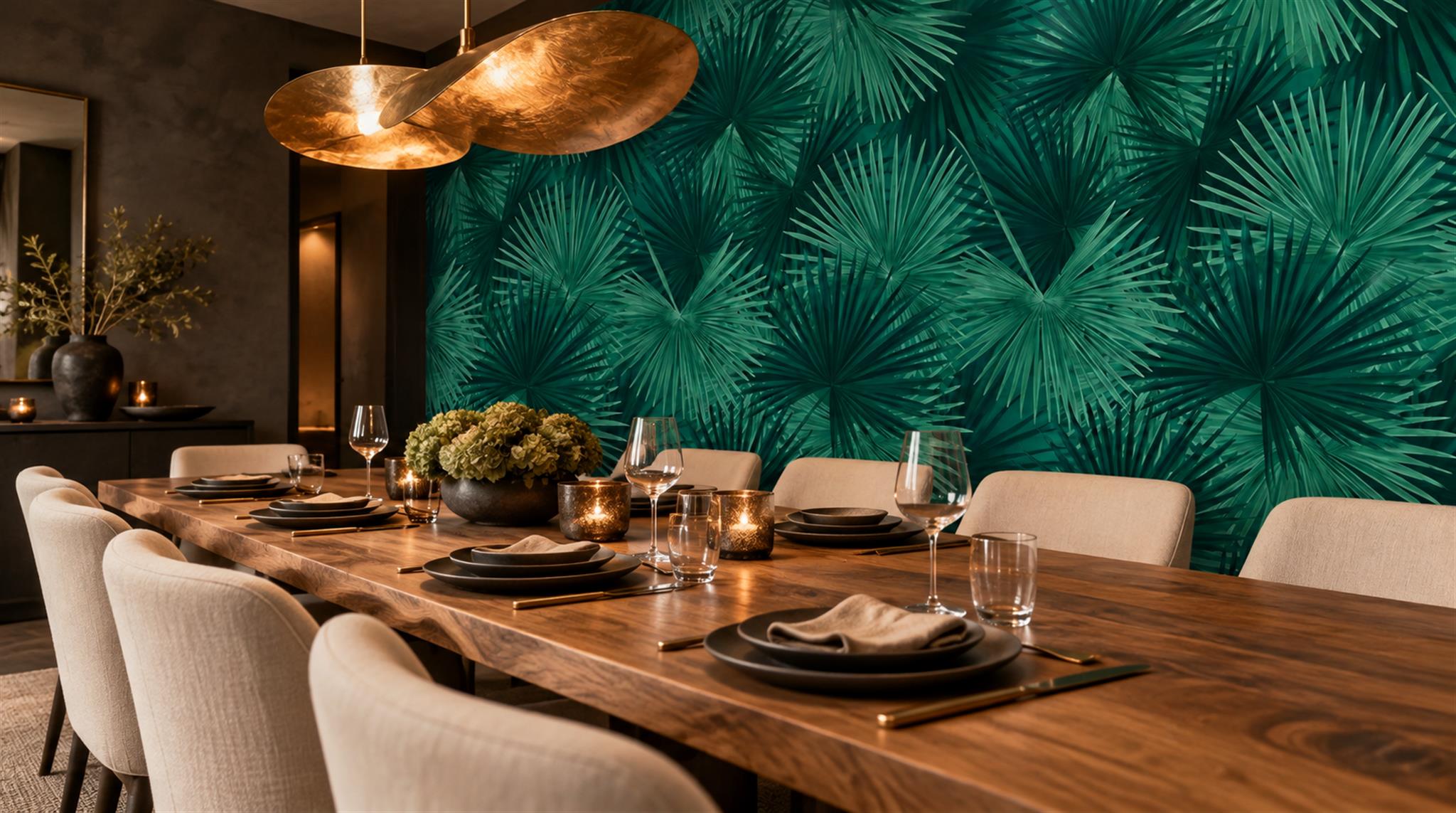
Example application: Dining room · installation and removal
Yes, mural wallpaper can work in a restaurant, but diners encounter it differently from a domestic feature wall. They see it on entering, pass it on the way to a table and may sit beside it for an entire meal. Bright teal palm leaves can give one dining zone energy; repeated geometric arches can structure a long banquette; pale stems on a dark ground can make another row of tables feel more intimate. The right choice depends on seating, service lighting and the wall's exposure to everyday contact.
Decide what diners should notice
At the entrance, a mural may identify the room's character immediately. At a table, it is often in peripheral vision while people talk and eat. These roles can point to different designs. In the opening photograph, large teal palm leaves create a strong backdrop for a long dining table, while warm pendant light and pale seating keep the setting legible. Such a high-contrast wall can work in a lively zone, but it needs checking at seated distance over the length of a meal.
Take photographs from standing height at the entrance and seated height at several tables. The view changes markedly. Chairs and diners can hide the lower mural, while hanging lamps interrupt the upper portion. An artwork with one main subject may lose its point when a pendant sits directly over it. A more distributed composition can tolerate these interruptions.
Be wary of choosing a mural solely because it makes a strong social-media photograph. Photography can be a valid consideration, but guests experience the wall in real time and at full scale. A pattern that looks exciting in a small image may be overstimulating beside every table. Compare the artwork from normal seating distance and under the actual dining lights.
Let the restaurant concept set the visual language
A restaurant's menu, service style and architecture should guide its mural. An intimate room with timber, soft light and upholstered banquettes may suit a dark botanical. A bright daytime dining room may welcome clearer colour and larger forms. A modern space with stone surfaces could use a printed, stone-like image, but the visual effect is not evidence of a hard, textured or washable surface. Physical finish and cleaning requirements must be checked separately.
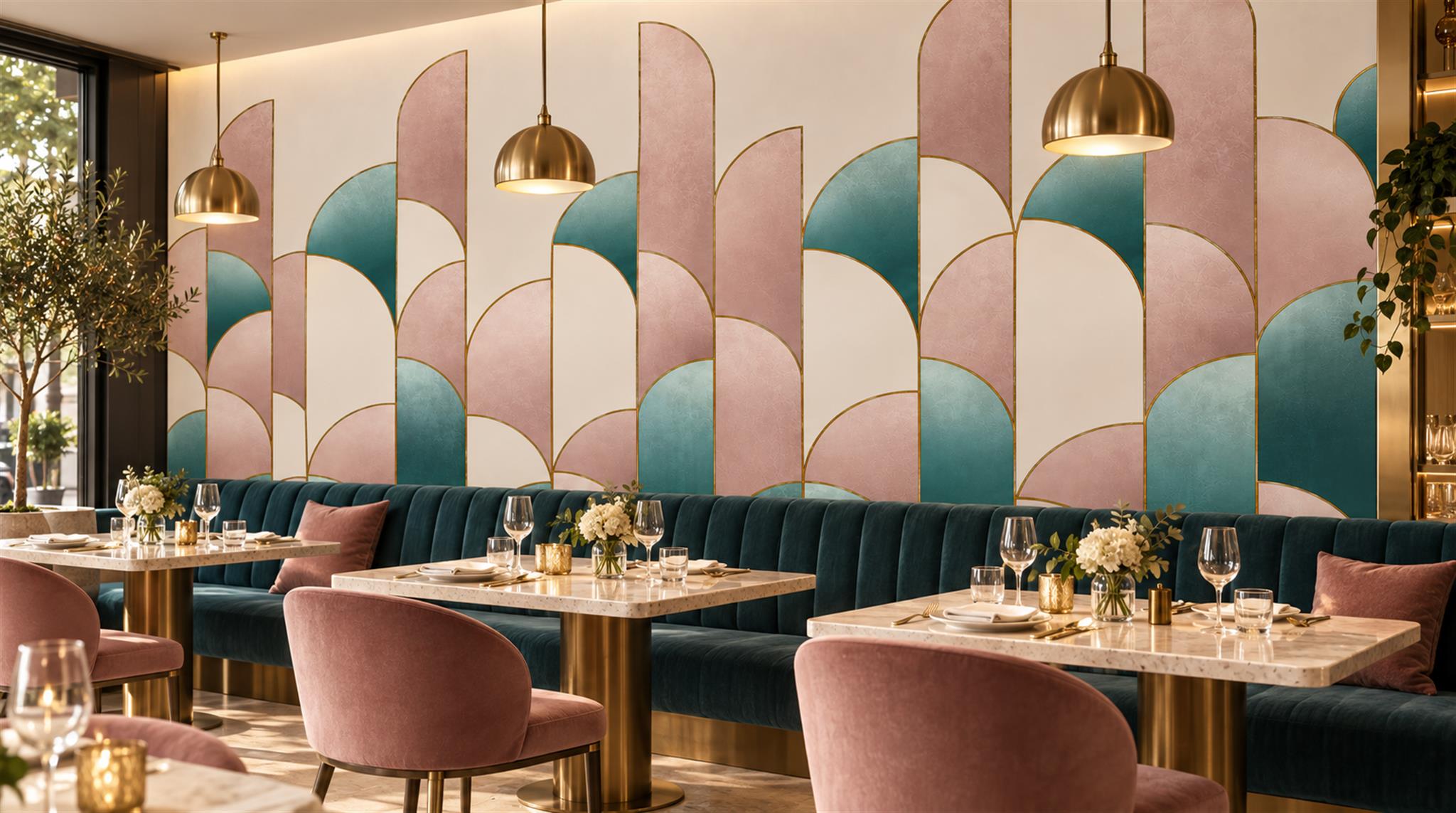
The geometric wall below uses orderly repetition rather than the opening image's dense overlapping leaves. Tall blush and teal arches repeat behind a long green banquette, while gold pendants interrupt the upper shapes. The repetition gives multiple tables a shared backdrop without requiring one central scene to remain unobstructed. Before using a similar design, check whether its vertical divisions line up awkwardly with booths, wall lights or a doorway.
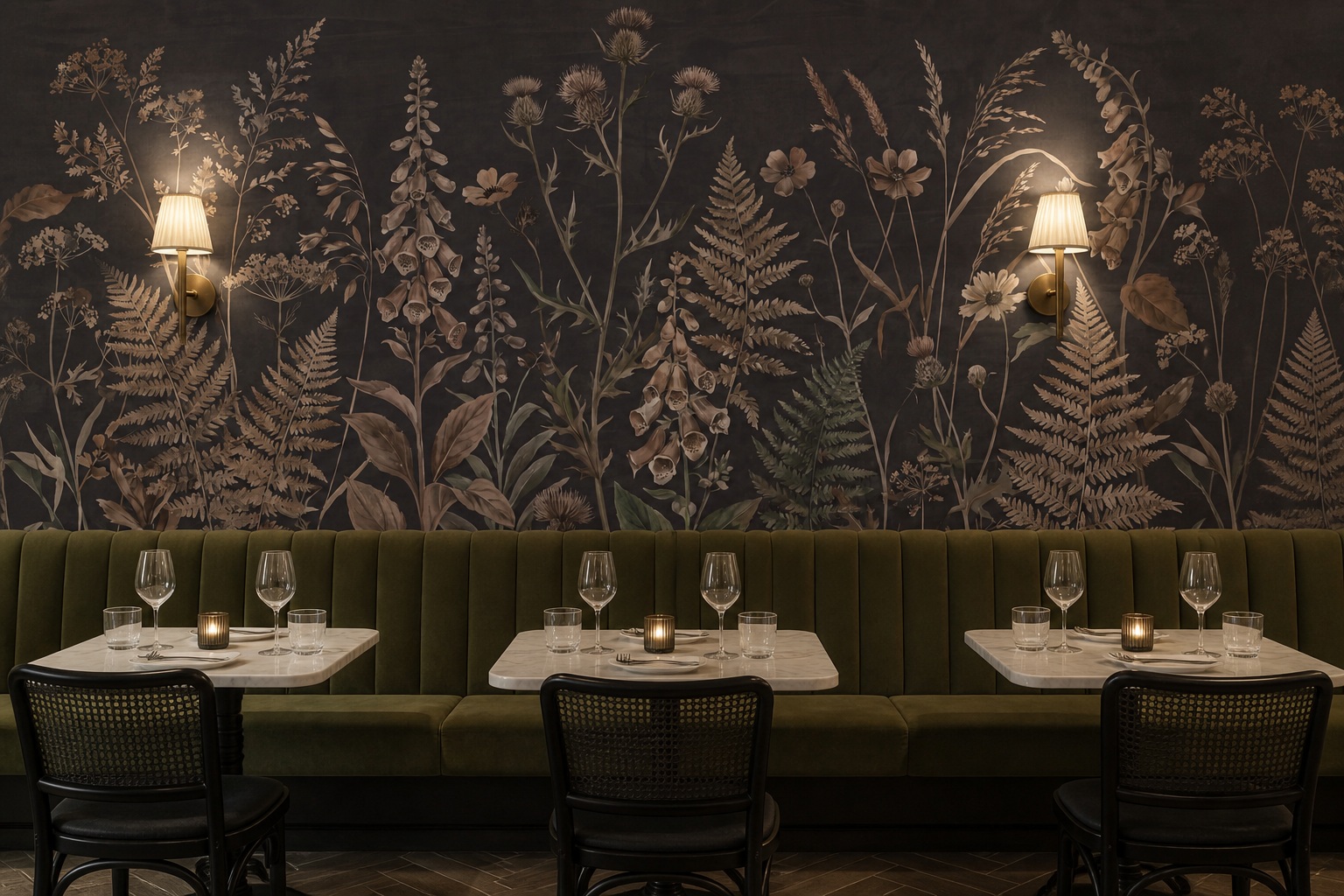
A darker botanical creates a different mood for a banquette. In the later example, pale stems and fern fronds sit against a deep ground. Wall lamps illuminate separate patches, so the mural changes across the length of the seating. That effect may be desirable, but the team should judge it under the actual service lighting rather than assume the staged photograph represents every evening.
Plan for the view along the room
Restaurant walls are often long and interrupted by doors, service stations and changes in seating. A panoramic image needs enough continuity to make sense across these breaks. A repeated design may make a long run easier to manage, but visible repetition can become monotonous. Decide whether the wall is one composition, a series of panels or a set of separate zones.
Mark the positions of banquettes, chair backs, wall lights and artwork on a scale drawing. A floral cluster hidden behind a booth is not contributing to the room. A horizon crossing a service door may look accidental. Sometimes a mural works best on one uninterrupted end wall rather than wrapping every available surface. More printed area does not necessarily create a stronger design.
From an oblique view, the straight sides of geometric arches can appear to converge or break at panel joins. A loose botanical may be more forgiving, though its larger flowers or leaves still need placement. Review the exact crop and panel layout with the installer, especially if the wall has corners, niches or changing heights. Test the drawing with seats occupied as well as empty.
Check colour under service lighting
Restaurants may shift from daylight lunch to warm, dim evening service. A mural that is pale and detailed at noon can become a broad dark field by dinner. Strong amber lamps can change the apparent hue of green, pink or grey. Put a physical sample on the intended wall and view it during each service condition. A digital image cannot settle the final colour or sheen.
Look for glare and uneven illumination. A glossy finish under a focused lamp may produce highlights; a matte-looking photo does not guarantee the installed material is matte. Ask for the actual finish sample. Check whether wall lights cast shadows over a focal part of the print. The lighting designer and mural designer should review the wall together, not in separate mock-ups.
Colour affects the dining setting too. A highly saturated mural reflected in mirrors or onto pale table surfaces can change the room's visual balance. It does not literally recolour food, but it can make the whole scene feel warmer or cooler. If food presentation is a priority, consider a calmer field near the tables and stronger colour at the entrance or a secondary wall.
Address cleaning and compliance explicitly
Restaurant walls near tables, circulation routes or service areas face different kinds of contact. Do not choose a material by assuming all wallpaper is washable, waterproof or suitable near heat and moisture. Request the exact product's cleaning guidance and technical documentation, then have the project team assess the location. Local building, fire or hygiene requirements may apply and should be verified for the actual installation system.
A mural behind a banquette may be touched less than a wall beside a narrow aisle, but it can still be splashed or marked. Consider accessible cleaning and whether damaged sections can be replaced. Ask the supplier about panel layout, production records and any limitations of future replacement prints. Do not promise invisible repairs or exact colour matching across print runs without confirmation.
Wall condition and downtime matter. Installation may require surface preparation and a period when seating cannot be used. Coordinate this with the venue's operating schedule and the chosen material's instructions. A print can look excellent in concept yet be a poor fit if the wall surface or maintenance plan is overlooked.