What Mural Wallpaper Is Best for a Bedroom?
Choose a bedroom mural by mood, scale, colour, furniture position, viewing distance and the amount of visual movement you want.
Article focus: pricing and measurement
The cost and measurement decision
Start with accurate wall measurements; the final custom mural price depends on area, material and any finishing options.
Example application: Bedroom · pricing and measurement
There is no single “best” bedroom mural. A soft landscape can give a busy room breathing space, while large flowers or dark foliage can make a simply furnished bedroom feel intimate. Start with the wall you want to notice, the mood you want at different times of day and the patterns already present in the room. Judge designs at the size of your actual wall, not by the small product image.
Decide whether the mural is a view or a backdrop
The wall opposite the bed is an image you may look towards while resting. A landscape with a gentle horizon or a botanical scene with an open centre can reward that longer view. Check where a wardrobe door, television or dressing mirror interrupts it, and whether the focal point sits where you can see it from the pillow rather than only from the doorway.
The wall behind the bed does a different job: it frames the furniture and is often seen from the entrance, not continuously from bed. A broad abstract or distributed foliage can work as a backdrop even when the lower portion is obscured. If this is your chosen wall, use the dedicated behind-bed mural guide for headboard height, lamps and placement; those details should not decide the design for an opposite or side wall.
A side wall may be the right choice when the bed wall has doors or built-in storage. From the pillow, a mural running along the side can feel close and immersive, so check the motif at that near viewing distance. Photograph all three candidate walls from the entrance and from bed. The most continuous rectangle is not necessarily the wall that contributes most to the room.
Measure the full surface you intend to paper at several points and follow the supplier's trim guidance. Compare the resulting crop with the wall's actual openings and furniture. A styled product photograph rarely shares your room's proportions, so let it suggest a mood rather than dictate placement.
Choose the kind of bedroom atmosphere, then the motif
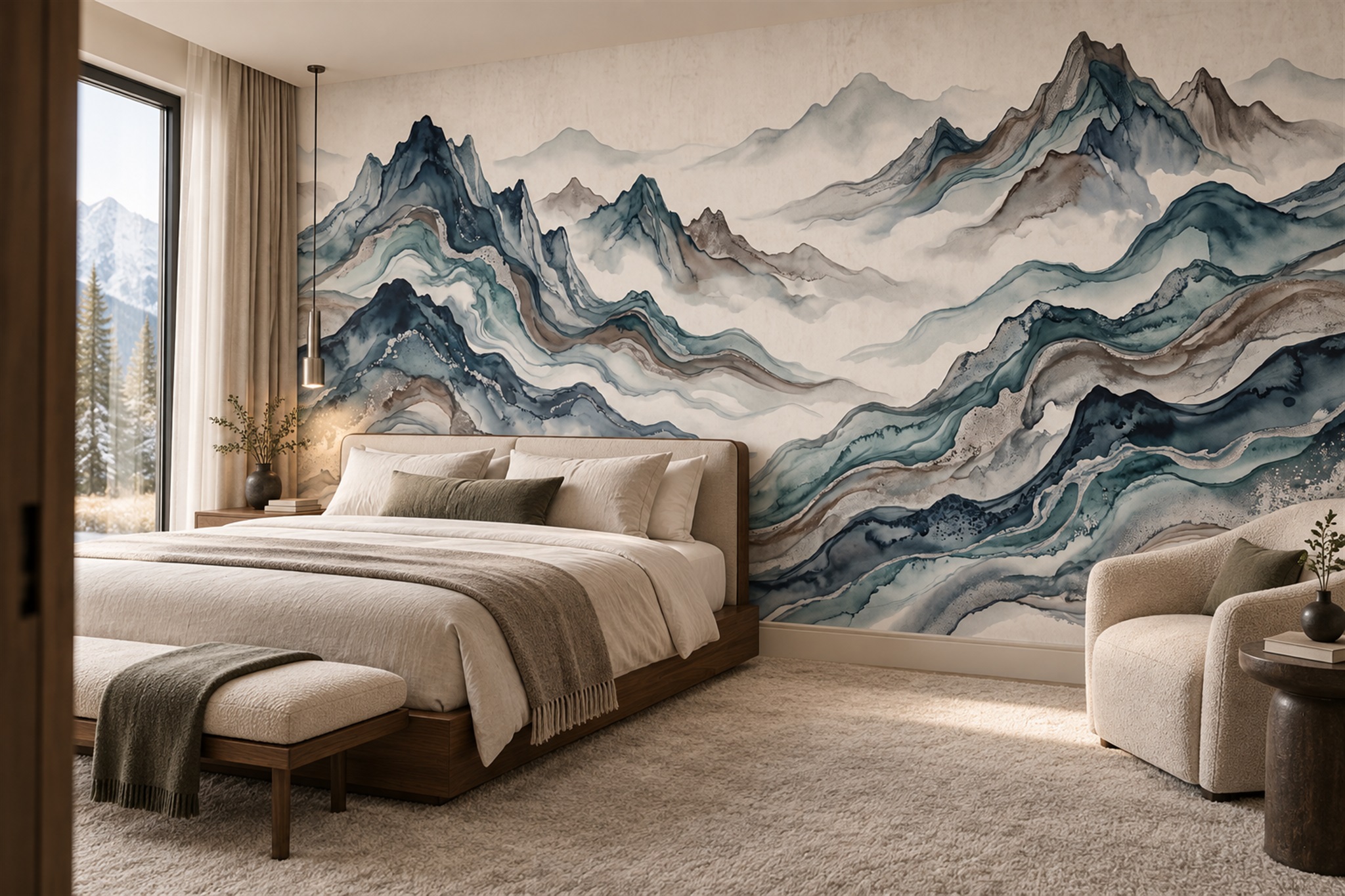
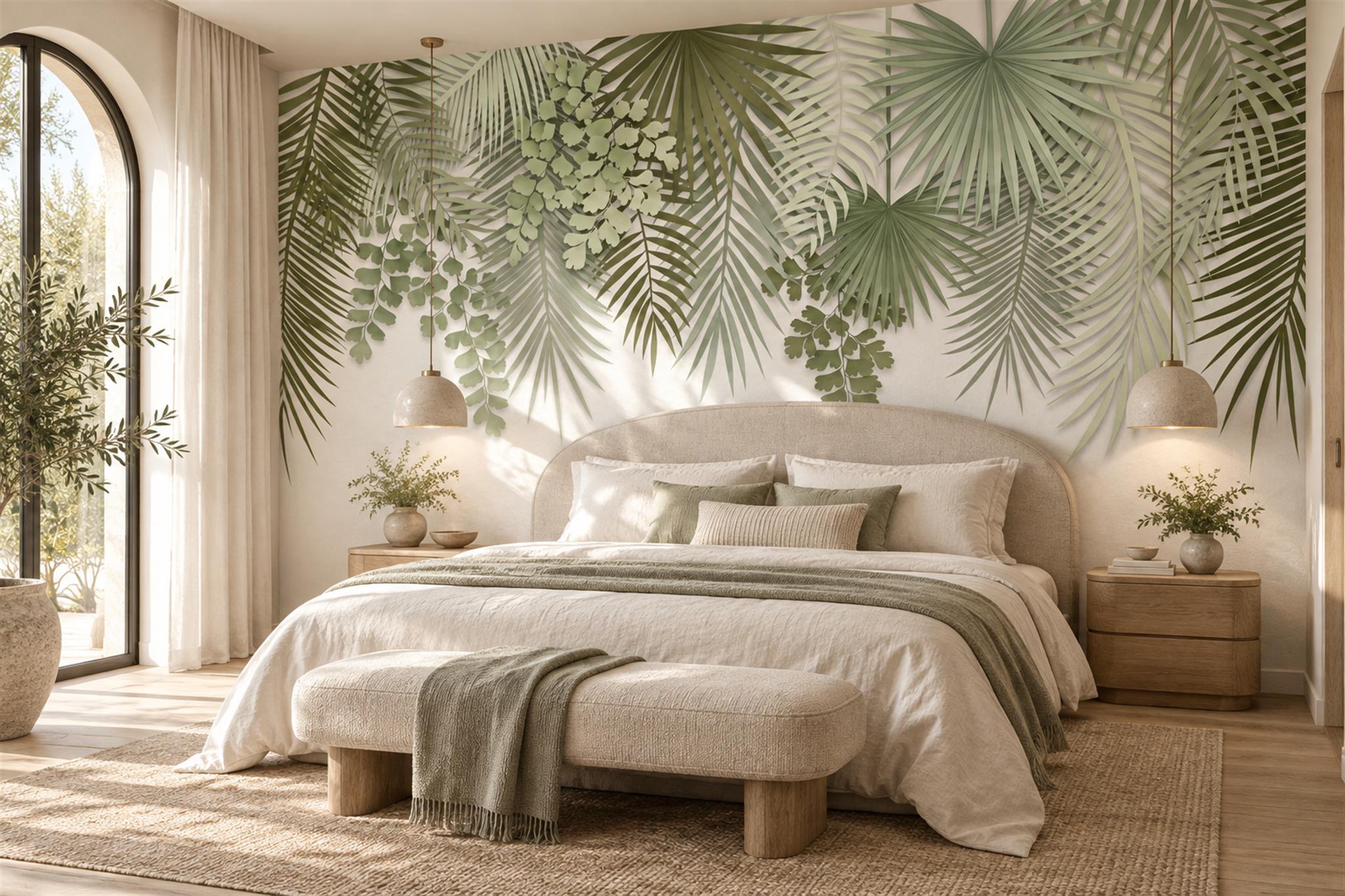
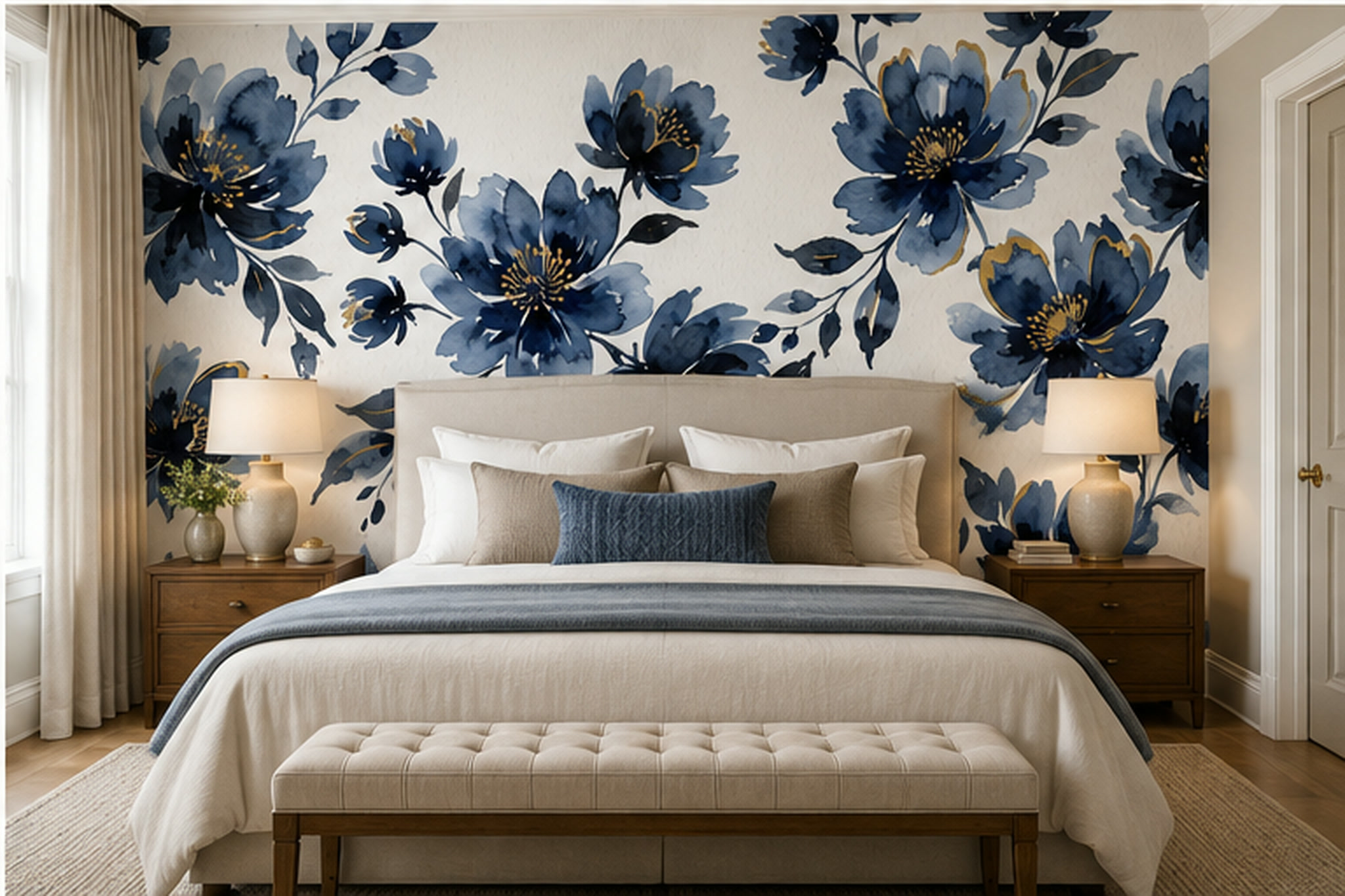
If you want the wall to feel spacious and quiet, look for a landscape with open sky or soft transitions. The blue mountain scene in this article’s feature image uses wide pale areas between darker peaks; it is a different proposition from a dense all-over print. If you prefer natural pattern without a single dramatic subject, broad fronds can fill the upper wall while leaving a light background around the bed. If you want the wall to make a statement, large dark-blue flowers can do that, especially when the bedding remains plain.
These are design directions, not sleep claims. A person who enjoys vivid art may find a deep floral wall more comfortable than a pale scene, while another may prefer much less contrast. Look at the design from the pillow as well as the doorway. A busy print can seem very different when it is the last thing you see before turning off a bedside lamp.
Do not choose by colour alone. A pale print with hundreds of small high-contrast marks can feel busier than a dark mural with large quiet areas. View the design as a complete wall and close up, and ask for the approximate size of a recognisable leaf or flower at final print dimensions. The Wallcoverings Association distinguishes large, small and overall patterns by their different visual effects; that distinction is more useful here than a blanket rule that bedrooms must be pale.
Balance the mural with bedding and curtains. If you already use patterned textiles, choose artwork with more open background or gentler contrast. Plain bed linen can make room for a more expressive scene. There is no need to match every colour; picking one supporting tone from the mural for cushions or a throw is often enough.
Use the room’s light as part of the decision
A bedroom may be viewed in morning daylight and under warm bedside lamps. Those conditions can make the same printed colour look different. A cool blue may seem softer in diffuse daylight and deeper at night, while cream can look warmer under a lamp. These are possibilities, not guarantees. Hold a physical sample of the chosen finish on the intended wall at both times. A screen emits light and cannot predict the print’s exact appearance in your room.
Consider lamp placement. A sconce close to a mural may cast side light that reveals texture and seams. A glossy or smooth finish could reflect a bright bedside light from the pillow’s viewpoint. Ask for a sample of the exact material you intend to order and view it from the bed, not only standing in front of the wall.
If the bedroom is small, avoid assuming it needs a tiny pattern. A large, simple motif with open space can feel calmer than a dense small print. A dark design can also work with thoughtful lighting and restrained surrounding walls. Judge the whole room rather than relying on a single colour rule.
Check the wall and material before committing
Whichever artwork you choose, the bedroom wall needs to be clean, smooth, dry and sound. Wallcoverings Association preparation guidance emphasises checking the substrate before hanging. Choose between self-adhesive and pasted finishes using the instructions for the specific product and your wall coating. Peel-and-stick is not automatically damage-free on weak paint, and a pasted product is not automatically unsuitable for a bedroom. Test a sample if the surface is uncertain.
If the headboard touches the wall, check whether it rubs the print and allow the clearance appropriate to that bed and room. If an external wall shows condensation or damp, investigate the cause before installing any wallcovering. Ask for the chosen material’s care guidance if children or pets will touch the lower area; do not assume every finish is washable or waterproof.
Compare three bedroom directions in the room you have
Put the blue mountain scene, green fronds and navy floral beside a photograph of your own bedroom. The mountain scene offers long horizontal pauses; check whether those pale bands are useful on the wall you face from bed. The fronds provide recognisable natural forms without requiring a single central subject, so they can suit a side wall broken by a door. The navy flowers make a more assertive focal point; give them visual space by considering the existing bedding and curtains.
Now remove one candidate for a specific reason. If the curtains and duvet already carry strong pattern, the floral may compete with them. If the room is mostly plain but the mountain crop loses its horizon behind a wardrobe, the landscape loses its advantage. If you want a quiet view from bed, broad fronds close to your pillow may feel busier than they did from the door. This comparison produces a more useful answer than choosing a design because it is labelled “bedroom”.
Review the remaining candidates under the light used when you wake and when you settle for the night. A print sample can confirm colour and finish, while a wall-size crop shows composition; neither replaces the other. The best choice is the one that serves the selected wall and the actual room at both times, not simply the strongest empty-wall mock-up.