Which Mural Wallpaper Works Best in a Hallway?
Use wall width, corridor lighting, viewing distance and pattern direction to choose a hallway mural that feels intentional.
Article focus: pricing and measurement
The cost and measurement decision
Start with accurate wall measurements; the final custom mural price depends on area, material and any finishing options.
Example application: Bedroom · pricing and measurement
Which mural works best in a hallway depends on the shape of the route. A long, uninterrupted corridor can carry a composition that unfolds as you walk; a hall broken by doors needs artwork that still reads in pieces. Before choosing a subject, look down the passage from both ends and notice how the visible wall changes with each step. A hallway mural is rarely experienced as one still photograph.
Read the hallway as a route
Stand at the entrance and look toward the far end. What wall is visible first? A mural there can create a destination. On a long side wall, the image may unfold as you walk, but only a portion is visible at once. A landscape with a strong central mountain may lose its point if doors repeatedly cut through it; a rhythm of foliage or a gradual scene may survive those interruptions better. The mural’s composition should make sense in motion as well as in a single photograph.
Then turn around and walk back. A design that pulls the eye one way may feel different in reverse. If the corridor opens into a living room, consider how its mural relates to the colours and artwork seen beyond the doorway. The hallway does not need to copy the adjacent room, but a shared undertone can make the transition feel considered.
Mark three stopping points along the passage: where someone enters, where they pass the middle and where they turn into the next room. A large subject may be legible from one point yet disappear behind a door frame at the next. If no single view contains the whole scene, choose a composition that rewards the sequence rather than depending on a one-time reveal.
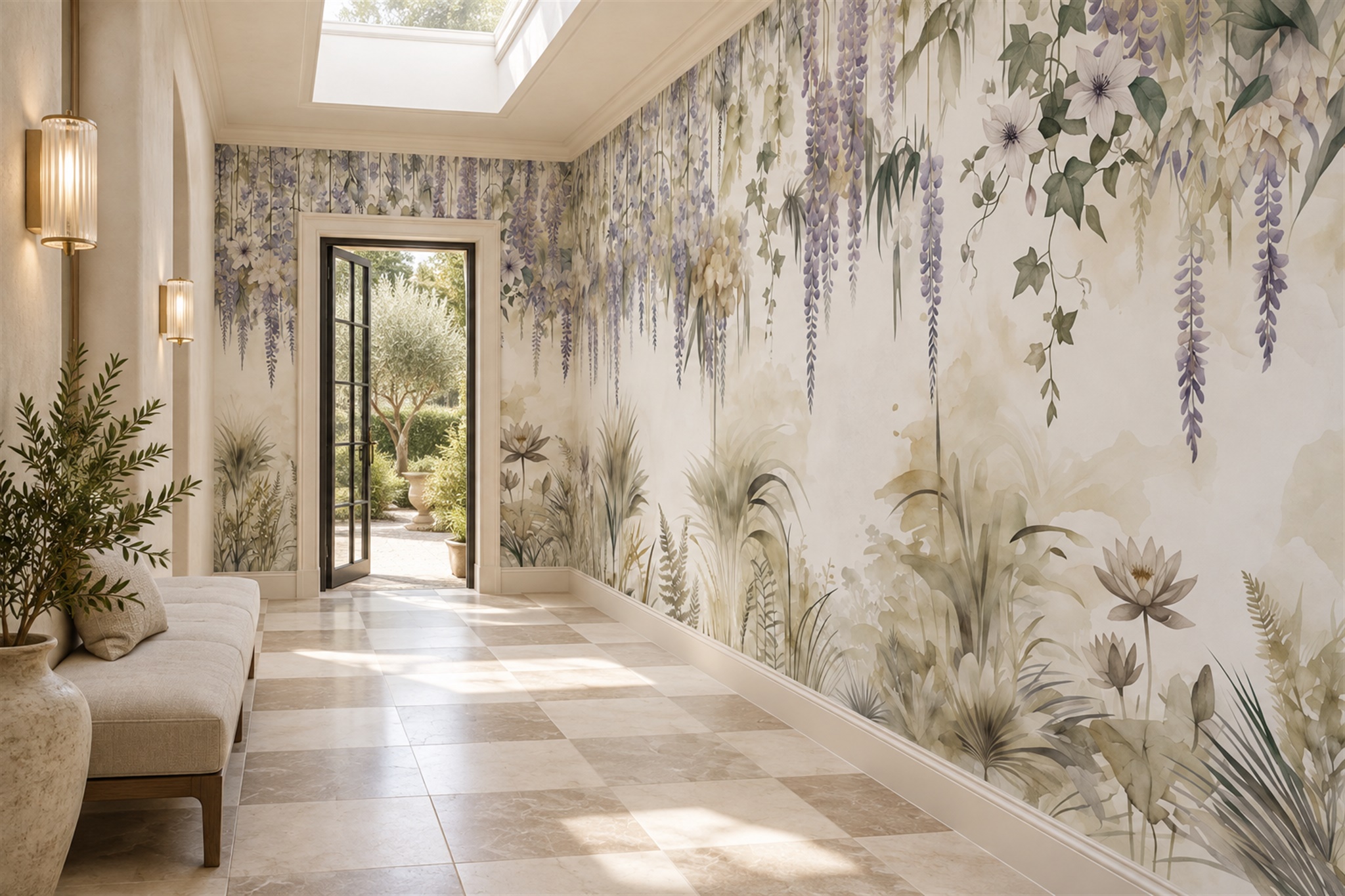
The flowered corridor shown in the featured image demonstrates a continuous-wall option. Hanging wisteria and pale leaves repeat along the right-hand wall, so a person approaching the open door sees a sequence rather than one isolated focal point. That approach would be harder to reproduce on a wall cut every metre by doorways. If the corridor has several interruptions, choose a crop that leaves a recognisable fragment within each visible section.
Work around the interruptions
Check the door swing as well as the opening on the drawing. A door left open during daily use may hide an entire section of the mural, while a handle can strike the print near the frame. Put both the closed and open door positions on the plan, especially in a narrow passage. If the only focal tree or figure disappears whenever a bedroom door is open, move the crop or choose artwork whose interest is distributed across the remaining wall sections.
Hallways often contain several doors, switches, radiators, coat hooks and mirrors. Mark all of them on a simple elevation drawing. Measure each opening from a fixed corner and note its outer frame. A continuous mural may be printed for the enclosing wall area and cut around doors on site, but the important parts of the artwork should stay in the visible wall sections. Do not simply subtract the widths of doors from the order and expect the scene to align.
A large mirror can duplicate part of the mural and increase its visual intensity. That may be welcome in a restrained corridor, or too much if the artwork is already dense. A run of picture frames placed over a mural can also compete with its subjects. Decide whether the wallcovering is the main decoration or a background for other objects before choosing a detailed design.
Measure width and height in several places, especially in older corridors where corners and ceilings may lean. Check the supplier’s trim allowance; if panel placement matters around several doors, ask whether a separate layout can be supplied. Narrow wall sections beside doors can be awkward to install, so discuss the starting position and seam placement with an installer if the wall is complex.
Choose scale and direction deliberately
Vertical trees, reeds or architectural lines can draw attention to height; a distant landscape can direct the eye along a corridor. Strong horizontal bands may emphasise length, which can be useful or overwhelming depending on proportions. These are visual tendencies, not guaranteed spatial tricks. Test them with a wall-sized crop and stand where the hallway is normally entered.
Fine detail may disappear from the far end yet feel busy close up. Large quiet areas can keep the passage calm, but too little variation may leave a long wall flat. A composition with changes along its length gives the eye something to discover without requiring a high-contrast motif at every step. Compare candidate designs in the real lighting and at the actual mural size.
If the hallway is very narrow, be cautious about a single face or large animal placed at eye level beside the walking path. It may feel more intense at arm’s length than in a wide-room product photograph. A softer botanical or abstract arrangement may be more comfortable, unless that drama is exactly the effect you want.
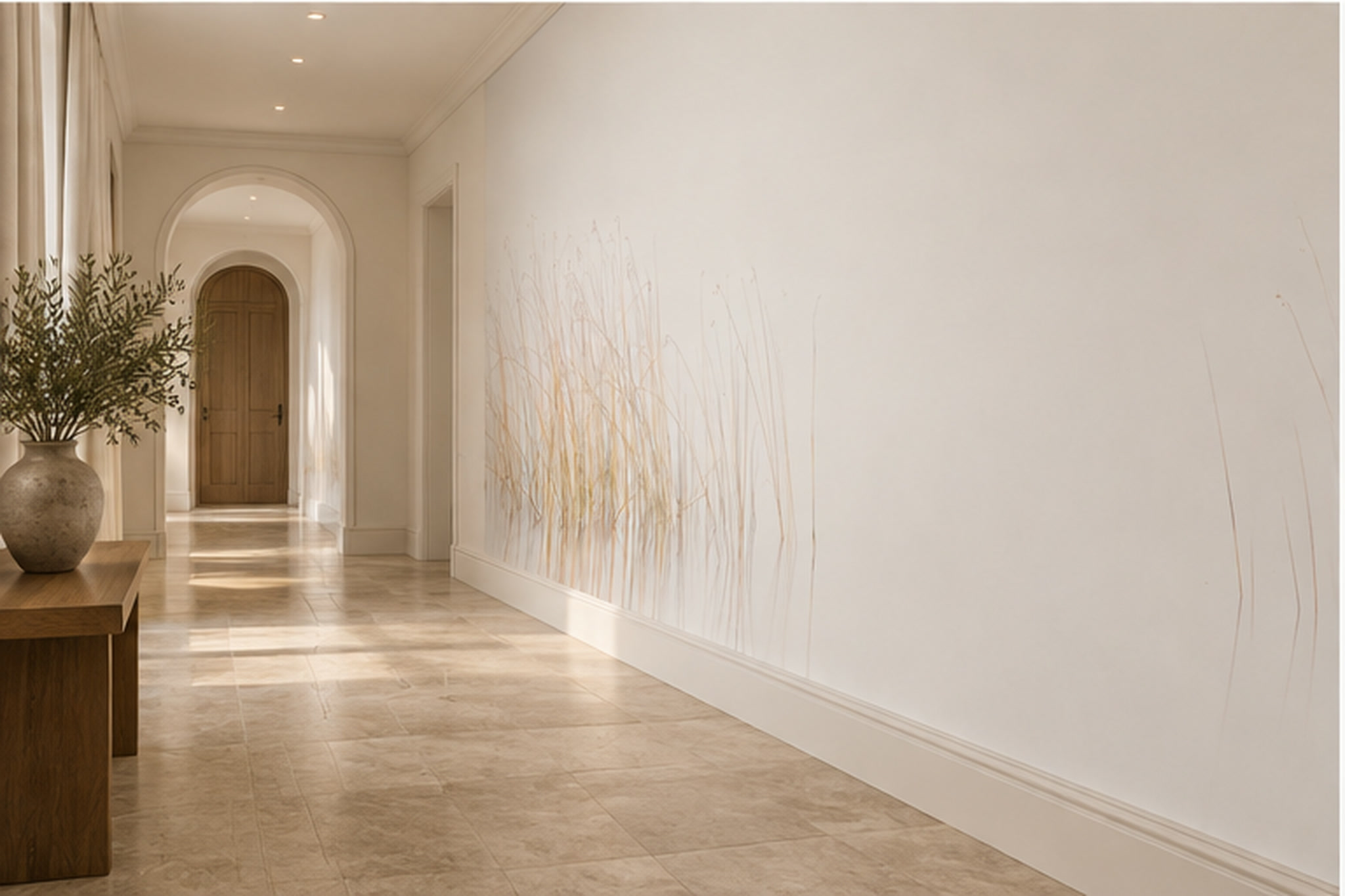
The pale reed example keeps much of the upper wall open. That matters when the hall is viewed from the far end: the delicate stems do not compete with its doors and arches. In a different corridor, however, the same fine marks might disappear under dim lighting. A sample and a scaled crop will tell you more than a claim that light colours always make a narrow hall feel larger.
Follow the changing light along the route
One end of a corridor may borrow daylight from a window while the other relies on ceiling or wall lights. Walk the proposed mural wall at the times the passage is normally used. A botanical with fine outlines may be readable near the bright end yet collapse into a pale field beyond the last doorway. A darker scene may become a strong destination at one end but lose its detail when seen obliquely from the side.
Place a print sample at more than one point along the route, keeping it upright on the intended wall. Side lighting can change how the printed surface and seams appear; a screen mock-up cannot predict that. Then return to the full-wall crop to decide whether the image's strongest section belongs at the brighter or dimmer end. This is about the sequence of views, not a promise that a particular colour will make the corridor wider.
If coats, bags, benches or door handles repeatedly reach the artwork, use the separate busy-hallway planning guide to map contact points and check the selected material's care information. A general route-based composition does not establish that the finish is washable or suitable for frequent abrasion.
Walk the route with the doors and coats in place
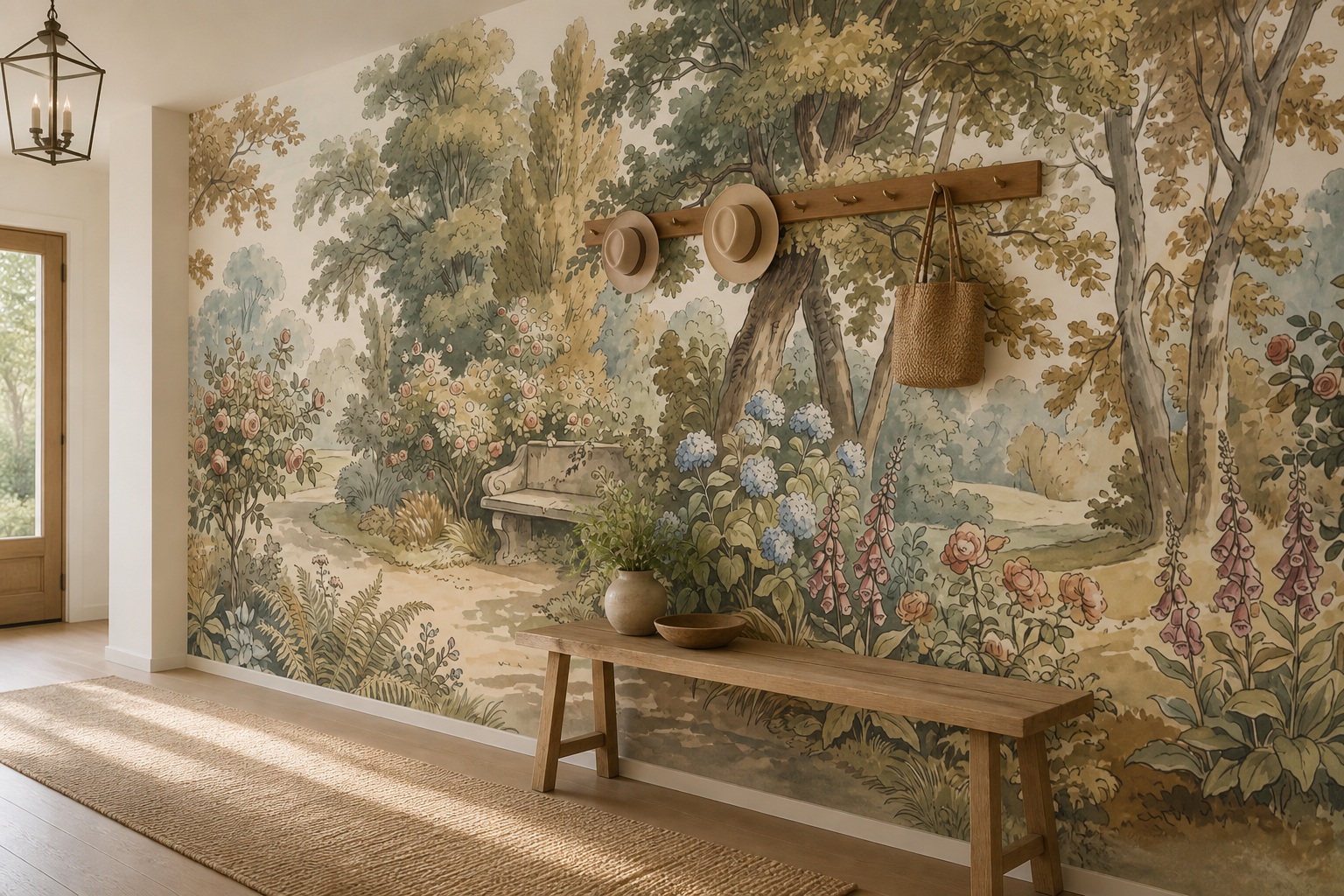
Map the wall as a sequence of stretches between door openings, then walk past it in both directions with the doors in their usual positions. In the garden entry pictured above, a bench and path are printed into the artwork, while the timber bench and coat rail are real objects in front of it. That short space invites a single view; the long wisteria corridor asks the image to develop over time. Test the route your own hall actually offers instead of copying either room photograph. For a short front-door space, use the separate entryway assessment.
Make two quick sketches of the same hallway: one with every door closed and one with doors in their usual open positions. Shade the wall still visible in both. In a long corridor, that common visible strip may favour a repeated rhythm such as reeds; in a short entrance, a single garden view may need a wall that stays unobstructed. Mark the reach of door handles, coats and luggage separately from the artwork crop. Those contact points can decide which side of the passage should carry the mural even when both sides look equally good in a still photograph.