What Mural Wallpaper Works Best in a Home Office?
Choose a home-office mural that supports concentration, video backgrounds, furniture placement and a comfortable working atmosphere.
Article focus: pricing and measurement
Budgeting this wall with confidence
Start with accurate wall measurements; the final custom mural price depends on area, material and any finishing options.

Example application: Home office · pricing and measurement
What works best in a home office depends on who sees the mural most: you at the desk or other people through a webcam. A wall behind you can carry a bolder composition; a wall beside your monitor usually needs a gentler visual rhythm. Start with the desk position, the camera crop and the hours you work. Only then compare a graphic abstract, a detailed landscape or a quiet botanical design.
Decide which wall has the role
A mural behind the desk is often seen by colleagues on calls but not by the person working. It can project character without distracting you during concentrated tasks. A mural opposite the desk is in your own sightline and may be more rewarding day to day, but a dense or high-contrast design can pull attention from the screen. Choose based on how the room is used, not on a generic rule that the desk wall must be the feature wall.
Walk into the room and sit at the desk. Check whether shelves, a filing cabinet or a monitor will hide the focal point. A low sideboard may cover the bottom of a scene without much loss, while a tall bookcase can remove its centre. Mark these obstructions on a separate wall sketch and compare it with the crop preview. If the office doubles as a guest room, include the bed and its likely position.
Measure the whole intended wall at several points. Furniture does not reduce the print size if the mural will run corner to corner. If the design is only for a defined section behind a desk, give that partial area a deliberate boundary rather than letting the print end at an arbitrary point behind furniture.
Compare a bold backdrop with a quieter working view
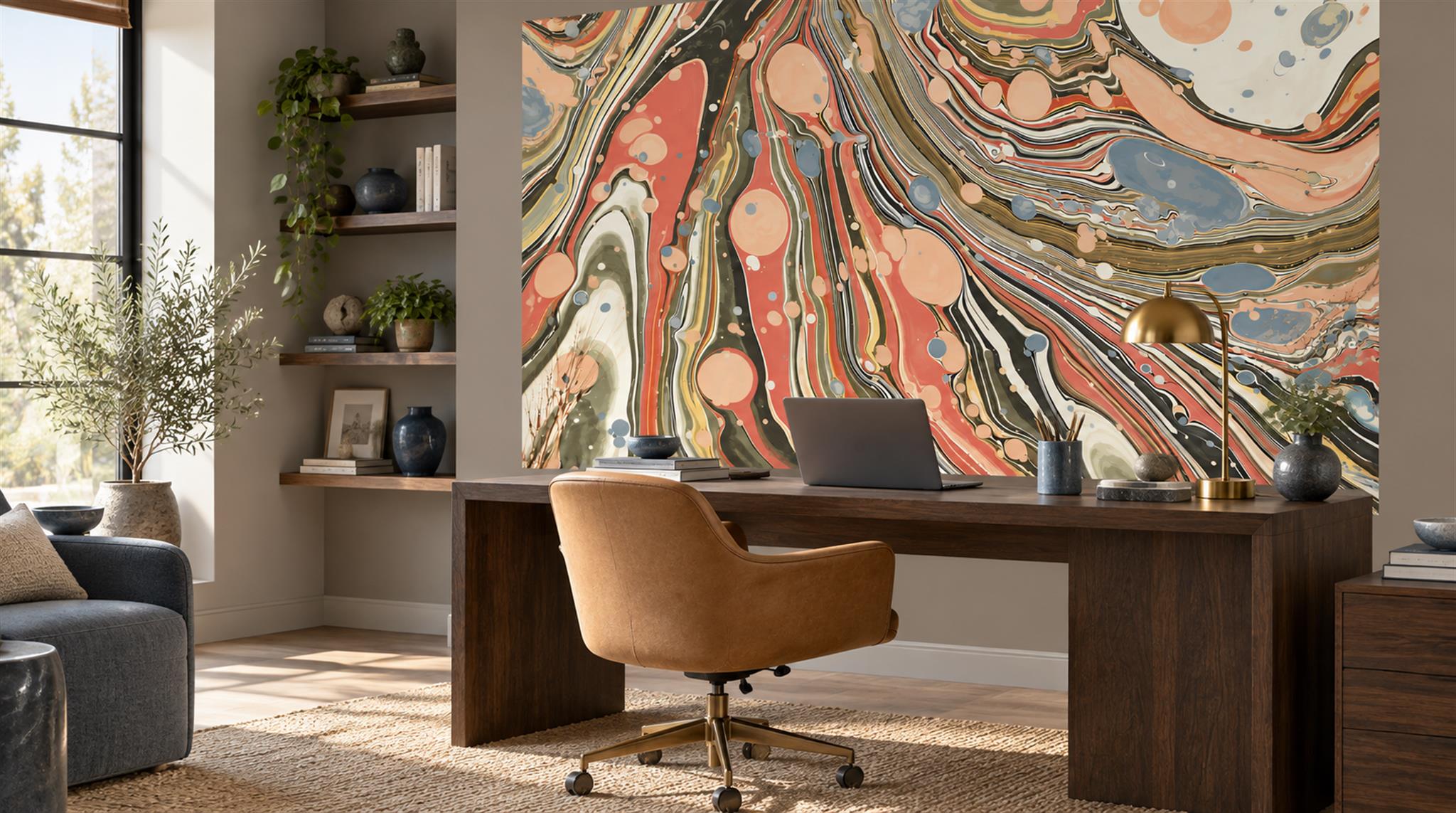
Compare two illustrated office arrangements. In the first, a desk sits immediately in front of a flat-printed marbled design with coral, olive and blue bands. The flowing lines make the wall lively, but they also occupy almost the entire field of view above the worktop. That is an appealing choice for someone who enjoys expressive colour and faces another wall while working. If the desk faces this mural, test whether the darkest bands land directly beside the monitor, where repeated contrast changes may be more noticeable.
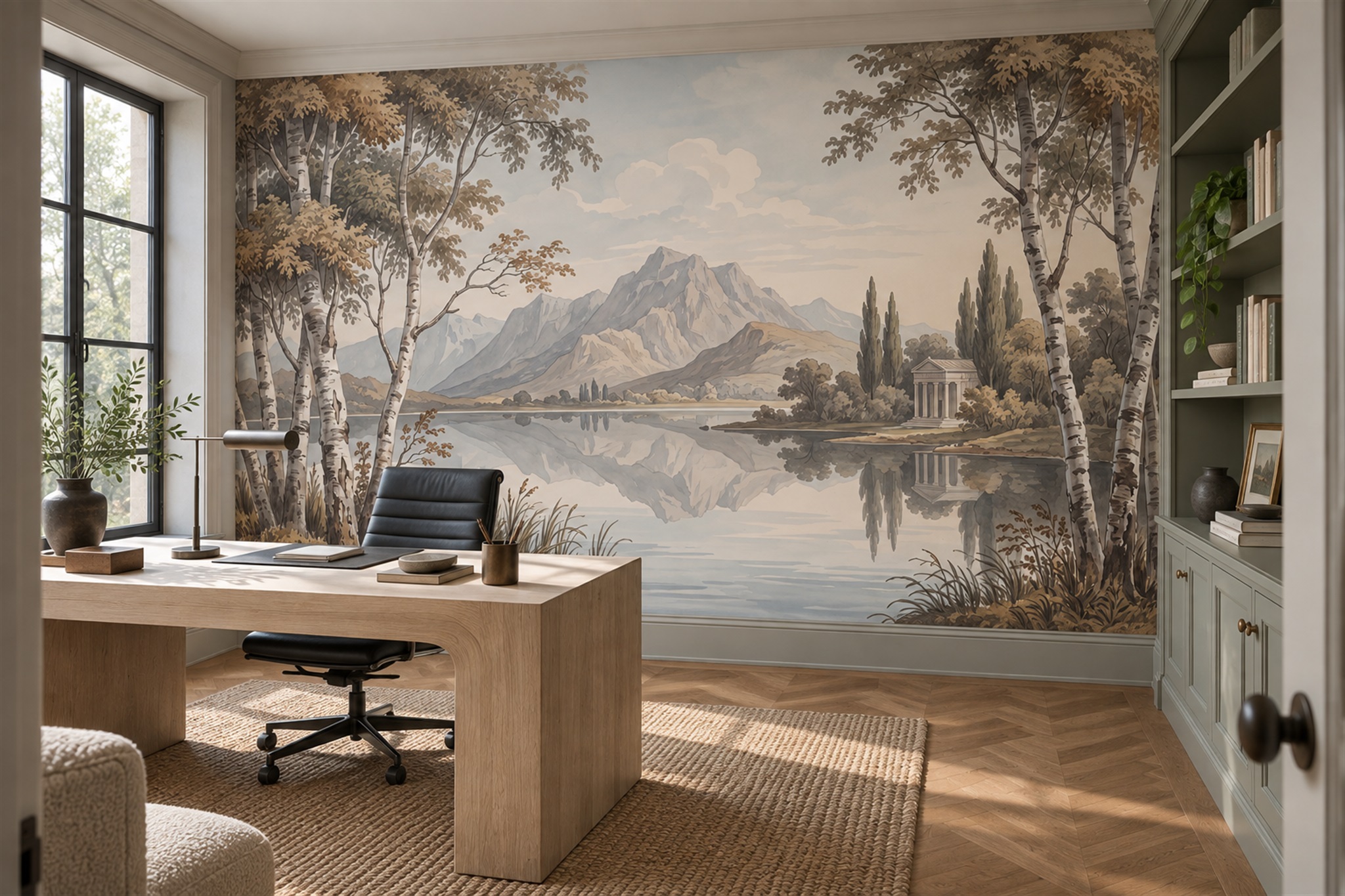
In the second arrangement, a desk stands in front of a sepia landscape: trees frame the edges, while the lake and distant mountain hold the middle. The composition gives the eye somewhere to travel, yet the central tonal range is relatively soft. It may be preferable when the wall stays in your peripheral vision through long sessions. Neither example is universally more productive. The useful difference is where its contrast falls in relation to your screen, chair and camera.
Test the video-call background
Use the camera and framing you actually use, including any automatic crop or virtual-background setting. A wide room photograph is not the same as a head-and-shoulders video frame: only a narrow slice of the mural may appear, and a bold shape can seem to touch your head when the camera shifts slightly. Record the seated and standing-desk positions if you use both. A composition that survives those two frames is more reliable than one arranged around a single still screenshot.
Lighting matters. A window behind you can darken your face while making the mural bright; a desk lamp can cast a colour on the print that differs from its appearance in daylight. A highly detailed wall may look visually noisy after video compression. A quieter area of artwork behind the head and a more expressive area outside the camera frame can balance personal enjoyment with a clear call background.
Think about the tone you want on screen. A painterly landscape may be calm, a botanical scene warm and an abstract design more graphic. These associations are subjective, so test them against your actual camera view and work context. The best background is the one that looks intentional without overpowering the person speaking.
Make the scale comfortable for close work
In a small office, you may sit less than a metre from one wall. Tiny, high-contrast marks can become distracting at that distance; an oversized form may feel very different from the catalogue image photographed across a large room. Use the measured-wall crop preview and ask the supplier for a motif-size estimate if scale is critical. Look at the result from the seated working position as well as from the doorway.
A low-contrast mural is not the only route to concentration. A bold design behind you may be invisible while you work yet create a strong backdrop. A quiet design opposite you may offer a pleasant pause from the screen. Decide where attention should go and use the mural accordingly. The room’s acoustic or ergonomic needs will not be solved by wallpaper, so keep the decorating decision in proportion to the rest of the workspace.
Coordinate the mural with desk finish, chair upholstery and storage. A warm timber desk can relate to a muted botanical scene without exact colour matching. If open shelving is already visually busy, choose artwork with more space around its main subject.
Do not judge scale by thumbnail. Tape paper to the wall to represent the approximate width of a mountain peak, flower or geometric block, then sit in the chair. A motif that appears modest in a full-room image may fill the camera frame. Conversely, fine scenic detail that looks beautiful close up can disappear on video. Cropping is therefore a composition decision, not merely a print-production step.
Sample the print under working light
A home office may be used under strong task lighting for long periods. Side light can reveal texture and seams; a glossy or smooth finish may reflect a window into the camera. Ask for the exact material sample and hold it on the intended wall during a normal workday and an evening call. Screens are useful for the crop but not reliable physical colour references.
Consider the wall’s practical condition. It should be clean, dry, smooth and sound for the chosen material. If the office is a rented room, check permission before fitting self-adhesive panels. “Removable” does not guarantee weak paint will survive. If the desk chair or equipment will brush the mural regularly, ask for care guidance and create clearance where possible.
Choose the mural by the wall it will occupy
Suppose the desk faces a window and the camera points towards the wall behind the chair. In that layout, the marbled bands can serve as a call backdrop, but shift the approved crop only after checking where the strongest line appears around the seated head. If the desk may later turn towards that wall, make a second mock-up from the new working position: the same line would then sit beside the monitor all day. The quieter lake scene may be the more adaptable choice for a room whose desk position is likely to change.