What Mural Wallpaper Works Well in a Living Room?
Plan a living-room mural around seating, sightlines, daylight, artwork scale and the wall’s role in the wider interior.
Article focus: pricing and measurement
The cost and measurement decision
Start with accurate wall measurements; the final custom mural price depends on area, material and any finishing options.
Example application: Living room · pricing and measurement
The best living-room mural depends on what the room already asks you to look at. A wide, quiet coastal drawing can sit behind conversation; a wall of tropical birds becomes the conversation piece; a sunset landscape may give a plain seating area a dramatic backdrop. None is universally better. First identify the wall seen from the entrance and main seats, then decide whether the artwork should lead, support a fireplace or view, or remain a calmer background for a television.
Map the room’s competing focal points
Rank the room's fixed focal points before selecting a print. If evening television use dominates, test the proposed mural with the screen's real size drawn over it and the room lights on. If a fireplace already leads the view, choose whether the mural will frame that area quietly or define another seating zone. A side-wall scene may be seen at an angle from the sofa but in full from an armchair. Compare those everyday views rather than relying on the symmetrical product photograph.
Stand at the doorway and note which wall is most visible. Then sit on each main seat. A mural that looks balanced from the entrance may be seen at a sharp angle from the sofa, or much of it may be blocked by a tall chair. Consider whether the artwork has a focal subject that must be visible from all positions, or whether it can function as a layered background. A panoramic scene can be effective even when only part is visible from one seat, provided the whole composition still makes sense.
Do not automatically place the mural behind the sofa. That wall may be ideal for a broad background, but a wall opposite the seating can give occupants a more complete view. In an open-plan room, the mural can visually mark the seating zone without a physical divider. Choose a surface with enough uninterrupted area for the subject; a scenic centre lost to a window is not rescued by an attractive colour scheme.
Choose an image whose important parts remain visible
A sofa can hide the lower third of a mural; a console or shelving unit can interrupt one side. Draw their outlines on your own wall elevation and compare it with the proposed crop. A coastal horizon might sit just above the sofa back, while a large bird or flower may need to shift away from a lamp or shelf. If the furniture is likely to change, avoid placing the only important detail in a narrow gap that exists only with the current arrangement.
Measure the full wall if the mural will extend corner to corner, even where furniture hides it. Record the widest and tallest points and follow the supplier’s trim instructions. If the mural is intended as a smaller framed artwork area, define and measure that boundary separately. A product photo with a low sofa cannot predict how much your taller furniture will cover.
Mark openings on your wall sketch before using the crop preview. A window can remove the centre of a landscape; a doorway can cut through a symmetrical geometric design. If the placement remains uncertain, ask the supplier whether a separate layout review is available before printing.
Compare a quiet wall with a statement wall
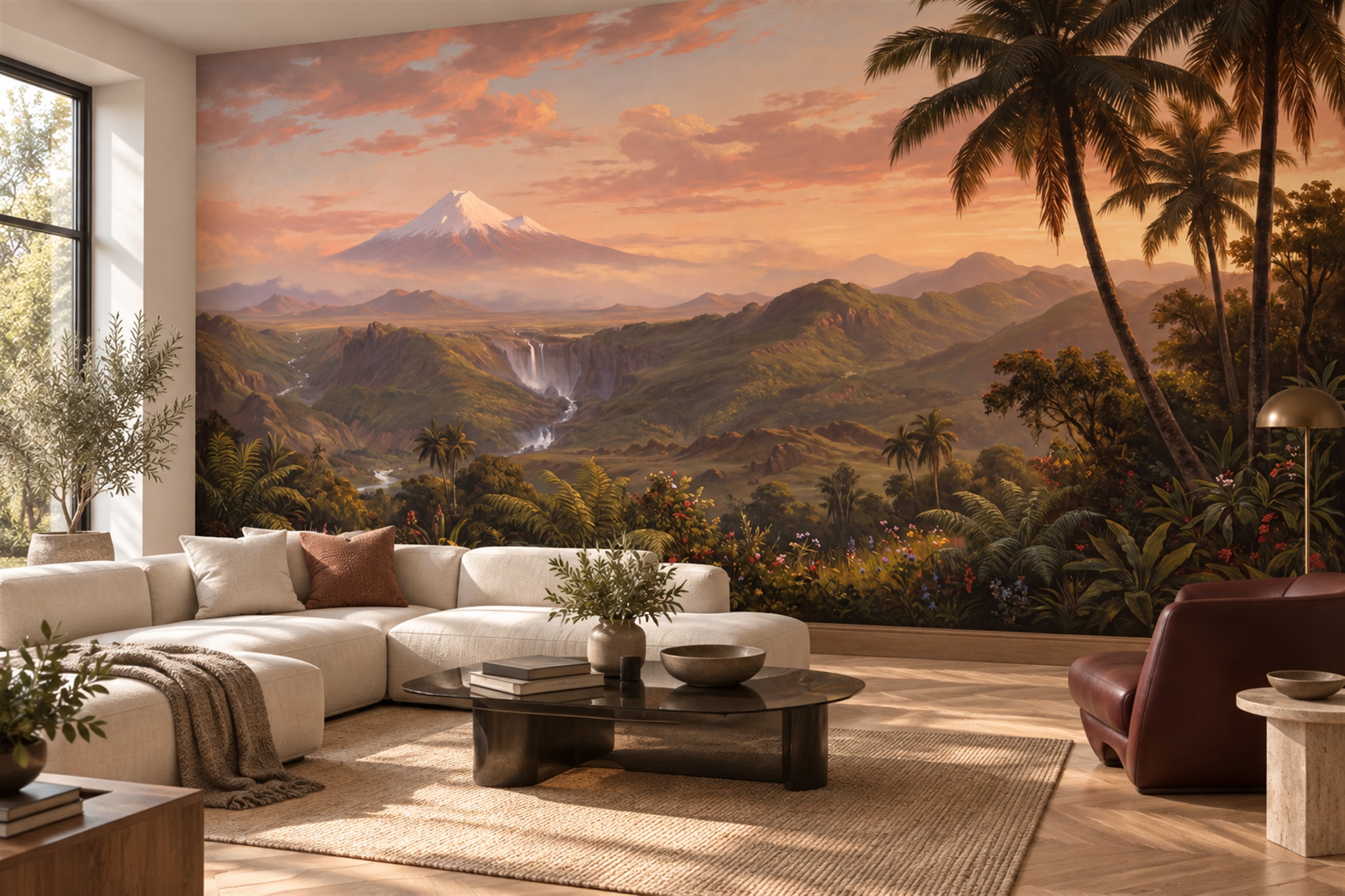
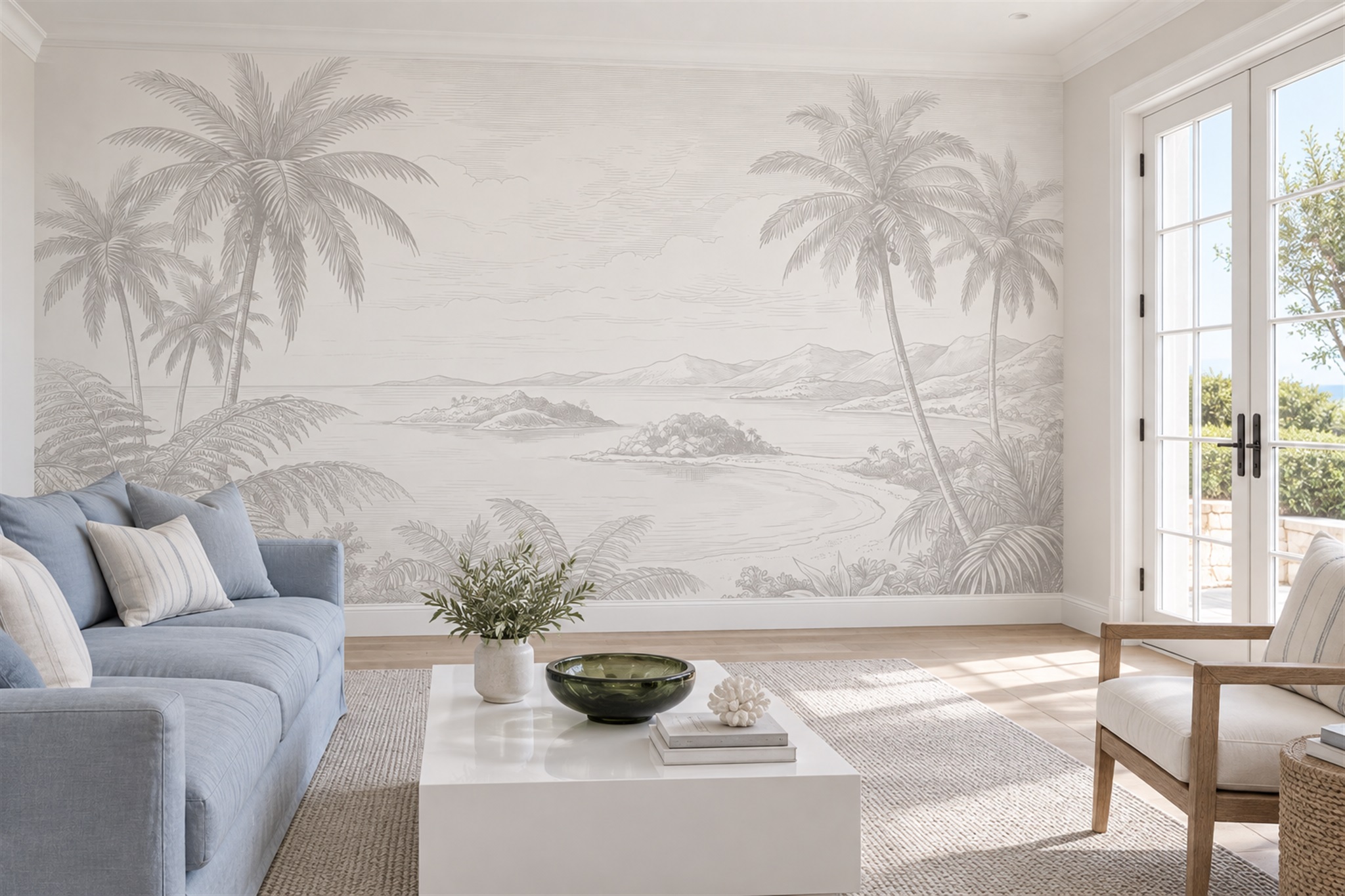
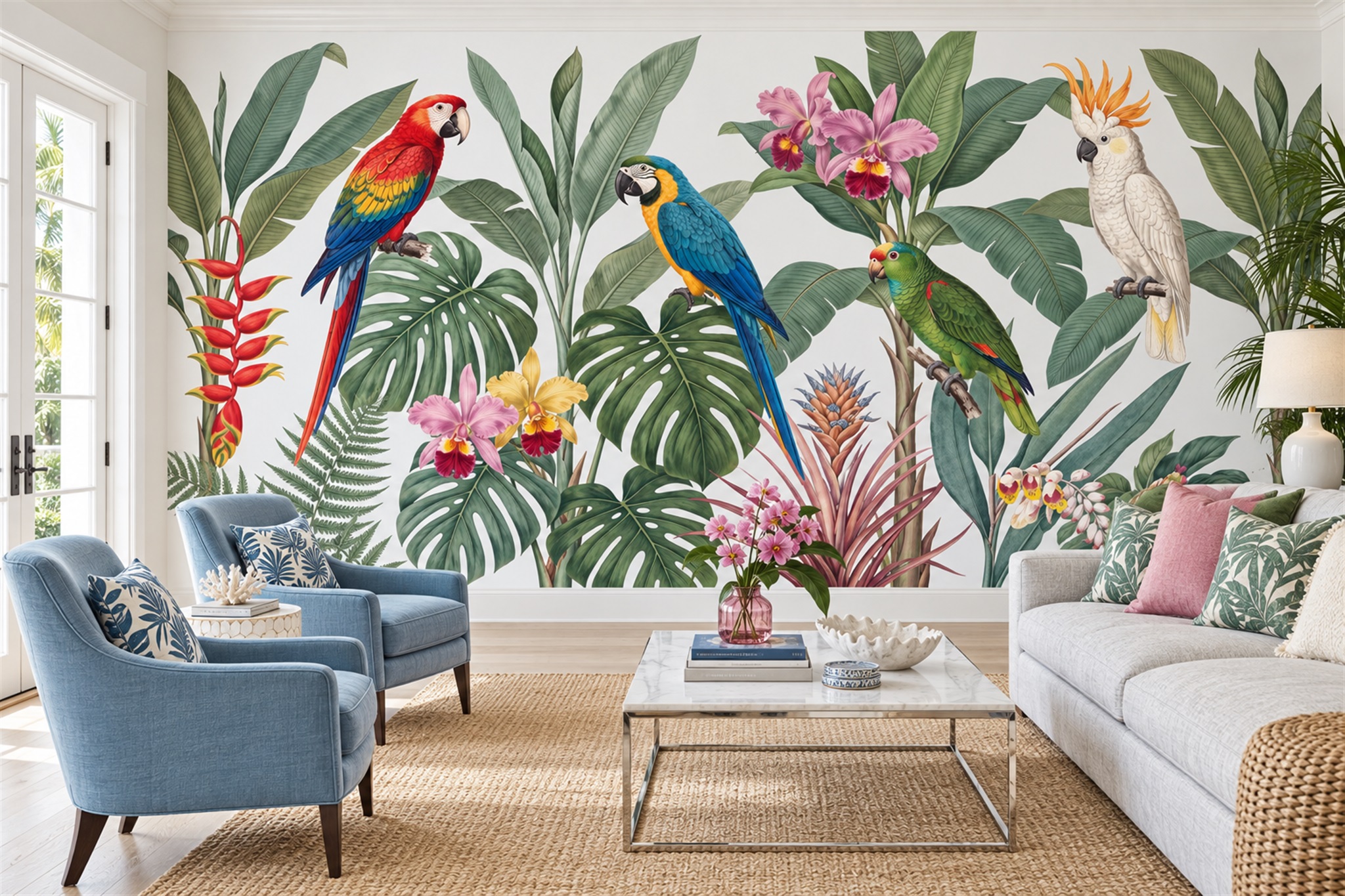
The engraved coast above is one way to bring a scene into a room without making it the loudest element. The tropical-bird design below is the opposite choice: colourful parrots, a cockatoo, orchids and broad leaves ask to be seen first. The sunset mountain mural used as this article’s feature image is different again: it has a strong panorama and darker lower foreground, so the pale sofa obscures less essential detail than it would in a composition whose main subject sits at floor level.
If your rug, curtains and upholstery are already expressive, begin with artwork that has open areas or lower contrast. If the furniture is mostly plain, the mural can supply the main pattern. The Wallcoverings Association’s pattern guidance distinguishes the effects of large and small prints and recommends considering colour and scale when mixing patterns. Use that as a way to compare candidates, not as a rule that a living room may contain only one print.
Use physical samples to compare undertones with the fixed elements: flooring, sofa fabric, cabinetry and existing paint. A cool grey mural may feel different beside warm timber than on a screen. One subtle colour connection can be enough; you do not need cushions in every mural shade. Test samples under both daylight and lamps, because a living room often changes character between afternoon and evening.
Consider scale from the sofa, not just at arm’s length. Fine palm lines across a broad wall may read as tonal texture from a distance, while a large bird or flower remains individually recognisable. Ask for the approximate printed size of a distinctive motif on your wall. If it will be mostly hidden by a sofa, shift the crop; if it feels too dominant from the nearest seat, compare a design with more open background.
Choose material for the room’s traffic
Living rooms can be low-contact or busy with children, pets and furniture moving against the wall. Ask how the selected finish should be cleaned and what preparation it requires. Do not infer waterproofing, scratch resistance or effortless removal from a generic material name. Wallcoverings Association preparation guidance starts with a clean, dry and sound wall; the chosen mural’s own instructions determine the rest.
If the mural sits beside a fireplace, heater or other heat source, ask the supplier and relevant equipment maker about clearances and suitability. A styled photograph near a fireplace is not proof that every wallcovering is approved for the same conditions. Choose another wall if the required performance cannot be confirmed.
For a prominent living-room feature wall, precise installation matters. A continuous horizon or geometric line can make small seam errors obvious. Lay out the numbered panels and consider an experienced installer if the wall is high, uneven or difficult to access.
Choose the wall's role in the living room
Make the choice with three room-specific tests. First, place a printout of the crop behind a sketch of the sofa, television and shelving to see what remains visible. Next, view a sample in the room's evening lighting as well as daylight. Finally, ask whether the wall can hold the artwork's visual weight alongside the fireplace or outside view. The strongest candidate is not necessarily the boldest image: it is the one that still serves conversation and ordinary seating after the camera angle of the product photograph is gone.