Which Mural Wallpaper Works Best in a Small Room?
Choose scale, contrast, colour and composition for a small room without making the wall feel visually crowded.
Article focus: pricing and measurement
What to settle before pricing
Start with accurate wall measurements; the final custom mural price depends on area, material and any finishing options.
Example application: Bedroom · pricing and measurement
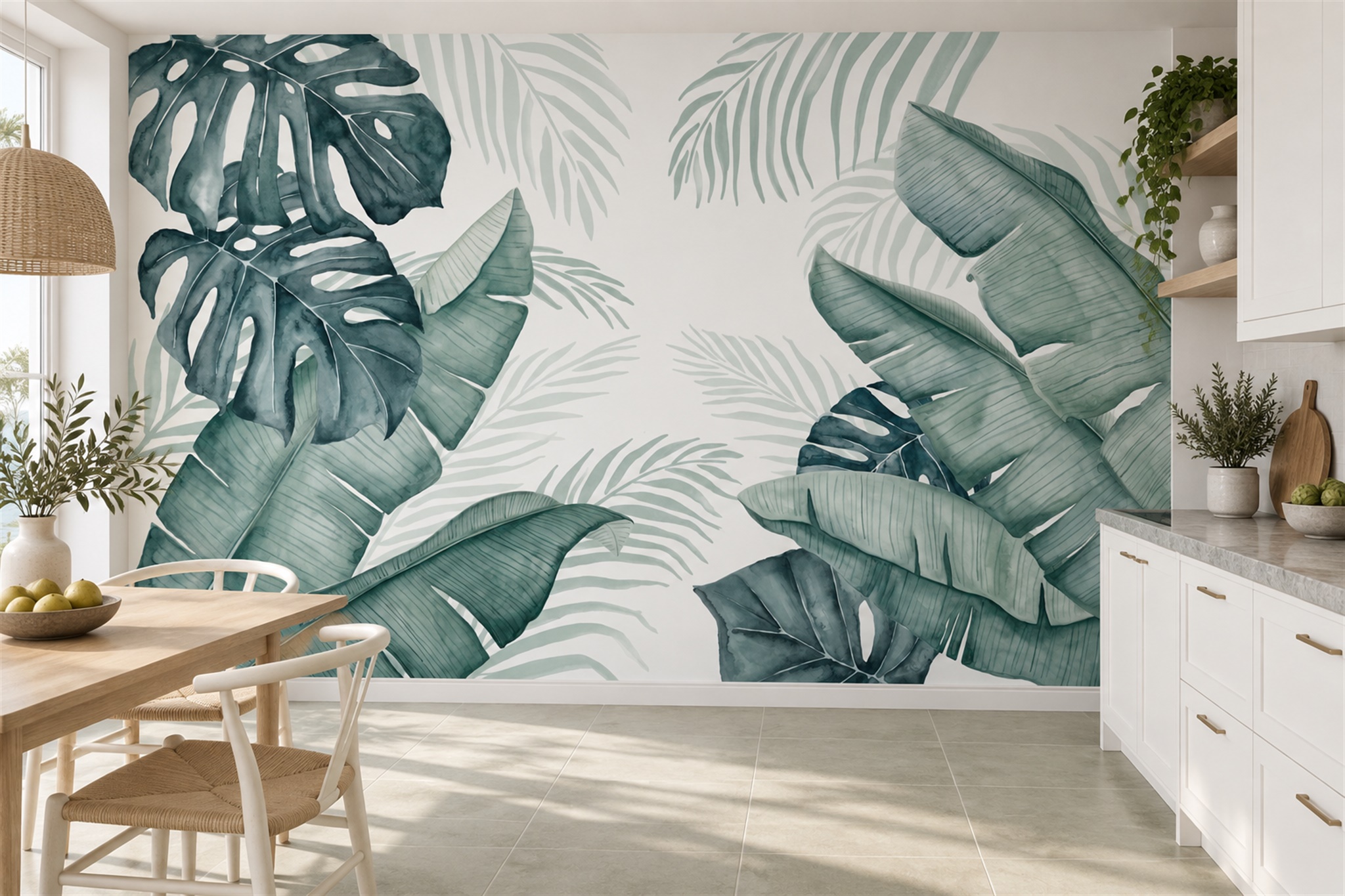
Which mural works best in a small room? Start with what you will actually see from the doorway or the main seat, not a rule that small rooms require tiny pale patterns. At short viewing distance, a few large flowers can read more clearly than dozens of fine marks; a landscape can feel calm if its open sky survives the crop. The right choice depends on visible subject, contrast, furniture and light together. Two very different room images below show why scale alone is not the answer.
Decide what the room lets you see
In a small room, the camera angle of a product photo can be especially misleading. A wide lens may show the full mural from farther away than any person can stand in the actual room. Measure the distance from the bed, desk or doorway to the intended wall and judge a scaled crop from that distance. Ask whether the design still has a readable centre when part of it is outside your field of view. If not, a simpler subject or different crop may work better than merely making every motif smaller.
A compact bedroom may present the mural mainly from the bed, while a small workroom may be viewed from a desk only a short distance away. Stand and sit in those real positions. If you see the wall in fragments around a wardrobe, shelf and window, a panoramic view that relies on a continuous horizon may lose its subject. If one wall is relatively clear, the same room can carry a stronger mural despite its small floor area.
Sketch the main furniture on a copy of the wall-sized crop; the site's preview does not place it automatically. A headboard may obscure low flowers but leave tall stems visible; shelving may hide the centre of a landscape but leave open sky above it. Judge the artwork you will still see, not the complete thumbnail. A compact composition or framed partial mural may be better if openings cut the image into unrelated pieces. The Wallcoverings Association's hanging-planning guidance treats focal points and architectural interruptions as part of placement.
Distance matters separately from size. A mural with intricate linework may be engaging from a desk one metre away but visually busy from the room entrance. A large simplified motif may read at both distances. View a scaled print or saved crop in the room, if available, from the actual seat; a catalogue photograph taken across a large showroom is a poor substitute for that check.
Compare two different ways to use a compact wall
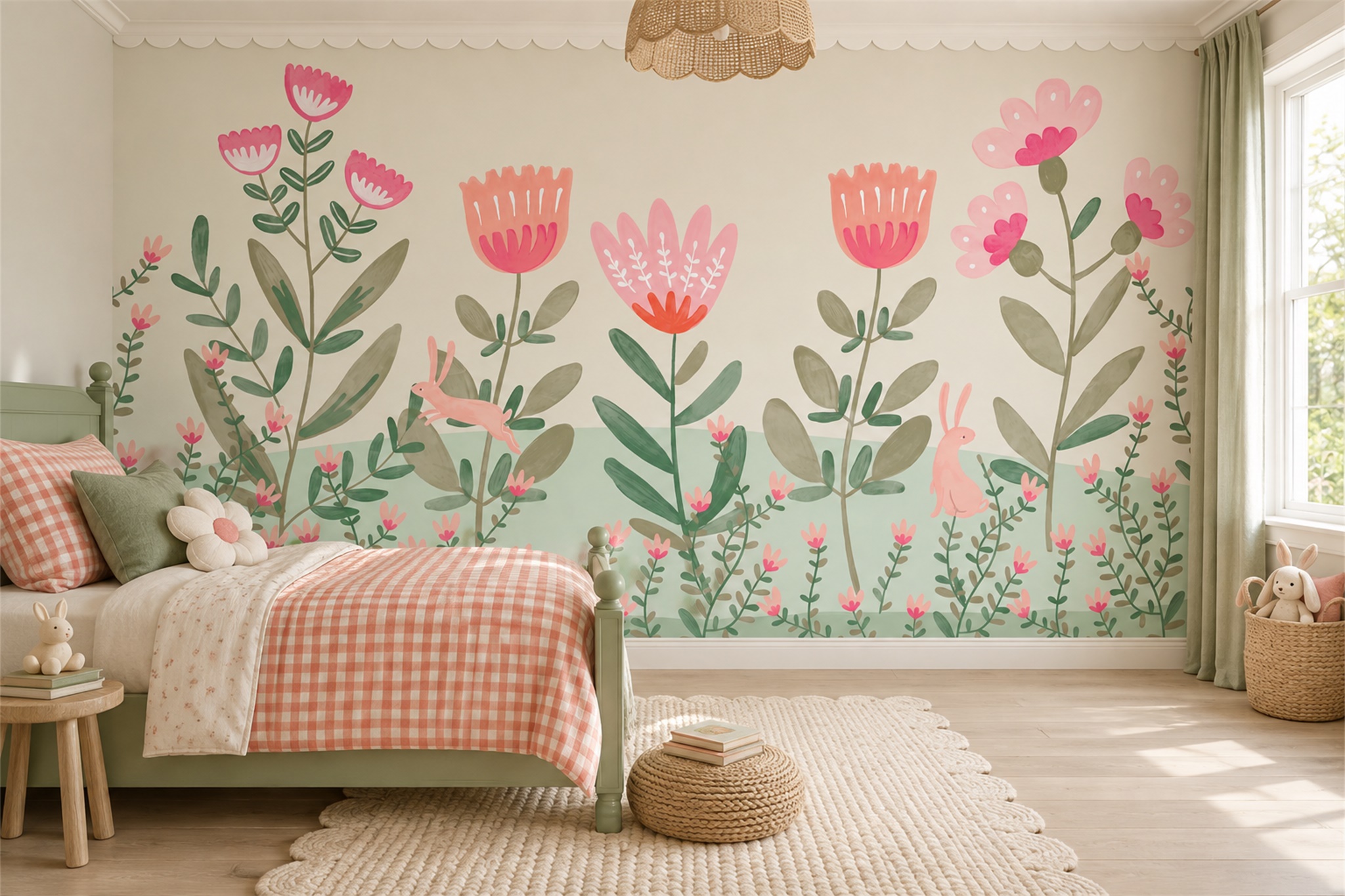
In the first photograph, broad pink and coral flowers rise above a pale green lower band, with small rabbits among the stems. The child's bed hides part of the lower print, yet the tall flowers remain legible across the wall. The image works as a focal subject because individual forms are large enough to read and there is light background between them. If the same print were cropped so a large flower disappeared behind the headboard, its effect would change.
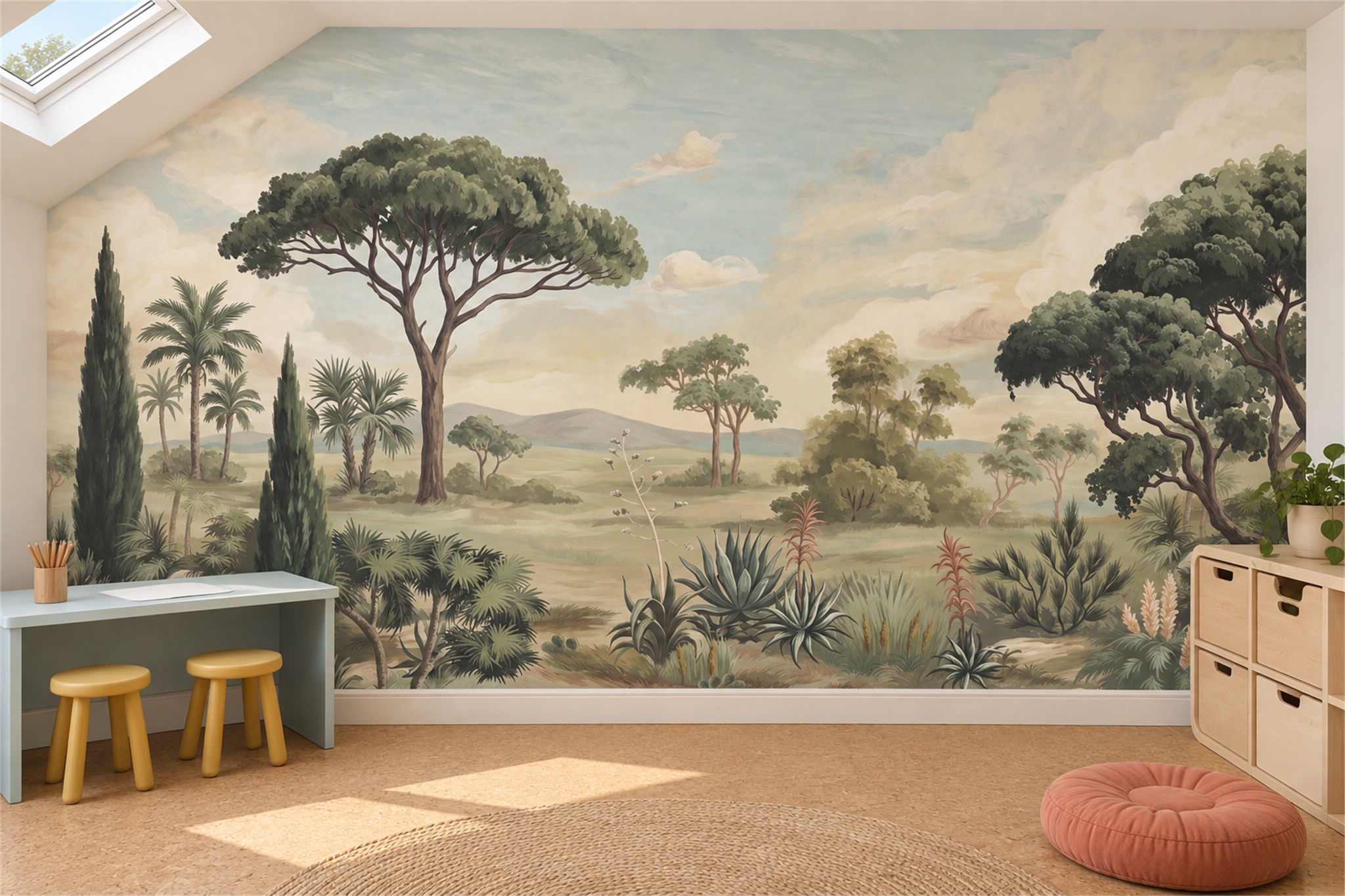
The second photograph shows a tree-led landscape above a low desk in a child's room with a sloping ceiling. Its pale sky and distant ground provide a different type of breathing space. The broad tree canopy is still a large motif, but the scene does not require many small high-contrast marks to create interest. A crop cutting the main tree at the slope would be less convincing than one that keeps its form intact. These photographs illustrate possible approaches, not evidence that either exact mural will fit every small room.
Check approximate motif size in the crop and mark the room's obstacles on a separate measured sketch. A narrow wall can remove much of a wide source artwork. If half a building, animal or tree disappears unintentionally at the edge, the scene may look cramped. Receding hills or open sky can offer visual depth, but no composition guarantees that a room will feel larger. The Wallcoverings Association's pattern guidance distinguishes the different effects of large, small and overall prints; the actual crop decides which effect reaches your wall.
Judge contrast before labelling a mural “light” or “dark”
A pale print with many hard black outlines can feel busier than a deeper scene with soft transitions. Look at the light-to-dark range and the density of marks, not simply the colour name. The pink flowers in the bedroom are saturated focal points against a quiet ground; the tree landscape has muted greens and a broad sky. Both have open areas, but they produce different energy. Choose according to the room's use and what other patterns are already present.
Take a physical sample into the space. Screens may make sage appear cooler or cream brighter than the print. Compare the sample with real paint swatches, floor and upholstery in daylight and evening light. In a small room, even one feature wall occupies a large share of the visible field, so undertone differences can become prominent. The goal is not to match every surface exactly; it is to avoid unintended conflict.
If the room already contains patterned bedding, a colourful rug and many displayed objects, a mural with lower contrast or more open ground may give the eye a place to rest. If furnishings are plain and low, a vivid floral or geometric subject can lead. Do not prescribe “white only” to a compact room; consider how many elements are trying to be the focal point at once.
Choose a coverage area that preserves the subject
A full-wall mural may feel more resolved than a narrow strip left floating behind furniture, but a framed panel or area above panelling can work when it has a clear edge. In a compact room, those edges are close to the viewer and should be deliberate. Mock up the intended rectangle before ordering and check whether the important flower, tree or horizon remains intact inside it.
For corner-to-corner coverage, measure the actual wall at several points and follow the supplier's trim guidance. If only part of the wall is to be covered, measure the defined artwork area rather than guessing from the exposed space around current furniture. A sofa may move later; an intentionally finished mural edge should still make sense without it.