Can Removable Mural Wallpaper Be Used in a Rental Property?
A renter-focused guide to removable mural wallpaper, including landlord permission, paint testing, temporary installation, and removal planning.
Article focus: pricing and measurement
What to settle before pricing
Start with accurate wall measurements; the final custom mural price depends on area, material and any finishing options.

Example application: Bedroom · pricing and measurement
A removable mural may be used in a rental, but product removability does not grant permission to alter the wall. The tenancy agreement, landlord's instructions and applicable local rules determine whether this particular covering is allowed and what condition the wall must be in at move-out. Identify the proposed wall and adhesive method, resolve any permission question in writing, then test the material and document the starting paint condition. The product decision and the tenancy decision are separate.
Begin with the agreement, not the wallpaper
Tenancy rules differ by property and location. Some agreements allow ordinary decoration; others require prior written approval for any wallcovering or change to the finish. The distinction matters even if the mural can later be removed. Read clauses on alterations, decorating, repairs and end-of-tenancy condition. If anything is unclear, ask the landlord or property manager to confirm the proposed mural and wall in writing.
Do not generalise from someone else's rental story. Even two English council pages address different tenures: Hackney Council tells private tenants to seek written permission before changing a wall, whereas BCP Council says its own council tenants do not need permission for general interior decoration. Neither page creates a rule for every private rental, every council home or another country. Check your particular agreement and local requirements; seek local tenancy advice if they conflict or remain unclear.
A specific written request reduces ambiguity: identify the exact wall, the proposed material and how it attaches; include a product link if possible. Ask whether a discreet sample test is permitted, whether the mural must be removed before handover, and whether the original paint colour or finish must be restored. A reply saying only “decorating is fine” may not cover an adhesive wallcovering. Save the response with your check-in inventory and photographs so the agreed scope is clear later.
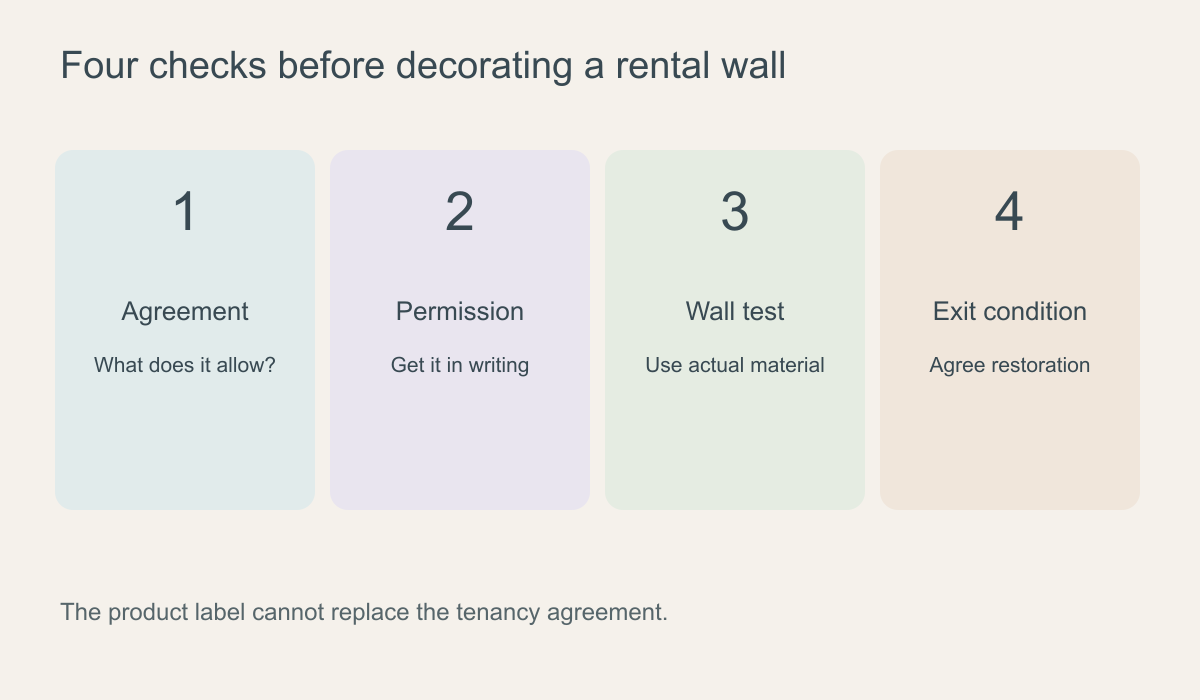 Permission, product suitability and exit condition are three separate checks.
Document the wall before you change it
Take straight-on and close-up photographs in good light. Record existing scuffs, patched holes, lifted paint, stains and uneven texture. Compare them with the check-in inventory where one exists. This is not an excuse to cover a problem; it is a fair record of the starting condition and a way to identify whether the wall needs attention before you apply adhesive.
Ask when the wall was last painted if you do not know. Fresh paint may feel dry long before the maker considers it fully cured for adhesive contact. Test the exact mural finish in a discreet place according to its instructions, after any required paint cure. If a sample takes paint with it, stop. A larger panel is unlikely to be safer merely because it covers more of the wall.
The Wallcoverings Association's preparation guidance says a wall should be clean, dry and sound before a wallcovering is installed. That principle matters especially in a rental, where you may not be able to repair old paint or dampness yourself. Report a persistent moisture problem to the property manager rather than hiding it under a print.
Choose the wall, not just the design
An uninterrupted bedroom or living-room feature wall is often easier to assess than a kitchen splashback, damp bathroom or heavily repaired hallway. The best design still fails if the chosen surface is textured, unstable or subject to repeated steam and splashes beyond the product's stated suitability. Check the material instructions for the actual location, including temperature and moisture restrictions.
Measure the full wall and preview the crop before ordering. A custom-size mural is made for that wall; it cannot be assumed to fit your next home. If you may move soon, think about whether the expense of a one-wall print makes sense, even if removal is straightforward. A framed print or freestanding panel may better match a short tenancy and a strict alterations clause.
What to ask before paying
Confirm the exact material name and installation method, whether a test sample is available, how the maker says to remove it, and what wall finishes are excluded. Ask whether the design is divided into numbered panels and whether a damaged panel can be replaced separately. Do not infer that “removable” means reusable. A peeled sheet can stretch, curl or gather dust on its adhesive.
Ask the landlord or manager a different set of questions: Is this wall approved? Must the mural be removed at move-out? Is repainting expected, and if so to what specification? Are there restrictions on drilling, priming or changing paint? Keep their answers with the product instructions. An agreed plan is more valuable than a verbal “it should be fine.”
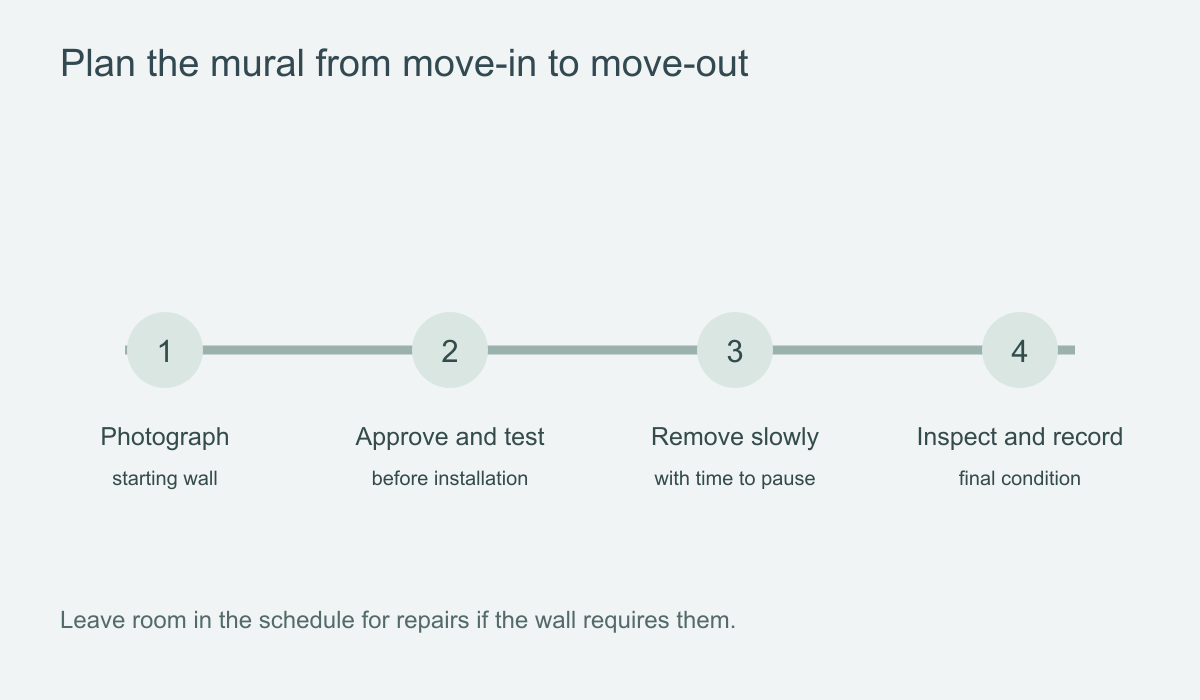 Make the removal and wall-inspection plan before installation, not on moving day.
Plan the exit while the room is still empty
Set aside time to remove the mural slowly under the manufacturer's instructions. Do not wait until furniture is packed and the final inspection is minutes away. Begin at an accessible edge, support the sheet and pause if paint starts to lift. Use only an approved method for any residue. Water, heat or solvent used without checking compatibility can create a repair problem larger than the original adhesive mark.
After removal, photograph the same angles you recorded at move-in. Inspect under daylight for residue, sheen changes and pulled paint. If repairs are needed, agree the method with the person responsible under the tenancy. A small touch-up may not blend with an aged painted wall, so a full-wall repaint might be required for a consistent finish. The fact that a mural was removable does not settle responsibility for that work.
When to choose a non-adhesive display instead
Do not cover active dampness, crumbling plaster or paint that lifts during the permitted sample test. A refusal of consent or an unresolved decorating clause is a separate stop sign. If the landlord requires an untouched finish and you cannot accept the possibility of repainting, a framed or freestanding display may meet the visual goal with less uncertainty. It will have its own fixing and floor-space considerations, but it does not depend on a peel test of the entire wall.
Before ordering, put three items side by side: the clause or written approval for this wall, dated photographs of its current paint, and the exact material's installation and removal instructions. Reviewing a design sample alongside the room's existing finishes, as pictured, can help judge colour; hold it against the intended wall to assess placement. Neither viewing method establishes permission or proves that the adhesive will leave old paint untouched. Ask in writing whether a small adhesion test is allowed and what restoration is expected at handover. If the answer permits only a different wall or requires repainting, revise the plan and cost before commissioning a print cut to these dimensions.