Can You Order Custom-Size Mural Wallpaper? What to Know
Learn how made-to-measure mural wallpaper works, from wall measurements and image cropping to panel production and installation planning.
Article focus: pricing and measurement
What to settle before pricing
Start with accurate wall measurements; the final custom mural price depends on area, material and any finishing options.
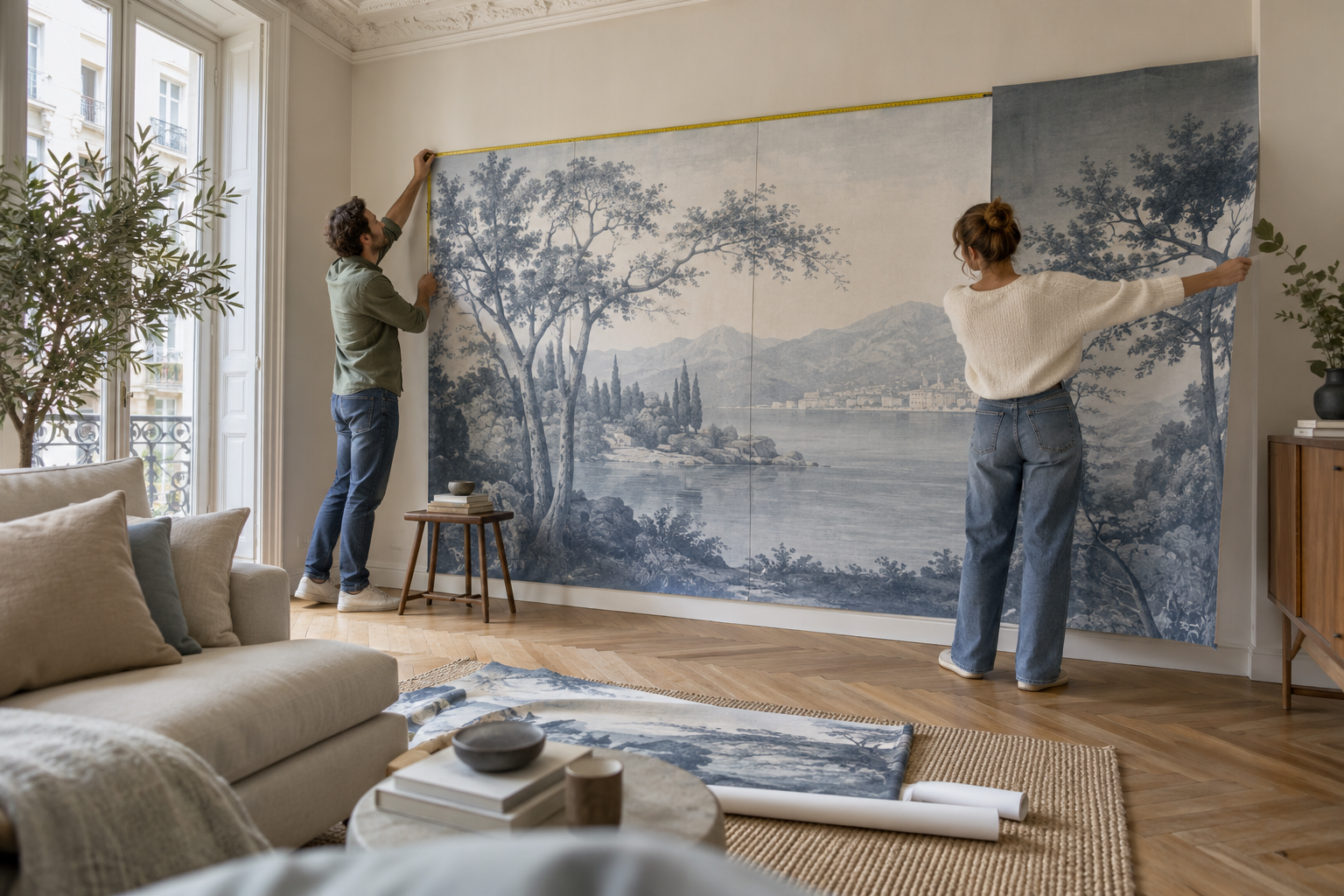
Example application: Bedroom · pricing and measurement
Yes, you can order a mural to entered dimensions within the limits offered for the particular product. Custom size means a print for the rectangle you specify; it does not mean the scene is redrawn to fit. A wide panorama on a narrow wall may lose its edges, while a customer-supplied image enlarged beyond its source detail may look soft. Check the crop and any available quality warning before ordering.
What “custom size” actually changes
With a conventional repeating wallpaper, you buy enough rolls or strips to cover the surface and match the repeat. A made-to-measure mural instead starts with a composition and fits it into a specified width and height. The result is usually supplied in numbered panels that together form one scene. Your entered dimensions influence the printed area and the visible crop, not just how much paper is delivered.
That does not mean every image can be stretched into any shape without consequences. If a panoramic woodland is made much taller and narrower, the production preview may show only its centre. A square illustration placed on a very wide wall might need substantial cropping above and below, or a different design. Watch for recognisable subjects near the edges: a bird, doorway, peak or face can disappear when the aspect ratio changes.
Custom size describes the printed rectangle; it is not a promise that the artwork will be redrawn to fit it. The available crop, minimum or maximum size, and print resolution depend on the particular design and ordering tool. Check the dimensions that the product page actually accepts before committing to a layout. If it rejects your wall size, shows a quality warning or removes a subject you need, ask about a different composition or a supplier-approved alternative. Do not assume that widening the print adds new scenery beyond the original artwork.
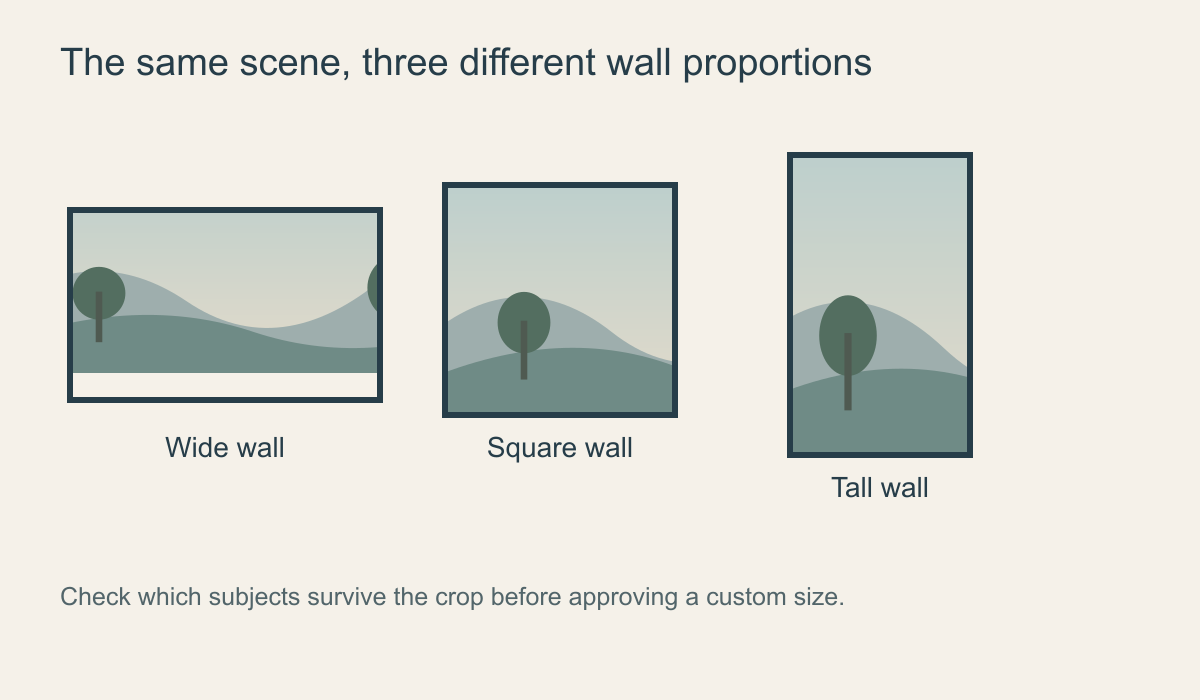 One artwork can yield different visible compositions on square, panoramic and tall walls.
Know which dimensions you are entering
Bring a finished-wall measurement to the product page, not an estimate taken from a styled photograph. Keep the measured width and height separate from the larger print dimensions entered after the supplier's fitting allowance. Solowalls' current guidance asks for about 4 inches (10 centimetres) added once to each overall dimension. That addition changes the print rectangle; it does not add new scenery to an artwork with a fixed source image.
Check the unit displayed beside each input. A centimetre measurement typed into an inch field is not a small fitting error. Review the width-to-height relationship in the updated preview as well as the numbers themselves: a valid size can still produce a crop that removes the only subject you wanted. Keep a screenshot of the accepted dimensions and composition if you need to discuss a revised layout with the supplier.
If you have not yet measured the wall at several points, use the wall-measurement guide before reaching this order decision. The custom-size question begins after those measurements exist: can this particular product accept the intended rectangle, and does its artwork still make sense in that shape?
Plan what belongs inside the crop
Think of the crop preview as a framing decision. Where should the visual centre sit after the panels are hung and trimmed? In a bedroom, the main subject may need to rise above a headboard. In a dining room, the strongest part of the scene may sit between a door and a tall cabinet. A full-wall print is usually ordered even when furniture will hide part of it; the artwork can then continue naturally behind the furniture.
Use Customize & Buy to preview the crop at the entered dimensions. Do not assess only a generic product thumbnail; it may represent another wall ratio. If the focal point is close to a cut edge, try a different position or choose artwork whose composition better suits the wall. Keep a screenshot of the selected preview and your measurements for a complicated project.
For example, a mural centred on a single tree may work well behind a sofa on a broad wall but lose its branches when cropped for a narrow stairwell. Conversely, a design with open sky or a quiet textured edge may tolerate a tighter crop. Compare the preview with the visible portion of your wall, allowing for areas hidden by furniture, while ordering enough material to cover the measured surface. If the preview cannot show the required placement, ask whether the supplier can review a marked wall sketch before you order; installation cannot restore a subject cropped away at production.
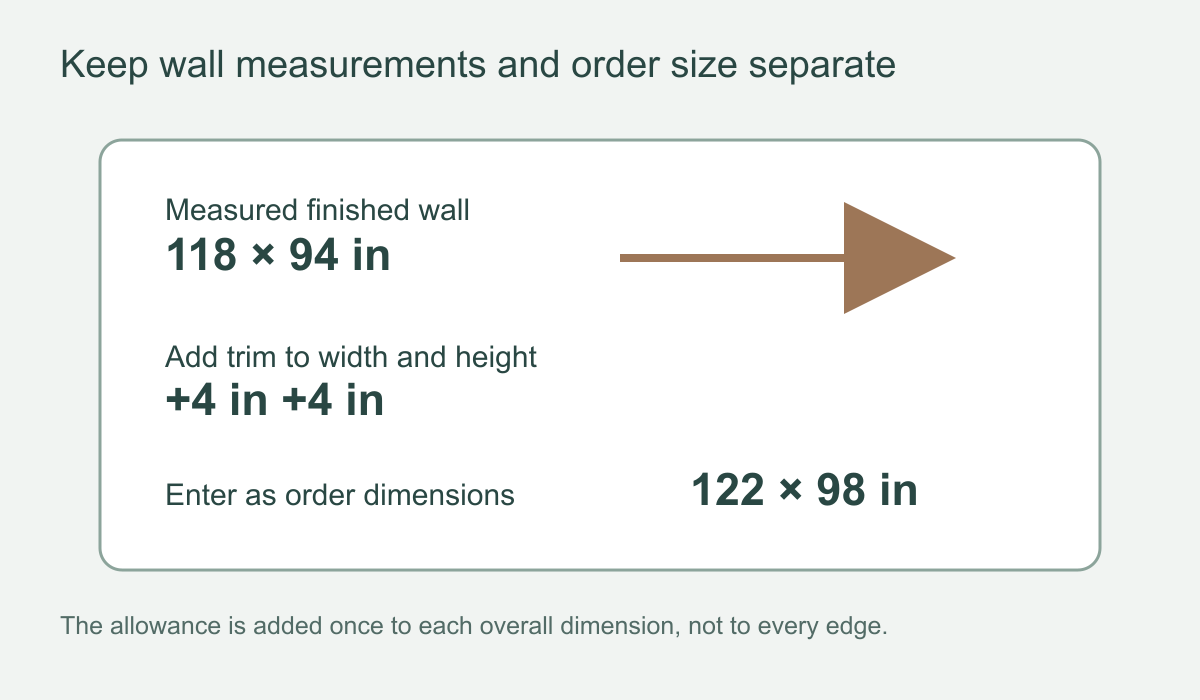 Keep the measured dimensions separate from the larger production dimensions.
What if your wall is not a simple rectangle?
A sloped ceiling, arch, alcove or staircase makes the measurement more demanding. Draw an elevation of the entire area and label every relevant point. A mural printed as a rectangle may still be trimmed on site to a slope, but the artwork behind that cut will be lost. Place important subjects well inside the final visible outline. For a steep roofline or several connected walls, send the drawing to the supplier before assuming the standard online crop is sufficient.
Windows and doors need similar thought. Measure their position from a fixed corner and from the floor. The print may run across the opening and be cut away during installation, allowing the remaining scene to align above and beside it. Do not subtract window area from the wall width and height unless the supplier specifically requests that method. Doing so could shift every panel and make the image impossible to align.
If the mural wraps around a corner, treat each wall face as its own measured plane. A physical corner can interrupt a tree trunk or geometric motif even when the total combined width looks right. Ask whether the artwork should continue across the turn or whether separate crops will work better. Photography of the room and a marked sketch are more useful than a bare width-and-height pair for this decision.
Will a very large mural look sharp?
Image quality is a separate question from manufacturing size. Fine lettering, detailed faces and close-up photography demand more source detail than a soft watercolour landscape viewed from across a room. A low-resolution image cannot gain detail merely because it is printed on a larger sheet. For a mural made from your own photograph, provide the original file rather than a messaging-app copy or screenshot. Check any tool-generated quality warning at the ordered dimensions; for critical detail, ask whether a human print-quality review is available.
A sample can help judge colour and surface texture, but a small sample cannot prove that a full-width image has sufficient detail or that its crop is balanced. Judge those separately. The Graham & Brown mural FAQ distinguishes a custom composition from repeat wallpaper and describes how its own sizing tool limits dimensions that would produce poor resolution. That is an example of a supplier-specific safeguard, not a guarantee that every mural printer uses the same limits.
Allow for installation rather than ordering exact-to-wall
The extra material is there because ceilings, floors and corners rarely form a perfect frame. An installer aligns each numbered panel, smooths it and trims the surplus at the boundaries. Without an allowance, a slight variation in wall height or initial panel position could expose a narrow unprinted strip. The allowance is not a reason to ignore measurement accuracy: too much surplus can still move the desired subject away from where you planned it.
Before approving an order, read the material-specific installation instructions and inspect the wall itself. The Wallcoverings Association advises that the underlying surface be clean, dry and sound. A mural tailored to a damaged or damp wall does not solve adhesion or finish problems.
A practical order check
There are three sensible responses when a size is accepted but the preview disappoints. If the subject is clipped, first move the crop and inspect every edge; if the wall ratio still cuts away essential artwork, choose a composition with quieter margins. A screen preview alone cannot establish print sharpness: if a print-scale detail or supplier quality review shows insufficient source detail, provide a higher-resolution original or choose different art rather than merely enlarging the file. If an opening splits the focal point, send a measured elevation and ask whether a revised layout is available before paying. The aim is a print that works on this wall, not merely a number the order form accepts.