How to Choose the Right Scale for Mural Wallpaper
Use room size, viewing distance, furniture and the artwork’s visual weight to choose a proportion that feels intentional.
Article focus: pricing and measurement
The cost and measurement decision
Start with accurate wall measurements; the final custom mural price depends on area, material and any finishing options.

Example application: Bedroom · pricing and measurement
Choose mural scale by deciding how large one recognisable feature should be on the finished wall, then testing that choice in the actual room. “Make the leaves larger” is too vague; “show the main leaf about 70 cm wide above the sofa” is a question you can put to the supplier if exact motif sizing matters. Keep wall dimensions and furniture constant while comparing crops. A broad leaf, a fine fern and a tall flower stalk need different checks even when each fills the same wall.
Set a measurable motif target
Choose a feature that is easy to identify in every proposed crop: one leaf, flower head, arch or mountain peak. Ask for its approximate finished dimension if the preview alone cannot show scale. On a hypothetical 320 cm-wide wall, a 40 cm leaf and an 80 cm leaf are two clearly different proposals even though the mural itself remains 320 cm wide. Hold a tape against the real wall to see where those sizes land relative to the sofa, window and ceiling. The numbers are comparison aids, not universal design rules.
Keep scale separate from position. A larger leaf may also force more artwork beyond the crop edges; moving the leaf right does not make it larger. For a repeat, count how many complete motifs appear across the wall at each option. For a panorama, note whether a tree or horizon disappears when the view is enlarged. If the available preview does not distinguish resizing from repositioning, ask what adjustment is actually possible before ordering.
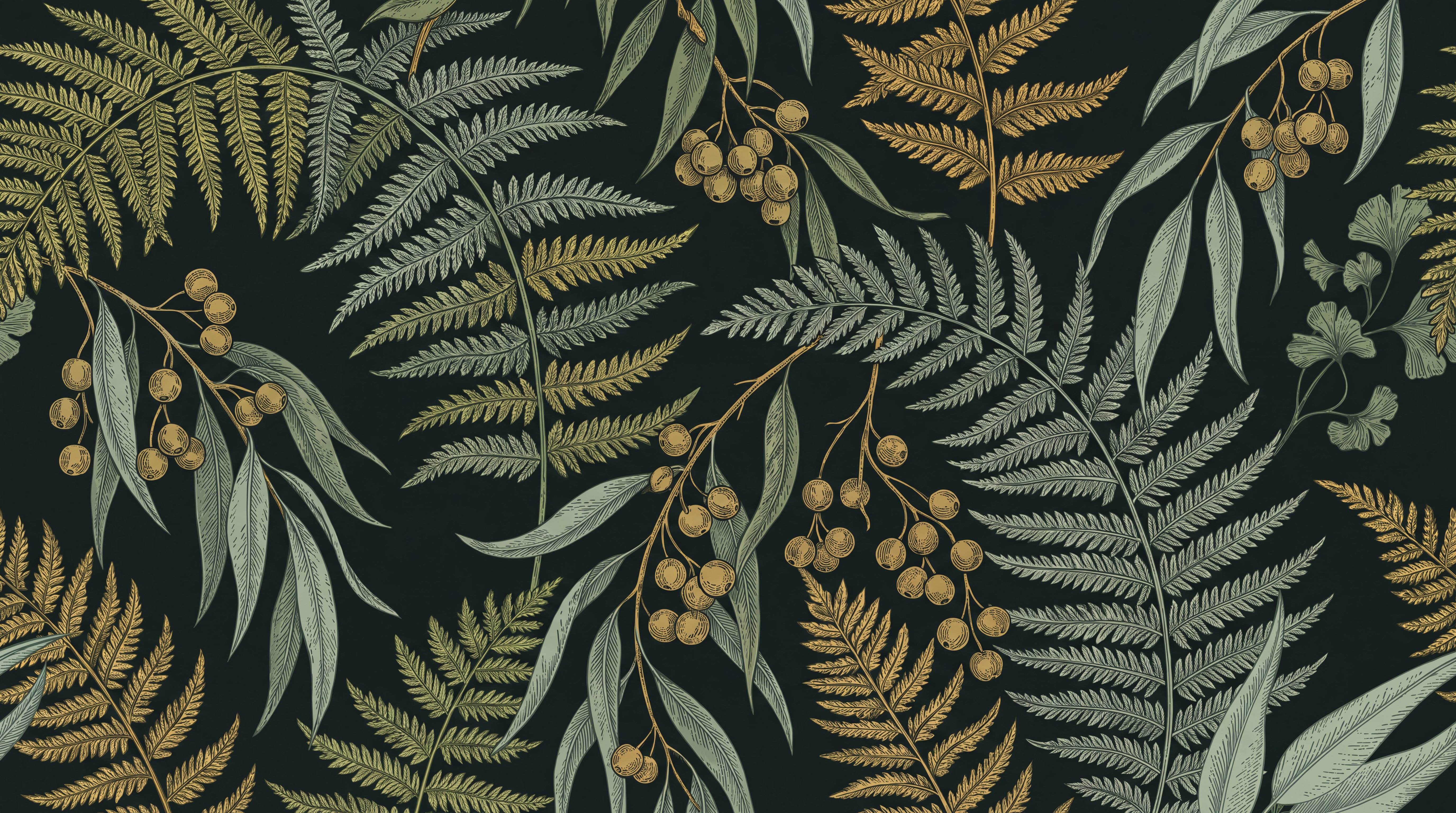
The green monstera artwork at the top of this article has broad, recognisable leaves separated by a pale ground. The different botanical artwork below has fine fern leaflets, narrow leaves and clusters of round berries on a dark field. Both are botanical, but they ask different questions at print scale. An oversized monstera leaf may become the wall's focal point; the fine leaflets need to remain visible without becoming a mass of tiny marks. Compare the largest and smallest elements within each candidate, not merely its colour or subject label.
Start with the distance from which the wall is seen
Stand where the mural will most often be viewed. In a narrow corridor, you may see the wall from less than an arm's length away. In a living room, the normal view might be from a sofa several steps back. Large forms can feel immersive at a distance and overwhelming close up. Fine lines may reward a close look but disappear across a large room. A printed sample helps with line weight and colour; only a full-wall mock-up shows the overall scale.
Take a photograph from the normal viewing position and place the proposed wall crop over it at the correct proportions. If digital tools are unavailable, tape sheets of paper to the wall representing the approximate width and height of one important motif. Walk back to the doorway, then sit down. Ask whether you can identify the subject without searching for it. If every detail demands attention at once, try a slightly smaller motif or a more open composition.
Do not judge scale from the ceiling height alone. A high wall seen from close range can still make a dense print feel intense. A low wall seen across a deep room may support a bold shape. The relationship between eye position and image size matters more than a general rule about small or large rooms.
Use furniture as a measuring tool
Furniture gives the eye a familiar reference. A leaf nearly as wide as a sofa cushion has a different presence from a leaf spanning the whole sofa back. Photograph the sofa, bed or dining table against the bare wall and draw the intended motif over the photograph. Check not only whether the scale feels comfortable but whether the central subject is hidden by the furniture. A mural with its only flower placed behind a headboard may lose its purpose.
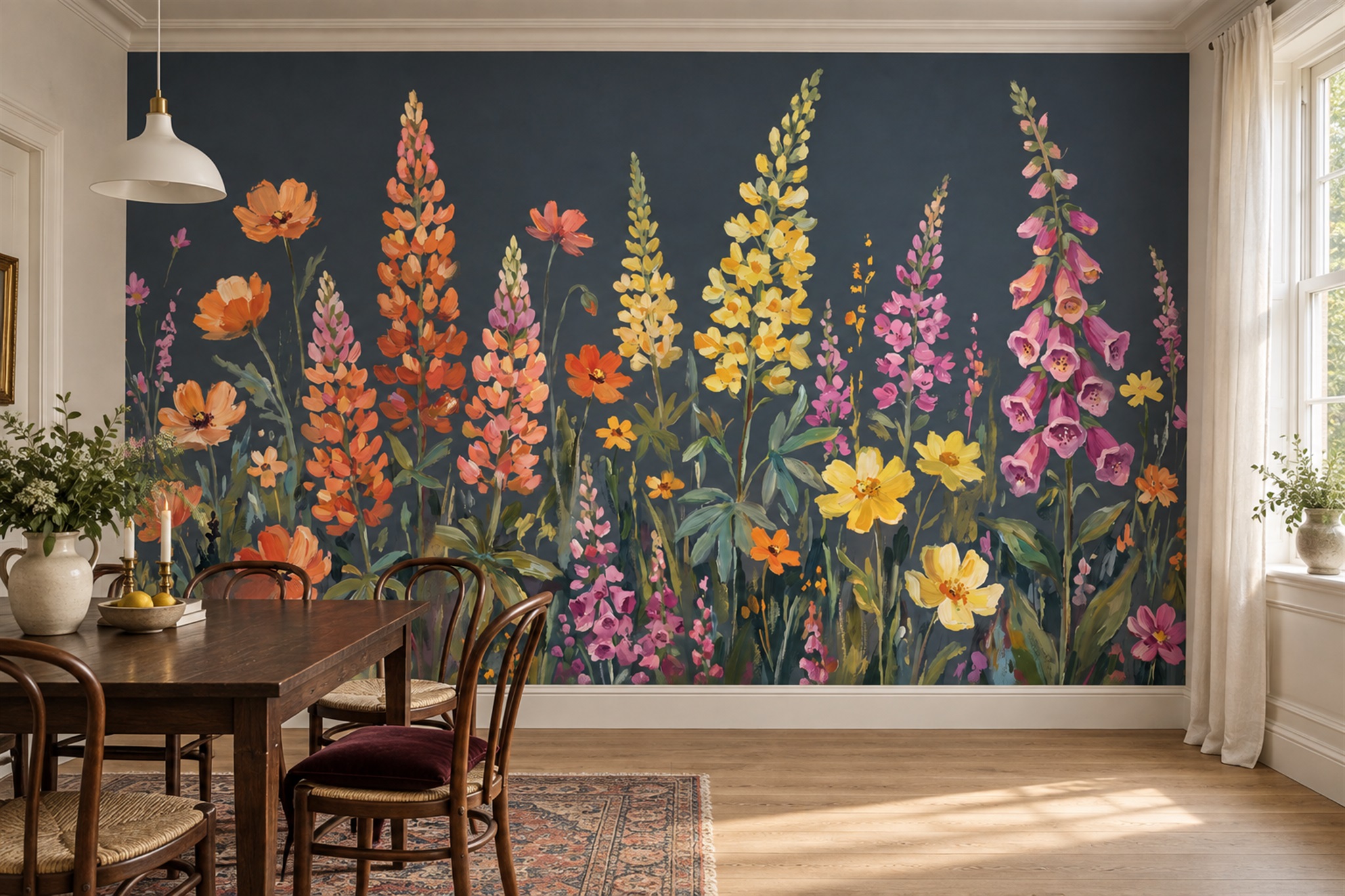
The dining-room view below gives furniture a more concrete role. Tall orange, pink and yellow flower stalks rise well above the table and chairs, so the important shapes remain visible from across the room. The dark ground provides space between stems. If that artwork were reduced until the flower heads became tiny, its vertical rhythm would weaken; if enlarged too far, individual stalks might be cut off at the ceiling or sides. The decision is about the visible field after furnishing, not the bare wall dimensions.
Balance focal points with breathing room
Scale is not simply a number. A large tree surrounded by pale sky can feel calmer than a smaller but densely repeated pattern. Look for negative space around focal points and near the edges where the mural meets adjoining walls. If the design is busy from corner to corner, a modest increase in size may intensify the room rather than clarify the artwork. Conversely, reducing a scenic design too far can turn individual trees or buildings into barely legible specks.
Think about the wall's job. Behind a dining table, large forms can frame the seating area, provided they are not visually sliced by a pendant or shelving. In a bedroom, a scene with a quiet central area may work better behind a tall headboard than a composition whose subject sits precisely at mattress level. In a study, moderate detail can offer interest without competing with screens and books. These are starting points, not room-based rules.
Read the motif at the visible wall edges
After judging the centre, cover the middle of the preview and look only at the left and right thirds. An enlarged leaf may turn into two unrelated fragments at the corners; a smaller arrangement might leave recognisable stems on both sides. A landscape can lose the distant opening that made its scale feel expansive, even when the central mountain still looks attractive. Decide whether those fragments are intentional framing or evidence that the motif is too large for this wall.
Repeat the check with the door and window shapes drawn over the visible image. If a tree trunk appears only as a thin strip beside a door, repositioning the artwork may be enough; if every larger-scale version breaks the subject at both edges, compare a smaller scale or a different composition. This is a visual test of the finished wall, separate from production panel positions and installation trim. Ask for those technical details only after you have chosen a version whose visible forms make sense.
Compare versions using the same four checks
Compare two or three crops at identical wall dimensions against the same furniture sketch. Record four observations: the approximate size of a reference motif, whether its main subject remains visible, how it reads from the doorway and normal seat, and what openings or trim might remove. This separates two commonly confused corrections. If the dining flowers disappear behind a table, shifting the crop may help; if the fern leaflets merge into an indistinct field even on an open wall, a different scale or artwork is the more relevant test.
Put the preferred version on a wall photograph at the correct proportion, then mark the reference motif's width with removable tape on the bare wall. The tape test is deliberately crude: it will not reproduce colour or detail, but it exposes whether a supposedly “modest” flower will actually span half the sofa. A material sample answers a different question—print finish, line weight and colour close up. Neither the sample nor a thumbnail replaces the full-wall crop.
Record the chosen motif size, visible crop and wall dimensions so the decision is not reduced to “the larger one” in later discussions. If the selected design requires an actual enlargement rather than a change of position, the artwork-scale change guide explains what to ask about available controls, alternative files and print detail. The design decision here is whether the motif has the right presence in the room; production feasibility must still be confirmed separately.
Pass one approved scale to production
Once a candidate passes the room test, save the actual wall dimensions, approved crop and one reference measurement together. For example, note the width of the selected monstera leaf on the finished wall, not just “large leaves”. If the fern's fine detail is the reason for choosing it, identify the section to inspect at print size; if the flower heads must clear the dining table, record their position above its top edge. Ask the supplier to confirm whether the proposed print can meet those specifics without an unsupported enlargement. A proof showing a different motif size is a new design decision, even if the wall dimensions have not changed. Approve that proof before production rather than leaving “scale” open to interpretation.