How to Compare Mural Wallpaper Prices Fairly
Compare like with like by checking dimensions, material, panel format, finish, production and delivery details.
Article focus: pricing and measurement
Budgeting this wall with confidence
Start with accurate wall measurements; the final custom mural price depends on area, material and any finishing options.
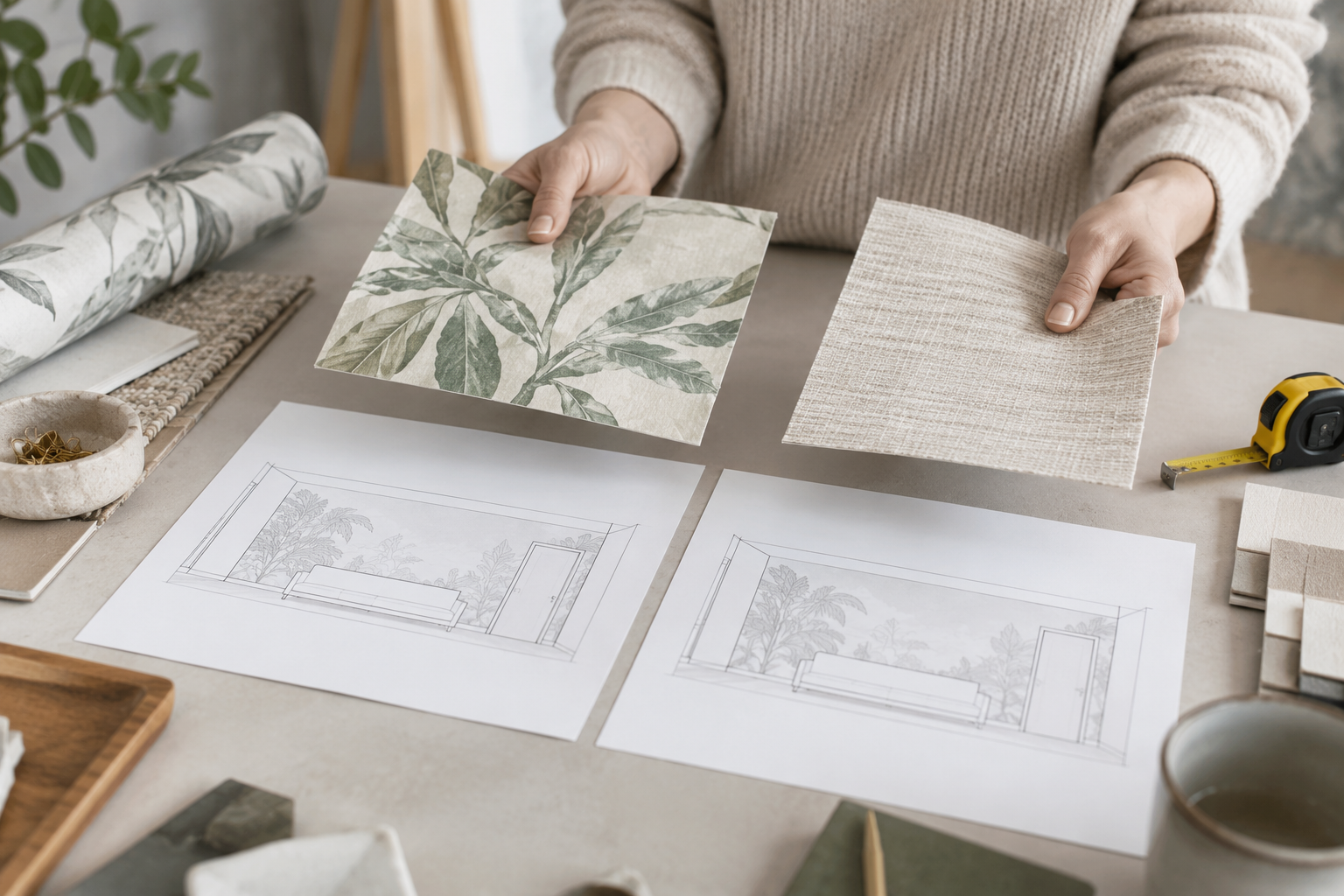
Example application: Any room with a suitable, prepared wall · pricing and measurement
To compare mural wallpaper quotes fairly, normalise them to one wall and one purchasing brief before looking at the headline rate. One seller may charge for a larger print rectangle because you add trim to the entered dimensions; another may ask for finished-wall dimensions and include that trim in production. Delivery and proofing can differ as well. A lower price per square metre can therefore produce a higher payable total. The exercise is to expose each assumption, not to declare one supplier cheaper from a thumbnail.
Normalise two quotes for the same wall
Take a hypothetical 3.2-by-2.4-metre wall. Seller A asks you to add 10 centimetres to each overall dimension, then charges £24 per ordered square metre. Its priced rectangle is 3.3 by 2.5 metres, or 8.25 square metres, making the print £198. Seller B asks for the finished-wall dimensions, says it produces the same 3.3-by-2.5-metre printed rectangle with trim included, and charges £27 per measured square metre. Its billed area is 7.68 square metres and its print is £207.36. These invented rates illustrate arithmetic, not current offers or a recommendation.
The first headline rate looks lower, and A's print charge is £9.36 lower. Now suppose A charges £15 delivery to the same address while B includes standard delivery. The payable figures become £213 and £207.36 respectively, before any other applicable charge. B is cheaper in this illustration by £5.64 only if the material, actual printed coverage and included services are genuinely comparable. If B's promised allowance or finish differs, obtain clarification instead of treating the numbers as equivalent.
Start every real comparison with one measurement sheet. Record how each supplier converts that wall into print dimensions, then whether it prices square metres, square feet, a fixed panel set or a whole-wall custom job. Convert units only after those rules are clear. A displayed “from” price may describe a much smaller wall. Save the configured quote after entering dimensions, material and delivery address, not just the initial product-card figure.
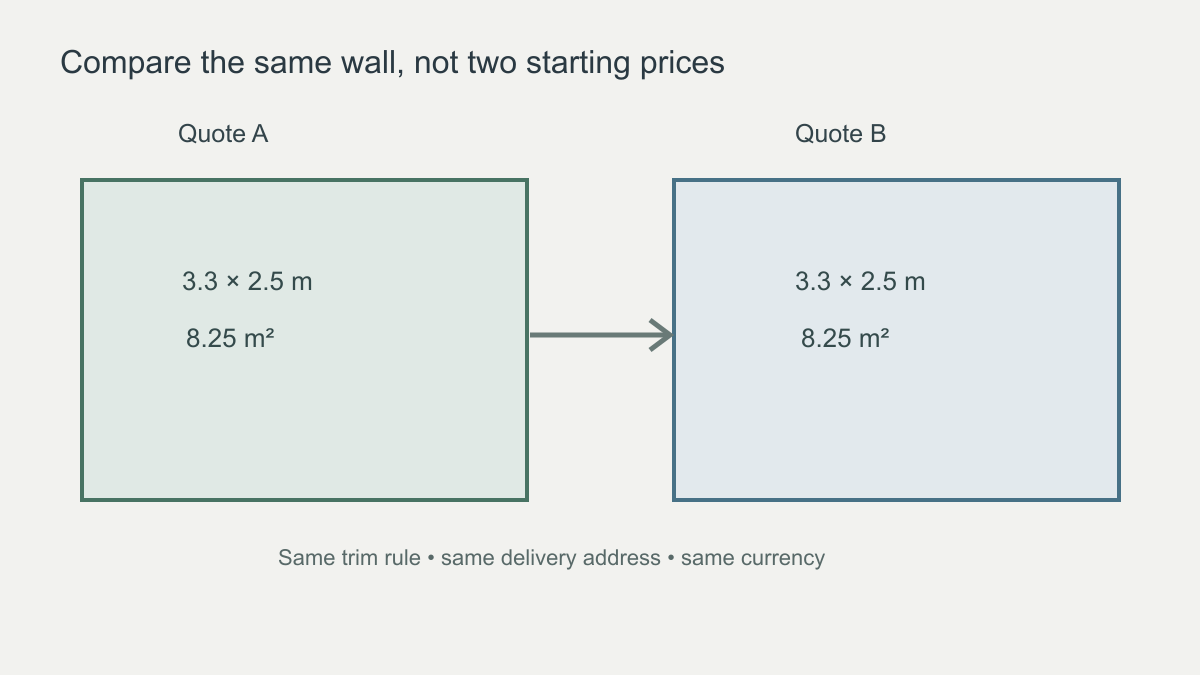 Both examples produce the same 3.3 by 2.5 metre print; the sellers bill on different areas.
Match materials by specification, not a broad label
“Vinyl”, “non-woven” and “peel-and-stick” describe broad product families, not identical specifications. Ask each seller for the actual construction, finish, application method and care instructions for the offered material. Compare matte with matte where appearance matters, and confirm whether a quoted self-adhesive product suits your prepared wall. Do not infer durability, removability, fire classification or washability from the material name alone.
Order samples if colour and texture affect the decision. Examine them on the intended wall under morning and evening light, not just beside a computer monitor. A lower price is not a bargain if the finish is visibly unsuitable for the room. Likewise, paying more for a claimed property is not justified unless the specific product documentation supports it. Keep the sample charge in the comparison, including any stated credit toward a purchase.
When samples arrive, label them with the quoted product and finish. A print sample on one material cannot verify the texture, sheen or opacity of another. Place each sample over the actual wall colour, since a pale design may read differently over a dark or uneven background. Ask whether the sample reflects the final printing process and scale; a tiny swatch can show colour and feel, but not necessarily the size of leaves or buildings across a full wall. These distinctions matter more than a few pounds in the example quote.
Compare the printed artwork and service scope
Ask whether both quotes include a scaled crop preview or proof, especially when the motif must fit around a bed, window or door. Confirm how many panels will be printed, the panel sequence, and whether the artwork can be repositioned before production. Some sellers may charge separately for design editing or additional proof rounds. If one quote includes an approved proof and the other does not, the difference is a service difference, not merely a pricing difference.
Check what happens if you discover a measurement error after approval or a printing defect on delivery. Read the seller's current custom-product terms and the applicable consumer rules for your location; do not assume a standard return policy applies to made-to-measure print. The important comparison is clarity of process and available remedy, not an unsupported promise that every outcome is guaranteed.
Send the same design brief to both suppliers: the measured wall, final trim expectation, locations of doors or sockets, preferred artwork position and desired material characteristics. Ask when a crop becomes final, whether one revision is included and what happens if the approved image cannot be printed sharply at the requested size. If one seller offers only an automated preview and another checks a proof with you, note that as a service difference. It may matter more on a mural with a face or horizon than on a diffuse texture.
Get to the delivered, wall-ready number
Include shipping to the same address, taxes, any import duties and currency conversion. A quote in another currency can move before payment and your card provider may add a fee. Check whether a rush service changes manufacturing time, delivery time or both. Compare the promised delivery estimate against the installation date, but avoid treating an estimate as a guarantee. The US Federal Trade Commission's online-shopping advice likewise recommends checking total cost, including shipping and other fees, when comparing sellers.
Separate wallpaper supply from installation. If both sellers supply only the mural, obtain a comparable installer quote or list the same DIY materials for both. One product might require a different adhesive or primer; one wall may need extra preparation regardless of supplier. The Wallcoverings Association's surface-preparation guidance shows why an otherwise fair product comparison can fail if the wall condition is omitted.
Ask each seller what happens between payment and dispatch. One may let you reposition a crop before production; another may print the submitted preview immediately. A quoted lead time may begin at payment, artwork approval or completion of a separate design stage. Note the trigger and the date the quote remains valid. A cheaper print that cannot be approved in time for an installer booking may carry an extra project cost, even when its delivery charge looks favourable.
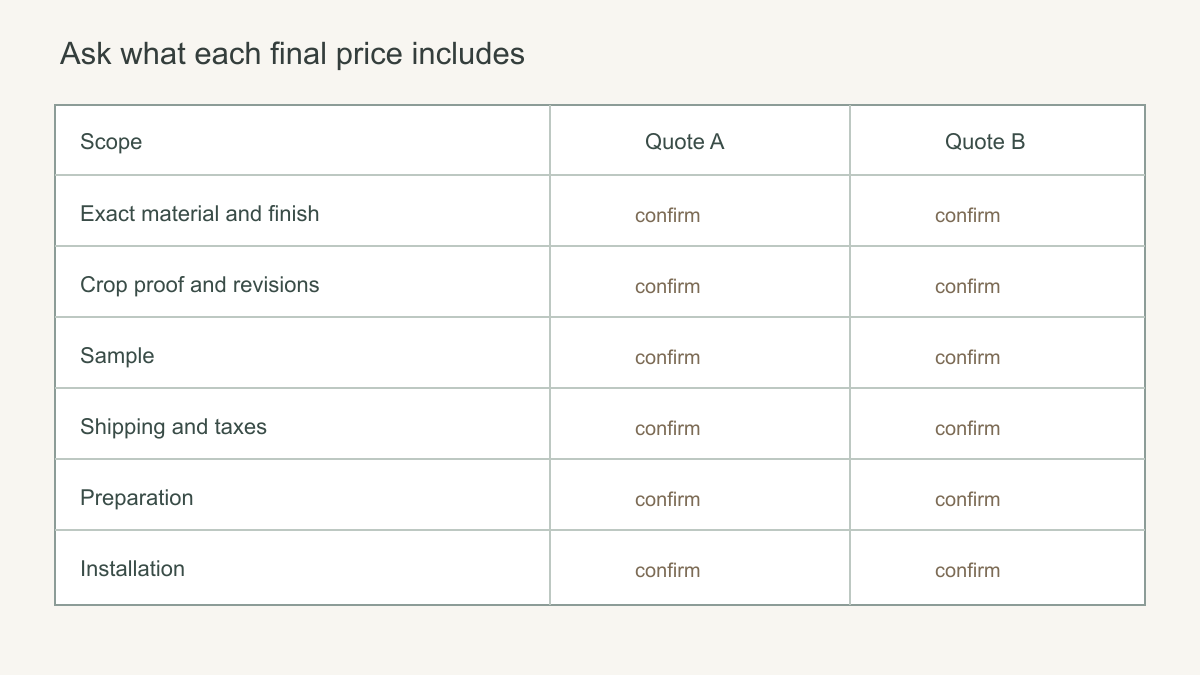 A visible “unknown” is more honest than assuming an unlisted service is included.
Use cost per finished wall with care
When the full payable totals are available, compare what it will cost to complete the same wall with each supplier. Keep the wallpaper, delivery and any necessary preparation or installation charges visible as separate lines. Delivered cost per ordered square metre can help check the arithmetic if the products are genuinely comparable, but it cannot tell you whether the composition, finish or service suits the room.
In the hypothetical example, both sellers provide an 8.25-square-metre printed rectangle. Dividing their delivered totals by that common printed area gives about £25.82 for A and £25.13 for B. B's advertised £27 rate uses the smaller measured-wall area as its billing basis, so it must not be compared directly with A's £24 rate. This calculation reverses the headline ranking only under the stated assumptions. An additional charge for artwork changes could reverse it again; keep unknown proofing, tax and installation costs visible beside the calculation.
A large, continuous mural may have a different panel layout from a repeating wallpaper even at the same area. A repeat pattern may require matching or wastage that a simple area calculation hides. Ask how the seller has accounted for it rather than assuming every roll or panel yields its full nominal area. The Wallcoverings Association's hanging guidance stresses planning around focal areas and seams, both of which affect the finished appearance but may be invisible on the quote.
Minimum order sizes and rounding rules can also overturn a straight area calculation. One seller may round each dimension up to the next increment; another may charge a fixed minimum for a small wall. Ask for the final configured total rather than applying a headline rate to your own measurements and assuming checkout will match it. If a design must be stretched or heavily cropped to fit, the technical or visual compromise should be discussed before deciding whether its lower quote is worth accepting.
A fair side-by-side check
- Same physical wall, measurements and agreed trim.
- Same level of material detail and the finish actually quoted.
- Clear treatment of samples, proofing and any design revisions.
- Final delivered price in one currency, including known tax and duties.
- Separate but comparable surface preparation and installation costs.
- Current production, shipping and custom-order terms checked before payment.
If the quotes still differ, ask each seller to identify the cause. Sometimes the answer is a better-suited material or a more complete service; sometimes it is simply a different pricing model. Reject a comparison only when it cannot be brought onto a common basis. The goal is not to make every mural identical, but to avoid choosing on a headline price that belongs to a different product or a different wall.