How to Coordinate Mural Wallpaper with Curtains
Compare colour, pattern scale, fabric weight, window position and the amount of visual movement in the room.
Article focus: pricing and measurement
The cost and measurement decision
Start with accurate wall measurements; the final custom mural price depends on area, material and any finishing options.
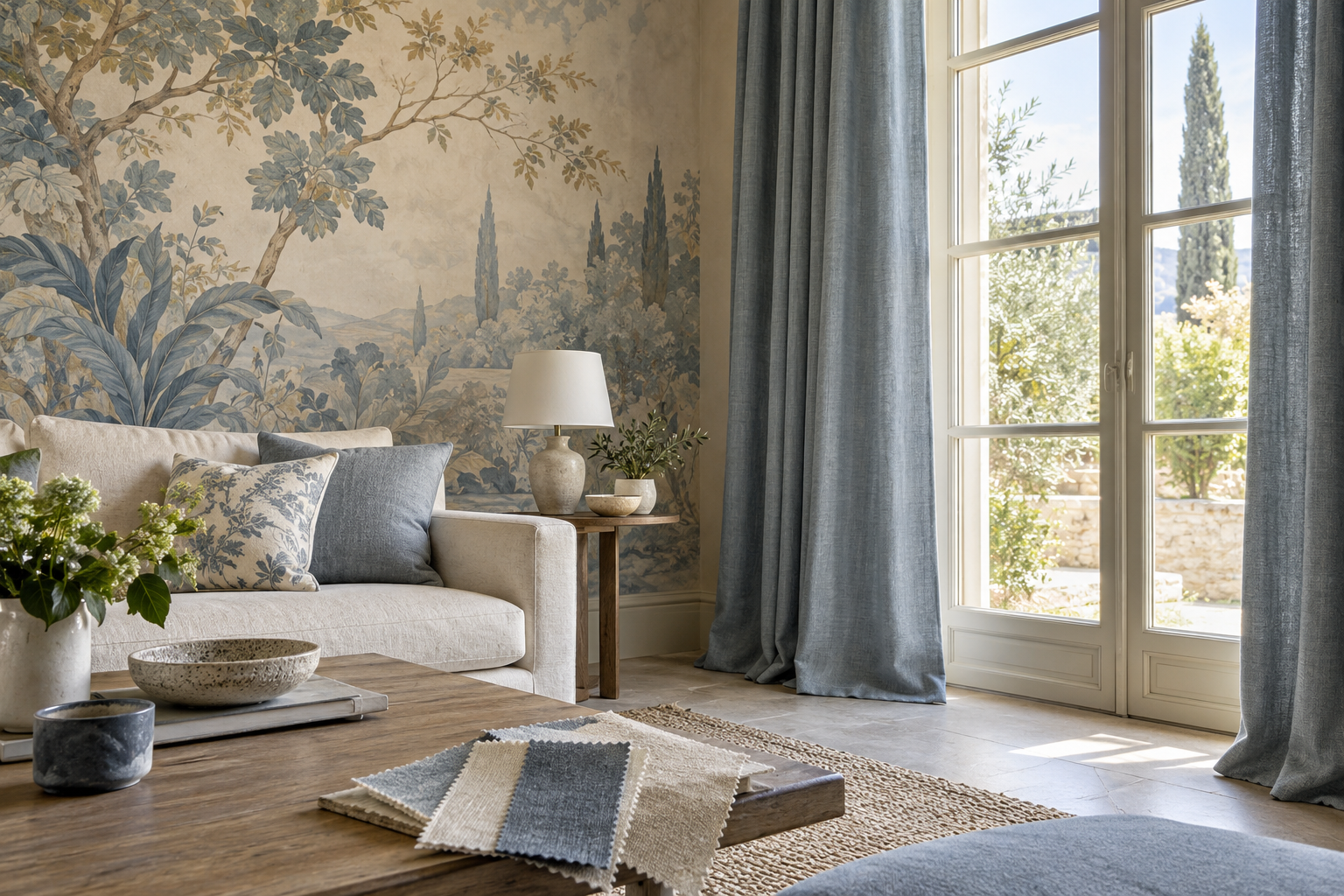
Example application: Bedroom · pricing and measurement
Coordinate a mural with curtains by deciding what the fabric must do, where it will sit when open and how much colour or pattern each surface should carry. A plain curtain can frame a detailed landscape; a mural with broad open forms can support a more patterned fabric. Choose one colour connection rather than forcing an exact match. Then judge the pairing both with the curtains gathered and fully closed, because the visible amount of fabric changes dramatically.
Start with the curtain's practical job
Before selecting a colour, decide how much privacy, light control or darkness the window needs. A sheer chosen only because it looks delicate beside a mural may not serve a bedroom at night. A lined curtain can read as a substantial opaque panel when closed, even if its small unlined sample looked light and airy. Confirm the intended heading, lining and finished dimensions with the curtain maker before treating the swatch as the final visual effect.
Draw the window and curtain track on a simple wall elevation. Mark the fabric's full width when closed and its stack-back when gathered. A curtain may occupy only a narrow strip of wall in a daytime photograph but cover a large colour field after sunset. These two states must both work with the mural. A wall crop approved without the real stack-back can lose its focal flower or horizon behind folds.
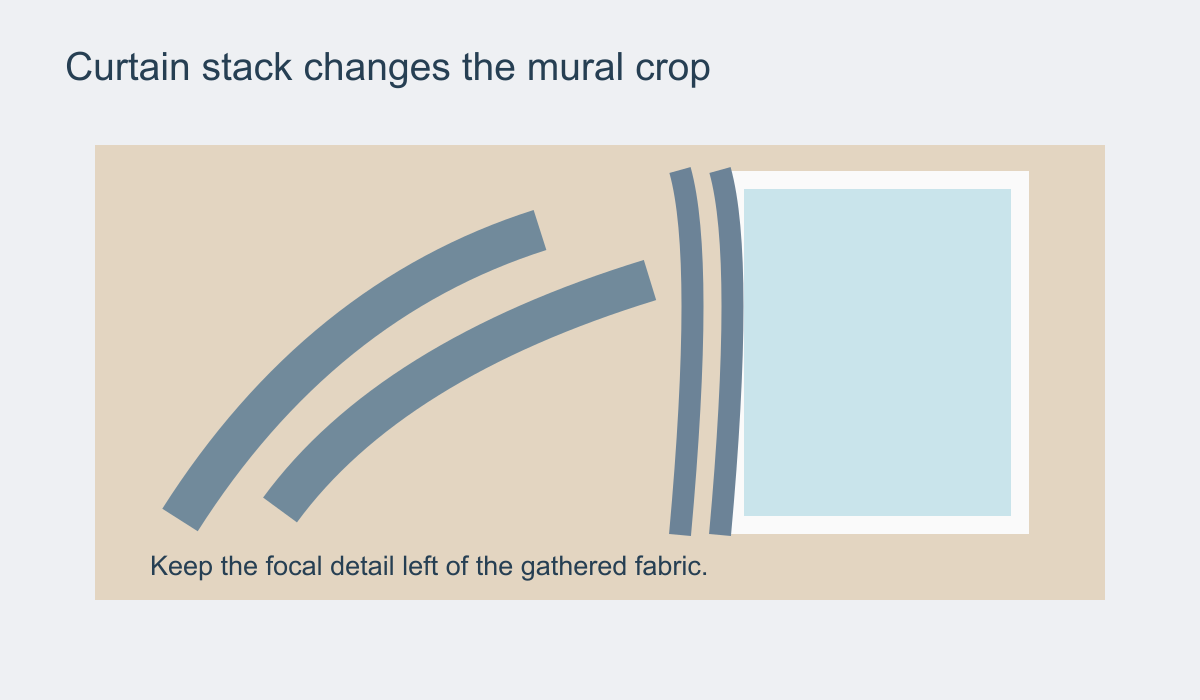 Reserve space for the fabric when it gathers beside the window.
Choose one colour relationship, not a perfect copy
Look for a secondary colour in the artwork's ground, foliage or distant scenery. Using it in a plain curtain can connect the two surfaces while leaving the mural's dominant colour to lead. In the accompanying room photograph, dusty blue curtains relate to blue-grey leaves and distant trees; they do not reproduce the illustrated branches. The curtain becomes a vertical frame while the wall carries the fine drawing.
A contrast can also work if another element in the room supports it. Deep terracotta curtains beside a quiet cream mural may feel deliberate when a chair or ceramic piece repeats that warmth. But avoid collecting every colour from the picture across the window, sofa and rug. The room needs a hierarchy, not a complete inventory of the print.
Compare real samples on the intended wall. Two surfaces both sold as cream can have different undertones, and dyed fabric and printed wallcovering rarely read as identical materials. Slight variation can look layered; an almost-match intended as exact may look accidental. Graham & Brown's sample guidance notes that light and surrounding furnishings affect appearance, and that an unlined fabric sample may look different once made up. Use that principle with the actual mural and curtain products being ordered.
Let one pattern take the lead
A wall full of small leaves, birds or architectural marks already supplies detail. Curtains in a solid colour, a visible weave or a very subtle stripe can add depth without making a second illustrated scene. A sparse abstract mural with broad shapes may have enough visual space for patterned curtains. The question is not whether two patterns are forbidden; it is whether they compete at the same scale and contrast.
View the combination from across the room and close to the window. A narrow stripe may vanish from the sofa but become noticeable beside the glass. Two equally large floral motifs can make the window and wall feel like rivals, especially when the curtains close across the whole opening. If the pairing looks crowded, change one variable at a time: reduce the curtain's contrast, reduce its pattern scale or use a quieter mural crop.
Fabric texture is useful even without a printed pattern. A plain linen-like weave or soft pile can contrast with a painterly image while keeping the artwork legible. Do not assume the wallpaper itself has physical brushstrokes or textile texture because the printed design resembles them; check the specified finish.
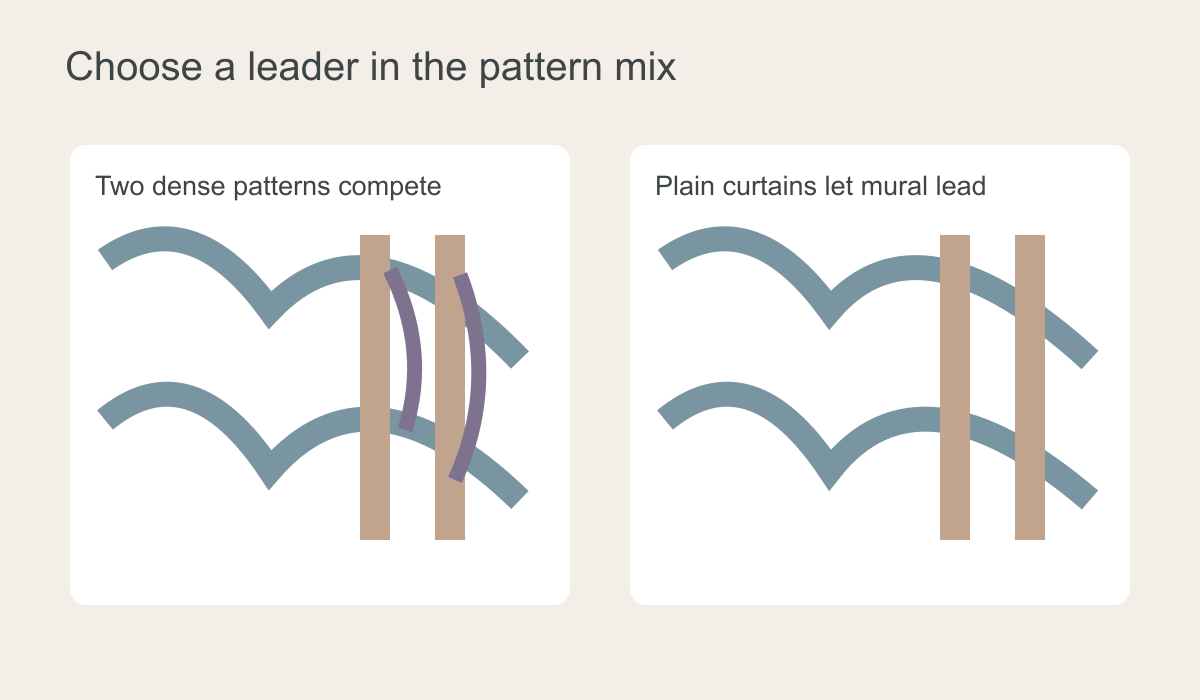 Give the most detailed surface the leading role.
Test daylight and the fully closed view
Hold the mural and fabric samples beside the window in morning light, at dusk and under the lamps normally used in the room. A translucent cloth can glow and look warmer when backlit; a heavier lined curtain may become a flatter block of colour when shut. Photograph both arrangements from the usual seat with the floor and major furniture included.
If the closed curtain overwhelms the mural, a quieter fabric colour may help. If the open stack obscures the mural's only focal detail, adjust the wall crop or track position before ordering rather than hoping the fabric will stay closed. Hardware also adds a line: a dark rod and prominent finials can become part of the composition, while a discreet track places more emphasis on fabric and artwork.
Do not choose a window treatment on appearance alone. Privacy, glare and sleep requirements may determine whether sheers, blinds or lining are needed. Once that functional specification is set, judge the final made-up curtain against the mural rather than judging only a small unlined piece.
If the curtains already exist, design around their strongest feature
Leave existing curtains hanging in their normal folds while reviewing mural samples. Notice where their detail sits: a patterned hem concentrates interest low, while a bold vertical stripe is present from ceiling to floor. Place the mural's focal area so it does not compete in the same zone. A broad landscape may sit beside a strong stripe more comfortably than another set of narrow vertical forms.
Check that the mural remains coherent if the curtains are later replaced. Cropping a single subject into an awkward corner solely to avoid today's fabric stack can leave an unbalanced wall when the window treatment changes. A composition with a quiet edge or several distributed points of interest is easier to live with through that change.
If both are new, finalise the window plan first
Agree the track height, stack-back, hem length, lining and expected fold depth with the curtain maker. Put those finished measurements on the mural proof, then position the artwork's key forms in the wall area that stays visible. A large motif on patterned fabric may partly disappear in pleats, so ask to see a larger made-up section or a comparable heading rather than relying on a flat swatch.
Three pairings illustrate the method: a detailed floral scene with plain curtains in its background colour; a minimal landscape with a smaller-scale fabric pattern; or a strong geometric mural with a mid-tone solid curtain that avoids doubling the highest contrast. These are starting arrangements, not rules. Physical samples and the two real curtain positions decide which version works in the room.
The clearest coordination is usually an agreed division of labour: the curtain handles the window's practical needs and contributes colour or texture, while the mural provides the room's visual story. Measure the fabric's occupied wall space, compare finished materials in the actual light and approve the crop with both open and closed curtains shown.