How to Coordinate Mural Wallpaper with a Rug
Use shared undertones, different scales and enough negative space to connect the mural with the floor covering.
Article focus: installation and removal
Planning the work and the exit
The right installation method depends on the chosen material and wall condition, so prepare the wall before ordering and follow the material-specific instructions.
Example application: Any room with a suitable, prepared wall · installation and removal
A mural and a rug occupy different planes, but they are seen together every time you enter the room. The useful question is not whether their colours match exactly. It is which surface gets attention first, how much of the rug remains visible once furniture is in place, and whether the two patterns speak at different scales. Start with those three decisions before choosing cushions or accessories to reconcile a pairing that was never quite right.
Decide whether the wall or the floor leads
Look at the room from the doorway. A panoramic landscape covering the wall behind a sofa will usually command attention before a rug tucked under the seating. In that arrangement, the rug can still have a pattern, but a restrained contrast or smaller repeat keeps the landscape legible. If you already own a strongly patterned rug and want it to be the centre of the scheme, reverse the balance: seek a mural with more open space, softer transitions or a focal area away from the busiest part of the floor.
“Quiet” does not mean plain beige. A rug with a broken stripe, faded check or tonal weave may offer enough detail to feel considered while remaining secondary. Likewise, an understated mural need not be featureless. It can carry a misty horizon or broad abstract shapes that give the room depth without competing with an intricate floor design. Judge the whole room, not two product thumbnails shown at equal size.
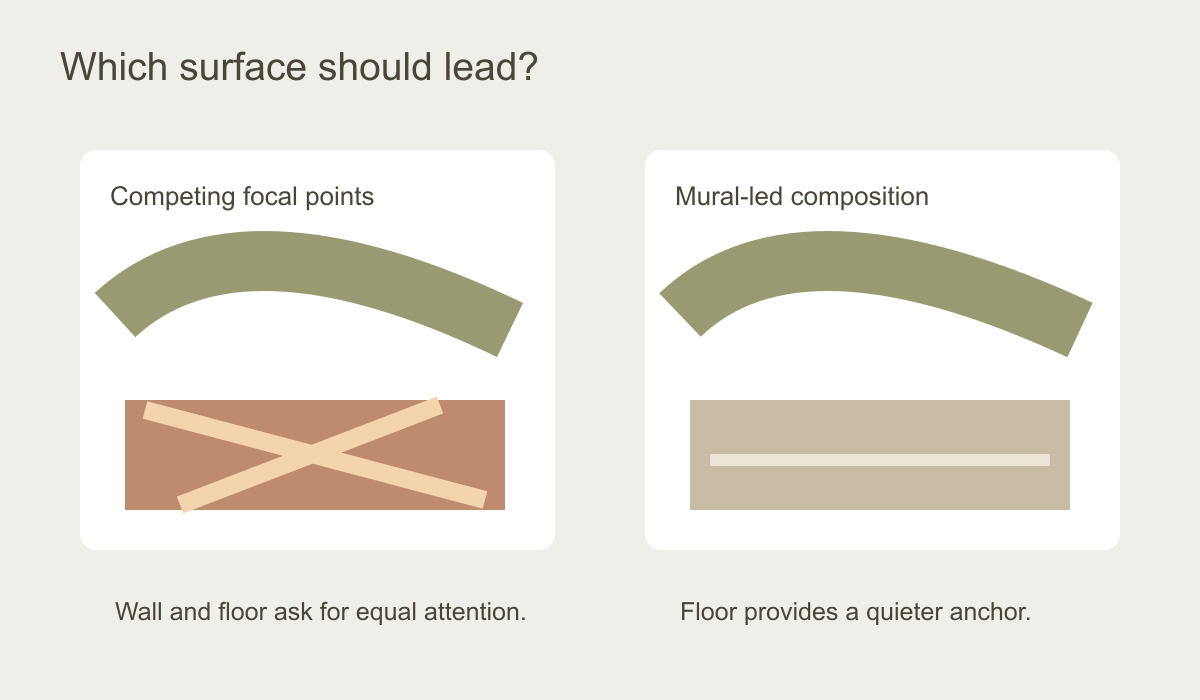 Give one surface the stronger visual role; the other can provide rhythm without matching it.
Work out which part of the rug will actually show
A rug's catalogue photograph often displays a complete rectangle. A furnished room rarely does. The sofa covers one end, the coffee table breaks up the centre, and armchairs may hide two corners. Before deciding that a rug's central medallion provides the perfect colour link to the mural, ask whether anyone will see that medallion. The exposed edge may be the only area that matters.
Mark the proposed rug size on the floor with low-tack tape, then place the furniture as it will be used. Take a photograph from the entrance and another from the principal seat. In each view, identify the visible border, the open patch between furniture pieces and the strip nearest the wall. A vivid border can dominate even when most of a rug is covered; a bold centre can become almost irrelevant beneath a table. If the floor has a character you want to retain, note how much of it the rug will conceal too.
This exercise is especially useful with an existing rug. Moving it a little farther under the sofa may hide a distracting motif without buying anything new. Moving it too far, however, can leave a narrow decorative strip rather than a useful area for the seating arrangement. Test the layout in the room rather than treating concealment as the sole goal.
Connect the colours with one shared note
Exact colour copying is unnecessary and can make the room look over-coordinated. Instead, find one note that occurs in both surfaces. An olive landscape mural might relate to a rug with a small olive thread in a predominantly warm-ivory field. A muted rust accent in the wall art could reappear only at the rug's edge. The shared colour gives the eye a route between wall and floor; the different proportions keep each surface distinct.
Compare undertones as well as named colours. Two products labelled “cream” may behave differently when one leans pink and the other looks yellow beside the floor. Digital images are unreliable for this decision. Graham & Brown's sample guidance explains why seeing wallcovering colours with the room's light and furnishings matters. Hold the mural sample vertically where it will be installed and lay the rug sample on the floor. Check them together in daylight and with the lamps you normally use.
A rug's pile or weave can also change its apparent shade when viewed from opposite ends. If you have the actual rug, turn it through 180 degrees and compare photographs from the same standing position. If you only have a small swatch, treat it as a colour and texture clue, not proof of how the full rug's border or direction will read.
Mix pattern scale rather than repeating the subject
It is tempting to pair a tree mural with a leafy rug because both are “botanical”. That can crowd the room with similar marks. A simpler stripe, uneven check or textured plain rug may give the trees a clearer backdrop. Conversely, a quiet, almost monochrome mural can leave space for an intricate vintage-style floor pattern. The relationship is in scale and contrast, not a requirement to repeat the same leaves, arches or flowers.
Look at the size of the dominant shapes from across the room. Large branches or sweeping mural forms can sit comfortably above a much finer floor rhythm. If both surfaces contain large, high-contrast shapes, they may divide attention into two competing focal points. Two small, dense patterns can merge into visual noise. You can sometimes keep both by lowering the contrast of one, but there is no need to force a pairing if another rug or mural would make the composition easier to read.
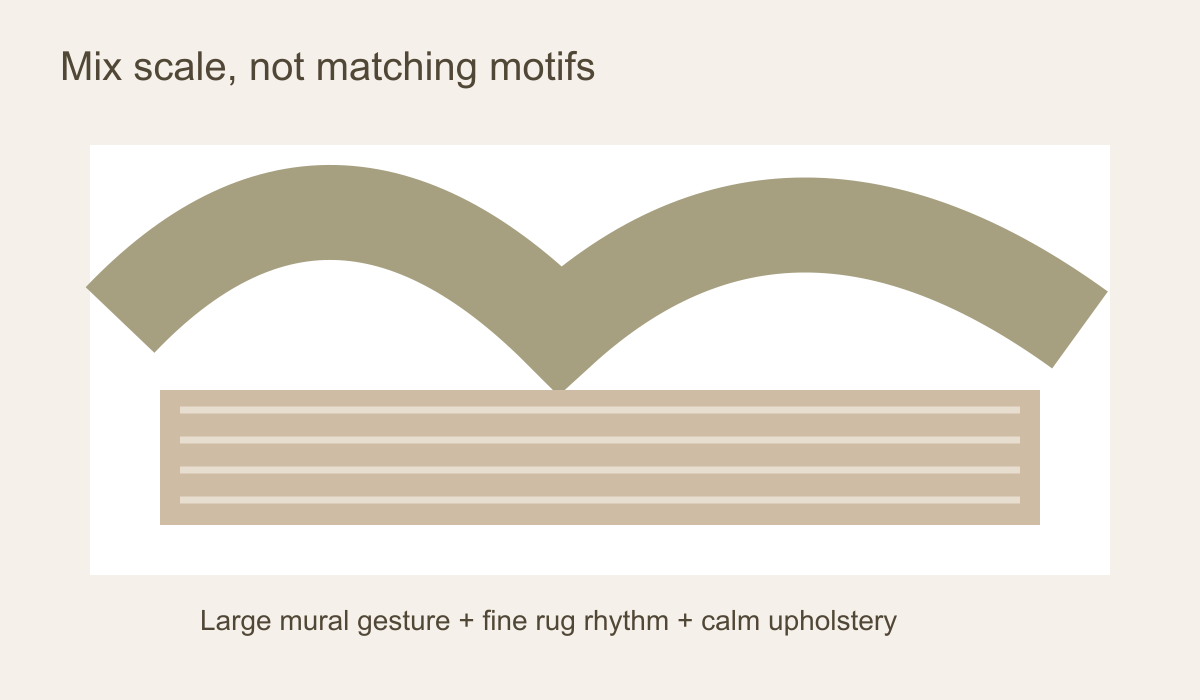 Broad wall gestures and a fine floor rhythm have distinct roles.
Do not overlook borders. A strong rectangular rug border can anchor a loose, painterly mural, which may be exactly what a large seating area needs. In a narrow room, the same dark border can feel like a frame around an already tight floor area. See the full rug in a room photograph or draw its border within your taped footprint; a swatch alone cannot answer that question.
Let furniture form the middle layer
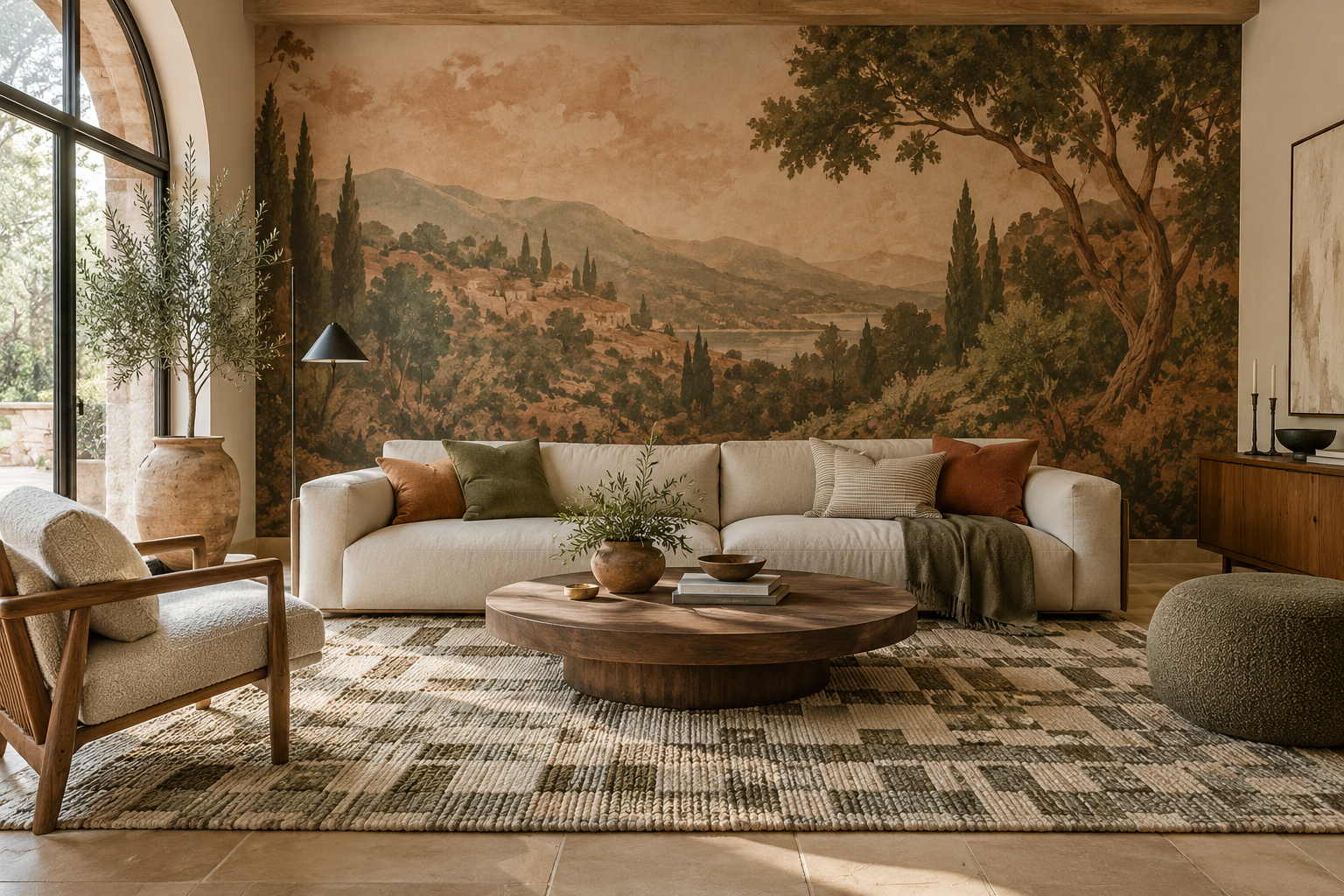
The sofa sits between wall and rug. It can give the eye a pause when both other surfaces contain pattern. In the room pictured above, a pale, mostly plain sofa separates a detailed landscape from a visible checked rug. Olive and warm brown accents connect the three layers without making the upholstery repeat the wall scene. The coffee table covers part of the check, so the rug reads as a textured base rather than a second picture.
If your sofa is patterned, take it seriously as a third surface. A floral mural, patterned upholstery and ornate rug can work in some deliberately layered rooms, but each piece needs enough difference in scale and a controlled colour range. If the combination feels restless, simplify one element rather than adding more cushions to “tie it together”. A plain throw can soften an existing sofa temporarily while you assess the wall and floor.
Also examine the meeting point at the base of the wall. When the lower mural is dark and the rug is dark, a pale sofa, visible floor margin or light skirting board can separate them. Where the mural fades to a pale tone near the floor, a deeper rug may offer useful weight. These are compositional choices, not universal rules about which colours make a room look larger.
Choose in the right order for the room you have
If the rug is already yours, begin with it. Photograph it in its intended position, then make a short note of its base colour, strongest accent, visible border and pattern scale. Shortlist murals against that real object. A wall image that looks lovely on its own may be wrong if its busiest area lands directly above the rug's most emphatic edge. Check the mural crop for your wall size before assuming the online product image represents what will be installed.
If the mural is the fixed starting point, settle its placement and focal area first. Then choose a rug by its visible footprint, not merely by a close-up of its weave. A tonal rug may be enough beneath a scene with strong depth; a more decorative rug may enrich a spare abstract wall. Check the practical role of the floor covering as well: where people walk, sit or dine will influence the size and type of rug you can reasonably use. Appearance does not tell you a rug's fibre, cleaning requirements or suitability, so confirm those details with its seller.
Make a final comparison at the two views that matter most: entering the room and sitting in it. Remove temporary cushions or styling props for this check. If the wall and floor still compete, decide which deserves the lead and reduce the other surface's contrast or complexity. If the pairing feels disconnected, look for one visible shared colour before changing the entire scheme. A mural and rug need not be twins; they need a clear relationship in the room they actually occupy.