Can You Use Any Image for Custom Mural Wallpaper?
Understand permission, ownership, licensing and image quality before supplying artwork for a custom mural.
Article focus: installation and removal
The installation choice in practice
The right installation method depends on the chosen material and wall condition, so prepare the wall before ordering and follow the material-specific instructions.
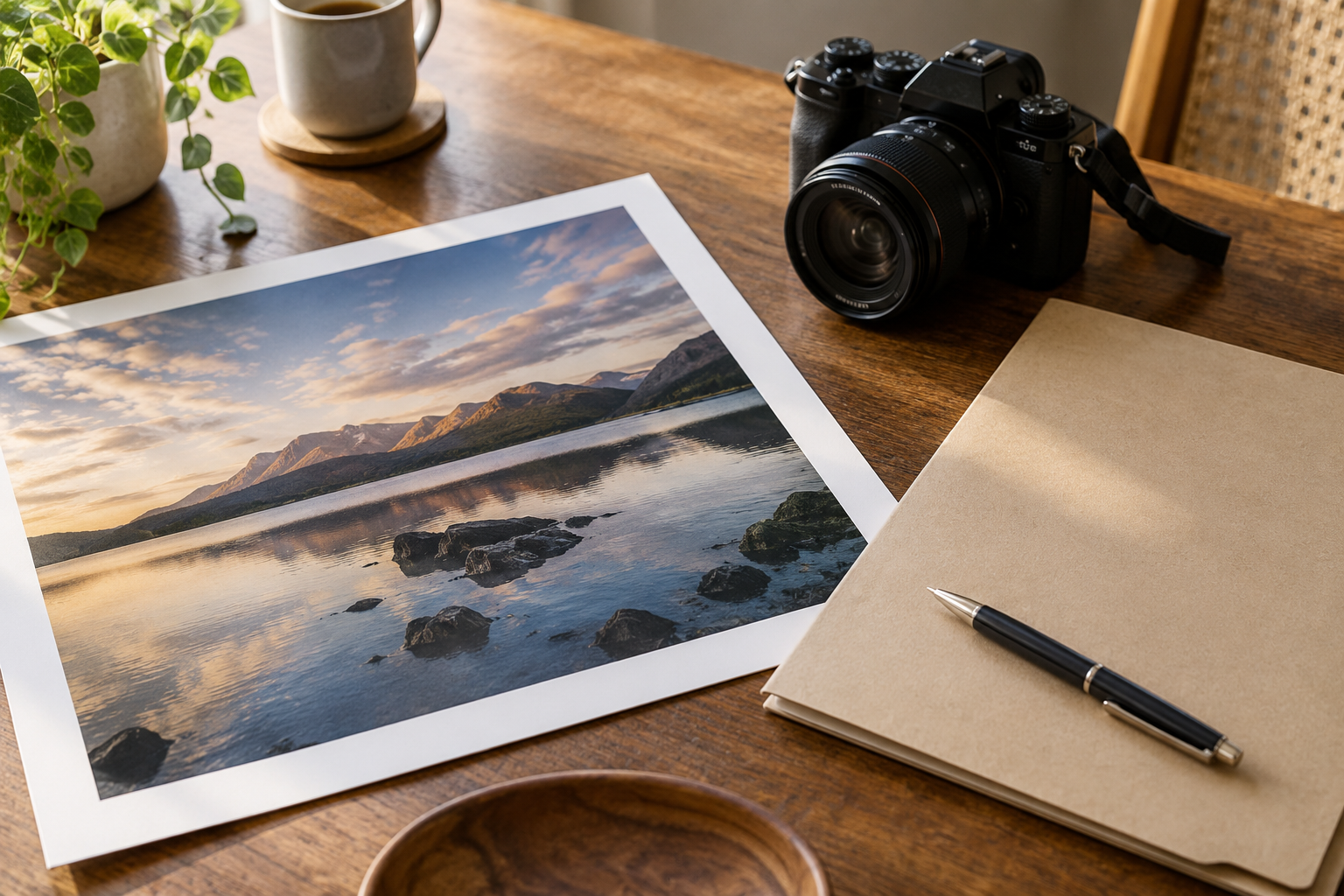
Example application: Bedroom · installation and removal
No, not every image you can upload may be used for custom mural wallpaper. Finding a picture, purchasing a small print or receiving a file from a friend does not itself establish permission to reproduce it across a wall. First identify the creator and any other rights holders; then check that your own rights or licence cover the proposed printed mural and its setting. Only after that should you invest in enlarging, cropping and colour-proofing the file. This distinction matters whether the mural is for a private bedroom or a hotel lobby.
Short answer: Use your own original work when you control the relevant rights, or obtain a licence that clearly covers physical wallcovering reproduction. Check embedded artwork, recognisable people and the intended public or private setting separately. Credit, online availability and a successful upload do not replace permission.Begin with the source, not a reverse-image download
Ask where the image came from. Was it a photograph you took, a painting you made, a licensed stock image, a family photograph taken by someone else or a screenshot from a website? The file name rarely answers that question. Save a record of the source page, creator, date and licence at the time you obtain it. Rights and terms can differ between similar-looking images on different websites. A search-engine thumbnail is a pointer to a source, not a licence to reproduce the image at wall scale.
Put each candidate image into one of three practical groups: work you created and can document; work from another creator with written terms you can read; or work whose origin or terms are uncertain. The third group is not ready for production. A reverse-image search may help locate an original publisher, but it does not establish that the publisher owns the rights or that its use conditions cover wallpaper. If an image has passed through several reposting sites, trace it back before assuming the most generous label applies.
The UK's Intellectual Property Office guidance on digital images and photographs explains that images found online are often protected and that permission may be needed from more than one rights holder when a photograph includes another protected work. The US Copyright Office's photography guidance explains that the person who takes a photo is generally its initial copyright owner, subject to exceptions. Laws vary by country, so confirm the rules relevant to where the image will be reproduced and displayed.
“I took the photo” is a strong start, not the whole check
If you photographed a landscape yourself, you may control copyright in your photograph. That is different from photographing a living artist's painting, an illustration in a book or a branded character and then assuming the underlying work is free to reproduce. The subject inside the image can have its own protection. Likewise, the fact that a friend sent you their photograph does not mean they assigned the right to print it as a wallcovering. Ask the photographer for permission covering the intended size, number of copies, installation location and any later reprints.
Consider two holiday images. In the first, you photographed an open landscape and kept the original file. In the second, your friend photographed a mural painted by another artist in a restaurant and sent you the picture. The second case raises more questions: the photographer, the depicted artwork and any restrictions at the location may need separate attention. The answer is not determined by whose phone holds the file. Where the underlying work or the image's origin is unclear, get project-specific advice before printing it.
Commissioned photography can have terms that differ from a casual snapshot. The contract may give the customer a defined right to use the pictures while the photographer retains copyright. Find the agreement, not just the invoice. If the mural is for a hotel, café or promotional setting, describe that use explicitly; a licence for a private family wall may not cover a publicly displayed or commercially associated installation. Do not assume that a previous print of the image confers unlimited reuse.
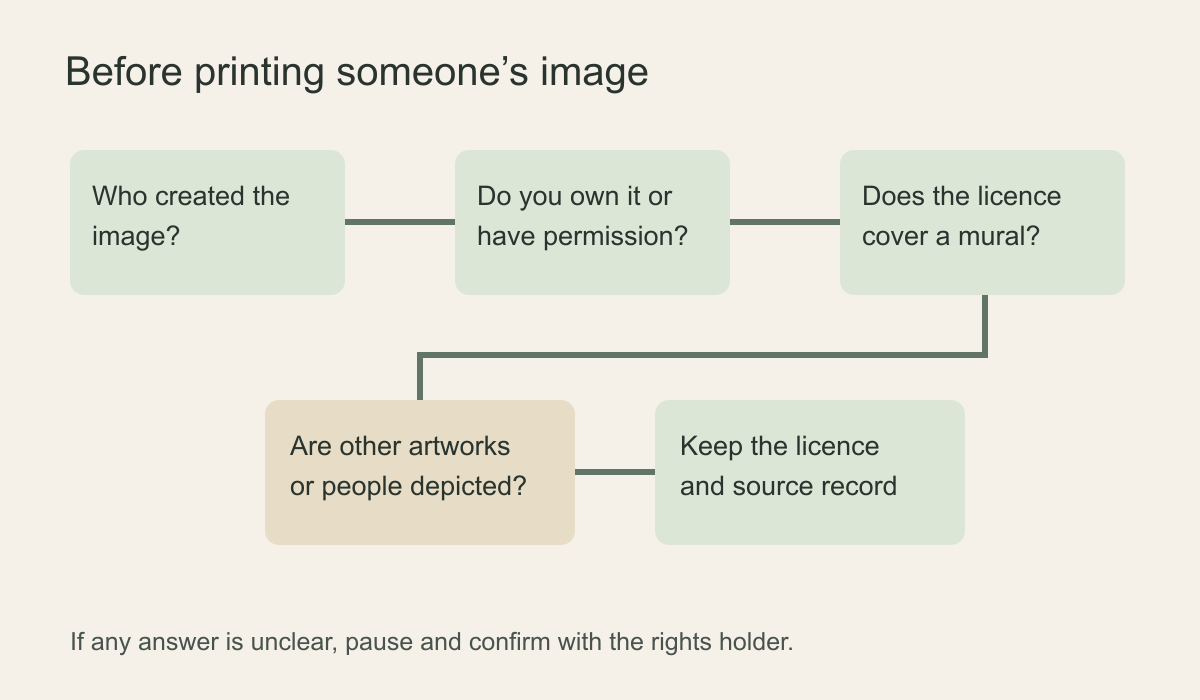
Read the licence for the intended use
Stock-photo licences can differ on physical reproduction, decorative products, redistribution, commercial use, print runs and modifications. An image described as “royalty-free” is not necessarily free of restrictions; it usually means the licence uses a particular payment structure. Read the actual terms for that image and that platform. Confirm whether a single custom wall is covered, whether the printer may handle the file, whether the work may appear in marketing photographs of the room and whether additional copies are allowed. If the terms do not address the proposed use clearly, ask the licensing provider in writing.
In particular, distinguish a file licensed for editorial publication from one licensed for decorative commercial display or a made-to-order product. Do not assume that buying an image for a website banner authorises a mural. Ask the provider whether the wallcovering will be treated as one installation, as merchandise or under another licence category. State the approximate wall dimensions, number of walls, location and any planned promotional photographs. Keep the provider's written answer with the order record.
Creative Commons licences vary too: some require attribution, some limit commercial use, and some prohibit sharing adapted versions. Whether a particular crop or finished-wall photograph falls within a restriction depends on the licence and circumstances, so read the specific licence rather than treating the CC badge as a universal permission slip. “Public domain” may be an appropriate source, but check provenance, jurisdiction and whether the underlying work as well as the file you found is free of relevant restrictions. A third-party upload marked “free” is weaker evidence than a statement from the actual rights holder.
Why credit is not a substitute for consent
Putting the artist's name in a caption, on an order form or under a photo of the finished wall may be respectful or required by a licence. It does not create permission where none exists. Similarly, a watermarked preview is not a usable production file just because the watermark can be removed technically. Cropping out a signature or logo does not change the ownership of the artwork. If you cannot identify the creator or obtain a licence, do not ask a print supplier to guess that the use is harmless.
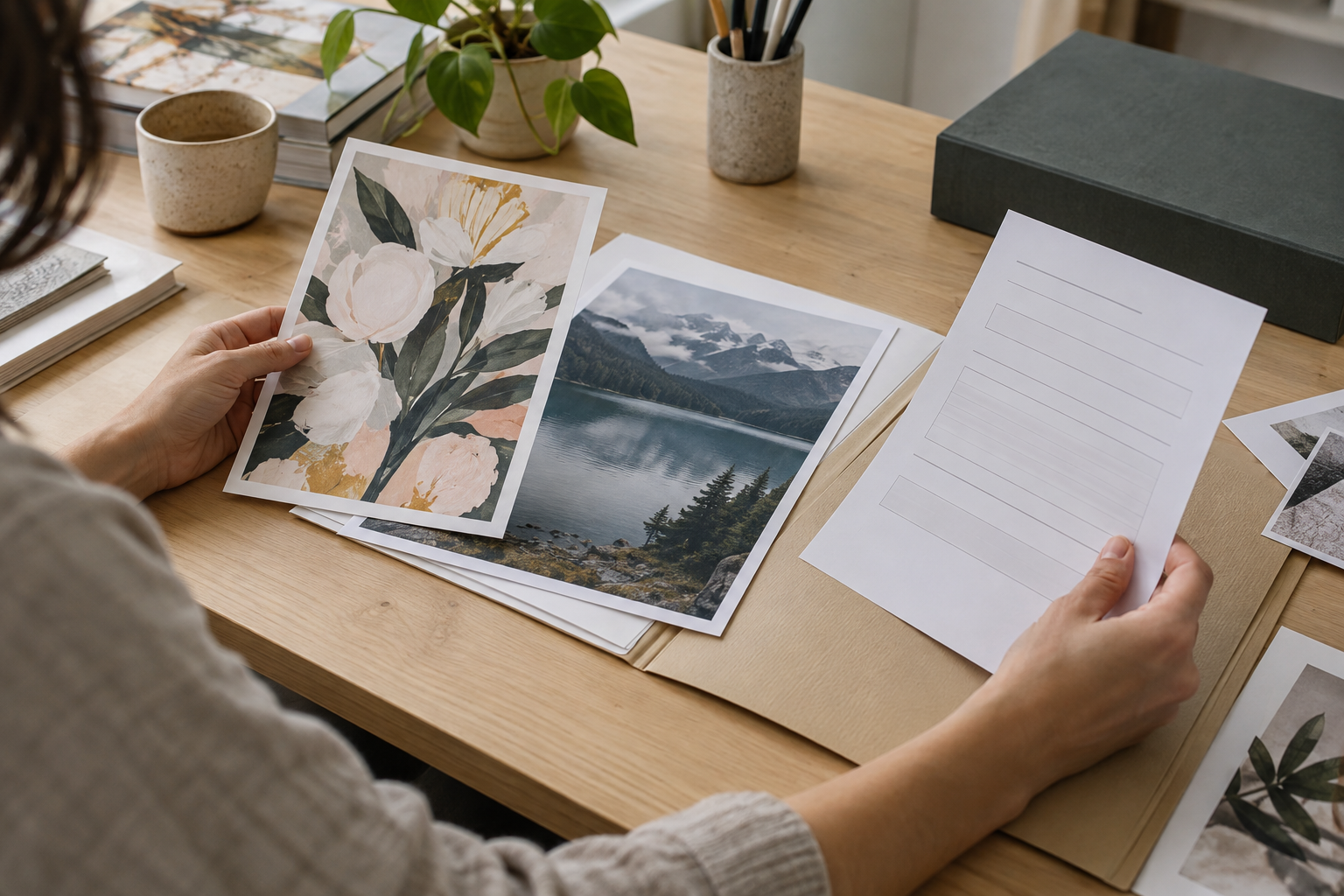
The editorial photograph below shows image prints being compared with a blank permission document. It is a reminder to connect each selected file to its source and terms; it is not a real licence, proof that either pictured image may be used, or advice that a signed form alone resolves every right. Permission attaches to the particular work and the particular use, not merely to the fact that a picture is visible online.
People, brands and sensitive locations
Copyright is not the only consideration. A recognisable person may have privacy, publicity or data-protection interests depending on the jurisdiction and how the mural will be used. Logos and characters can raise trademark or other rights questions. A photograph taken inside a museum or privately managed location may be subject to contractual photography terms. None of these issues can be resolved merely by checking the image's pixel dimensions. If the wall is in a business or will appear in promotional material, the stakes can be higher than for a private home.
A photographed painting in the background is different from a recognisable person in the foreground, and neither issue is solved by a stock-photo copyright licence alone. Ask what the image actually depicts and how prominently it will be displayed. A private family wall, a restaurant feature wall and a hotel marketing photograph create different use contexts. For uncertain cases, consult an appropriate professional in the relevant jurisdiction; do not treat this checklist as a legal clearance certificate.
For a family photograph, ask the photographer and consider the expectations of the people shown, particularly children. Avoid publishing a close-up of the finished wall online without thinking about their privacy. For a public venue, keep written releases or permissions where required and involve the relevant professional if the situation is complicated. This article is practical orientation, not legal advice for a particular jurisdiction or commission.
What to give the printer
When you upload your own image, keep the original file and documentation of your right to use it. If it is licensed, save the licence text, transaction record and any specific written approval. Share restrictions that affect cropping, colour changes, attribution or public display. Do not ask the printer to remove a visible watermark or recreate a copyrighted character. A print provider can help with technical preparation but cannot automatically verify that your permission is valid. The responsibility to establish the rights should be settled before production.
A useful permission request identifies the exact file and creator, then describes the physical wallcovering, approximate size, number of walls and installation setting. Say whether the image will be cropped, colour-adjusted or combined with other artwork, whether the printer may receive it, and whether photographs of the finished space will be published. Ask whether a damaged panel may be reprinted later under the same permission. Keep the reply with the specific image version you submit; an answer to “may I use your photo?” may not cover these materially different uses.
Make the final go/no-go decision against the actual order. A photographer's email allowing one mural in a private bedroom may answer that order, but it does not automatically cover a second print for a hotel lobby or photographs used in advertising. If the permission mentions only display and says nothing about a printer receiving the file, ask for clarification before upload. If the creator declines, the source cannot be verified or the terms remain ambiguous, choose another image or seek advice in the relevant jurisdiction. The UK government's copyright guidance is a useful starting point, not clearance for every country or image.