How to Arrange Furniture with Mural Wallpaper
Protect the focal subject, preserve circulation and use furniture height to support the composition of the wall.
Article focus: pricing and measurement
The cost and measurement decision
Start with accurate wall measurements; the final custom mural price depends on area, material and any finishing options.
Example application: Bedroom · pricing and measurement
Arrange the room for living in first, then choose a mural crop that makes sense above and around the furniture. A floor plan shows whether people can move, sit and open doors; a wall elevation shows which parts of the printed scene will remain visible. Use both. A sofa can conceal the lower forest in a mountain mural while leaving the peaks and clouds intact. A cabinet placed over the only printed doorway in an architectural scene could make that same wall incoherent.
Separate floor-space decisions from wall-image decisions
Start with a scaled floor plan of the real room. Mark doors, windows, radiators, sockets and the furniture that must remain. Give each object its complete footprint, including projections such as a shelf or lamp base. Then test what happens when the room is in use: dining chairs are pulled out, cabinet doors swing open and people pass between seating. A layout that exists only in an empty-room rendering is not a workable plan.
Next draw the mural wall as a flat elevation. Outline the sofa back, headboard, bookcase, screen or console at their actual heights and widths. Shade the areas they will hide. A floor plan cannot tell you whether a mountain peak disappears behind a television; an elevation cannot tell you whether moving that television blocks the doorway. Together they reveal both problems before the wallcovering is printed.
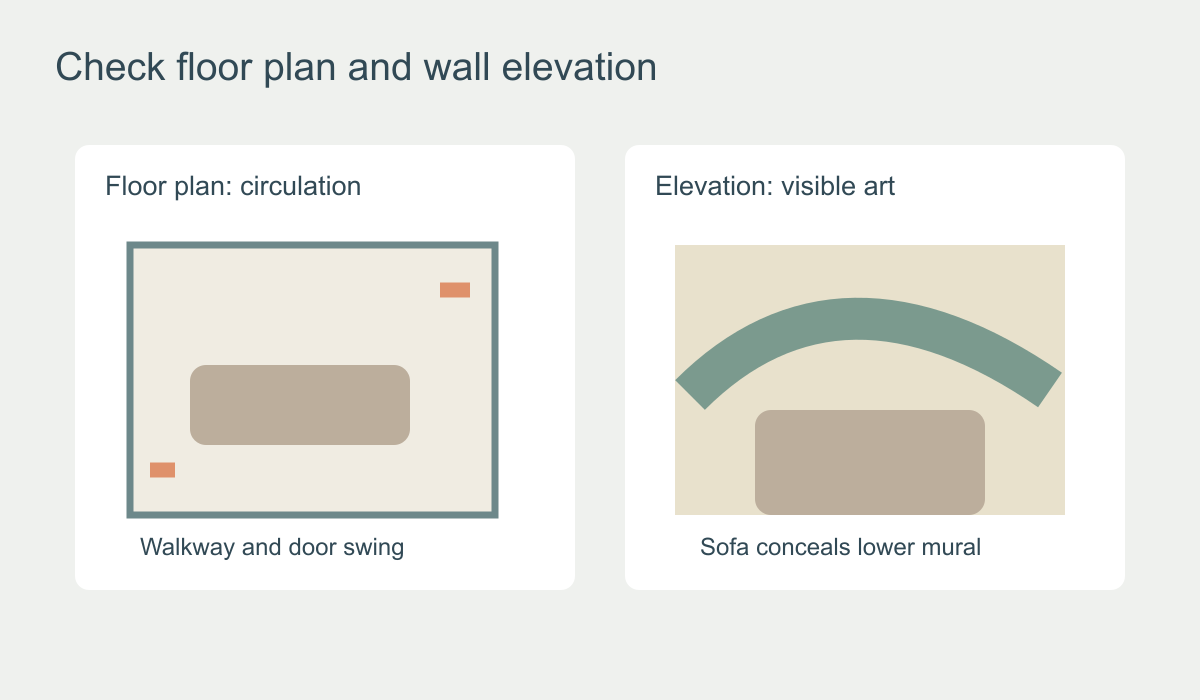 The plan checks circulation; the elevation checks how much of the mural survives.
Keep the two drawings simple enough to compare alternatives. You do not need a complex design programme. Tape on the floor, a measured sketch of the wall and a mural proof at the correct aspect ratio can expose most conflicts. Add the viewing positions that matter, because an image centred on the wall may not appear centred from the doorway or a favourite chair.
Identify what is fixed and what can move
Some pieces govern the room: built-in storage, a bed, a dining table with chair clearance or a screen that depends on power and seating distance. Others may have several acceptable positions. Mark the genuinely fixed elements first and resist moving them for a better photograph of the mural. If the only usable sofa wall hides the print's principal subject, change the crop, design or wall rather than forcing the sofa into a poor conversation layout.
Now test one or two plausible positions for flexible pieces. A floor lamp might move from the middle of a printed tree to a pale edge without reducing its usefulness. A side table might shift to expose a flower. A heavy cabinet may not move if the alternative blocks a door or cuts off access to storage. Write down the cost of each proposed move in light, circulation or daily function. This prevents a tiny visual improvement from becoming a significant practical compromise.
Future changes deserve a separate look. A sofa may eventually be replaced by a taller model; a temporary shelf may disappear. If the mural only works around one exact furniture silhouette, it may be too fragile a composition for the room. An image with useful interest across a wider upper area often accommodates more change than one focal detail perched just above today's sofa back.
Protect the visible part of the scene
Identify the mural's central subject and the details that give it meaning. For a mountain landscape, the skyline and cloud band may matter more than the dark foreground. For an illustrated doorway or animal, covering the subject may destroy the story. Overlay furniture outlines on the proposed crop and see what remains. If the subject is hidden, try moving the crop within the wall's proportions before changing furniture positions.
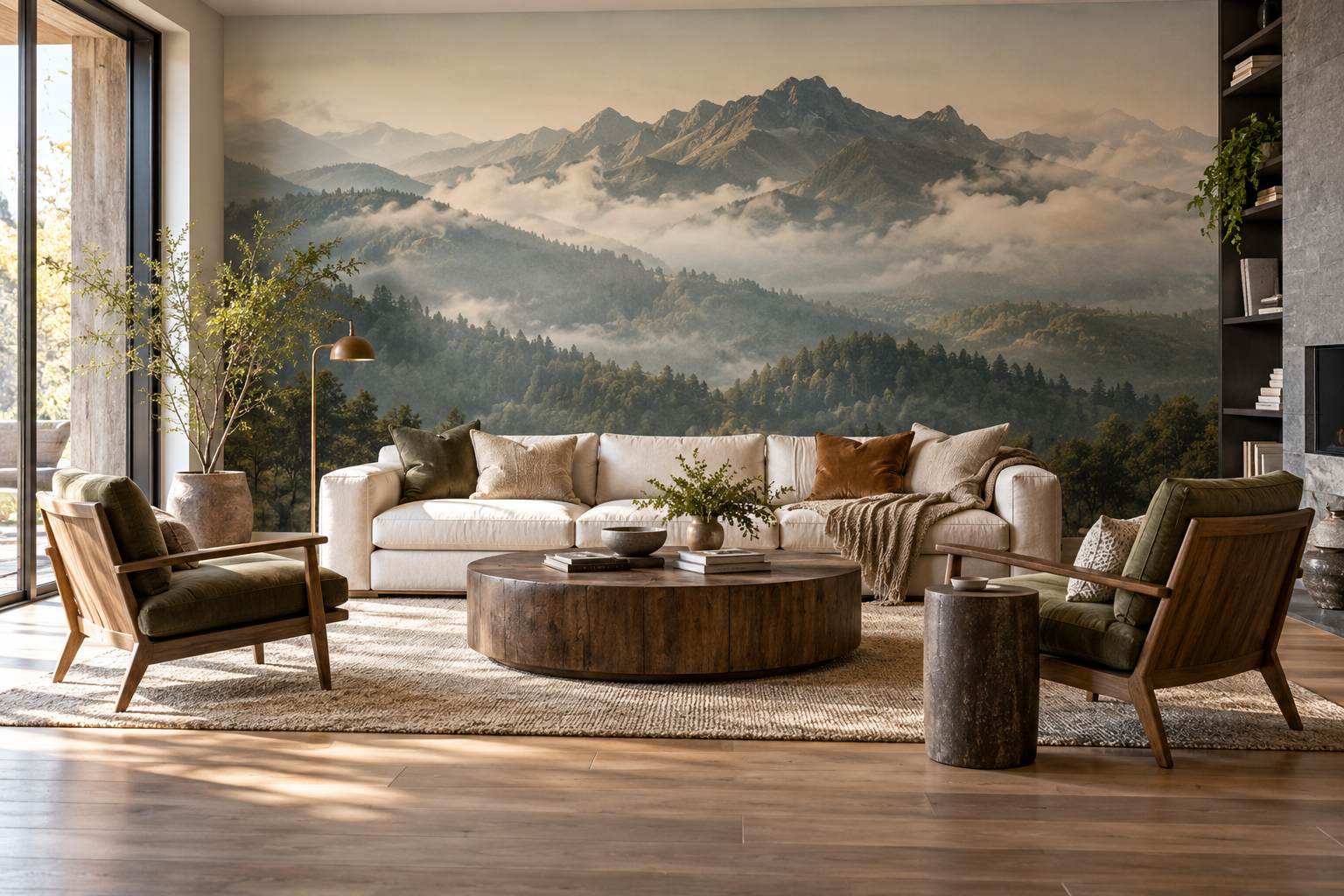
The feature room makes the distinction clear. The pale sofa covers a broad lower strip of trees, yet the peaks and clouds read above it. Tall shelving occupies an edge without crossing the main ridge. The plant and lamp form a foreground near the left side, but they do not erase the mountain. That is a purposeful overlap: the scene still reads across the seating group.
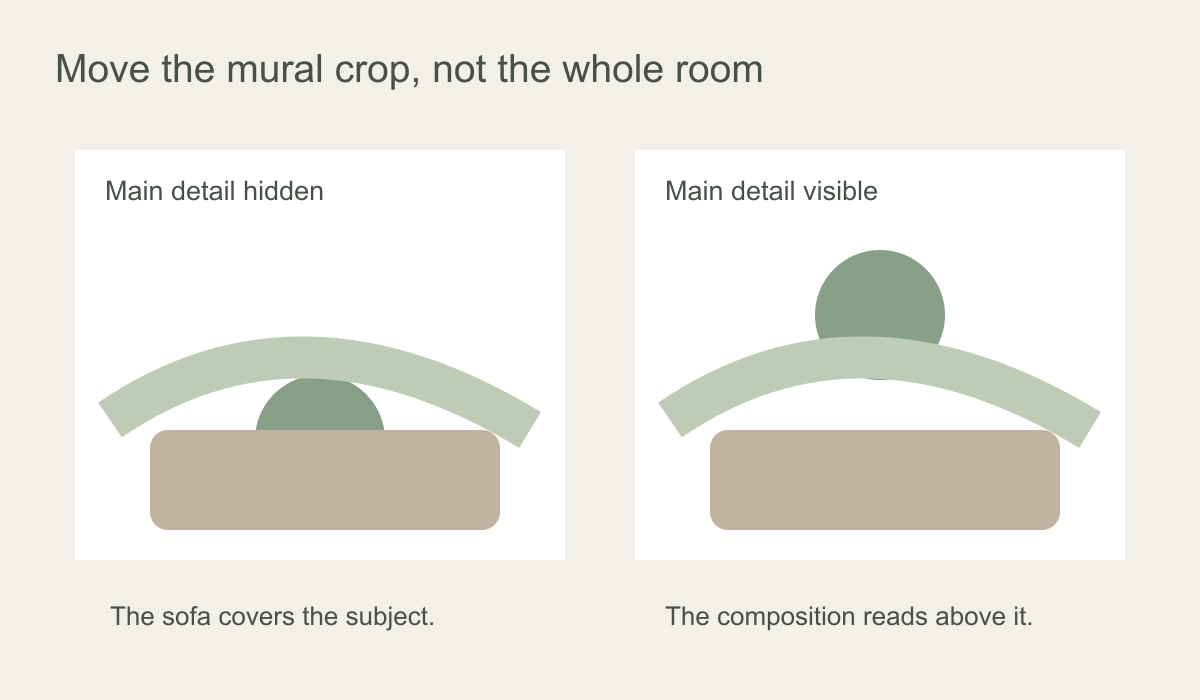 Move the crop when a fixed sofa would otherwise conceal the important detail.
Check from the doorway and from the seats, not just straight on. A tall chair back may cover a detail from one viewpoint but not another. A printed focal point close to a corner can disappear when seen obliquely. If the wall is made to measure, review a proof with the furniture outlines and wall dimensions shown together. The separate focal-point guide explains how to identify and protect the part of the artwork that must remain visible.
Keep circulation and wall contact realistic
Walk the proposed routes before ordering the mural. Can someone pass behind the armchair, open the storage doors and move a dining chair without striking the wall? Use cardboard or low-tack floor tape to represent the furniture footprint, then sit and move through the room as usual. Required clearances depend on the actual furniture and occupants; a single universal number cannot resolve every layout.
Do not push a cabinet against the printed wall solely to show more floor. Sharp edges, moving chair backs and frequently handled furniture can rub the finish. The Wallcoverings Association distinguishes abrasion resistance and washability as characteristics of particular wallcoverings, not guarantees attached to every printed mural. Follow the specification and care advice for the material you purchase. If a high-contact route is unavoidable, reconsider the wall or the furniture placement.
Maintenance matters too. A sideboard that must be dragged across the print whenever it is cleaned behind is badly planned. Leave practical access where needed and note any furniture that will be moved regularly. A composition designed around a stationary cabinet may be fine; one depending on a chair never being pulled back is not.
Let furniture frame the mural without repeating it
A simple sofa can provide a visual pause in front of a detailed landscape. Open shelving allows glimpses of a pattern but may chop a single scene into unrelated strips. A sculptural chair can create foreground depth against a soft mural, while a busy upholstery pattern may compete with it. Choose the stronger visual element deliberately rather than matching every printed colour in cushions and furnishings.
Height is particularly important. A low sofa masks one continuous band. A bookcase interrupts the image through most of its height. A floor lamp blocks only a narrow slice from one viewpoint and may be easy to relocate. A tall plant changes outline as it grows. Draw each silhouette on the elevation, not merely a rectangle representing its floor position.
Colour links can be modest. The feature room's olive chairs echo some of the landscape without reproducing it; the pale sofa separates the richly printed wall from darker timber furniture. A small material or tone connection is often enough. The furniture should support the mural's scale and leave the room comfortable rather than become a catalogue of repeated mountain colours.
Make the final choice for the room's real use
In a bedroom, the bed may be non-negotiable and the headboard will hide the lower mural. In a dining room, seated eye level, chair movement and a pendant may be the decisive constraints. A home office may have a screen or shelf that cuts across the image; a library wall may offer only narrow strips between tall bookcases. Ask what will remain visible in each room before choosing a panoramic composition.
If essential furniture cannot move and only a narrow wall band is exposed, treat that band as the actual display area. A broad abstract field or a scene with meaningful detail above the furniture may work; a landscape whose only focal point lies behind a media unit will not improve simply because the print is enlarged. Compare alternate crops and, if needed, alternate walls.
Approve the final arrangement only after the floor plan works, the wall elevation preserves the image and the seated sightlines make sense. Furniture belongs to the room's everyday life. The mural should fit that life while still offering a clear view, not demand an awkward layout for the sake of an unobstructed photograph.