Geometric or Abstract Mural Wallpaper: Which Is Right for Your Room?
Understand how geometry and abstraction change rhythm, contrast, movement and the perceived proportions of a room.
Article focus: pricing and measurement
What to settle before pricing
Start with accurate wall measurements; the final custom mural price depends on area, material and any finishing options.

Example application: Any room with a suitable, prepared wall · pricing and measurement
Geometric and abstract mural wallpaper are not opposites: a wall of arcs can be abstract art, and a painterly image can still have a strong underlying structure. For a practical choice, compare how the design behaves on your wall. Does your eye follow repeated lines and clearly bounded shapes, or travel through washes and brush marks? The answer matters most when furniture or a doorway interrupts the composition.
Ask what the room gains from visible order
Choose the geometric candidate when its readable line or bounded shape gives the room a useful structure that the furniture lacks. A long sofa may sit comfortably beneath one broad arc; a row of cabinets may gain a counter-rhythm from diagonal lines. But if the floor tile, shelving and rug already establish several grids, another equally strong one can make the wall feel crowded. Compare the same room photograph with a geometric crop and a looser abstract crop at identical wall dimensions before judging either style.
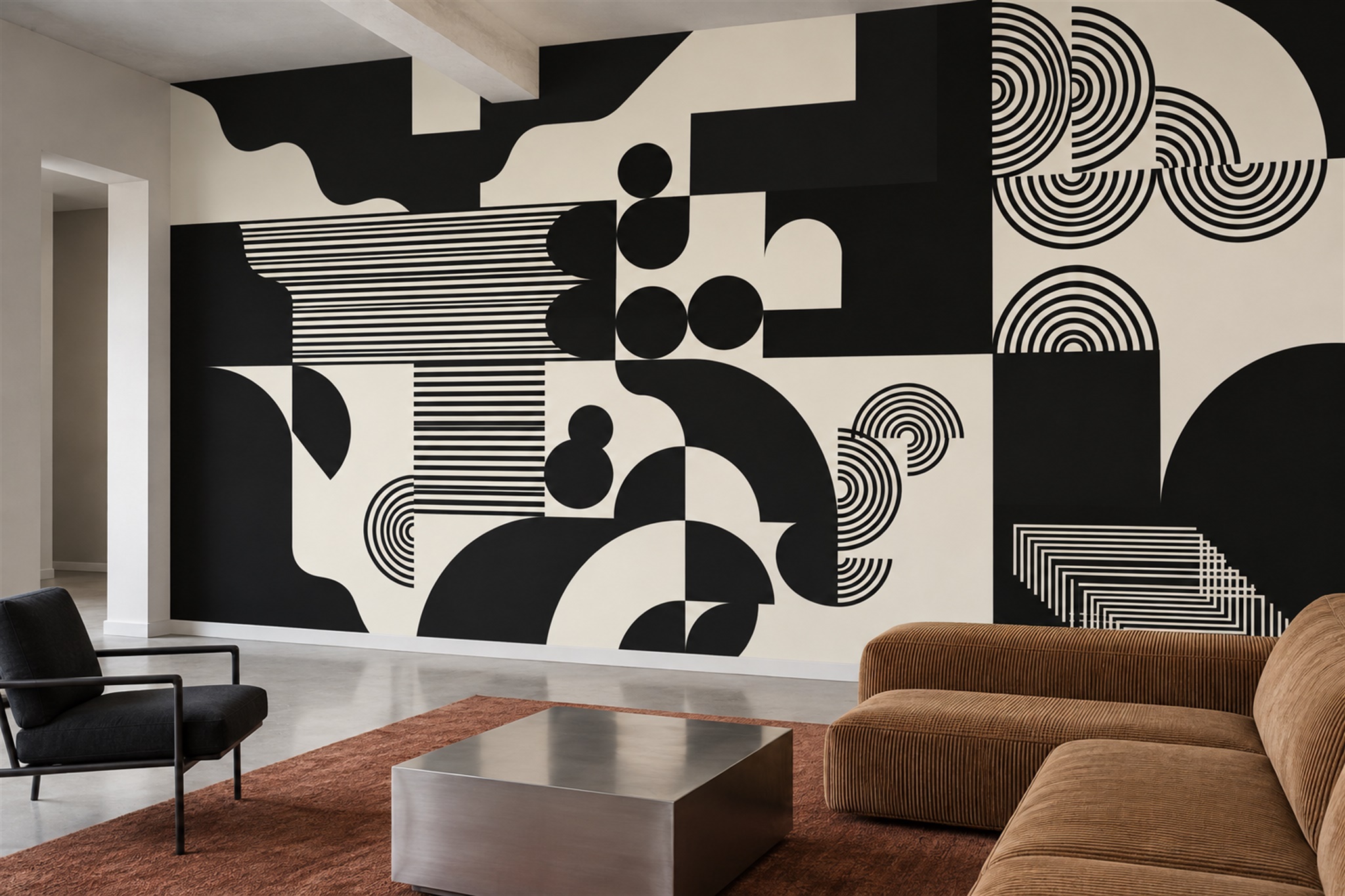
Look at the interruptions. If a door cuts the only circle in half, the geometric mural may lose its central idea; a distributed wash could retain its movement. If the wall is clear and long, a deliberate sequence of blocks may make better use of that uninterrupted span than a diffuse image. This is a crop decision, not a claim that geometric designs are always bolder. The feature image's pale diagonal lines read almost as texture, while the black-and-white arcs shown below make large architectural shapes.
Compare the two candidates at similar contrast. Otherwise a black-and-white geometric design will seem more insistent than a pale abstract mainly because of value difference. Ask what you still notice from the doorway and what you see from the usual seat. If the geometry becomes a clear beat at both distances, decide whether the room needs that beat. If its line vanishes at a distance or collides with furniture, its precision may bring no advantage. The exact printed motif size belongs to the separate geometric-scale check, not to a style label.
Ask whether freer movement solves the same wall
Choose the abstract candidate when a wash, diagonal or broad colour field gives the eye a route through a room already full of hard furniture lines. Test whether its visual weight remains balanced after the same door, cabinet and sofa masks used for the geometric option. A loose image is not automatically more forgiving: losing its only dark stroke or the pale interval between two large marks can change the composition as radically as losing half a circle.
If the geometric image feels too repetitive beside a tiled floor, a painterly abstract may provide contrast; if the abstract leaves an already sparse wall without a focal point, the geometric form may clarify it. Make those judgements with the furniture in place rather than ranking “modern” styles in isolation. Compare where each artwork invites the eye to begin, where it pauses and whether the room's existing objects interrupt that movement. The dedicated abstract guide examines the internal balance of one such image after this broader choice.
Neither choice determines physical surface feel. Brush marks, plaster effects and layered paint may be printed illusions, while a sharp geometric line can be printed on different wallcovering finishes. Use a sample of the exact material to judge sheen and texture, and the wall-size crop to judge where the forms land. Do not let an attractive close-up of either design stand in for the room comparison.
Run a fair comparison on the same wall
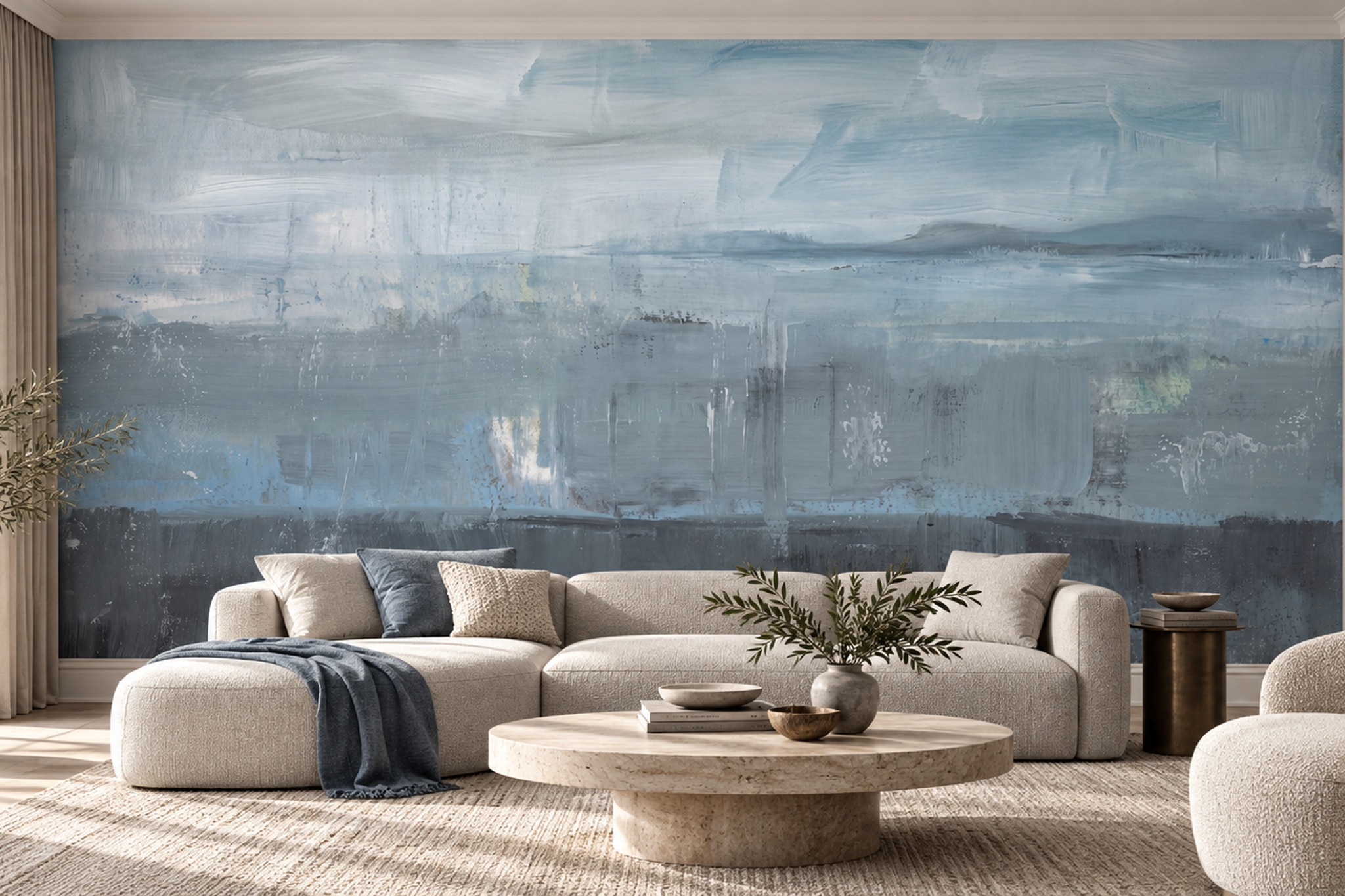
Put the geometric arcs and the blue-grey brushwork into the same measured wall photograph. Keep sofa, window and crop boundary unchanged. If one option is much darker, first find a version of the other with similar contrast; otherwise the decision may be about colour strength, not geometric versus painterly structure. Stand at the usual seat and look for the first shape that remains clear in each version.
Trace what furniture removes. The broad arc beside the sofa still reads as a bounded form, but a cabinet on the right could hide the black block that balances it. The brushwork does not require a complete circle; it does need enough pale interval between darker marks to retain its direction. A door through the arc and a door through the wash therefore create different failures. Compare those failures before choosing a style label.
Judge both from the doorway and close to the wall. Geometry may retain a distinct beat from across the room while loose marks blend into colour. Up close, a tight grid can become more insistent, while broad brushwork may reveal variations. This article helps choose between those readings; the abstract-selection guide examines relationships within one abstract image, and the geometric-scale guide works out the printed size of a specific motif.
Plan furniture and openings
A geometric mural with a central axis may need to be positioned relative to a bed or table. If a window removes half the axis, the composition can look accidental. An abstract design may tolerate the opening better if it has distributed interest, but a focal brush mark can be lost just as easily. Compare the crop with your own sketch of doors, windows, shelves and major furniture before choosing.
Panel seams matter differently. A geometric line crossing a join demands precision. A loose abstract stroke may hide a tiny mismatch, yet a gradient can reveal a visible shift in tone. Ask how the panels meet and check the exact material’s installation instructions. Neither design category eliminates the need for a plumb starting line or sound wall preparation.
Account for the furniture that may change
A fixed doorway will interrupt either design for as long as the mural is up, but a sideboard or sofa may be replaced. If the black-and-white arc only looks complete because today's narrow cabinet leaves its edge exposed, sketch a wider replacement before approving the crop. The blue-grey brushwork may adapt more readily to a different sofa height if its pale and dark areas remain balanced above either backrest. Conversely, a broad geometric form placed well clear of furniture can be more dependable than an abstract whose only strong stroke sits at sofa height.
Make the final choice using the room as it is and one plausible future arrangement, not every imaginable layout. Keep fixed openings identical in both previews, then change only the movable furniture. If the geometric candidate preserves its defining form in both versions, its precision is an advantage; if the abstract retains its movement while the arc becomes a fragment, the looser composition has earned its place. This test gives the two styles a practical distinction beyond their catalogue labels.