Are Large-Scale Mural Wallpapers Suitable for Small Rooms?
Understand how crop, negative space, contrast and viewing distance affect large artwork in a compact room.
Article focus: pricing and measurement
Budgeting this wall with confidence
Start with accurate wall measurements; the final custom mural price depends on area, material and any finishing options.
Example application: Any room with a suitable, prepared wall · pricing and measurement
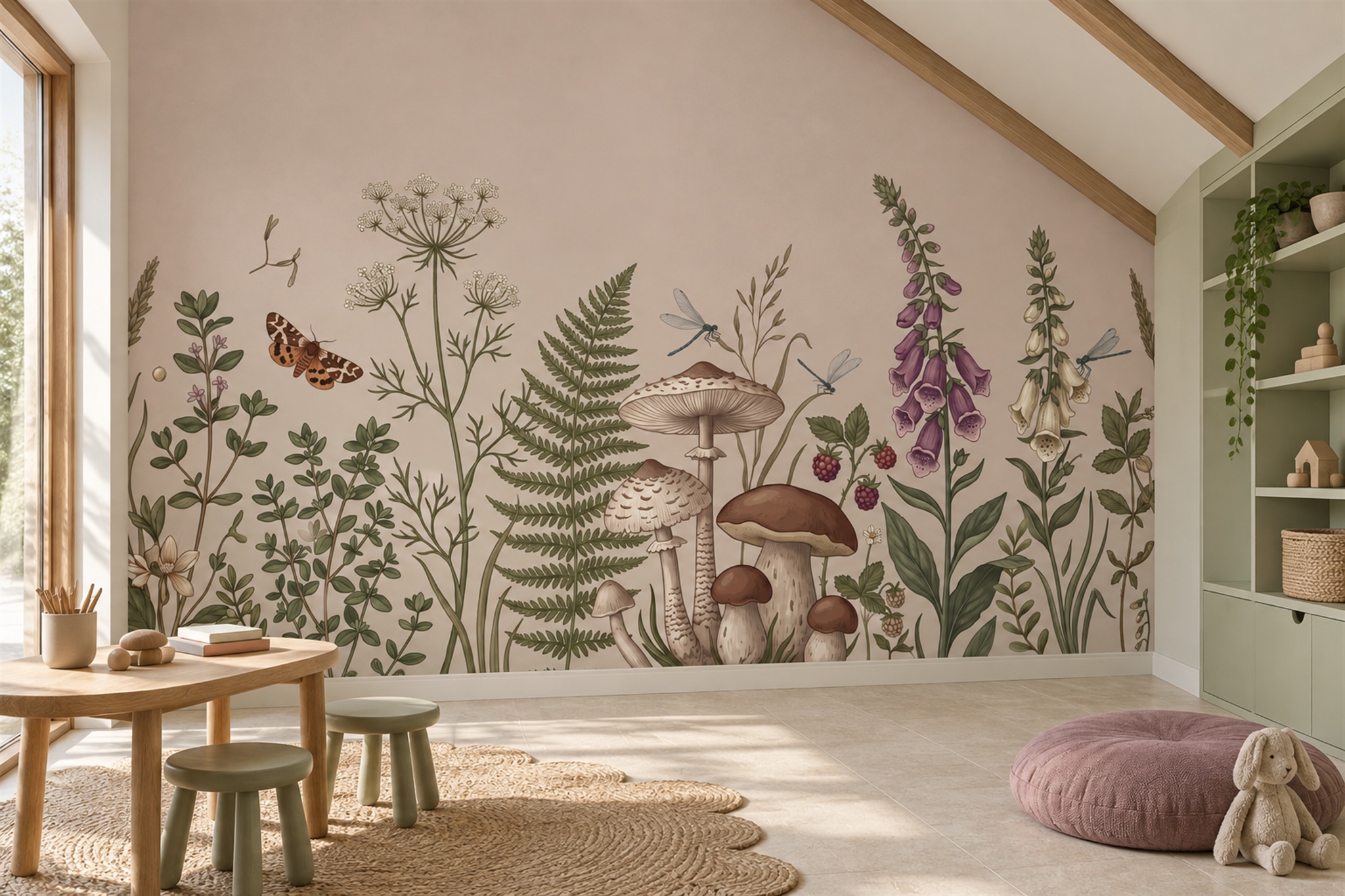
Can a small room carry a mural with oversized mushrooms, flowers or planets? Yes, provided the image has somewhere for the eye to rest and its main subject survives the crop. In the feature photograph, a low band of large mushrooms and plants sits below a wide expanse of pale wall, even though the ceiling slopes and shelving occupies one side. The photograph does not establish the room's dimensions; it illustrates a composition to test against your own measurements.
Why one large image can feel simpler
A fine repeat creates many small edges across a wall. From close range, the eye may keep moving from one detail to the next. A broad landscape or one oversized botanical arrangement can offer a clearer hierarchy: one main subject, a background and areas of rest. This does not mean every oversized motif is calm. A vivid object pressed against each edge of a short wall can feel cramped. Composition matters more than a rule about scale.
Think of a small room as a frame. The wall has a width and height; the doorway, window and furniture further reduce the visible image. A design meant to show a complete scene may be damaged if the room allows only a narrow slice. A design with one central cluster and open edges may fit beautifully. Inspect the mural as a crop, not as a standalone file.
Viewing distance changes perception. A study wall may be seen mainly from a desk only one or two metres away. A large flower can become an abstract arrangement of colour and line from that position. A guest entering the same room may first see the complete composition. Compare both views. The image needs to work at the distances that actually occur, not only in a staged wide-angle photograph.
Ask how large the subject will print
“Large-scale” does not tell you the diameter of a flower or the height of a mushroom. Use the measured-wall crop preview and ask the supplier for an approximate motif dimension if the scale is unclear. Compare it with a separate sketch showing the portion visible above a desk or headboard. If one flower occupies nearly half the wall, is that the intended focal point? If a window removes its centre, does the remaining outline still read as a flower?
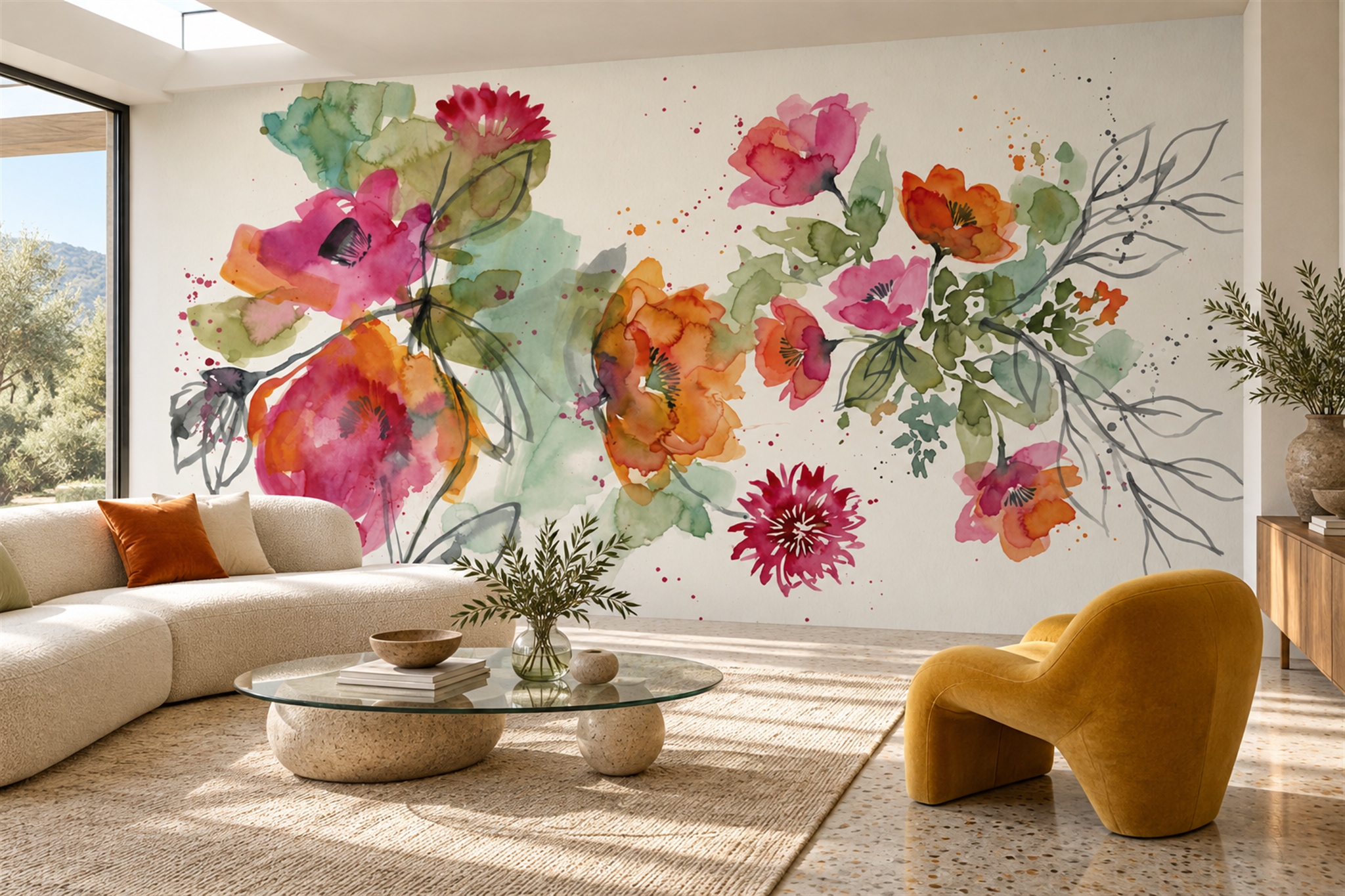
The floral mural below spreads substantial pink and orange blossoms across a white ground. Unlike the mushroom composition in the feature image, its large forms occur high and low across the wall. On a narrower surface, a crop might retain one strong flower and a generous white margin, or it might cut through several blossoms at once. Those are very different outcomes from the same artwork. Compare the crop with a furniture outline, not just the full showroom image.
Use negative space as carefully as the subject
Open background is not wasted space. It separates the mural's main elements, gives furniture room to sit against the wall and can keep a low ceiling from feeling busy. A pale sky above a landscape, a blank ground around one branch or a soft colour wash behind a few shapes can all do this work. The quantity and position of open space are as important as the size of the subject.
Do not assume that putting the subject in the centre is always best. A bed may hide a central composition; a wardrobe may cover one side. Shifting the subject towards the visible portion of the wall can make the mural feel balanced. Conversely, placing a large subject exactly against a corner can make it look accidentally cut. A crop preview can reveal where the eye needs a margin.
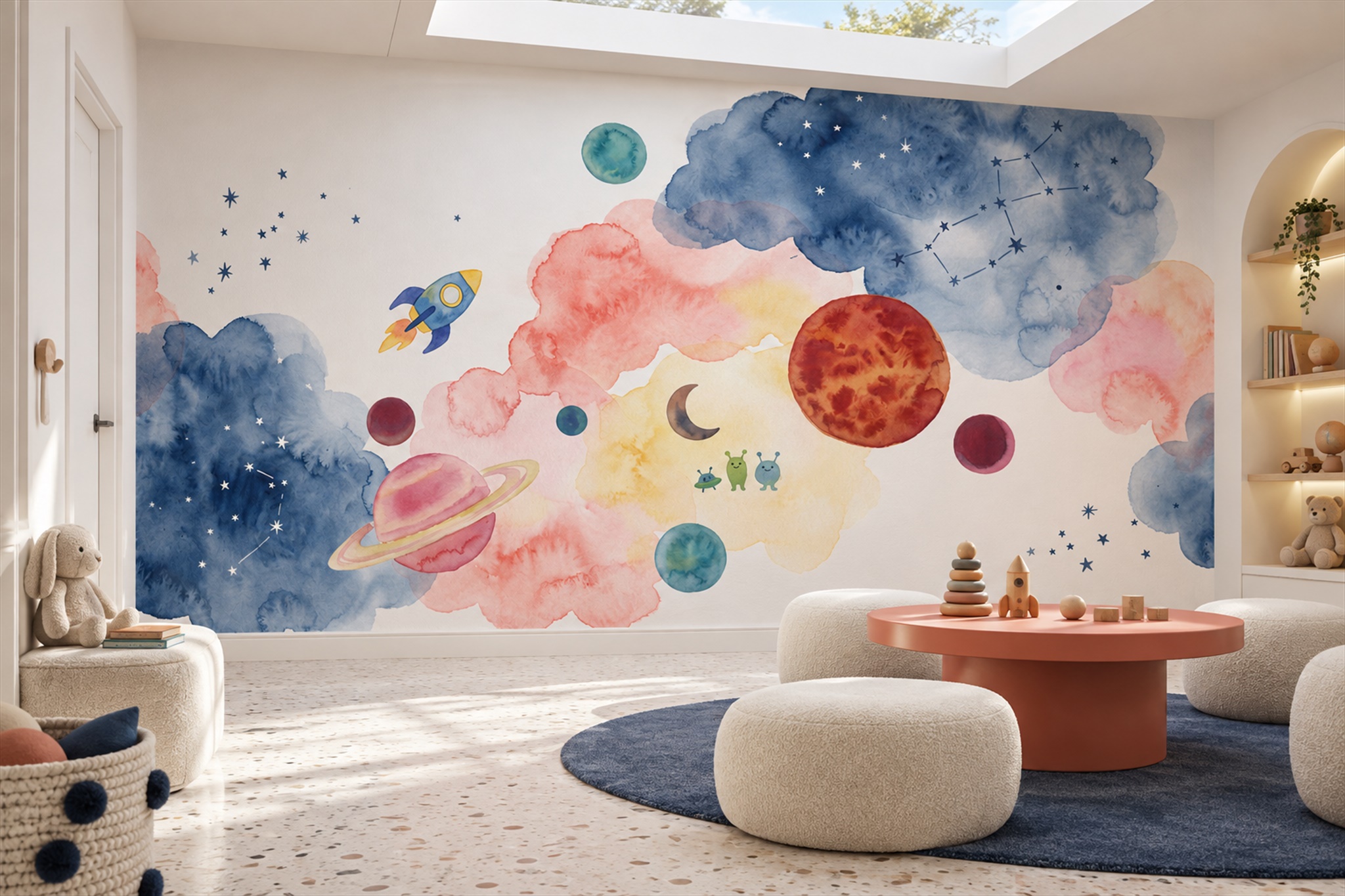
The space-themed room pictured here has large planets, a rocket and washes of colour, yet substantial white areas remain. The effect is playful rather than an all-over small repeat. On a much narrower wall, one orange planet might become the entire view while the rocket disappears. That could still be an intentional focal point, but it would no longer tell the same visual story. Check which elements your crop preserves before ordering.
Test whether the oversized subject survives
For each shortlisted image, outline one complete large form on the wall-sized crop: the full mushroom cap, one flower including its petals, or the planet and rocket as a pair. Now mask the real window, door and fixed furniture. Count how many of those outlined forms remain recognisable without mentally reconstructing the missing part. A small room can carry one very large subject, but not if the only complete example is hidden behind a headboard or cut through by a frame.
Compare a centred crop with one deliberately shifted towards the clear part of the wall while keeping the ordered dimensions unchanged. This tests placement rather than changing the motif's size. Record what the shift costs at the opposite edge: moving a flower away from a window may sacrifice the open ground that made its size comfortable. If no position retains both a readable subject and breathing room, the artwork may need a different scale or the wall may need another design.
View the surviving forms from the closest usual seat as well as the doorway. At close range, a single petal or mushroom stem may become an abstract colour shape; from the door it may reconnect into a clear picture. That can be intentional, but decide it knowingly. The general small-room mural guide weighs subject, contrast, furniture and light across different design types. Here the pass-or-fail question is narrower: does the large-scale motif remain legible after the actual room removes part of it?
Do not confuse a larger motif with a closer crop
A catalogue image may show a huge flower because the example wall uses a particular crop, not because the product always prints each flower at that size. Compare the recognisable feature against the actual wall width. If its width doubles while your wall width stays the same, less of the surrounding artwork can fit unless the supplier supplies an alternative layout. Moving an image sideways does not enlarge the subject. Ask what scale options exist for that design before treating an enlarged thumbnail as an order specification.
When the source is a personal photograph, zooming into one small area may leave insufficient detail for a wall-sized print. A simple painted shape may tolerate a different enlargement from a face or fine linework, but only the actual source and intended print size can settle that question. Request a print-scale detail check if the supplier offers one. A screen crop answers which portion is visible; it is not evidence that the remaining source detail will print sharply.
After confirming the feasible scale, return to the occupied room to assess colour and contrast. A dark mushroom against pale ground reads more assertively than a similar-sized shape in close tonal values; a low-contrast planet may disappear in the room's usual dim light. Use a physical sample for printed colour and finish, and a wall-sized crop for motif size. The two checks answer different questions, and neither replaces the legibility test above.
Know when a different design is the better answer
Do not keep enlarging or shifting an image once every workable crop sacrifices the part you wanted. If a desk permanently hides the mushroom cluster, try the opposite wall or a composition whose main forms sit higher. If a narrow wall leaves only severed petals, look for a single-flower artwork with its own clear margin rather than forcing this multi-blossom scene to behave like one. If a door removes the rocket, decide whether a planet-only crop is genuinely what you want; if the story matters, choose a clearer wall.
There is also no requirement to fill the entire wall with one oversized picture. A deliberately bounded mural area can give a large form adequate space on a short wall, provided its edge is planned rather than disappearing arbitrarily behind furniture. Compare that option with a simpler, distributed design at the same visible width. A successful large-scale mural is not the one with the biggest possible motif; it is the one whose subject and open ground still make sense in the part of the room people can actually see.