Mural Wallpaper Pre-Order Checklist
Review measurements, wall condition, image crop, material, room use, installation plan, address and product details before checkout.
Article focus: pricing and measurement
What to settle before pricing
Start with accurate wall measurements; the final custom mural price depends on area, material and any finishing options.
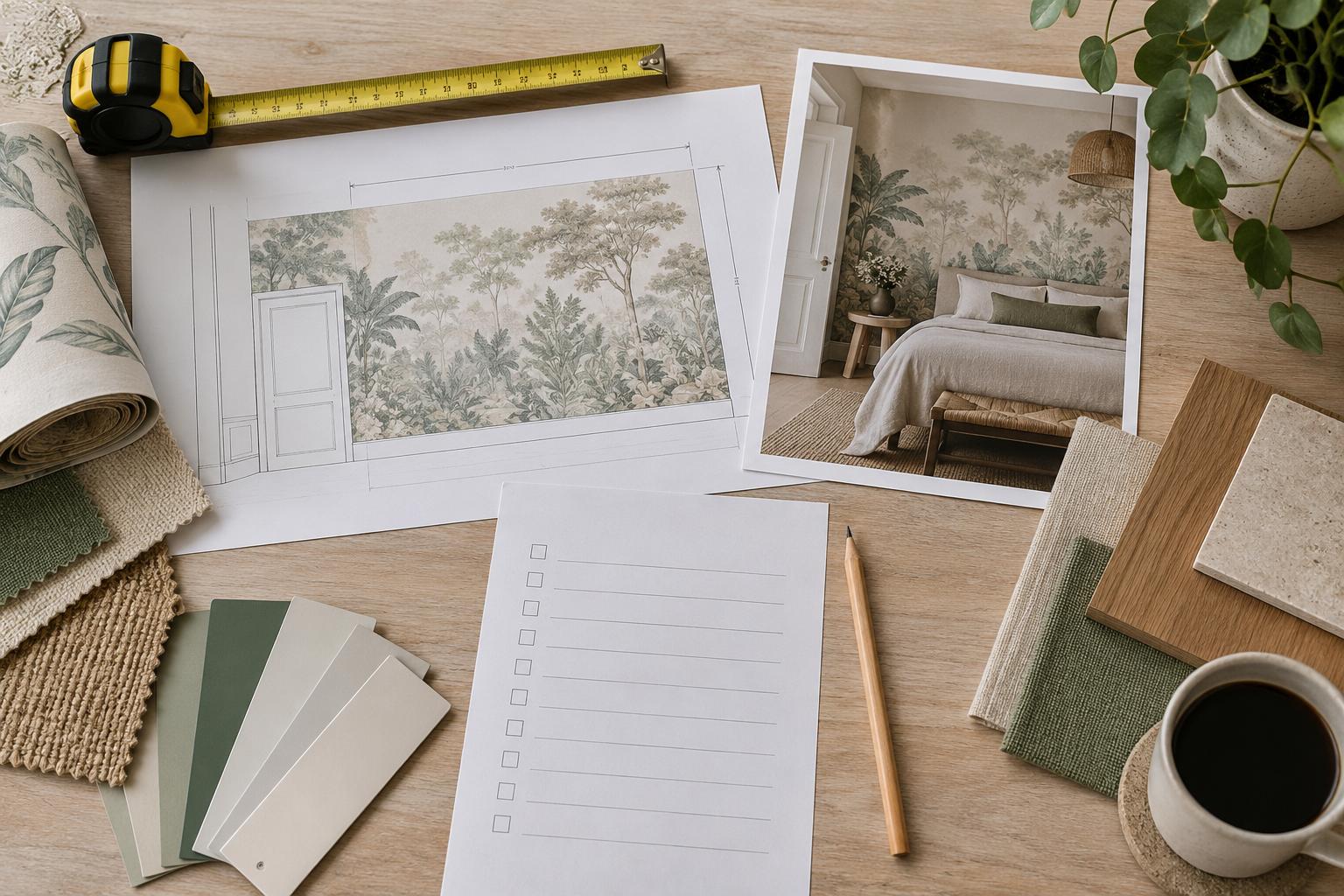
Example application: Any room with a suitable, prepared wall · pricing and measurement
Ordering a made-to-measure mural is a sequence of small approvals, not a single choice of picture. The most expensive errors tend to come from a measurement written in the wrong unit, a crop that hides the subject, or a material chosen before the wall has been assessed. A practical pre-order checklist catches those issues while they can still be corrected.
Short answer: Before payment, confirm the exact wall and dimensions, the supplier's trim rule, the chosen crop, the selected material, the wall's condition, the delivered price and the current custom-order terms. Save the final configuration. A sample, room mock-up or starting price does not verify the whole order.1. Identify the wall and measure it again
Record the wall's width and height at more than one point, using one unit consistently. Note skirting boards, coving, a sloped ceiling, a chimney breast or another feature that changes the printable rectangle. Decide whether you are covering the full wall or only a defined section. Measure the actual surface, not the floor plan or an estimated room size. Write down which dimension is width and which is height; reversing them can produce a very different crop.
Check the seller's trim allowance and add it exactly as instructed. The Solowalls product guidance currently asks customers to add about 10 cm (4 in) to both the overall width and height for installation trim. That is not permission to add 10 cm on every edge without checking the ordering interface. Record both the measured dimensions and the submitted dimensions so the extra amount remains visible. If the wall is markedly out of square, ask an installer or supplier how to size the mural rather than guessing.
For a 3.20 m wide by 2.40 m high wall, adding 10 cm to each overall dimension gives a 3.30 m by 2.50 m order size. Write both pairs on the same sketch and label them plainly. The order size is not the size of the unobstructed view after trimming; it is the printed rectangle requested from the supplier. If you switch the checkout from centimetres to inches, recheck the displayed converted numbers before proceeding. A small unit mistake affects the crop and the cost together.
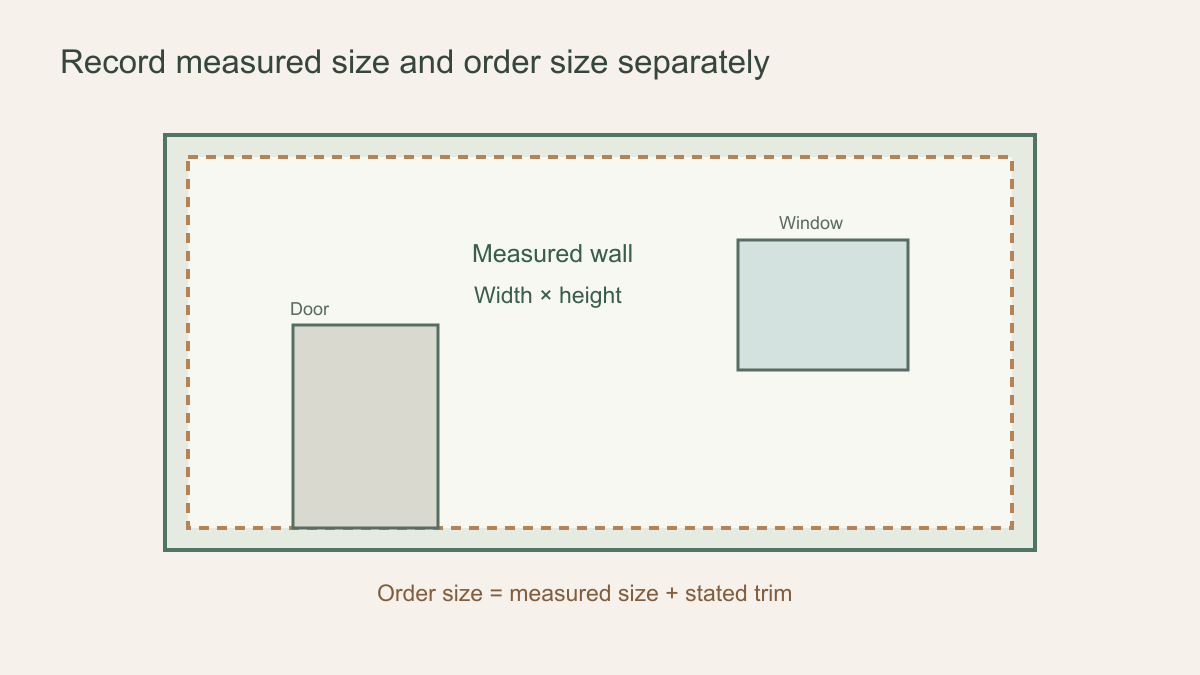 Keep the measured wall size and the ordered print size as separate numbers.
2. Mark everything that affects the picture
List doors, windows, sockets, radiators, large furniture and any part of the mural that will disappear behind them. Note the room's principal viewing position. A crop that looks centred on an empty wall may place a face behind a wardrobe or cut a landscape horizon at a window. Use a wall-size preview where offered, and zoom or reposition the image within the limits of the tool. Check the edges and corners rather than only the central motif.
For a mural made from your own image, review the original file. Use the highest-resolution lawful source you have, and confirm that you have the rights to print it. A sharp phone screen image can still be too small for a large wall. Ask for a print-quality assessment where the platform flags it, and distinguish a crop preview from a guarantee of final colour or sharpness. Keep a copy of the approved crop; the installed picture depends on that version, not merely the source photograph.
Confirm which version of a custom image is final. Cropping, retouching and colour adjustment can create several files with similar names. Identify the exact file and selected crop by date or reference in your own order notes; ask the supplier what will be used if the checkout cannot display that detail. Check faces, lettering and fine architectural detail at the expected viewing distance. If the supplier raises a resolution concern, resolve it before production rather than hoping enlargement will restore missing detail.
3. Match material to the wall and project
Check which material is actually selected at checkout rather than assuming the product photo determines it. Consider surface texture, paint condition, expected use, the supplier's installation method and how long the mural needs to remain. “Peel and stick” is not automatically removable without wall damage, and “vinyl” does not by itself establish waterproofing. Product-specific instructions are more useful than broad labels. If you can obtain a sample of the intended artwork on the intended finish, inspect it on the wall in daylight and evening light.
Look at the wall itself before ordering. Loose paint, moisture staining, uneven plaster and old adhesive may require repair or preparation. The Wallcoverings Association's surface-preparation guidance explains why a sound, clean, dry surface is a prerequisite. If a professional will install the mural, ask them to inspect a photograph or the site before you commit to a material and installation date.
Match the sample to the exact finish in the basket. A sample printed on a matte non-woven material will not establish the feel or sheen of a self-adhesive finish. If the wall has fresh paint, ask for the required curing period and any compatibility test for that chosen material. Record who is responsible for repairs and priming, because “the wall is ready” means little if the installer expects a prepared surface and the homeowner expects preparation to be included.
4. Check price and delivery as configured
Enter the final dimensions and material to see the relevant price. Verify the currency, delivery address, shipping charge, taxes and any possible import duties. If you are ordering a sample first, confirm its separate price and lead time. A product page's starting rate is not the amount payable for your wall. The Solowalls custom-wallpaper page describes its displayed rate as a starting rate per square foot and tells customers to enter dimensions and material for the estimated total.
Allow time for wall preparation and installation in addition to printing and shipping. Ask whether an installer quote includes adhesive, primer, old-wallpaper removal, difficult access and tax. Do not book a fixed installation date on the assumption that an estimated delivery date is guaranteed. If the project has a hard deadline, get the seller's current production and shipping information before paying.
A sensible sequence is wall inspection, any repair and drying, final measurements, print approval, delivery inspection, then installation. Measuring before a new lining or panelling is finished can leave the mural sized for a wall that no longer exists. Likewise, rushing installation immediately after delivery leaves no time to check the panel count or report a print issue. Keep a small scheduling gap where possible rather than making the installer the first person to open the package.
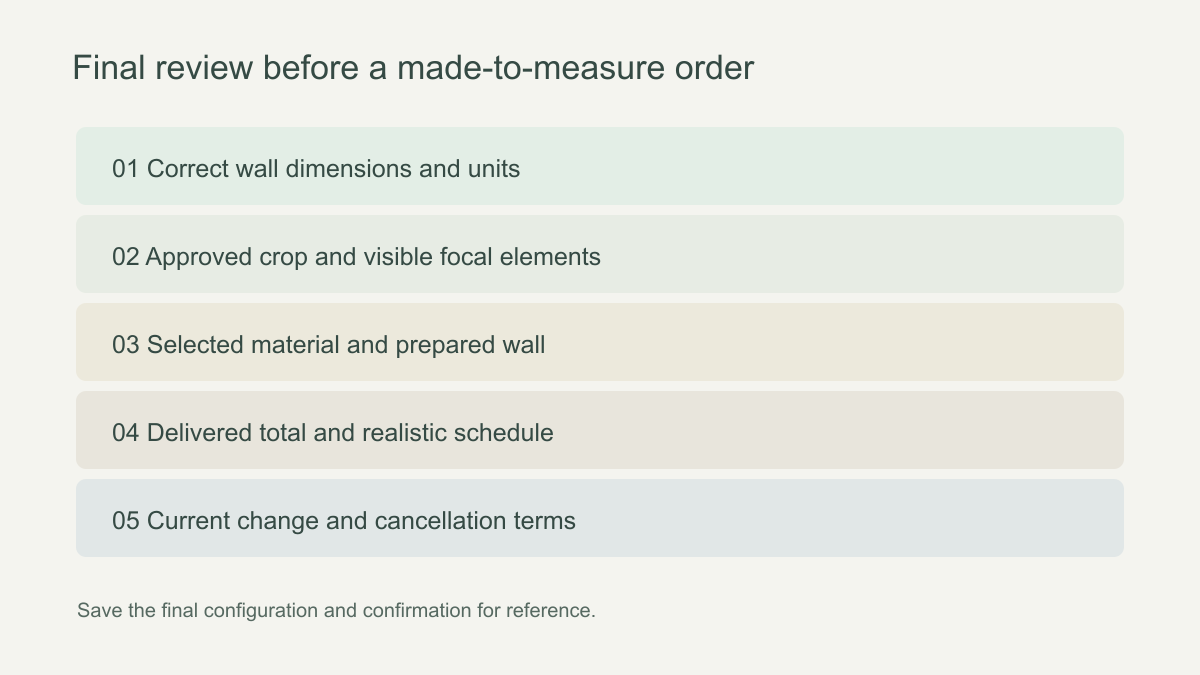 A final review should cover the printed artwork and the practical order details.
5. Read the terms that apply to your order
Made-to-measure goods can have different cancellation and return conditions from standard stock items, subject to applicable law. Find the seller's current policy for changing dimensions, changing a crop, production faults, delivery damage and order cancellation. Do not assume a change is possible after printing begins. If a design service or extra proof round is included, confirm its scope in writing. The order summary and approved preview are more dependable than a remembered chat message.
Take screenshots or save the confirmation that shows width, height, units, material, crop, price and destination. Check the confirmation email immediately after ordering. If a field is wrong, contact the seller promptly with the order reference and the exact correction requested; do not wait for dispatch. Keep the original files and a copy of any approval for a custom-image mural.
Before the final click, read the configuration aloud as one complete order: this design or customer file, this material, these width and height values in these units, this crop, this destination and this payable total. Compare the current order summary with the selected crop, not with an earlier screen that may show another size or finish. If a custom image was revised, identify the exact version. The purpose is to catch a mismatch while it can still be corrected, not to assume that checkout will reconcile conflicting files for you.
The final two-minute review
- Is this the correct wall, with width and height in the intended units?
- Has the supplier's trim allowance been added once, in the stated way?
- Are the subject, horizon and important details clear of obstructions?
- Is the selected material the one you sampled or otherwise evaluated?
- Is the wall sound enough, or is preparation scheduled?
- Does the total include the known delivery and tax costs?
- Have you checked current change, cancellation and defect terms?
- Did you save the approved crop and final configuration?
Use three outcomes, not a vague “looks fine”. Proceed when the dimensions, crop, material, price and terms are recorded and the wall is suitable. Pause when a fixable answer is missing, such as a delivery estimate or an unconfirmed trim rule; write down who will confirm it. Stop when the underlying problem makes the order unsafe or unusable: active moisture needs repair, an unlicensed image needs permission, and an unresolved crop that removes the main subject needs a new layout. Only return to checkout after that particular issue has been settled.