How Long Does Mural Wallpaper Delivery Take?
Plan around design approval, production, dispatch, delivery address and the time needed to prepare the wall before installation.
Article focus: pricing and measurement
Budgeting this wall with confidence
Start with accurate wall measurements; the final custom mural price depends on area, material and any finishing options.

Example application: Home office · pricing and measurement
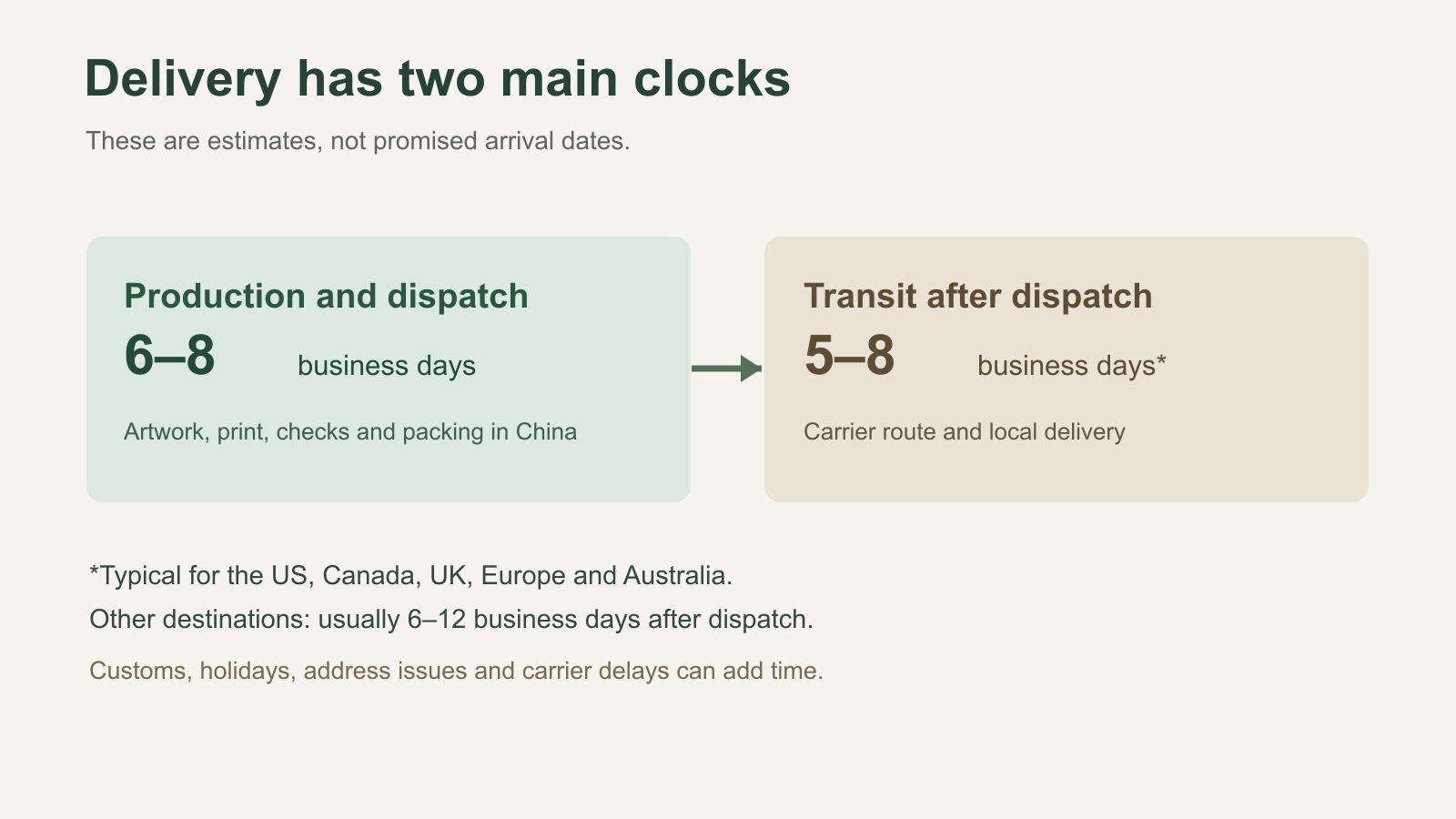
For a Solowalls made-to-measure mural, allow time for two separate stages: about six to eight business days for production and dispatch in China, then a destination-specific transit estimate. It does not go directly from checkout to a delivery van. Wall dimensions and crop may need review, the panels are printed and checked, and the order is packed before an international carrier begins its journey. A realistic arrival plan starts with those two clocks and leaves room for events neither the printer nor the buyer can schedule precisely.
The first clock starts with a complete order
Production time covers more than ink on paper. For a custom-size mural, the order may require artwork review, printing, quality checking and packing. A question about measurements, crop, material or address can pause progress until you reply. If a wall is measured in centimetres but the checkout was completed in inches, the correction may take longer than the actual printing. Check the confirmation email immediately and respond to any request for clarification rather than assuming silence means the order is already on its way.
Six to eight business days is the policy's approximate production-and-dispatch window, not a claim that every mural leaves the warehouse on the same numbered day. Large, trade or multi-room orders may take longer. Weekends and public holidays are not business days, and holidays in the production country can affect the calendar. A good planning practice is to leave room for review at the front of the timeline, especially when the design needs a custom crop around a door or a sloping ceiling.
If you order on a Friday evening, do not count Saturday and Sunday as the first two production days. Likewise, an email asking you to confirm a crop is not a dispatch notice. Reply with the exact correction or approval and keep the exchange with your order confirmation. For a bespoke image that needs manual checking, ask whether the published estimate still applies after the image and crop details are confirmed. That is more useful than calculating an arrival date from the payment timestamp alone.
The second clock begins only after dispatch
Once the packed order leaves China, the delivery page gives a typical five to eight business days for the United States, Canada, the United Kingdom, Europe and Australia. For other destinations it lists six to twelve business days. These are transit estimates after dispatch, not a total from the day you click “place order”. Adding the two typical stages gives a rough planning range of 11–16 business days for the first destination group and 12–20 business days for other destinations, before unusual delays. That arithmetic is useful for a renovation schedule, but it is not a promised delivery window.
The summed ranges are planning arithmetic, not a third estimate published for a particular postcode. The production calendar, carrier calendar and local holidays may differ, and time can be lost between a label being created and the first physical scan. Use the destination shown at checkout for your own address, then treat the policy ranges as a guide to when you should expect an update, not a reason to promise a contractor a fixed date.
The diagram keeps the clocks separate. It also names the kinds of disruption that can stretch either the apparent wait or the journey after dispatch. An individual order may move faster or slower, and the estimate at your checkout is the more relevant figure for your particular address.
Why the tracking page can look quiet
A tracking number may be created when a shipment is prepared, yet its first carrier scan may appear later. The delivery policy explicitly notes that a new number can take time to show its first movement. That does not, on its own, prove a parcel has been lost. Read the actual event descriptions and dates rather than judging by the presence of a number. If the status has not moved for an unusually long period or the order is beyond its estimated window, send Solowalls the order and tracking numbers so the production and carrier information can be checked.
Different statuses call for different questions. Before dispatch, ask the seller whether the artwork has been approved and the panels printed. After dispatch, check the carrier's official tracking record. If tracking shows a failed delivery attempt, follow the carrier's redelivery instructions promptly. If the parcel is held for a destination charge or document, confirm the request through the carrier's official site rather than a link in an unexpected message. These steps will not accelerate a routine customs check, but they can prevent an avoidable extra delay.
Customs inspection, import procedures, a remote delivery route, severe weather, public holidays, carrier disruption, an incomplete address or a missed attempt can add time. Some of those events happen after the parcel reaches your country, so “arrived in destination country” is not the same as “out for delivery”. If a carrier asks for an action, use its official tracking channel and respond promptly. Do not assume the seller can make an overseas parcel clear customs on a chosen date.
Plan backwards from the day you need the room
If the room must be ready for guests or a contractor is scheduled, begin with the day the mural needs to be installed and allow time for three distinct things: arrival, inspection and installation. A day of buffer between delivery and installation is often sensible, but a complex room or a tight project deadline may need considerably more. The delivery estimate covers reaching your address; it does not include preparing the wall, letting fresh paint cure, moving furniture or hanging the panels. Do not book the installer for the earliest estimated delivery date when the parcel has not yet arrived.
For a home-office refurbishment, separate the tasks you control from the shipment you do not. Finish dusty work and prepare the wall while the mural is in production; keep the installer’s slot provisional until every numbered panel is present and has been checked against the crop selected for the order. A label without a carrier scan does not confirm where the parcel is or when it will arrive, so it is too early to make a firm hanging appointment. If a fixed completion date matters, give the seller your destination and required date before ordering, then update the installer from actual tracking and inspection rather than the earliest policy estimate.
The photograph below shows a home office after its blue mural has been installed; it is the intended endpoint, not a room waiting for delivery. If the office must be usable again on a particular Monday, work backwards from that date: allow the paint and repairs their specified cure time, leave room to inspect every panel after arrival, and give the installer a realistic fitting slot. A tracking scan cannot tell you whether the printed image is complete or the prepared wall is ready.

If the estimate slips, identify which clock is running
Use the latest confirmed event, not the checkout date alone. If the seller is still waiting for a dimension or crop answer, the useful action is to resolve that question with the seller; repeatedly refreshing carrier tracking will reveal nothing. If production is complete but the parcel has only a label, ask whether it has physically entered the carrier network. Once a carrier scan appears, read its dated events and use that carrier's official channel for a failed delivery attempt or document request. A quiet screen does not identify the cause by itself.
Keep the order confirmation, artwork approval and dispatch message in one thread so the two stages can be separated. Tell the installer which milestone has actually occurred: “crop approved”, “dispatched”, “carrier scanned” and “all panels received” mean different things. For the address, duties and cross-border purchase decisions that happen before this timeline starts, use the separate international ordering guide; those questions should not be confused with the progress of a parcel already in transit.
When is the installation booking safe to confirm?
“Delivered” is a carrier milestone, not a wall-ready sign-off. Before turning a provisional installer slot into a firm appointment, confirm that every package for the relevant wall has arrived, the numbered panels form the approved image, and the prepared wall meets the selected finish's instructions. A multi-room order may arrive in separate parcels; the first box can be complete for one room and incomplete for another. Record which wall each package serves instead of treating the first delivery notification as permission to start the whole project.
If a panel is damaged or the print differs from the order, photograph the package and affected piece while it is intact and contact the seller using the order number, as the site's Delivery Information directs. Keep the proposed fitting date provisional until the resolution and any replacement timing are clear. If everything is present, match the wall's actual readiness with the installer's availability. This final gate prevents a projected transit window, a delivery scan and a usable mural from being treated as the same event.