Can Mural Wallpaper Work in an Alcove or Niche?
Use a small architectural recess to frame a focal image while checking measurements, corners, lighting and panel direction.
Article focus: pricing and measurement
Budgeting this wall with confidence
Start with accurate wall measurements; the final custom mural price depends on area, material and any finishing options.
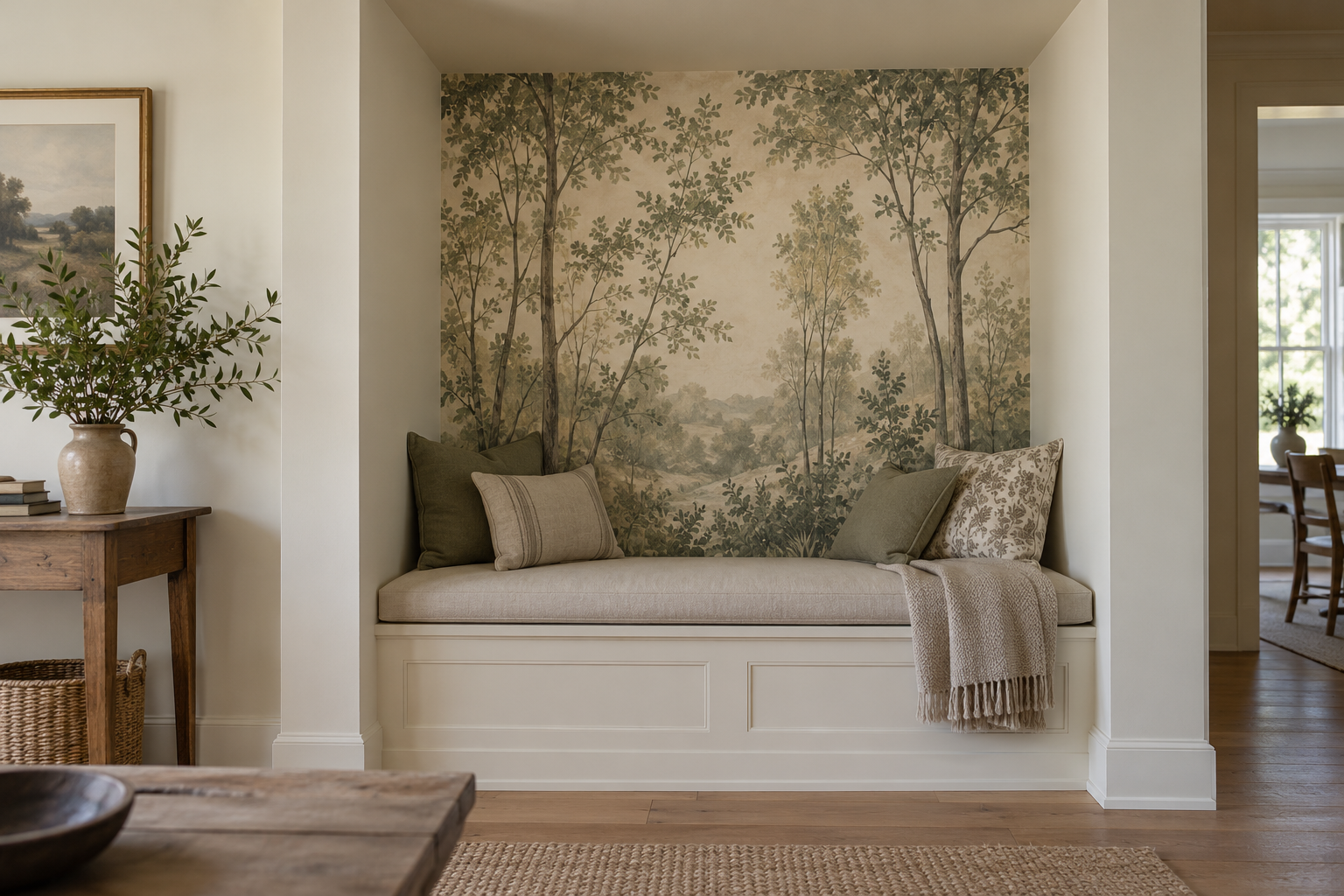
Example application: Any room with a suitable, prepared wall · pricing and measurement
An alcove gives mural wallpaper a ready-made frame, but its opening can also cut away the parts that make a scene work. The illustrative reading alcove above shows a woodland print on the recessed back wall, with plain painted side returns and a built-in seat below. The trees remain visible above the cushions while the seat hides the lower part of the image. That is the real planning question: what will remain visible through the opening after furniture, shelves and shadows are accounted for?
What kind of recess do you have?
A shallow desk recess has a back wall that is mostly visible from the room. A deep reading alcove also has side returns, so the viewer may see the mural obliquely through a smaller opening. A display niche with shelves is different again: the wall is divided into short horizontal glimpses. An arched top can clip tall trees or a circular sun. Draw the actual outline and photograph it from the room entrance and from the intended seat before judging an artwork in isolation.
List what will occupy the space. A desk hides the lower third, books interrupt the middle, and a lamp may cross a focal point. In the illustrated reading alcove, the built-in seat conceals the woodland's lower foliage but leaves the taller trees legible. Move those same trees down in the crop and the composition would lose its centre. If shelving is the purpose of the niche, a dispersed line drawing or tonal wash may support the objects better than a busy scene with one central subject.
Make the crop the main design decision
Use the site's dimension-based crop preview for the exact width and height of the back wall, while allowing the installation trim specified for the product. On a separate elevation, draw the opening, shelves, sockets and seat back. In the alcove example, the lighter space between the trees gives the narrow recess some depth; a crop of only dense foliage would feel different. Ask the supplier whether the artwork can be shifted or scaled without unacceptable loss of detail; a room mock-up alone cannot answer that.
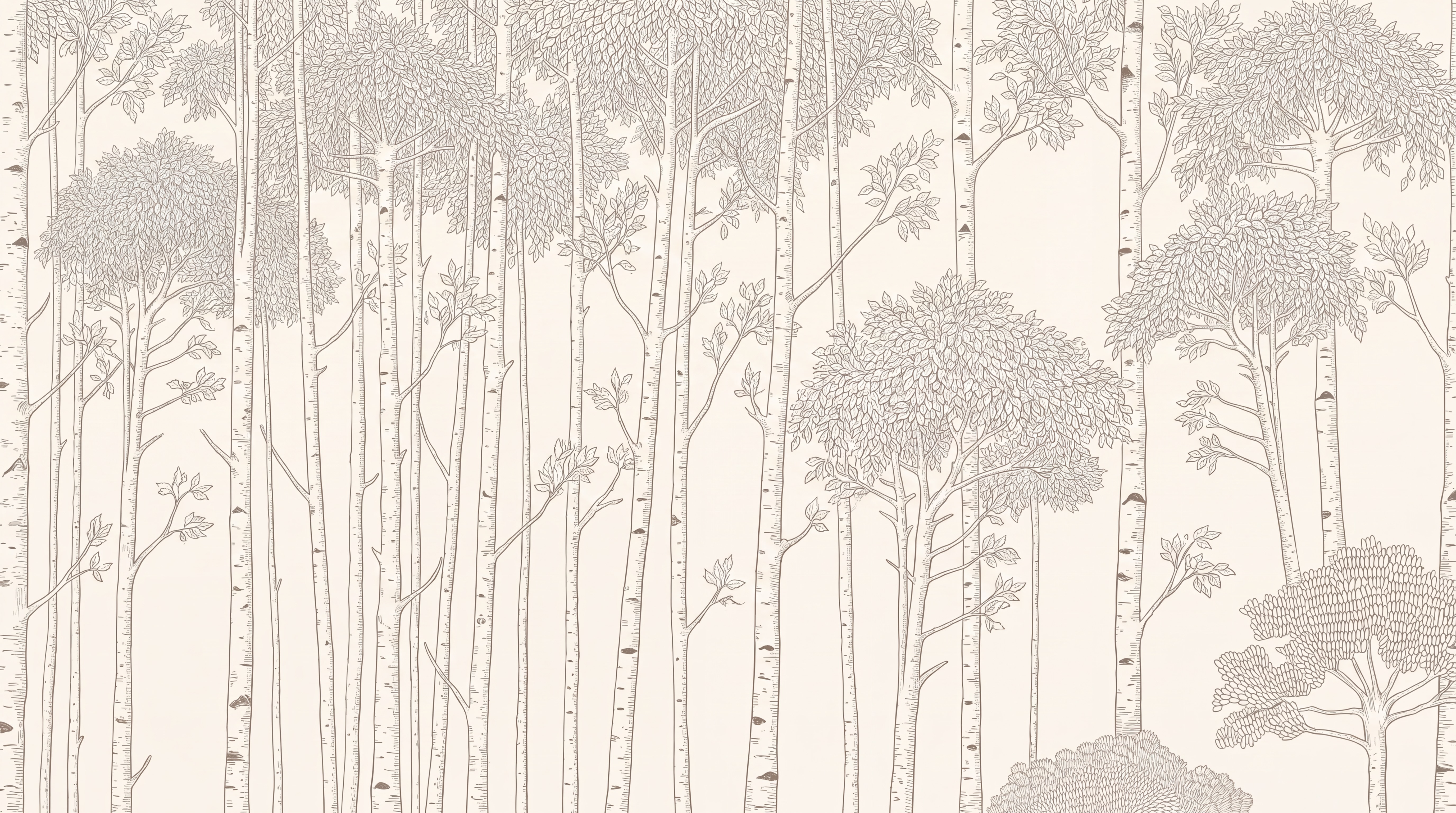
The tan woodland drawing below makes the opposite case. It has many slim trunks and areas of fine foliage, so a narrow slice can still read as a stand of trees. The image is the flat artwork, not a photograph of wallpaper fitted inside a niche. Its value here is as a crop exercise: cover both sides with paper to approximate the alcove width, then see whether the remaining trunks still form an attractive composition. Do not assume that every narrow crop of this image will be equally balanced.
Decide whether to cover the returns
Printing only the back wall turns the opening into a crisp frame. Painting the returns the same colour as the surrounding room emphasises that edge; a related colour can soften the transition. Wrapping the image onto the sides is more immersive, but a landscape horizon or tree trunk must be planned across each corner. A deep return also uses image width that is not visible from directly in front of the niche.
For a small shelf recess, the back wall may be all the mural needs. A deep reading seat might justify colour on the sides, even if the detailed artwork stays on the back. If a continuous wrap matters, ask whether the supplier can prepare a layout for the back, left return and right return as separately measured surfaces; an ordinary single-wall preview cannot show that join. If not, choose a deliberate stopping line at the inner corners rather than asking the installer to improvise from one flat-wall print.
Use the alcove's scale rather than fight it
A small recess can reward close inspection, so fine detail need not be ruled out. The question is whether the niche is seen mainly from across the room or used at arm's length. The tan woodland's fine linework may merge into a quiet beige texture from a sofa but reveal individual leaves to someone sitting in the alcove. Conversely, a broad abstract field may be clearer at a distance and calmer behind shelves.
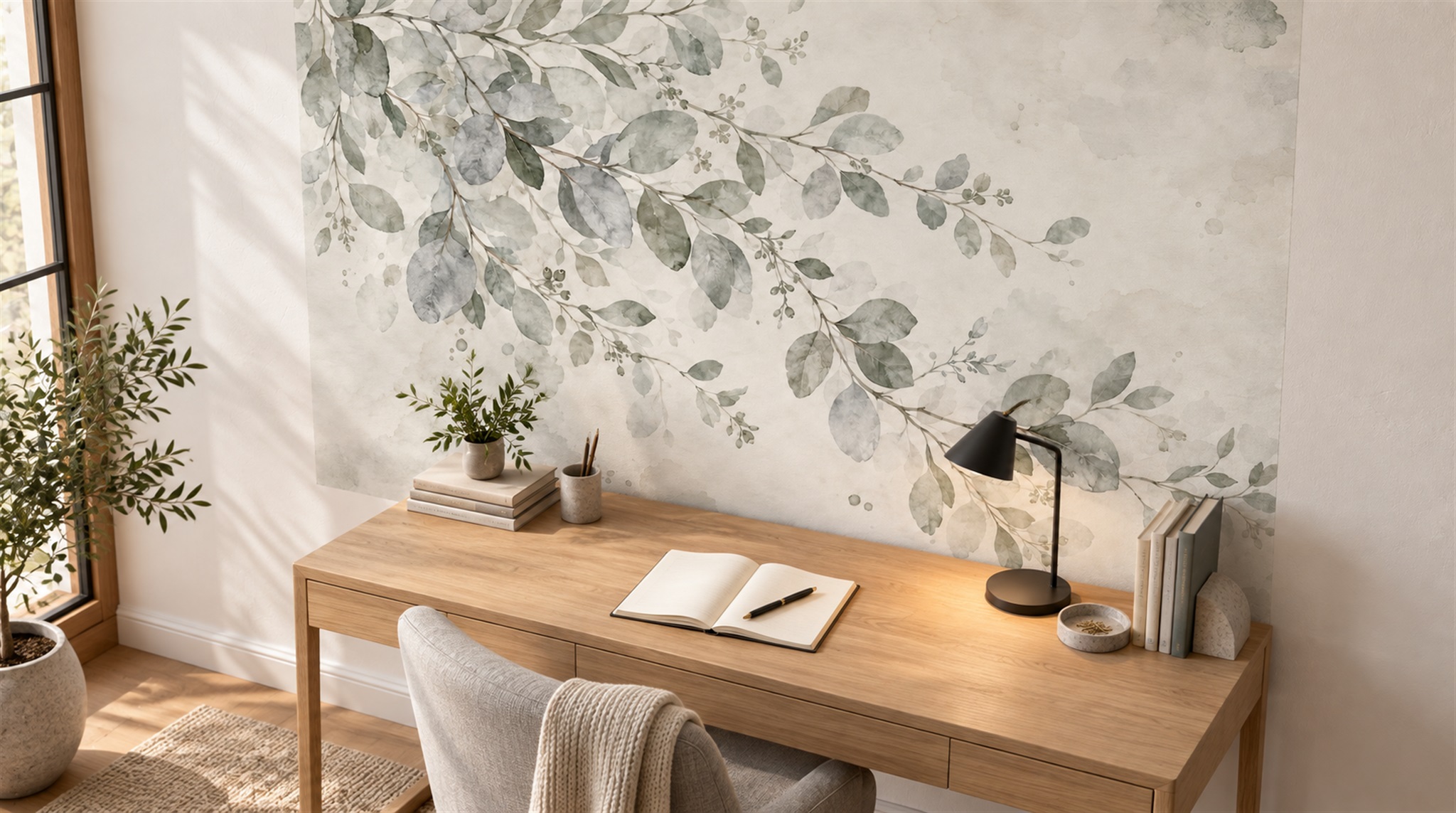
The sage leaf photograph below shows a contained area above a writing desk, but it is a flat wall, not an architectural alcove. Its branches travel diagonally across the upper backdrop while the desk conceals the lower portion. Use it to ask a practical question about a real desk niche: after the worktop, lamp and books are in place, will enough of the leaves remain visible to justify the mural? If the answer is uncertain, compare the crop preview with your measured furniture sketch rather than relying on the styled photograph.
Consider depth, light and shadow
A deep recess usually receives less light than the surrounding wall. In the illustrative alcove, the side returns cast soft shadows over the woodland print; a darker design would change the impression of depth. The pale tan woodland or sage leaves shown elsewhere in this article might connect more gently to a light room. Those are visual possibilities, not effects guaranteed by a photograph. Put a physical sample against the actual back wall and look at it when the alcove is normally used. A reading lamp or shelf light may illuminate only part of the print.
Side returns can cast uneven shadows over the back wall. Test the sample near an edge as well as at the centre; a soft sage leaf may almost disappear in one spot while appearing darker in another. If the opening is arched, view the artwork through the arch from several positions. An important subject near the top corner can be concealed by the curve even though it appears on a straight rectangular proof.
Measure the geometry precisely
Measure the back width at top, middle and bottom, and the height on both sides. Record each return's depth separately; one may differ from the other. For an arch, note the spring point and the maximum height, not just the opening's width and centre height. Position shelves, lights and sockets from a fixed corner. Small alcoves are not necessarily simple: a few millimetres of variation can be conspicuous where the print meets a close architectural edge.
Ask for the proposed panel layout. Some narrow niches may take one panel, but that depends on the supplier's print width and selected material. If two panels are needed, check whether their join runs through the only prominent subject. Confirm the installation trim allowance and whether the installer can access the back corners cleanly. Shelves that cannot be removed may affect both the crop and the practical fitting sequence.
Make the niche relate to the room
The recess can echo a colour elsewhere in the room or provide a measured contrast. If the room already has a strong focal wall, a pale line-drawn woodland may make the niche feel intentional without creating a second competing scene. Where two matching alcoves flank a fireplace, decide whether to use identical crops, mirrored compositions or one scene that has been planned across both openings. An accidental repeat can look especially conspicuous in an architectural pair.
Make a paper window the width and shape of the alcove opening, then move it over each candidate. The illustrated woodland works because its central clearing and several trunks remain visible above the seat; a narrower slice of the tan line-drawn trunks can still read as woodland, but in a different way. Once the back-wall image is chosen, decide separately whether the returns should stay painted, share a related colour or carry a planned continuation of the print. A wrap needs dimensions and a layout for each surface, not spare material folded around a corner. Finally, judge the sample inside the recess, where its shadows differ from those on the open room wall.