Can Mural Wallpaper Work in a Bohemian Interior?
Layer botanical, global-inspired or painterly imagery with textiles and collected furniture while keeping the wall composition intentional.
Article focus: pricing and measurement
The cost and measurement decision
Start with accurate wall measurements; the final custom mural price depends on area, material and any finishing options.
Example application: Bedroom · pricing and measurement
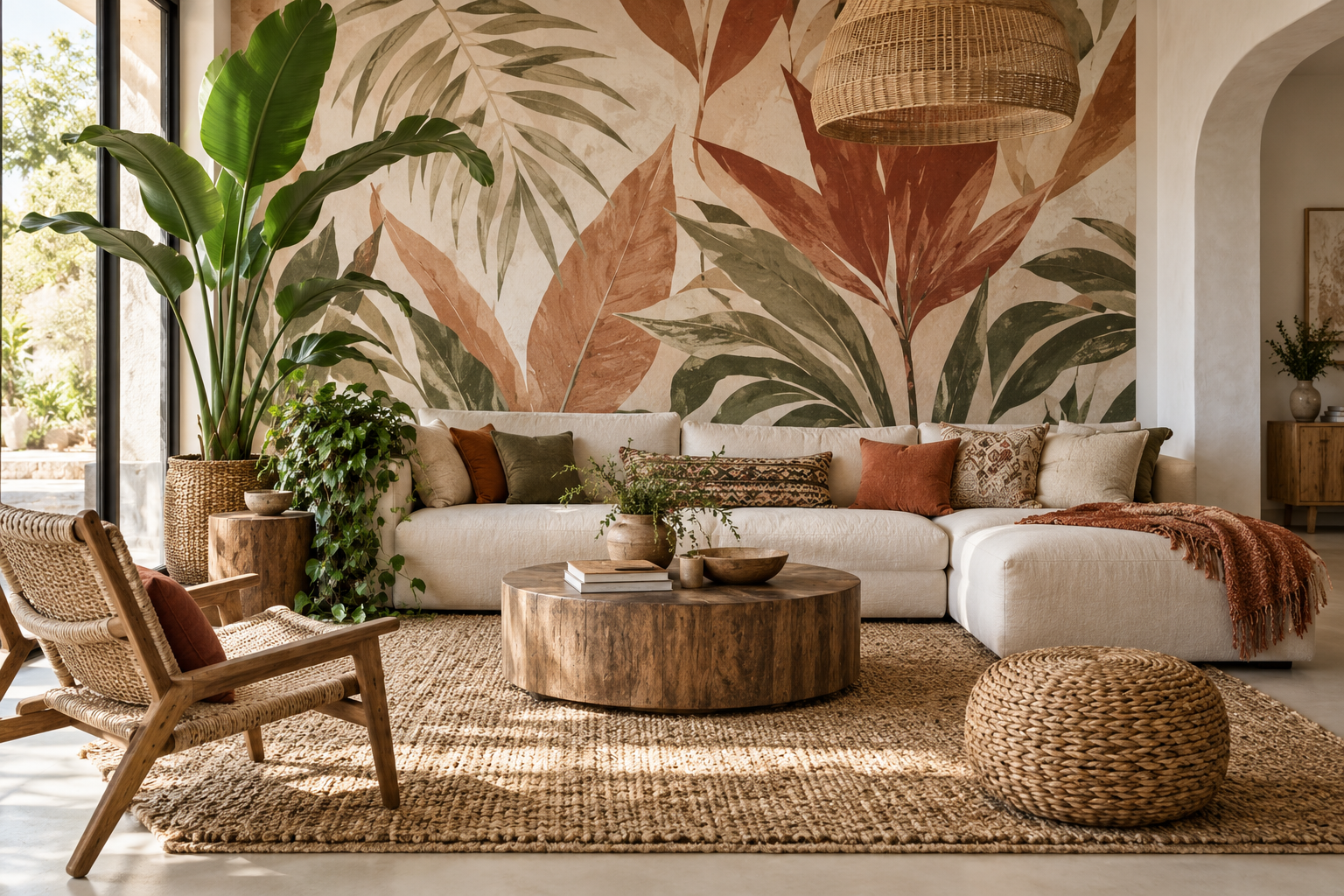
Yes, a mural can work beautifully in a bohemian interior, but it should have a role within the layers already in the room. A botanical scene can connect plants and natural materials; an abstract wash can calm a collection of patterned textiles; a landscape can give a crowded room a sense of distance. The least useful approach is to add a dense print because the room is labelled “boho”. Start by identifying what the existing rugs, upholstery and objects are already saying.
What makes a bohemian room feel coherent?
Begin with the pieces that are genuinely staying: perhaps an inherited cabinet, a rug bought from its maker, a collection of ceramics or a plant that has occupied the corner for years. Photograph them in their usual places. Their colours, scale and personal histories are more useful references than a generic “boho” mood board. If the rug has a large medallion, ask whether the proposed mural repeats its centre or gives it quieter ground. If the furniture is plain, the wall can carry a larger gesture.
There is no mandatory bohemian palette. Choose colours from the actual objects, but resist making every cushion an exact echo of the print. A mural can connect a clay-toned vase to an olive textile through a shared warm ground without turning the room into a matching set. The aim is a relationship among independently chosen pieces, not proof that they were purchased together.
Look carefully at designs described as “global” or “tribal”. Those broad labels do not tell you who made the source pattern, what it depicts or whether a new print has a documented connection to a particular tradition. If origin matters to the choice, ask for a clear design and maker reference. A loosely inspired mural should not be presented as an authentic piece from a named culture without evidence. An abstract wash, landscape or botanical can leave a meaningful textile or artwork to carry its own story.
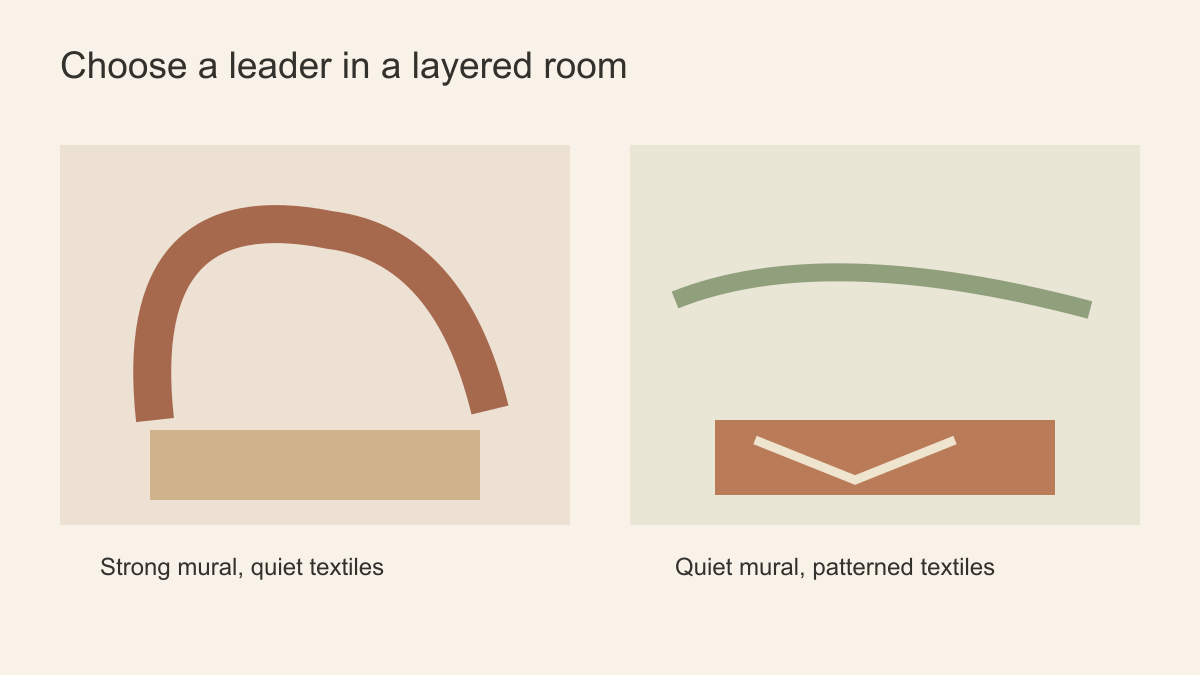 Give the wall and textiles different levels of visual intensity.
Let one collected piece set the mural's scale
Choose an anchor object before choosing the mural: the patterned rug, a wall hanging or a large piece of pottery. Note how much of the room it occupies and where it is seen from. A rug with a bold central medallion can be balanced by a wall image whose detail sits off-centre; a mural with another medallion directly above it may feel like an accidental duplicate. With a small-scale woven repeat, a few broad leaves or an open landscape can offer a different visual rhythm.
Make two mock-ups with the same furniture. In one, keep the collection in place and add a detailed mural; in the other, use a quieter wall but retain the room's strong textiles. Do not remove the rug or hanging merely to make the mural appear successful unless you genuinely intend to move it. A greyscale view helps reveal competing contrast, while a colour view checks whether the wall connects to the existing objects without copying them exactly.
There is no fixed quota of patterns. A botanical mural and floral upholstery can coexist when one is broad and spare and the other fine and regular. They become harder to read when both contain equally large, high-contrast flowers in the same visual field. If that happens, first try shifting the mural's active area away from the chair or hanging. If the collision remains, choose a different image rather than buying a series of new accessories to justify the wall.
How do plants and natural materials affect the choice?
Houseplants create actual changing silhouettes. A botanical mural behind them can become confusing if leaves of identical scale overlap. Try a mural with larger, simpler shapes, or place the plants against a calmer section of the design. If the plants are the room's main feature, consider an abstract wash rather than more printed foliage.
Rattan, cane, timber and woven rugs bring texture of their own. A printed linen or plaster effect is visual, not a physical substitute for those materials. It can be a useful backdrop, but a heavy simulated texture beside several real textured objects may look overworked. A smooth flat print with controlled colour can let the authentic materials stand forward.
Be attentive to daylight. A mural with warm rust tones may glow in afternoon light and become much darker by evening. Olive may look cooler next to a blue rug than it does on a product page. Place a sample beside the actual timber and textile colours, then view it at different times. This is especially important when choosing a full-wall print.
Consider what a plant actually hides. A tall leafy specimen directly in front of a printed central branch may merge into a confusing mass; moving the pot to the edge can frame the mural instead. A smaller plant against a quiet patch of colour will read as a separate living element. The printed leaves do not offer the movement or care needs of real foliage, and the plant does not need the mural to imitate it. Let each contribute something the other cannot.
Layering also has practical limits. Woven furniture, wall hangings and shelves may cast complex shadows over the print, changing how its colours look through the day. If the intended wall already supports many objects, a mural with a large calm area may be more resilient than one whose focal subject falls behind a shelf. A visual mock-up should include the actual wall hanging and the plant at their likely sizes, not just a blank rectangle and an idealised sofa.
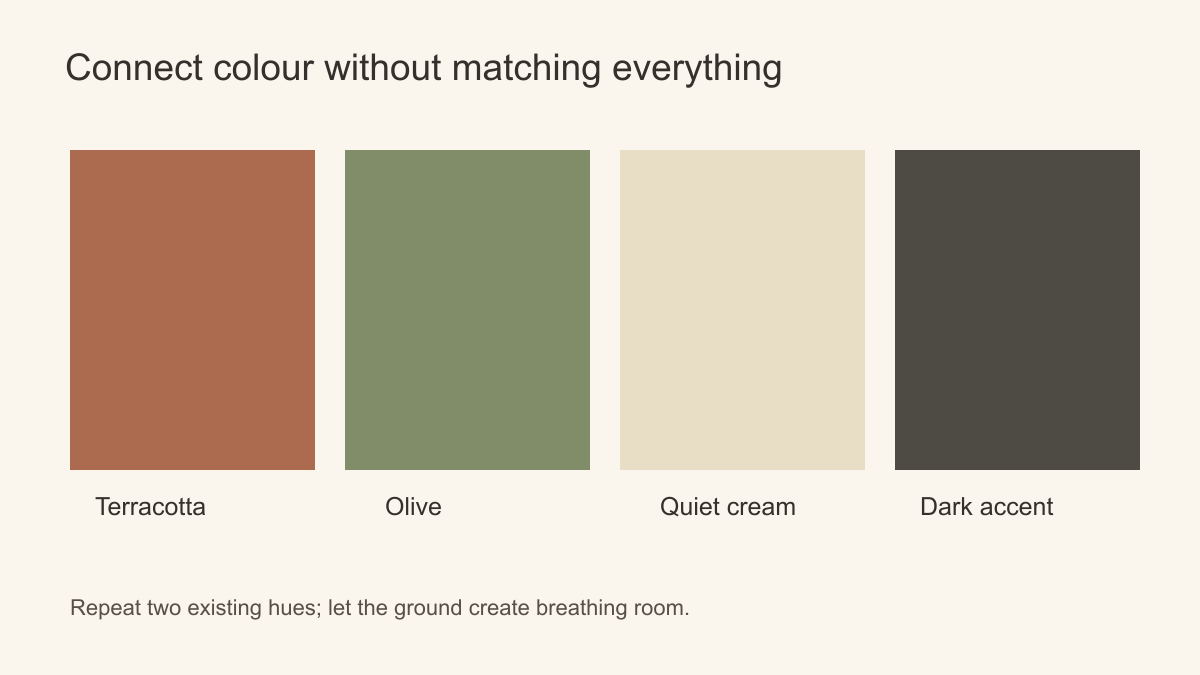 Connect the mural to two existing colours and leave a quiet ground.
Where should the mural go?
The best wall is not necessarily the one behind the sofa. In a room with shelving and many collected objects, a mural on the wall opposite the shelves can balance their visual weight. Behind a bed, an atmospheric scene can replace several small pictures and reduce clutter. In a dining nook, a botanical or abstract composition can create a contained destination without covering every wall.
Consider the furniture footprint and what will hide the artwork. A tall plant, wall hanging or bookcase may cover its key feature. Preview the crop with those objects in place. If the mural is made to measure, measure width and height carefully and allow for trimming according to the supplier's instructions. A wall with multiple windows may need a different composition from a clear uninterrupted wall.
Not every bohemian room benefits from one panoramic scene. A repeating pattern can work where furniture placement changes regularly, because no single focal object will be lost. A custom landscape can work where a stable seating arrangement gives it a clear view. Choose based on the way the room is used, not a rule that one format is inherently more bohemian.
Think about how often the room's collection changes. A broad abstract wash can accommodate a new framed print or a chair moved to another wall. A tree or figure placed precisely between shelves is more vulnerable to rearrangement. If you regularly rotate textiles and objects, leave open ground around the mural's focal area rather than composing the print around today's exact arrangement. If the furniture is stable, a more deliberate scenic crop can be worth the commitment.
Wall dimensions and openings matter too. A tall narrow wall beside a doorway may suit a rising botanical form, whereas an open wall behind a low sofa can accommodate a wide landscape. A panorama cut into several short sections by windows might lose its sense of place. Measure the actual surface, mark fixed obstacles and view the order-size crop rather than relying on a staged product image. Allow only the supplier's stated trim, and check that the essential motif remains visible after installation.
A few combinations worth testing
In a living room organised around a colourful rug, a botanical with open ground can borrow one green and one warm accent while leaving the rug's central design independent. In a plant-filled room with several woven chairs, a broad clay-and-chalk abstract may give the real leaves and textures room to stand forward. In a quiet bedroom where bedding changes often, a floral with a versatile ground can provide personality without dictating every future fabric colour.
A large patterned wall hanging presents a different layout problem. Putting it directly over a second dense pattern can make its edge disappear; placing a more atmospheric mural on the opposite wall may balance the two surfaces. The best candidate is the one that lets the collected object retain its outline and identity when the room is viewed in ordinary use. Test that relationship in a real room photograph rather than assembling an idealised set of new accessories.
The practical answer
Use one object with a real place in your collection as the anchor, whether it is a woven rug, an inherited cabinet or a piece made by a named artist. Photograph it in the room and note what the mural should leave visible around it. Compare candidate walls at full scale: one may echo a colour but crowd the object's outline, while another may leave enough open ground for its form to read. Keep the object's own identity and provenance in the description of the room; a newly printed, loosely inspired motif should not be presented as belonging to the same tradition without evidence.