How to Choose Mural Wallpaper for a Cafe
Consider customer atmosphere, seating, lighting, cleaning, circulation and the visual identity of the cafe.
Article focus: pricing and measurement
What to settle before pricing
Start with accurate wall measurements; the final custom mural price depends on area, material and any finishing options.
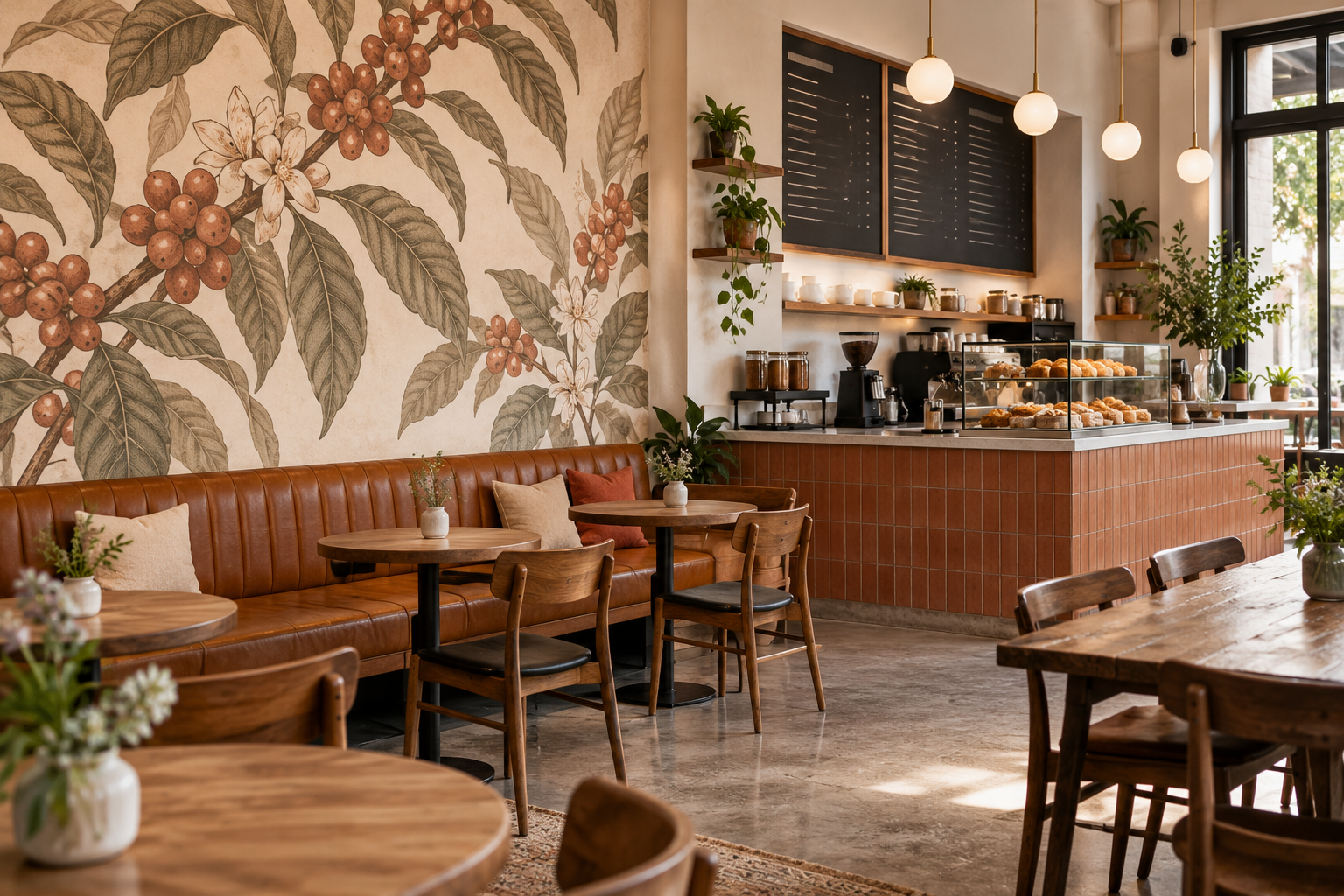
Example application: Any room with a suitable, prepared wall · pricing and measurement
Choose a café mural for the way people use the room, not for an empty-room photograph. Guests need to find the menu and collection point quickly, then may spend much longer looking at the seating walls. A good design gives one area a distinct atmosphere without competing with ordering information or asking a decorative surface to endure an unsuitable cleaning routine. The wall, the artwork and the specified material all need separate decisions.
Separate the ordering view from the seated view
At the entrance, a guest is looking for the counter, menu, queue and available seats. A mural near the service point can add identity, but it should not obscure prices or the route to order. From a table, the same guest has time to notice branches, a distant landscape or smaller illustrated details. These are different viewing distances and attention spans; one busy wall rarely needs to carry both the service information and the room's decorative story.
Map the busiest queue, not just the empty floor. A line of people can block the lower half of a wall. Chairs and coats can hide detail that looked central in a rendering. Photograph the café during normal service from the doorway and from a typical seat, then lay the proposed crop over those views. Place important artwork where it remains legible above occupied seating, or choose a composition that tolerates partial obstruction.
In the accompanying café image, illustrated coffee branches and pale blossoms sit over a fixed leather banquette. Their main clusters remain visible above the seat backs, while the menu boards have their own clear dark ground across the room. That separation is more useful than printing coffee imagery behind the menu text simply because the theme matches the business.
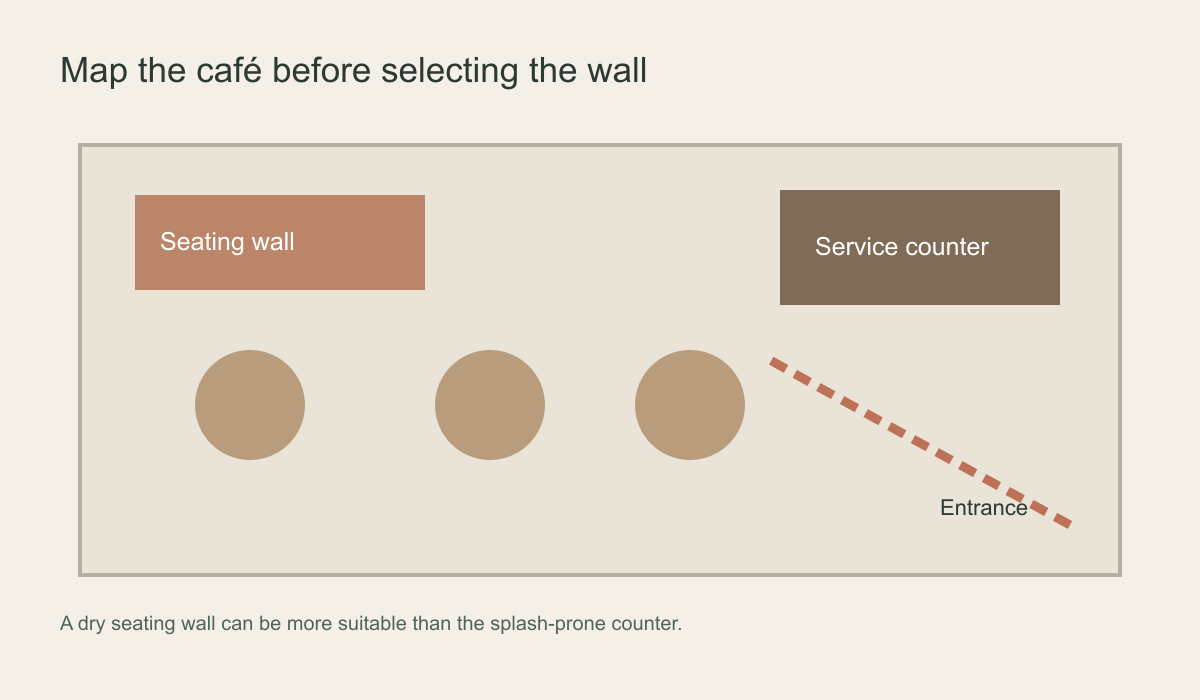 The seating wall and the service counter have different visual and practical roles.
Use the café's existing materials to narrow the theme
There is no requirement to put a cup, bean or slogan on a café wall. A botanical may connect with timber and living plants; a broad landscape can lend a long seating wall a slower visual rhythm; a restrained abstract may leave colourful pastries and drinks as the most noticeable elements. Compare each candidate with flooring, upholstery, tile and the actual counter display. When several of those surfaces already have strong pattern or colour, simpler artwork can provide welcome contrast.
A literal coffee-plant mural can still be appropriate, particularly when it introduces an illustrative style not already repeated on packaging and menu boards. But if beans and branches appear on every printed item, another coffee image may add no useful layer. Try two concepts in the same room photograph: one connected directly to the brand theme and one based on the interior's colours or sense of place. Judge them with chairs, lamps and people included, not in separate polished mock-ups.
Print a substantial sample and inspect it under the café's real daylight and evening lighting. Warm pendants can change the appearance of pale grounds and muted reds; a screen image is not a reliable test of printed colour or surface. The sample also lets you compare the mural with the upholstery at close range, while a scaled wall proof shows whether the subject is too large or too small for the seating length.
Protect the menu's clarity
Guests must be able to read prices, choices and any important ordering information from the distance where they make decisions. If a menu shares the mural wall, reserve genuinely quiet ground behind it or give it a separate solid backing. Test the real type size and content, including daily specials, rather than approving a mock-up with placeholder lines. A high-contrast leaf or horizon behind small lettering can interrupt reading even when the artwork itself is attractive.
Keep the pastry case in the visual hierarchy too. Food may already supply the strongest colour near the counter. A low-contrast wall nearby can let the display stay prominent, while a richer scene on a farther seating wall can define a place to linger. The point is not to make the mural invisible; it is to avoid giving guests two competing focal points at the moment they need to order.
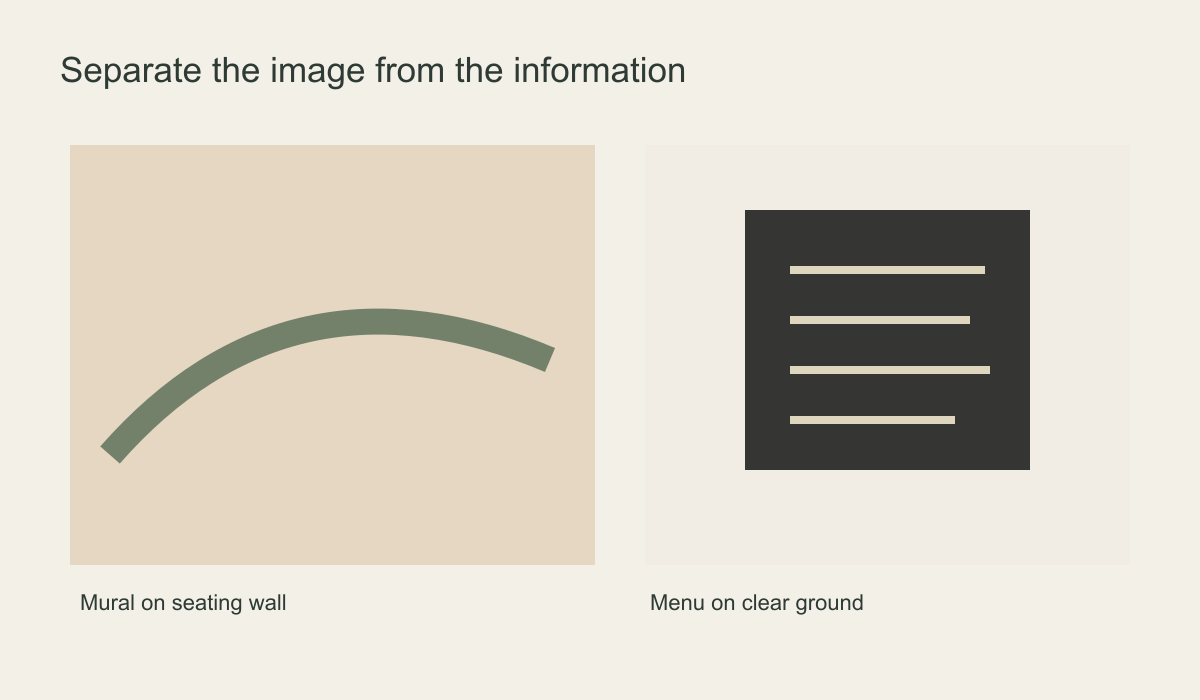 Give the menu clear ground and let the seating wall carry the image.
Crop for the seat, not just the room photograph
A fixed banquette offers a stable reference line. Mark its back height, wall lights and the nearest guest's eye position on the crop proof. A panoramic image with all its interest below the seat backs will be lost once the café opens. An oversized focal flower may look balanced from the entrance but feel like an isolated fragment to someone sitting directly beneath it. Check the composition from the end table as well as the central one.
Loose tables move for groups or events. The mural should still read when a table shifts or a temporary display appears. Distributed branches, broad tonal changes or a landscape with more than one area of interest can be easier to live with than an image precisely centred on one movable table. If the café hosts events, sketch the temporary arrangement over the same proof before finalising the crop.
Record doors, sockets, shelves, ventilation grilles and lights before printing. A branch cut by a wall lamp may be more noticeable than a modest adjustment to the crop. Measure the final installation zone after the furniture plan is settled, and confirm where panel joins will fall relative to the artwork.
Check the wall's exposure before choosing the finish
The dry wall above a banquette has different demands from the surface behind an espresso machine, sink or waste station. Steam, splashes, food residue, chair backs and frequent wiping should be assessed at the actual location. The Wallcoverings Association's types-and-usage guidance relates wallcovering choice to the environment and traffic. Its cleaning advice directs users to the manufacturer's instructions for the particular covering.
Ask the supplier for the exact finish's cleaning instructions, relevant performance documentation and installation requirements. Check local commercial and landlord requirements where applicable. A material label alone does not prove that the print can be disinfected, withstand repeated splashes or satisfy a fire classification. If the proposed decorative finish has no supporting evidence for the work zone, move the image to a protected seating wall and use a suitable surface behind equipment.
Staff routines are part of the brief. Does a chair back rub the wall after every table change? Is the banquette wiped at the end of each shift? Where do drinks get passed from counter to table? These observations are more informative than assuming every wall in a café has the same level of wear. Keep approved cleaning instructions where staff can find them, rather than using the cleaner intended for counters on the mural by default.
Plan installation around service
Arrange wall preparation and hanging when the area can be kept clear of guests and furniture. Inspect the exposed surface before final measurement. Agree who removes and refits lights, signs or shelving, and follow the selected product's instructions for installation and aftercare rather than promising immediate use of the wall. Where daily trading cannot pause, isolate the work area and consider whether another, less disruptive feature wall would serve just as well.
Keep the approved artwork version, crop, panel sequence and material sheet with the café's maintenance records. If a chair or event sign later marks one panel, those details make an assessment more precise. They also help future staff understand why the seating wall has a different cleaning procedure from the service counter.
For most cafés, the strongest choice comes from this order: keep ordering information clear, give the seated view an image worth living with, crop it around the occupied room, and verify the finish for the wall's actual exposure. The mural then contributes to the experience without taking attention away from the food, drinks and service.