Can Mural Wallpaper Be Used in a Commercial Space?
Plan a commercial mural around brand atmosphere, wall condition, traffic, access, maintenance and the intended customer experience.
Article focus: pricing and measurement
The cost and measurement decision
Start with accurate wall measurements; the final custom mural price depends on area, material and any finishing options.
Example application: Hallway or entryway · pricing and measurement
Yes, mural wallpaper may work in a café, office, boutique or reception area, but visual suitability is only the first test. A scene can fit the room beautifully while the proposed material, adhesive, cleaning method or installation system lacks the documentation a particular project requires. A lifestyle photograph cannot establish approval for a building. Start with the wall's location and use, identify who must sign off the finish, and only then finalise the print and crop.
Define the space more narrowly than “commercial”
A quiet office meeting room, a busy restaurant banquette, a salon waiting area and a hotel escape corridor create different demands. Note where the wall sits, how many people pass it, whether furniture or bags touch it, how the space is cleaned and whether food or moisture is nearby. A mural behind fixed seating may have less direct contact than one beside a queuing line. This usage map helps determine both where the artwork should go and what evidence you need about the finish.
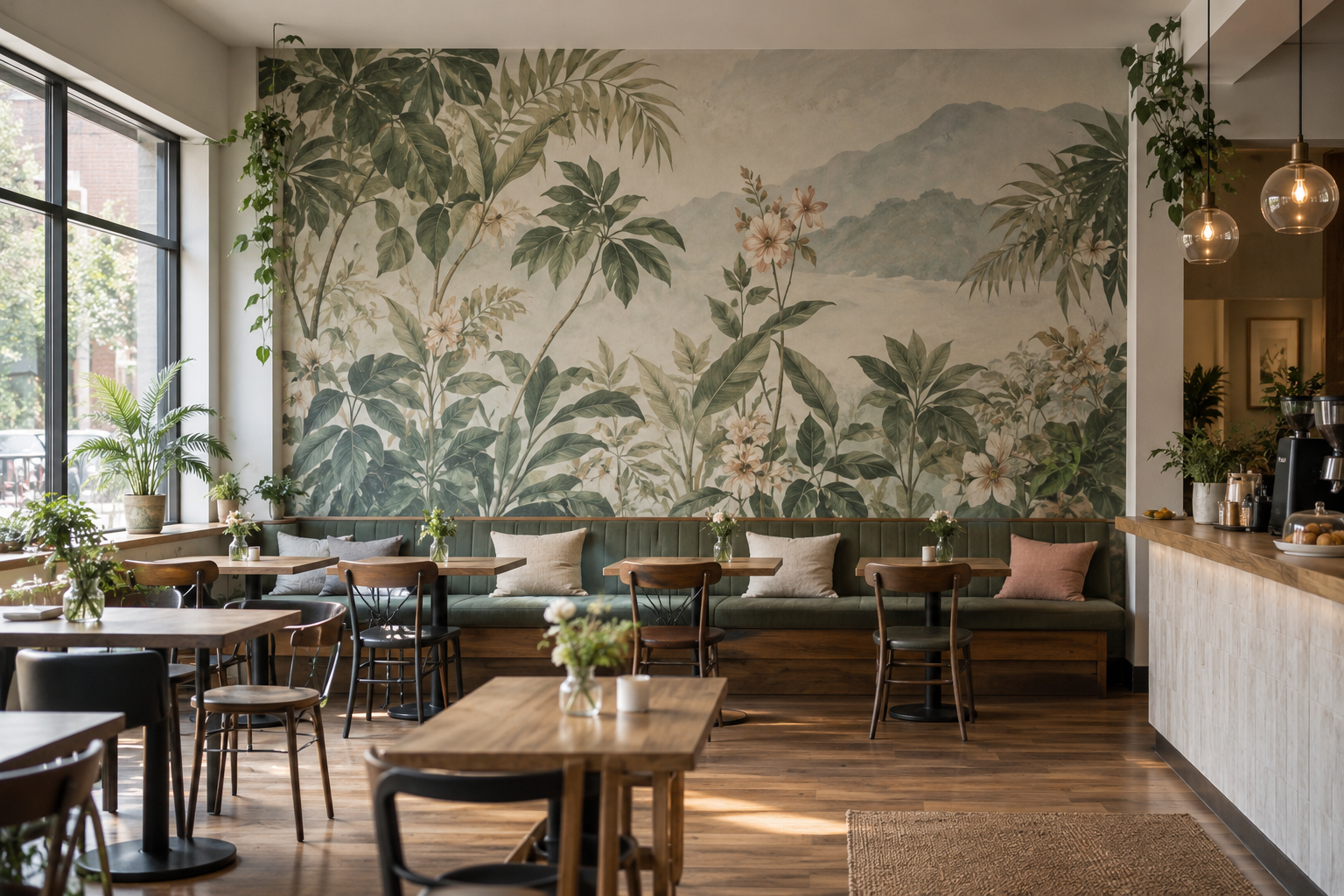
For example, a café owner might place the scene above a fixed banquette so customers see it from the counter, while keeping the lower wall out of regular chair contact. An office might prioritise a quiet meeting-room wall where the art can be viewed from seated positions. These are layout examples, not evidence that any particular mural finish meets the cleaning or safety requirements of either space.
Walk through the venue when it is operating, not only when it is empty. Chairs move, customers queue, cleaning staff carry equipment and signage may be changed. Mark the sections likely to be touched, washed or hidden. If the intended wall is immediately beside food preparation, a wash station or a high-contact circulation route, the project team may need a different finish or a different mural location. Moving the artwork to a lower-contact wall can be a sounder design decision than assuming a decorative print has an unverified performance rating.
The café concept in the feature image demonstrates a calmer wall behind seating. It is an editorial illustration of possible placement, not a photograph of a Solowalls installation or proof that a particular product meets hospitality requirements. Treat the image as a design conversation starter. The final specification must refer to the exact product, substrate, adhesive and venue.
Check approval before falling in love with a design
Building and fire requirements vary by jurisdiction, occupancy and location within a building. A corridor or protected route may be treated differently from a private room. For example, the International Building Code's interior-finishes chapter addresses classification of interior wall finishes; in England, Approved Document B gives fire-safety guidance. These are starting references for the project professional, not a determination that this store's mural qualifies or that a given edition applies locally. Ask the architect, fire consultant or responsible authority which adopted rules and test documents apply to the actual wall.
Do not describe a mural as fireproof, flame-retardant or code-approved unless current documentation for the exact product and installed system supports that statement. A material name such as Vinyl or Heavy is not itself a fire test result. Ask the supplier for any available technical data and test reports before the specification is signed off. If the required evidence is unavailable, choose another approved finish for that wall rather than assuming that a residential product photograph settles the question.
Make the approval request specific. Give the supplier the venue and wall location, existing substrate, proposed print stock, adhesive, installation method and the cleaning routine staff will use. Ask which current test reports and care instructions apply to that exact combination, then give the reply to the architect or other responsible reviewer to compare with local requirements. Keep the written decision with the project specification. A certificate for another print stock or an uninstalled sample cannot stand in for the proposed assembly.
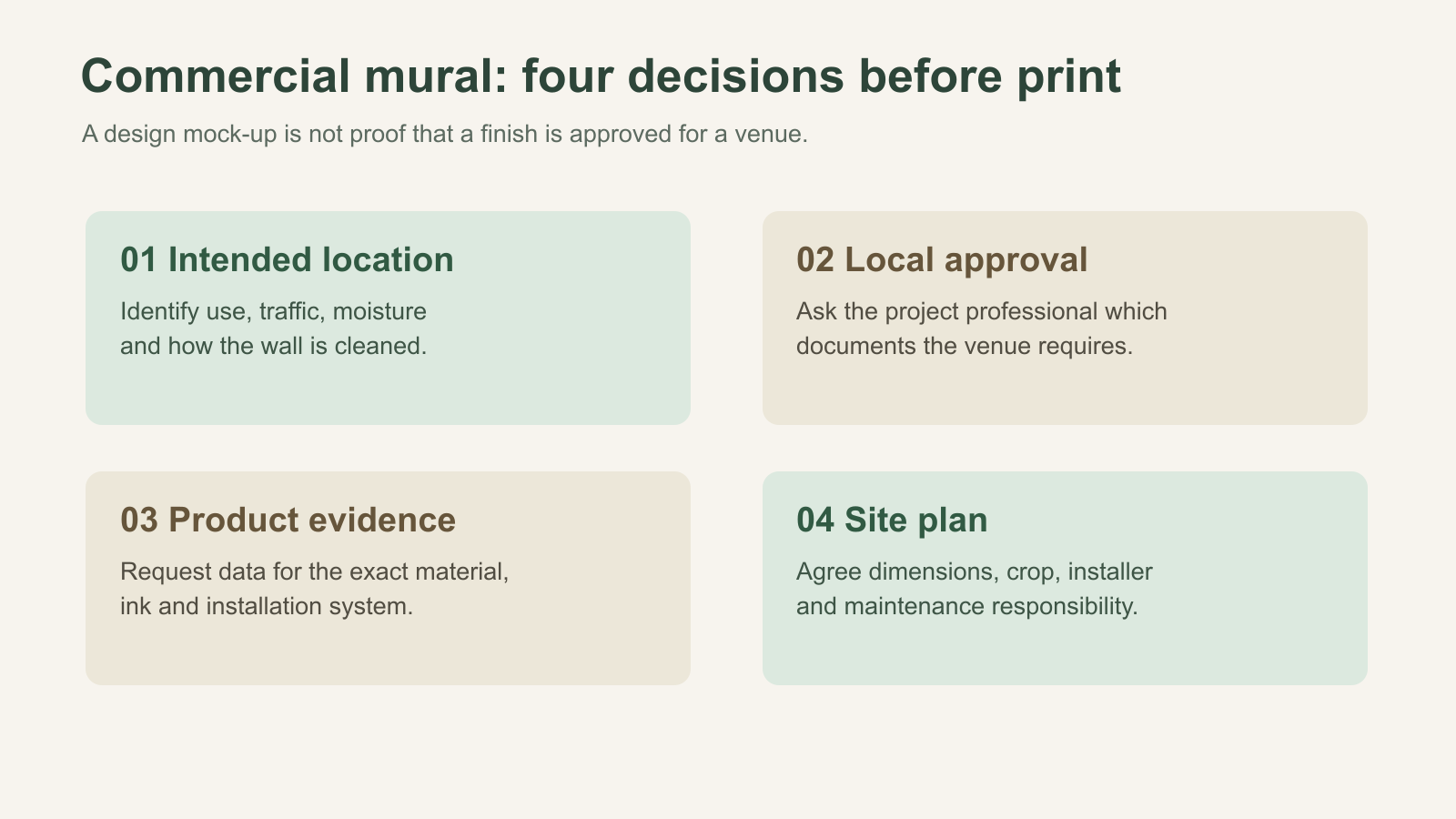
The decision chart below places venue use and local approval ahead of printing. It does not state that every project needs the same test or that the store currently supplies a particular certificate.
Choose artwork for the customer experience
Once the wall is viable, the mural can help people understand the space. A reception mural may establish the first impression; a dining-area scene may create a quieter backdrop; an office mural might mark a meeting zone without filling every wall. Consider the typical viewing distance and how much of the picture furniture will hide. A large canopy or panorama can work on a broad, unobstructed wall, while a small repeated detail may survive a short wall with doors and shelving more comfortably.
The flat forest artwork below looks upward through tall trunks towards strong light at the upper right. In a café or reception area, a high sign, ceiling bulkhead or crop at the top corner could remove that visual focus. Show the proposed layout with fixed signage and furniture overlaid before approving the print. This image is a design file, not evidence of commercial performance for the selected finish.

Measure the operational wall, not an ideal rectangle
Record finished width and height at several points. Mark doors, glazing, service panels, sockets, skirting, corners and any fixed furniture that will interrupt the print. A drawing should show how the artwork is cropped and where numbered panels start. The site's general ordering guidance adds approximately four inches or ten centimetres to both width and height for trim, but a multi-wall commercial fit-out may need a supplier-reviewed layout rather than a single checkout rectangle.
Schedule installation when the wall is clean, smooth, dry and fully ready, with other trades clear of the area. Confirm who will inspect panels on arrival, who will install them and who signs off the selected crop. A contractor should not discover at the wall that an access hatch or piece of signage cuts across the main subject. If the project has multiple rooms, label the prints by room and keep each room's dimensioned layout with its panels.
Ask the design team to agree a single dimensioned elevation for each wall. That drawing should show the finished wall size, crop, panel sequence, permanent fixtures and the position of the main subject. A reception desk can hide the bottom of a mural without affecting a canopy scene, but a menu board might obscure the part visitors are meant to notice. Approving a full-width digital image without testing those obstructions is not the same as approving the installed view.
Make maintenance a real part of the specification
Commercial staff may expect to wipe every surface, but not every decorative wallcovering is washable. Ask for the care guidance of the exact selected finish and compare it with the venue's cleaning routine. If staff must use a particular disinfectant or frequent wet cleaning near the wall, obtain written confirmation of suitability instead of assuming it. Consider protection from chair backs, carts and bags through furniture layout or a different location. Pattern can disguise a tiny mark at a glance, but it cannot prevent physical abrasion.
Hand over the approved care instructions to the person who actually cleans the venue, not only the person who ordered the art. A cleaner following a standard spray-and-wipe routine needs to know whether that method is permitted on this finish. Record who will deal with a lifting seam, a damaged panel and an obstruction added after installation. Those mundane responsibilities often determine whether the mural remains workable in a commercial interior long after the opening photographs have been taken.
For a café with two candidate walls, write a separate decision on each elevation. Above the fixed banquette, note who approves the wallcovering assembly, which area the seats conceal and how staff can reach the printed surface for permitted care. Beside the queue, record the cleaning method staff actually use at closing time and whether the selected finish's instructions allow it. If that routine cannot be reconciled with the care document, keep the mural at the seating wall or select another approved finish for the queue. Give the signed elevation, current product documentation and care sheet to the installer and facilities lead; an attractive render alone is not a handover record.