Can Mural Wallpaper Work in an Entryway?
Choose a composition and material with the scale, traffic, sightlines and welcoming atmosphere of an entryway in mind.
Article focus: pricing and measurement
The cost and measurement decision
Start with accurate wall measurements; the final custom mural price depends on area, material and any finishing options.
Example application: Living room · pricing and measurement
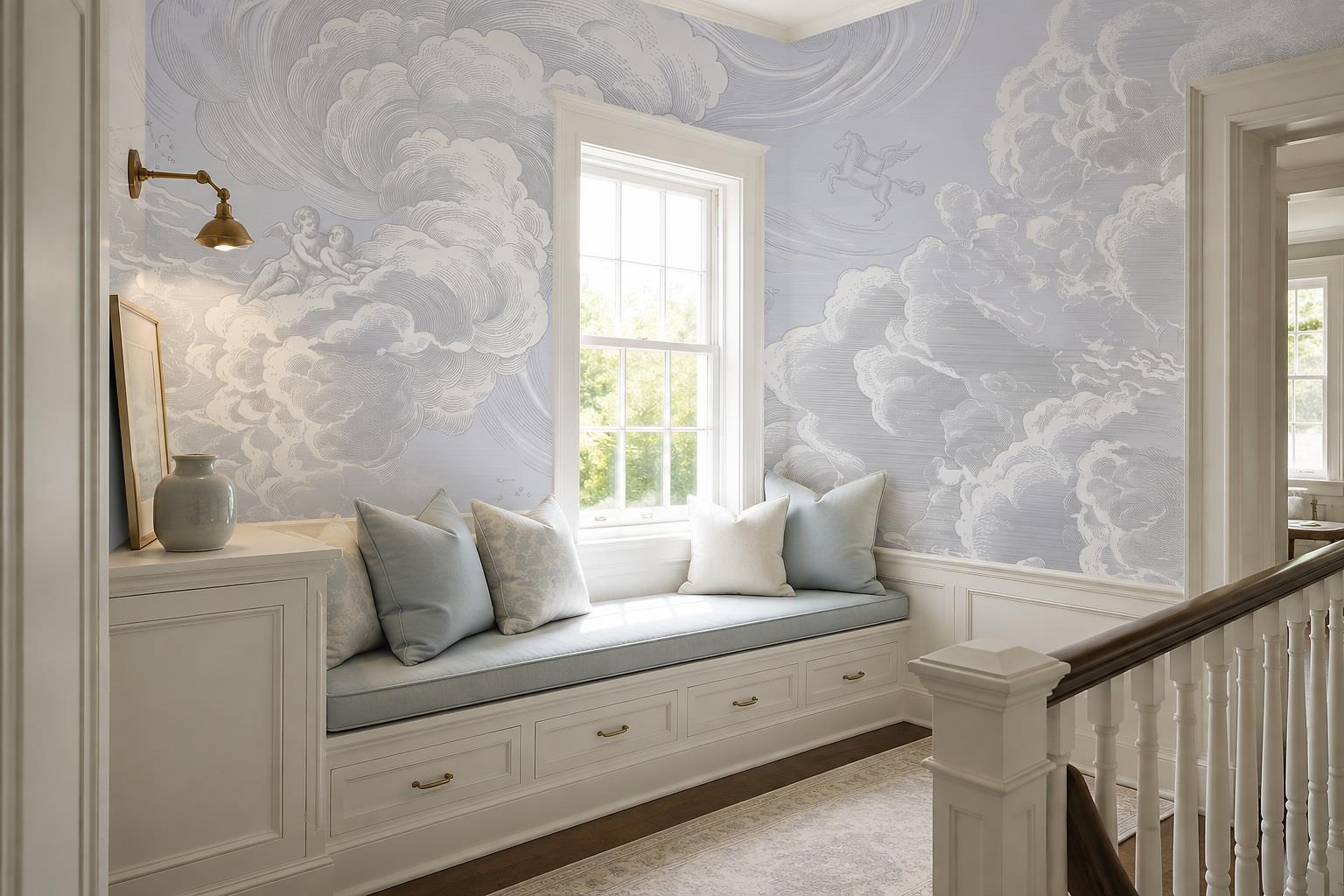
Yes, a mural can work in an entryway, including one broken up by a window, a door and storage. The pale engraved-cloud design shown above is in a stair-adjacent hall, not a front-door foyer; it demonstrates how a print can continue around a corner and either side of a window. Its small figures still need to be considered when cropping. A front entrance adds its own door swing and everyday storage to that challenge. Start with what is visible when the front door opens, then choose a composition that survives the room's actual obstacles.
Start at the front door
Open the front door to its usual stopping point and pause with a bag in one hand. Which part of the proposed wall is actually visible before you step inside? The door leaf may hide the design you planned as the welcome image, while a short wall above a console remains in view. In a small entrance, that first clear patch can matter more than the longest wall on a floor plan. Put the artwork's recognisable element there, or choose a distributed print if the opening door changes the view too much.
Then rehearse the first minute at home: close the door, take off a coat, set down keys and move past the bench. Hanging coats and a mirror can cover or double the mural at precisely those moments. Photograph the wall with storage in normal use rather than emptied for a mock-up. The cloud-lined landing in the opening image is not a front-door foyer, but its window and stair rail show how large engraved forms can remain legible when the wall is divided. Its smaller figures need more careful placement if a real coat rail or cupboard enters the crop.
Match the artwork to the viewing distance
A generous foyer can support a broad scene with a recognisable centre. A corridor-like entryway is usually viewed from only a few steps away, so tiny intricate detail may not register as intended. Large motifs can be compelling close up, yet they need enough uninterrupted wall to read as shapes rather than random fragments. Look at the crop at actual wall dimensions and imagine the view from the doorway, not just a close-up of the print.
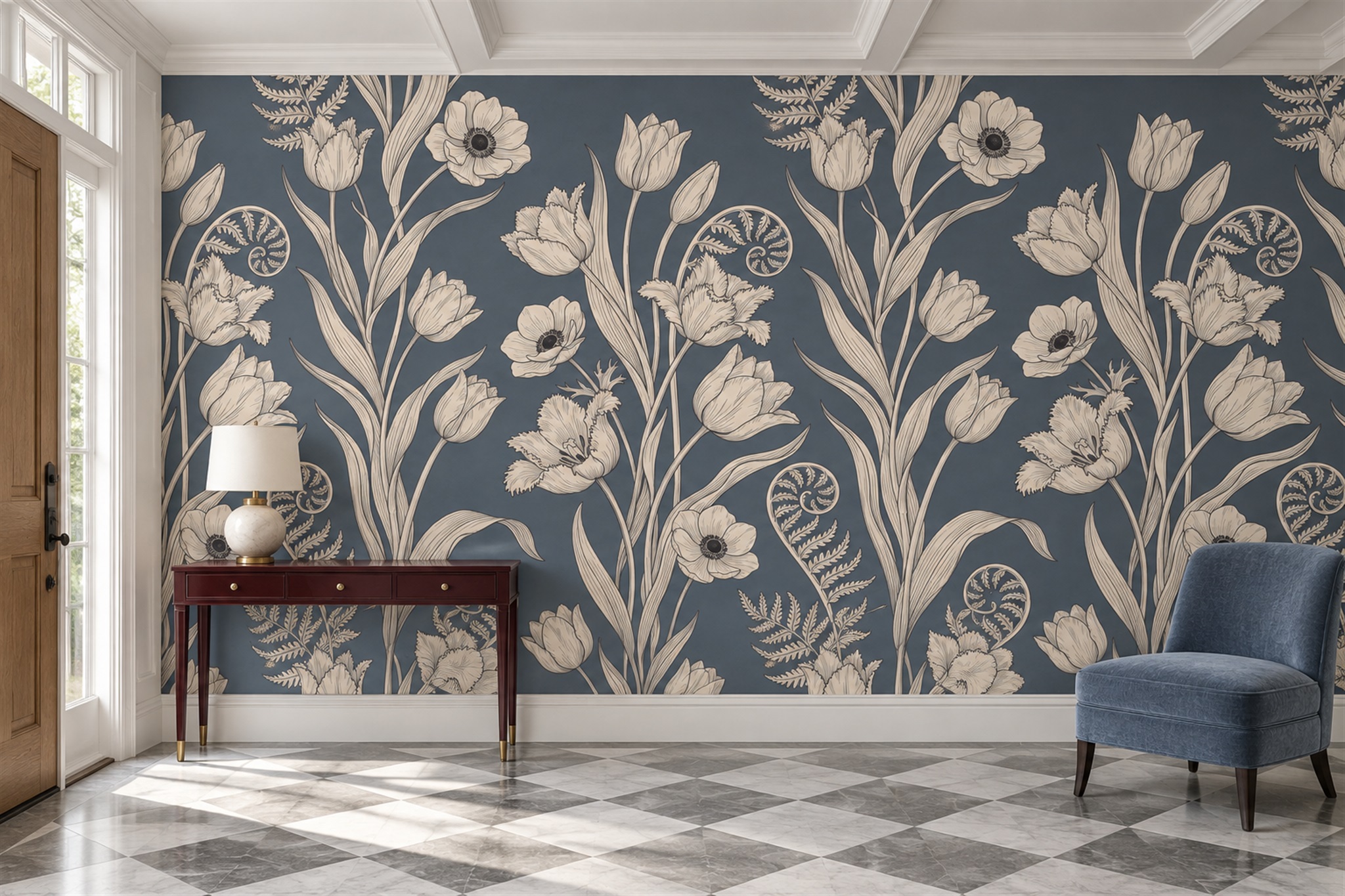
The floral entryway below uses oversized cream tulips, open blooms and fern-like curls against a dark navy field. Motifs recur across the wall, so the small console hides part of a stem without erasing the design's only subject. The dark ground is still a significant choice: seen at close range, its contrast with white joinery and pale flowers feels far stronger than a soft neutral. Check whether you want that impact each time you enter.
Let the entryway lead into the next room
The front hall rarely exists in isolation. From it, you may see a living room, stair or dining space, and the mural should have a considered relationship with those views. Repeating a colour already present in an adjacent room can create continuity without using identical décor. A contrast can work too: a dark, enveloping entrance can open into a pale living area. What matters is that the change feels intentional when both spaces are visible at once.
Consider materials underfoot as well as colours on the walls. Stone tiles, patterned flooring, timber and a runner each bring their own rhythm. If the floor is visually busy, a mural with spacious areas of colour may let it breathe. If the hall has plain flooring and simple joinery, the wall can carry more of the decoration. The artwork should also sit comfortably beside the door colour and any fixed cabinetry; a sample held against these finishes is more informative than a digital mood board alone.
Small entries need measured contrast, not necessarily pale prints
It is tempting to assume that a small foyer must have a light mural. The engraved clouds keep the photographed landing's window nook visually open, but the navy floral entry shows that a darker print can also work where the ceiling, joinery and daylight balance it. The distinction is between deliberate contrast and a wall whose details disappear in the evening. Check a sample with the front door shut, under the actual ceiling or wall lights, not only in a sunlit product photograph.
Colour can also define a zone in an open-plan entrance without constructing a partition. A mural behind a bench or console gives the arrival area a clear visual edge. If the hall is already full of hooks, shelves and baskets, it may be better to use the mural on a cleaner opposing wall. The design should support the way the entry functions, not make everyday storage look like an intrusion.
Use a landscape when the wall allows a longer view
A broad entryway can support a panoramic image that would be difficult to appreciate in a tight corridor. In the foyer below, snow-covered peaks rise above turquoise lakes under a pink-violet sky. The bench and low cabinet conceal part of the foreground, but the mountain ridge remains readable across the wall. The effect depends on that uninterrupted width. On a wall cut by two doors, the same landscape might become disconnected fragments rather than a coherent arrival view.
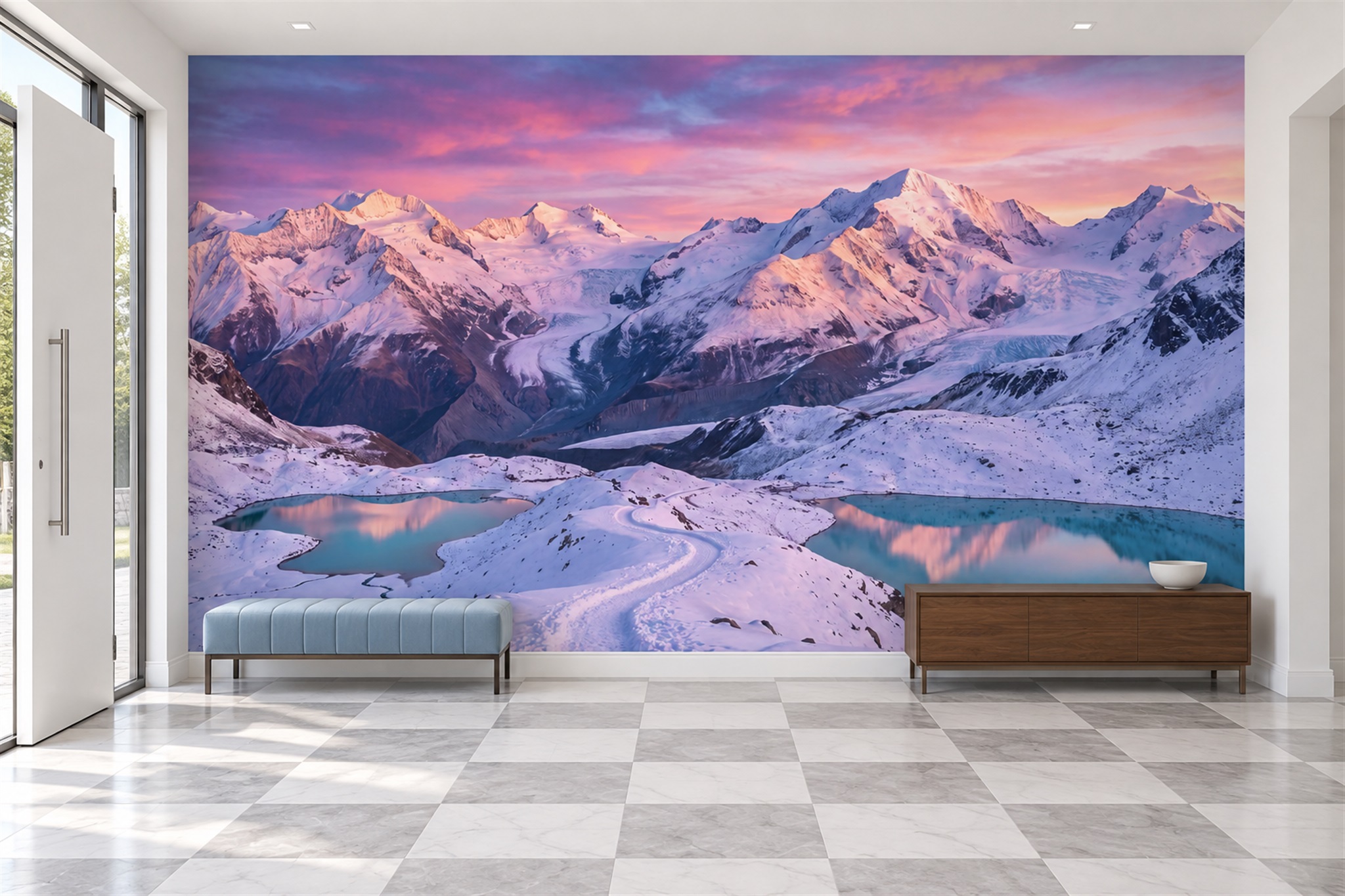
That does not mean a landscape is the universal answer. If the wall is broken by several doors, a distributed botanical or abstract arrangement may survive the interruptions better. If the entry is very tall but narrow, an upward movement in the artwork can make the proportions feel purposeful. Choose for the architecture you have, not for the room name in a product listing.
Measure around real obstacles
Draw the entrance in three states: door shut, door open, and storage in everyday use. Mark the console, mirror, hooks, shoe cabinet and the sweep of the door on each copy of the wall-specific crop. A flower that is clear when the door is shut may disappear every time a guest arrives; a mountain ridge might survive above a low bench but be cut by a tall cupboard. Agree which state matters most rather than trying to make every position identical.
Measure the wall width and height and locate the doorframe, switches, wall lights and fixed storage before approving the print. Keep the supplier's fitting margin distinct from the visible picture. If a meaningful figure lies beside the frame or cupboard, request a layout check; extra trim cannot bring back a hidden subject. Also inspect the actual surface and the chosen material's preparation and care instructions. The visual mock-up does not confirm that old paint is sound or that the finish tolerates contact from bags and coats.
Plan for daily use after installation
Think about where bags brush the wall, where shoes are stored and whether a bench back will touch the print. These details may suggest choosing a less exposed surface or ending the mural above existing panelling; they do not automatically rule it out. Ask the supplier for care instructions for the exact material rather than assuming a printed surface will tolerate frequent contact or cleaning. Good lighting matters both for seeing the artwork and for the practical task of finding keys or putting on shoes.