Can Mural Wallpaper Work in a Game Room?
Coordinate bold artwork with screens, lighting, seating, sound equipment and the way the room is used.
Article focus: pricing and measurement
The cost and measurement decision
Start with accurate wall measurements; the final custom mural price depends on area, material and any finishing options.
Example application: Any room with a suitable, prepared wall · pricing and measurement
Yes, mural wallpaper can work in a game room, provided the artwork sits outside the activity's impact zone and does not compete with what players need to see. A screen-led setup, a pool table and a dartboard make very different demands on nearby walls. Choose the wall after placing the equipment and testing the room in use. The image can give the space an identity; it cannot serve as a cue guard, dart backboard or substitute for documented wallcovering performance.
Decide which kind of game controls the room
Start with the activity used most often. In a video-game room, people face a screen for long periods. In a pool room, players move around all sides of the table and spectators look across it. Around a board-game table, chairs shift and shelves of boxes may fill the background. A dart setup puts repeated impacts close to one particular wall. The same mural could be well placed for one of these uses and poorly placed for another.
Draw the equipment at its actual size on a floor plan, then stand at every playing and viewing position. Mark the route of an extended cue, the space behind pulled-out chairs, screen sightlines, doors and storage. A wall that looks empty on a plan may be hidden by an arcade cabinet or within reach of moving equipment. Only then choose the position and scale of the image.
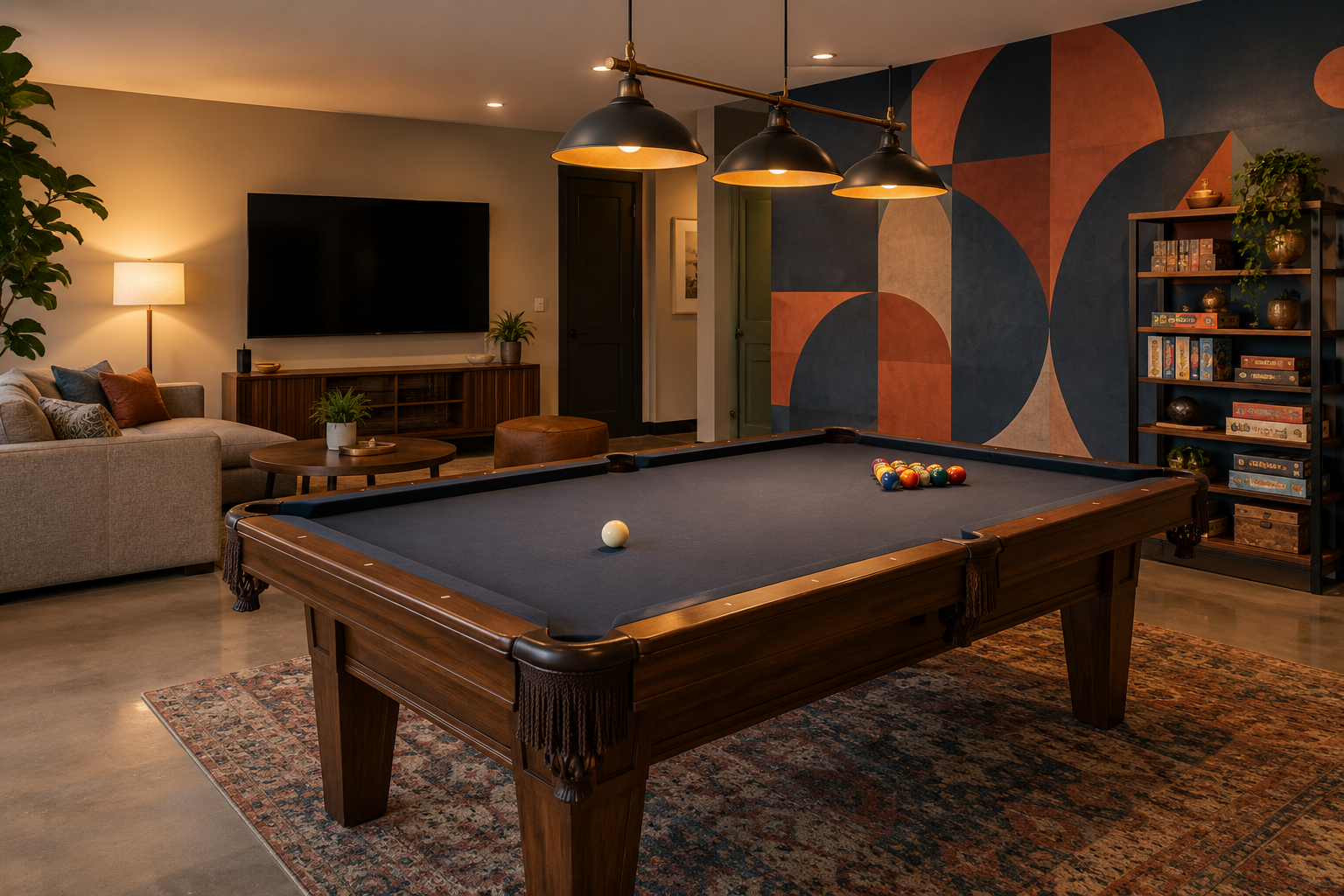
The accompanying photograph offers a practical example. Its large terracotta and navy geometric artwork occupies a wall beyond the pool table, while the television sits on a relatively plain wall. The two focal points have different jobs. Before copying that arrangement, however, a player should still test a full cue stroke along every side of the table; a compelling photograph does not prove the printed wall is outside the cue path.
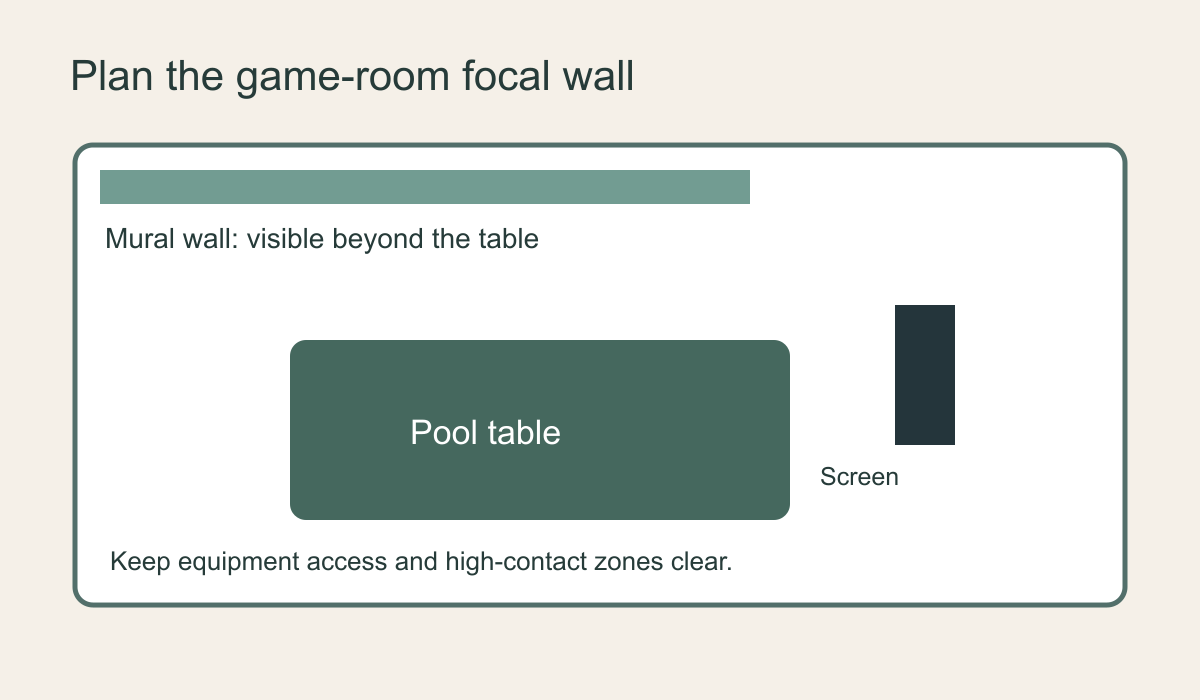 Map play and equipment movement before selecting the mural wall.
For screen games, give the display visual room
A high-contrast pattern immediately around a television can pull attention away from moving images. Try three positions in a mock-up: a restrained print behind the display, a more expressive mural on an adjoining wall, or artwork opposite the screen. The adjoining wall can carry more character without framing the display with hard-edged shapes. An opposite wall may appear as a reflection in the screen, particularly in darker conditions.
Test from the normal sofa or gaming chair with the screen on and off. A dark navy design may lose its internal detail under low ambient light; a light print may seem more prominent than expected. Coloured LEDs and daylight also change how printed colour appears. Use a physical sample on the proposed wall, and check the actual material finish rather than assuming a photograph tells you its sheen.
If a bigger screen is a likely upgrade, mark its outline over the proposed crop. A single focal subject centred behind today's display could disappear behind the next one. A broad abstract form, a flexible repeat or a mural on a separate wall can survive that change more easily.
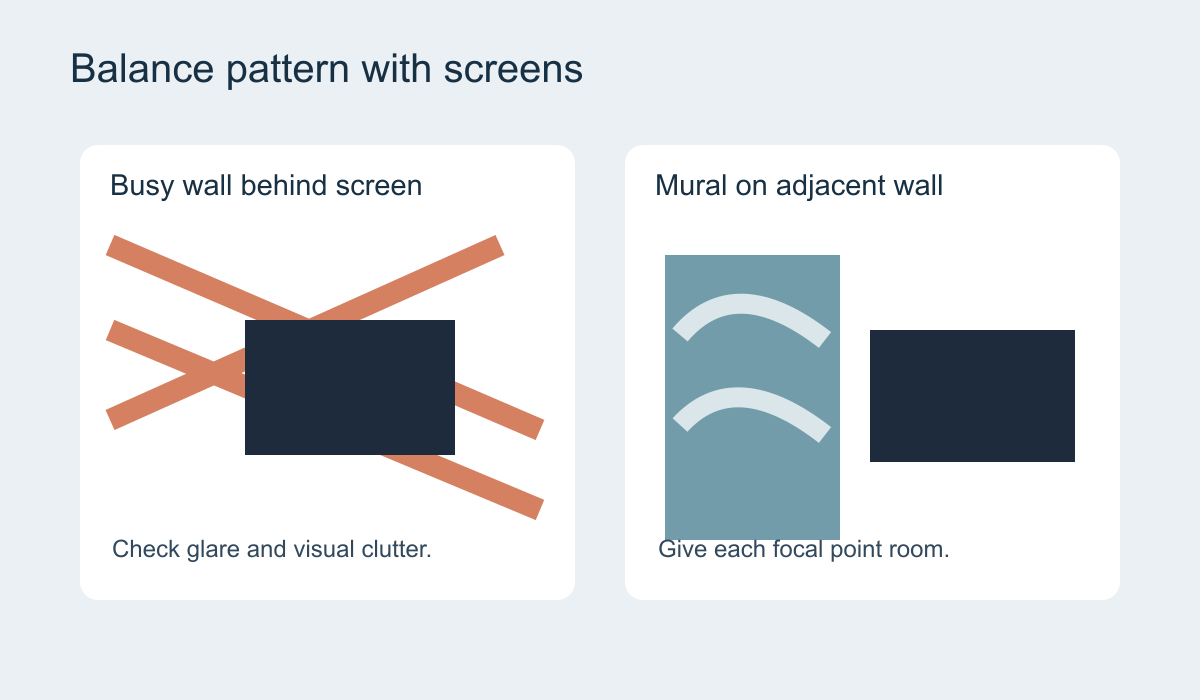 Keep the screen legible and let an adjacent wall carry the stronger image.
For pool and tabletop games, check movement and visibility
A pool table creates a viewing opportunity across the room, but it also creates a moving hazard near its perimeter. Trace actual cue strokes, not just the table's footprint. If the proposed mural is within reach of a cue, move the image or plan a separately specified protective surface. Decorative wallpaper should not be assumed to tolerate repeated impacts.
Broad geometry or a landscape may remain readable beyond the table even while people stand in front of it. A small, intricate repeat may merge with the visual detail of cues, balls, shelves and the floor covering. Preview the wall with players and the usual lighting in place. The photograph's large arcs stay recognisable between two doorways and beside shelving; a tiny motif at the same distance would have a different effect.
In a board-game room, people spend more time looking down at pieces and across at one another. The mural can be more detailed away from the tabletop, but a wall packed with game boxes already has a strong grid of colour and text. Leave the nearest play surface visually clear and put the scene where spectators or players see it when they look up. Account for chairs being pulled back and furniture being rearranged for larger groups.
Keep dart impacts off the decorative print
A dartboard wall needs a dedicated protective strategy around the target and the likely miss area. Do not treat a mural as that protection, regardless of whether its imagery looks robust. If darts are central to the room, place the mural on another wall or behind an independently specified protective system whose suitability has been checked. This is a different decision from choosing lower-contrast artwork around a television: it concerns physical impact, not only attention.
Other activities create their own contact points. Arcade cabinets can block large sections of artwork and need access and ventilation as their manufacturer specifies. A drinks counter brings spills and regular wiping. Heavy shelves and equipment should be installed and secured independently of the wallcovering. Mark sockets, controls and service access before approving the print crop.
Specify the covering for the wall's real wear
A decorative wall above a sofa may experience little contact; a wall beside a cue path, bar or frequently moved cabinet will not. The Wallcoverings Association explains that abrasion resistance and other characteristics belong to particular wallcoverings. An image of stone, leather or metal does not give a flat printed mural those materials' physical properties.
Ask the supplier for the chosen finish's wear and cleaning information. The Wallcoverings Association's care guidance directs users to the specific manufacturer's instructions; do not assume every mural can be scrubbed after a spill. A public gaming venue may have additional fire, building or landlord requirements, which must be checked for the actual product rather than inferred from a general material label.
Crop for today's furniture and tomorrow's equipment
Large geometric designs are sensitive to interruption. In the feature image, doors break the left edge of the mural and open shelves cover some of the right, but the broad arcs still connect across the visible wall. Draw the next likely cabinet or shelving unit over a crop proof. If it divides the only recognisable shape into unrelated fragments, move the focal form or choose artwork that tolerates partial coverage.
Measure the selected wall after the equipment plan is settled. Mark outlets, lights, doors and fixed shelves on the artwork proof. Check where panel joins cross strong lines, and follow the supplier's numbered panel sequence and installation instructions. Shifting a panel to clear an outlet after printing can disrupt the geometry across the whole wall.
Finally, test the room in three states: a screen session from the normal seat, active play around the table, and the room with equipment put away. The mural should make sense in each state without obstructing play or promising protection it cannot provide. That is the useful answer to whether a game room can take a mural: yes, when the activity determines the placement and the specified wallcovering matches the wall's actual use.