What Mural Wallpaper Works in a Heritage Interior?
Coordinate historical architecture with painterly scenes, traditional motifs, measured colour and the proportions of the room.
Article focus: pricing and measurement
The cost and measurement decision
Start with accurate wall measurements; the final custom mural price depends on area, material and any finishing options.
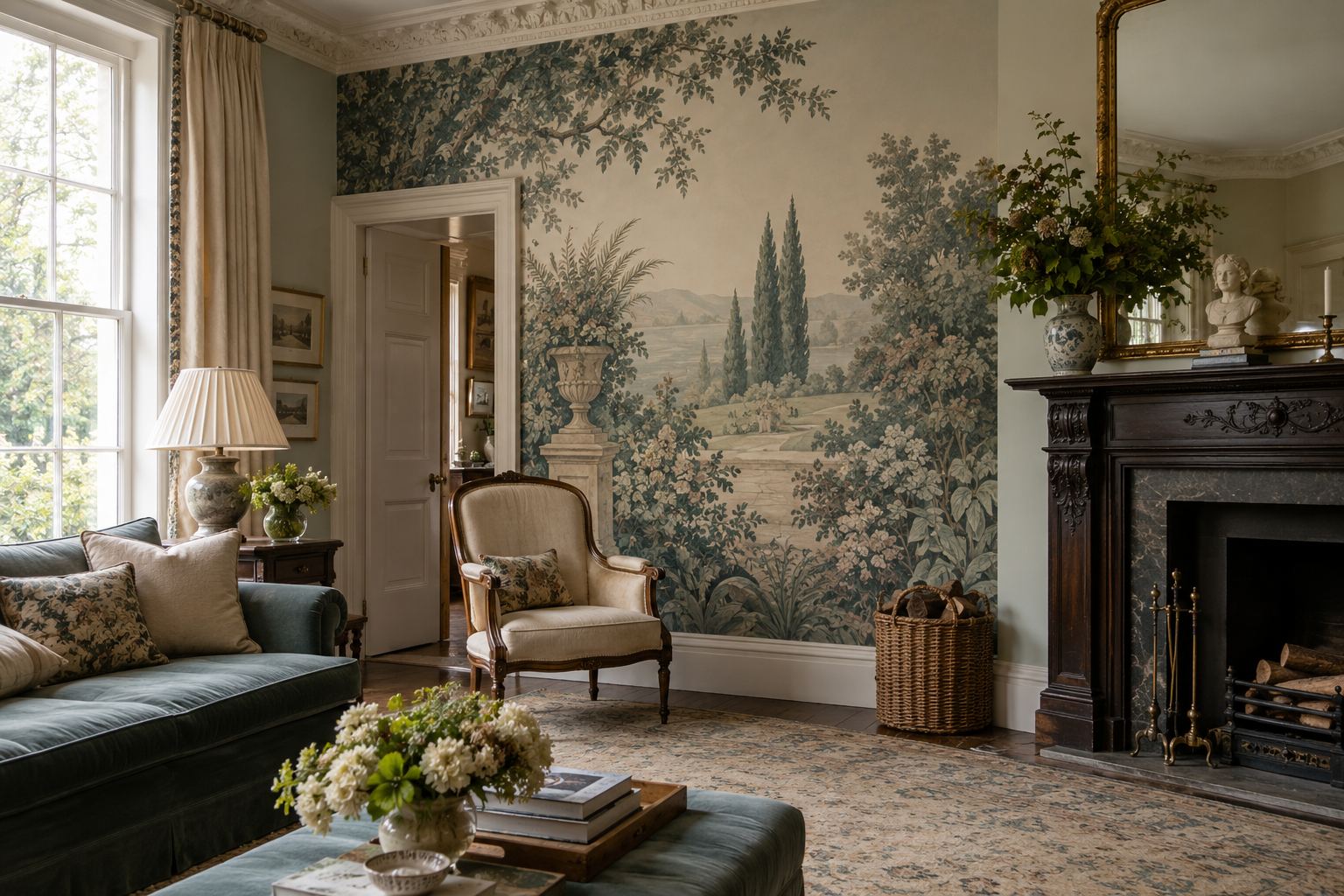
Example application: Living room · pricing and measurement
A heritage interior can take a mural, but the first question is not which period print looks right. It is whether the proposed wall has a finish worth protecting. In a genuinely old or listed room, later paint, wallpaper, plaster and decorative schemes may all carry evidence of the building's history. If the wall is sound, unprotected and appropriate for redecoration, a restrained scenic, toile or engraved-style mural can sit comfortably beside period architecture. If its history is uncertain, pause before covering it.
Short answer: On a suitable modern or plain wall, an engraved garden, toile-style drawing or softly painted landscape can sit well with period joinery. First establish whether the surface itself is historic or protected. In an old building, get local conservation advice before preparing or covering a wall of uncertain significance; no decorative style justifies damaging original fabric.Start with the wall, not the pattern book
“Heritage interior” can mean a modern room with antique furniture or a building with surviving historic fabric. The design question is similar, but the surface decision is not. In the first room, a sound, ordinary redecorating surface may be assessed under the chosen wallcovering's instructions. In the second, first establish what is already on and beneath the proposed wall. Historic England notes that wall paintings can be hidden beneath paint, plaster or wallpaper; a plain-looking finish is not proof that nothing significant survives.
Photograph the wall and its adjoining cornice, panelling and fireplace before specifying new work. Do not strip a test patch or assume an adhesive covering is harmless to fragile older finishes. Where significance is uncertain, seek advice from an appropriately qualified local conservation professional. In England, listed-building questions may also need to be discussed with the relevant authority; Historic England says many ordinary internal redecorations do not require consent, but work affecting special interest can. Elsewhere, check the applicable local rules rather than importing England's terminology.
If the proposed wall is unsuitable, choose an assessed newer partition or a different room rather than allowing the already chosen mural to dictate the building work. Keep the distinction visible in any design brief: a newly printed toile or engraved scene is contemporary decoration inspired by older art, not a recovered original finish.
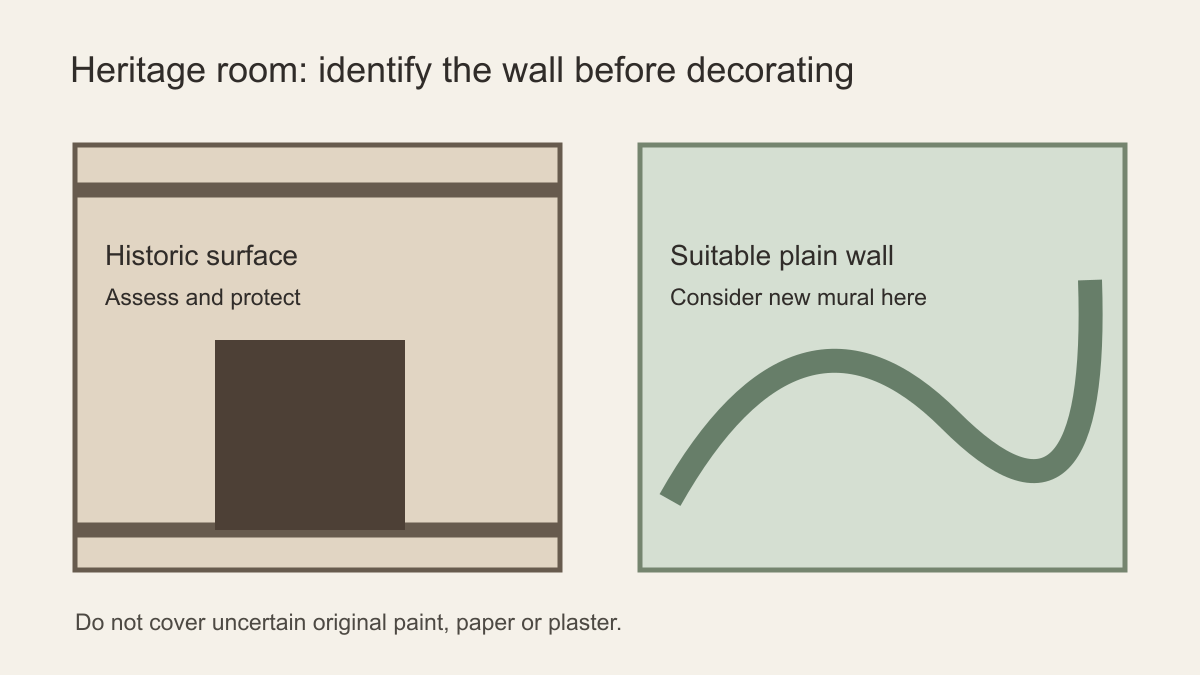 Identify historic finishes before choosing a wall for new decoration.
Which mural styles feel at home with period details?
Engraved botanical scenes work where the room already contains fine timber, plasterwork or delicate furniture. Their linework echoes the precision of traditional prints without needing to imitate a specific surviving wallpaper. A toile-inspired design offers a similar rhythm, particularly when the figures or landscape are legible from across the room. Choose it for its drawing and spacing, not simply because it is labelled “vintage”.
A softly painted landscape is another useful direction. A low-contrast horizon can make a small sitting room feel expansive while allowing a fireplace and cornice to remain the architectural focus. In a more formal dining room, an illustrated garden or restrained chinoiserie-inspired composition may support a layered scheme of upholstery and porcelain. Such a design should be described as an interpretation unless its historical origin is documented; a newly printed mural is not an archival restoration.
Large, high-contrast damasks or very busy florals can be beautiful, but they compete with ornate ceilings, carved joinery and patterned rugs. Try viewing the whole elevation rather than a cropped swatch. If the room already has three strong decorative elements, the mural can provide a quieter fourth. Sometimes a single panel or recessed wall is more convincing than covering every surface.
Consider what the architecture is already doing. A room with delicate cornices and an elaborate fireplace may need a mural with wide areas of quiet ground so those features stay legible. A simpler panelled room may support stronger colour or a more theatrical landscape. The label “heritage” does not prescribe sepia or faded blue. A modern composition can work when its proportions, colour and placement respond to the room's fixed details. Avoid selecting a design only because its product title names a historic era.
Let the architecture set the composition
Period rooms rarely present a perfect blank rectangle. Doors, picture rails, dado rails, alcoves, chimney breasts and windows divide the elevation. Before ordering, sketch the wall and note each feature. A landscape horizon should not disappear behind the tallest piece of furniture, while the most detailed portion of a garden scene should not be cut by an alcove edge. A repeating pattern can tolerate interruption better than a single central scene.
Use the natural boundaries of the architecture. A mural above a dado may feel intentional; forcing a full-height image across both panelling and plaster usually does not. In a fireplace room, a pair of balanced flanking walls can be stronger than trying to make one panoramic image cross the chimney breast. If the wall is narrow, check whether the artwork's focal point remains visible after cropping. A digital crop preview helps, but the physical wall measurements still control the result.
Measure the actual plaster fields separately from their surrounding trim. An upper panel above a dado and an alcove beside a chimney breast are not one uninterrupted rectangle. Record their widths, heights and irregular edges, then ask the supplier and installer how each approved image will occupy those zones. Do not expect a particular wallcovering to hide an uneven historic surface, and do not treat original joinery as disposable trim for a neater print.
A worked example makes the crop issue clear. Suppose a mantel projects into the centre of a 4-metre wall while a narrow alcove sits on one side. A panoramic garden centred on the wall may put its most detailed statue behind the chimney breast. Shift the artwork so the focal subject occupies the uninterrupted bay, or choose a design with distributed detail that can survive the interruption. A wall-size mock-up should include the mantel, alcove and the furniture expected to remain. The room's architectural divisions matter more than the neat rectangle shown in a catalogue.
Picture rails and dado rails can also define a sensible limit for new work, but do not assume they are expendable trim. If a mural is intended for the plaster above a dado, measure that actual zone and check the image's scale within it. A tree originally composed for a full-height wall may look cramped in a short upper panel. Conversely, a fine engraved repeat may read comfortably there. Plan the image for the surface that is genuinely available rather than forcing it across protected joinery.
Build the palette from what cannot easily change
The room's fixed features are better colour references than a trend board. Look at stone, dark or honey-coloured timber, fireplace tile and natural light first. Sepia, muted blue-green, warm ivory and softened olive can bridge many antique finishes, but none is universally “historic”. A cool grey image may jar against warm stone; an overly yellow ground can make aged plaster look dull. Test samples in morning and evening light and hold them near the actual furniture.
Contrast needs particular care. If there is a strong black fireplace, a mural with a little dark ink may connect to it without repeating black everywhere. If the room has pale plaster and fine gilding, keep the mural's darkest notes modest so the architecture retains its shape. The goal is not to make every object match. It is to establish a controlled relationship among wall, joinery and furnishings.
Printed samples are valuable here because aged surfaces rarely share the undertones of a white screen. Hold a sample upright beside the actual stone, timber or upholstery in both daylight and lamp light. Look for a relationship between grounds and shadows, not a perfect duplicate of a historic material. A flat printed illustration of stone or plaster will not acquire the depth of the real material simply because their colours are close. Let the mural be a visual companion rather than an imitation finish.
What should be checked before installation?
Use three separate sign-offs. First, identify the exact surface proposed for the mural and resolve any uncertainty about historic finishes before preparation. Second, check the building condition: dampness, salts, loose paint and failing plaster need appropriate assessment, not concealment under paper. Third, agree a product-specific preparation and hanging method with the installer. A design mock-up can approve the composition but cannot certify the substrate or adhesive choice.
Give the installer the surface assessment, wallcovering instructions, measured elevation and any written specialist advice before work begins. Mark the approved wall on the drawing. Moving from a newer partition to the opposite alcove is a change of substrate, not merely a change of crop. If preparation exposes an unexpected older layer, stop work there and seek qualified local advice rather than continuing because the print has already been purchased.
Keep a record of the wall before and after the new work: photographs, the approved image, the material and adhesive names and the installation date. That record makes the contemporary addition distinguishable from surviving historic fabric and gives a future owner a better starting point for maintenance or removal. It does not make an unsuitable wall suitable; the assessment must come first.
A practical answer for different kinds of heritage room
For a modest cottage with simple timber and little ornament, a lightly drawn meadow or woodland often works better than a theatrical palace scene. For a more formal Georgian-inspired room, an engraved garden with measured spacing can complement symmetry and fine mouldings. For a Victorian-inspired room already rich with pattern, a subdued scenic mural might offer depth without adding another small repeat. These are starting points, not period rules; existing architectural character matters more than an era label.
The same engraved garden need not be treated identically in all three rooms. In the cottage it might read too formal beside rough timber; in the Georgian-inspired room it may settle naturally between symmetrical joinery; in the patterned Victorian-inspired room its linework could disappear among smaller repeats. Compare the actual elevation and furnishing, not just a period name. Once an appropriate wall has been established, let its architecture decide the crop and let the new print be recognisably new.