How Mural Wallpaper Can Improve a Home Office
Use composition, contrast and visual quiet to support a home office without competing with screens, shelving or video calls.
Article focus: pricing and measurement
The cost and measurement decision
Start with accurate wall measurements; the final custom mural price depends on area, material and any finishing options.
Example application: Living room · pricing and measurement
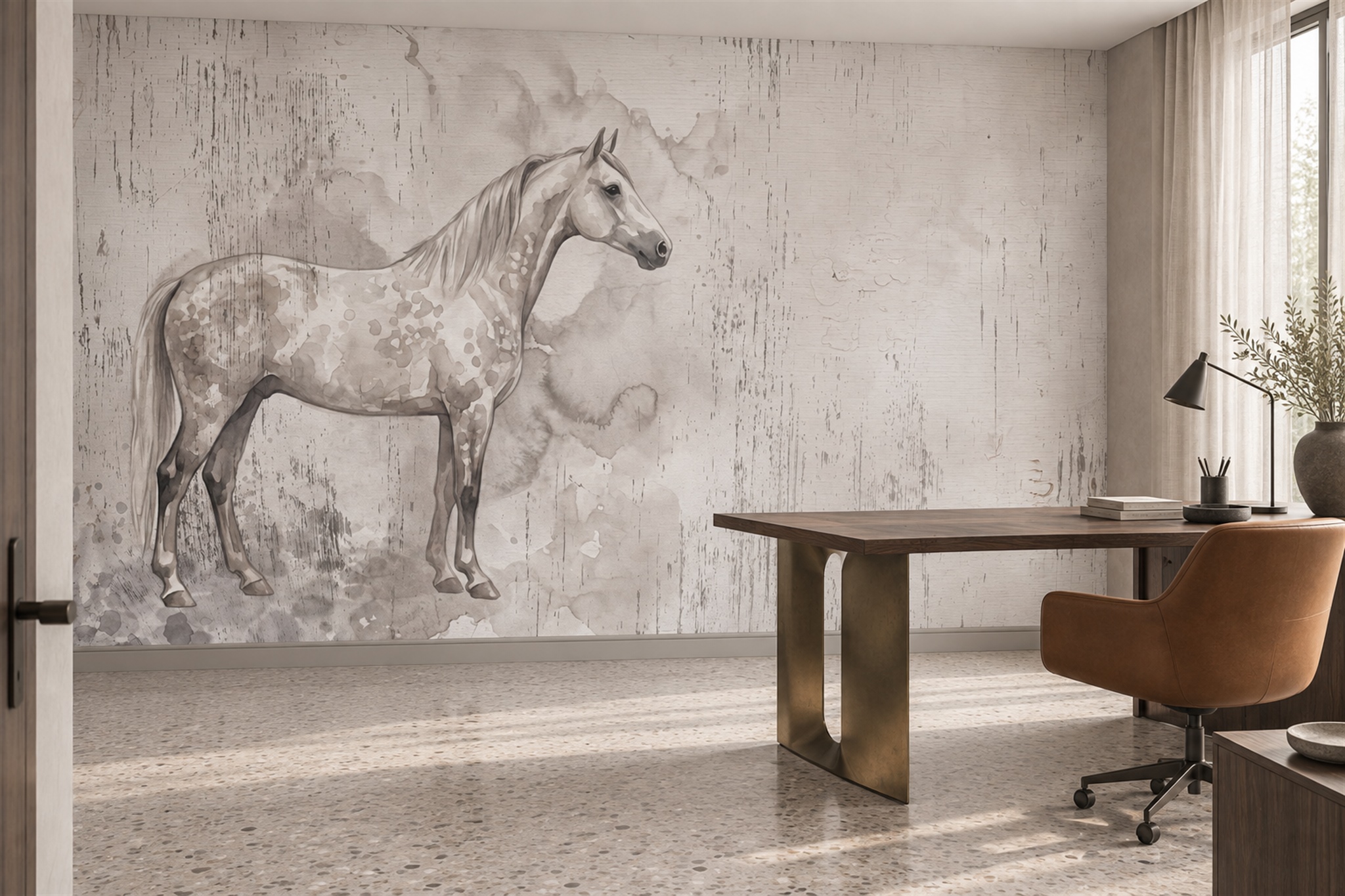
A mural can improve a home office by giving the working area a clear place within the room, not by guaranteeing concentration or productivity. In the horse artwork pictured above, the animal remains visible beside the desk rather than disappearing behind it. That is a layout decision as much as a design choice. Once the mural is selected, the harder task is fitting the desk, storage, light and cables around the printed wall without sacrificing daily use.
Start with the occupied desk, not an empty-room photograph
Put the desk, monitor, chair and the storage you actually need onto a measured floor plan. A desk that looks modest in a styled photograph may support two screens, a printer or a stack of files in daily use. Draw those objects at their real heights against the proposed mural. This reveals whether the artwork's main subject is visible only when the desk is cleared for a photograph.
In the horse room, the animal occupies wall space beside the desk. If the desk were wider or a tall bookcase moved into that area, the relationship would change. Before buying artwork for your own office, decide which large items are permanent. The home-office design-choice guide compares visual styles and viewing positions; here the question is how to make the chosen image work once the office is furnished.
Keep the working surface visually legible
A large design directly behind a screen can create visual competition. High-contrast stripes or dense detail near the monitor edges may feel more active than the same print seen from across a living room. An open landscape or a composition with quieter space immediately around the monitor can make the work surface easier to read. This is not a rule against bold art: a strong subject can work well to the side of the desk, as the horse does, or behind the seated position where it is not constantly in your line of sight.
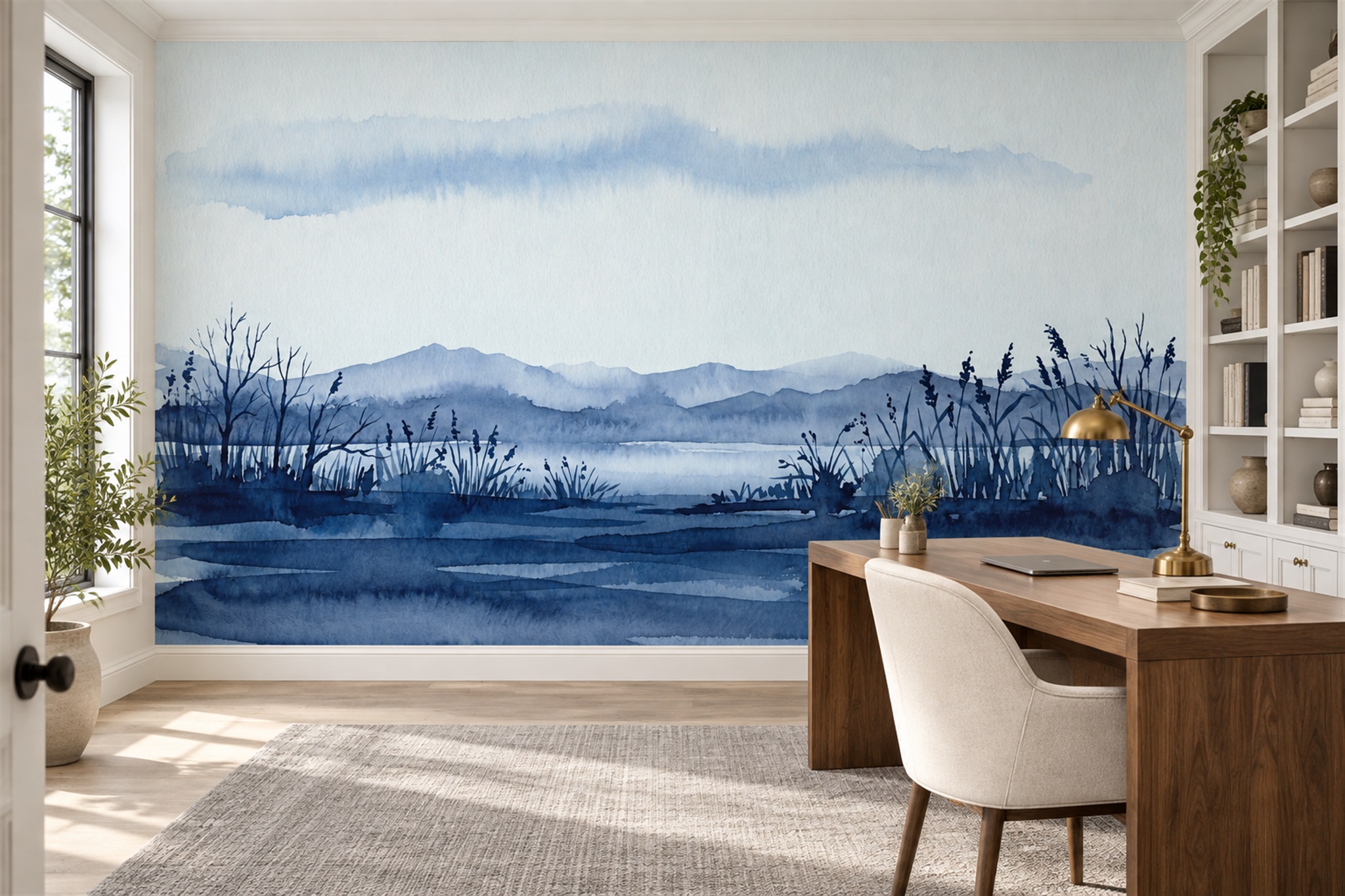
In the blue office pictured below, the darkest reeds and watercolour bands sit low while a broad pale area opens above them. The desk and lamp occupy one side of the scene, leaving the distant hills visible. This works differently from the horse mural's single large subject: if furniture hides part of the lower blue wash, the scene still reads. A narrower room could crop it less successfully, so preview the actual desk width and height on the proposed print.
Give storage a place before fixing the print
Floating shelves, pinboards and tall cabinets are often added after an office has been decorated. On a mural wall they can cover a focal detail or break a continuous line. Map the shelving you already own and the storage you are likely to need within a year. If the mural contains one animal, building or tree, reserve a clear area for it; if storage must expand across the wall, a distributed scene may tolerate that change better.
Leave practical access to sockets and cable routes. A desk can move, but hard-wired lights and network outlets are less flexible. Mark their positions on a wall elevation, then place the proposed crop over it. The print is a decorative layer, not a fixing surface: shelving and monitor arms need appropriate anchors in the underlying wall. Plan those fixings before hanging, rather than piercing the artwork later without knowing what sits behind it.
Make colour work with permanent office elements
Start with the desk finish, chair, floor and shelves. A mural does not have to match them precisely, but repeated undertones help the scheme feel intentional. A cool blue print may sit comfortably with pale timber and white storage; a warm, smoky neutral may suit walnut and tan leather. Check large background areas as carefully as small accents. Across a full wall, a pale ground with an unexpected pink or yellow cast can change the impression of the whole office.
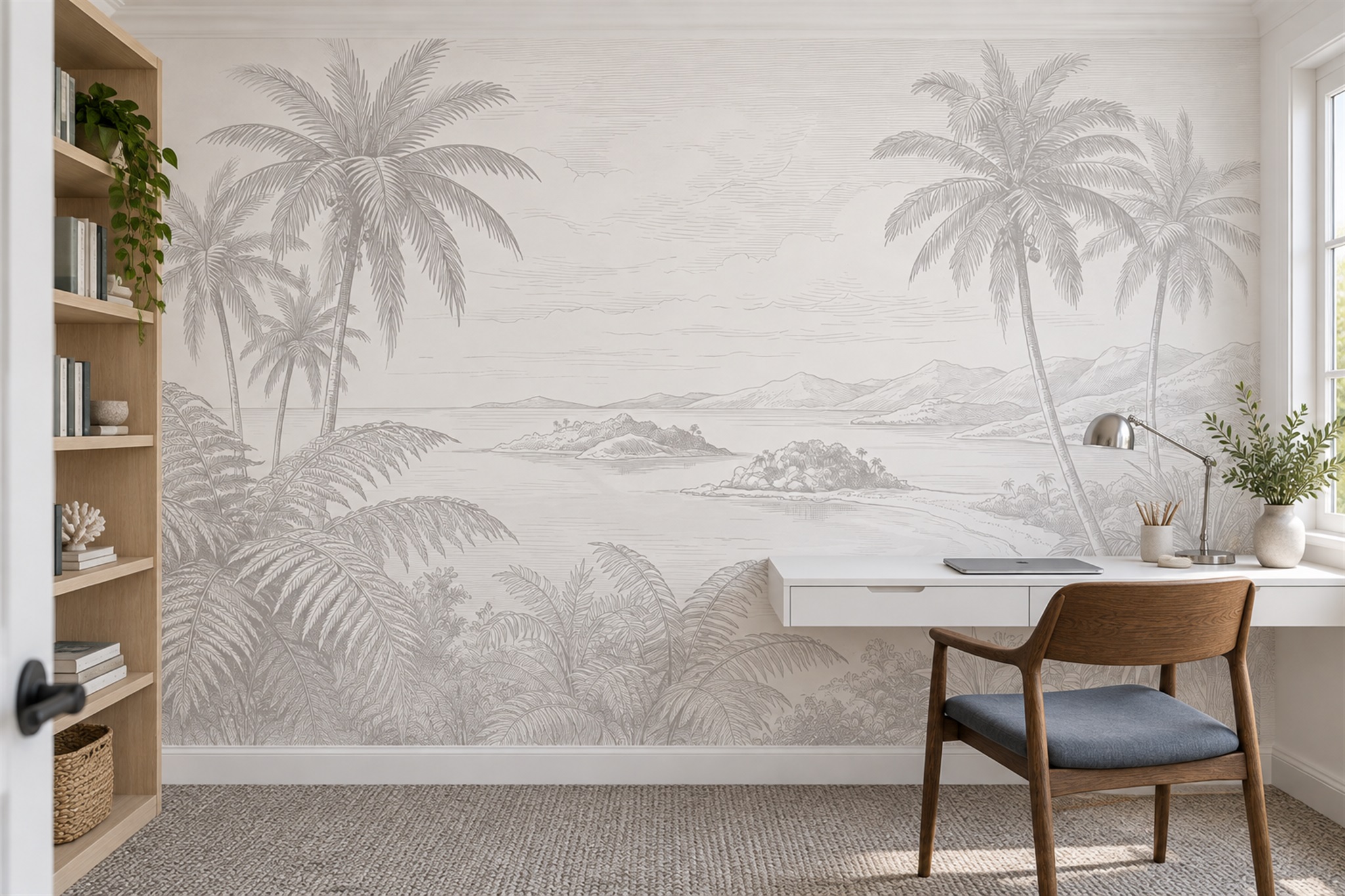
The second office image uses a pale engraved coastal view with palms and distant water. Its fine grey lines add detail at close range while leaving a light field around the desk. The laptop and task lamp remain distinct, and the shelves occupy a separate wall rather than covering the printed scene. This is one answer for a room that needs both work surface and storage; a stronger colour statement would be another, not an objective upgrade.
Decide what appears on a normal workday
Photograph the office at the end of an ordinary working day, not immediately after tidying it for a product shot. Paper trays, headphones, a chair pushed back and a lit monitor all change the amount of mural visible. If the artwork still gives the room a coherent background, the layout is robust. If one important subject appears only when every object is removed, reposition the crop or give that subject a different wall.
If video calls matter, take one actual call screenshot with the normal camera and lighting. Look for a motif awkwardly intersecting the head or a bright window that leaves the person underexposed. But do not redesign an office around calls that rarely happen. A room used mainly for writing, drawing or reading should be judged first from the seated work position, where the wall may sit in peripheral vision for hours.
Measure around fixtures before ordering
Record the full wall width and height, then note sockets, switches, radiators, shelves, built-in cupboards and the desk height. If the room has a sloped ceiling or window reveal, draw its outline with measurements at several points. Use the site crop preview at the intended dimensions, and ask the supplier about panel placement or a formal layout proof if a critical subject is close to an opening. Allow the installation trim specified by the supplier, but do not assume extra material can correct an unsuitable crop.
The wall must also meet the chosen wallpaper's preparation instructions. Existing paint, repairs and surface texture matter. If shelving will be mounted later, plan its position before installing the mural and use appropriate fixings for the wall construction; the print is a decorative layer, not a structural support. Keep cables and equipment locations in the layout so that the finished office remains practical.
Test whether the office still works when the wall is finished
Revisit the three illustrated rooms as working layouts. The horse needs clear wall space beside the desk. The blue reeds allow some lower detail to disappear behind equipment while the lighter area stays visible. The engraved coast leaves shelves on a separate wall, avoiding the need to cut through its fine drawing with brackets. Each arrangement depends on what the furniture leaves exposed, not on a claim that one style makes people work better.
Before ordering, check the crop against a plan containing the monitor, shelves, lights and sockets. After installation, put the equipment back in the same positions and look at the room from the desk and door. If the print competes with the screen, a change to task lighting or the placement of nearby objects may be enough; if a cabinet hides the only focal point, the problem was in the layout. A mural can give the office a visual identity, but it cannot replace sound ergonomics, task light or storage planning.