What Mural Wallpaper Is Suitable for a Nursery?
Consider calm imagery, gentle contrast, room ventilation, wall preparation and practical cleaning when planning a nursery mural.
Article focus: pricing and measurement
Budgeting this wall with confidence
Start with accurate wall measurements; the final custom mural price depends on area, material and any finishing options.
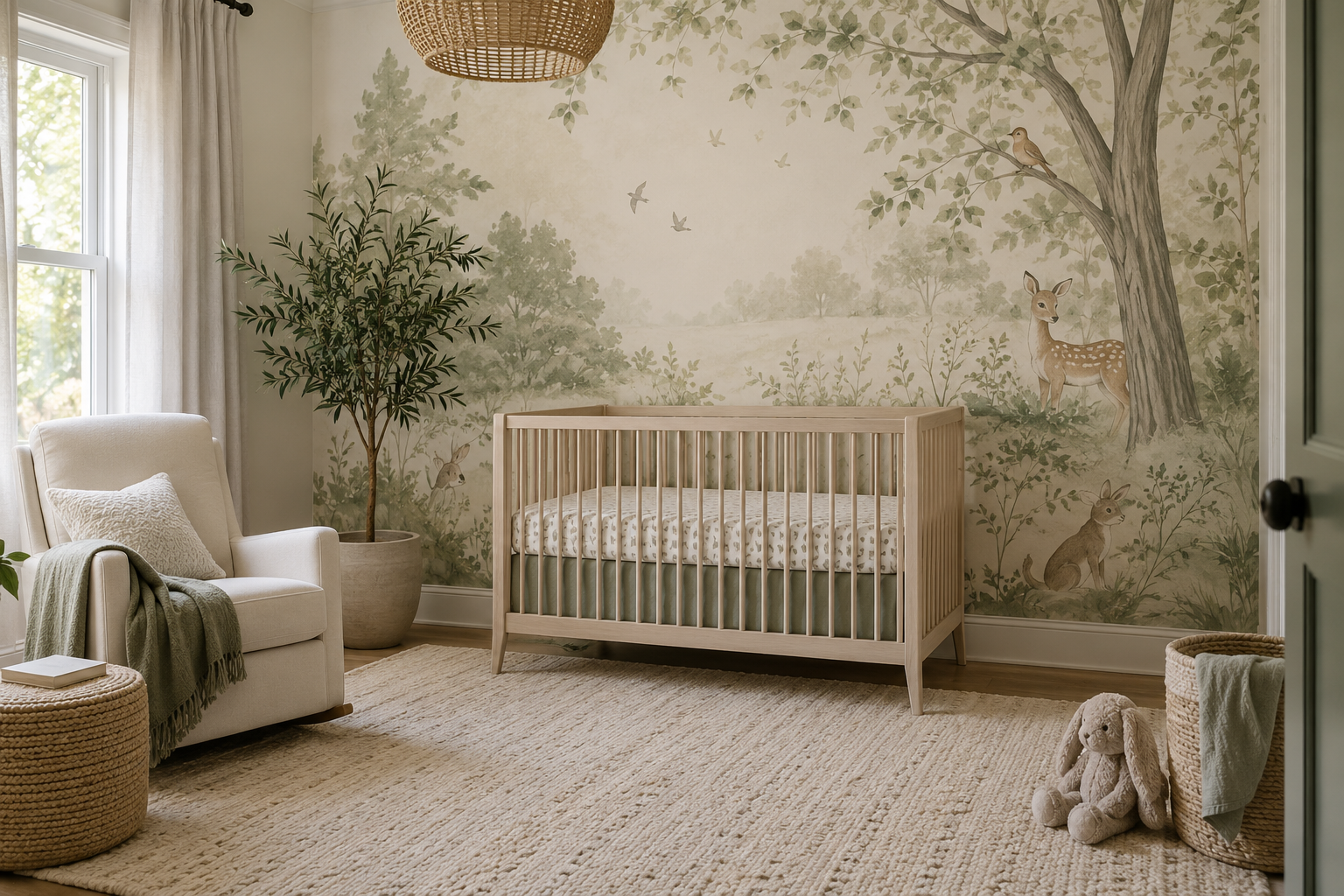
Example application: Nursery or children’s room · pricing and measurement
The most suitable nursery mural is one that works with the room's safe furniture layout and remains useful beyond the newborn stage. The woodland scene in the photograph above offers a good visual example: soft green trees, open cream sky and small animals can sit alongside changing bedding and furniture. It is a styling image, not proof that the pictured room or wallcovering meets nursery safety requirements. Choose the crib position first, keep the area around it free of avoidable hazards, and check the exact product information before choosing the print.
Choose a scene that can grow with the room
A made-to-measure mural is a larger commitment than a cushion or blanket. Think about how the scene will look beside a toddler bed, bookshelves or a small desk later. Broad hills, gentle trees, a garden with open areas or restrained geometric forms leave room for those changes. The deer and rabbits in the feature photograph make the woodland playful without requiring a nursery-specific slogan or a design that only suits the first year. A more literal baby motif is fine if you love it, but it is not necessary.
Assess pattern density from the doorway and from the feeding chair. A detailed scene may become visually crowded once toys, books and curtains arrive. The large light area above the trees in the pictured mural gives the eye a pause; a wall filled edge to edge with small figures would have a different effect at this scale. Do not treat a colour or woodland theme as a promise about sleep or behaviour. Design decisions are separate from safe sleep practices and the room's practical lighting needs.
Choose the wall after positioning essential furniture. Do not move a crib next to a window merely to centre it under a printed tree. The American Academy of Pediatrics' nursery safety checklist advises keeping cribs away from windows and window-covering cords. The floor-plan illustration below puts the sleep area away from the window; use it as a planning prompt, then check your actual room and current safety guidance. A mural crop can adapt to the furniture arrangement, not the other way round.
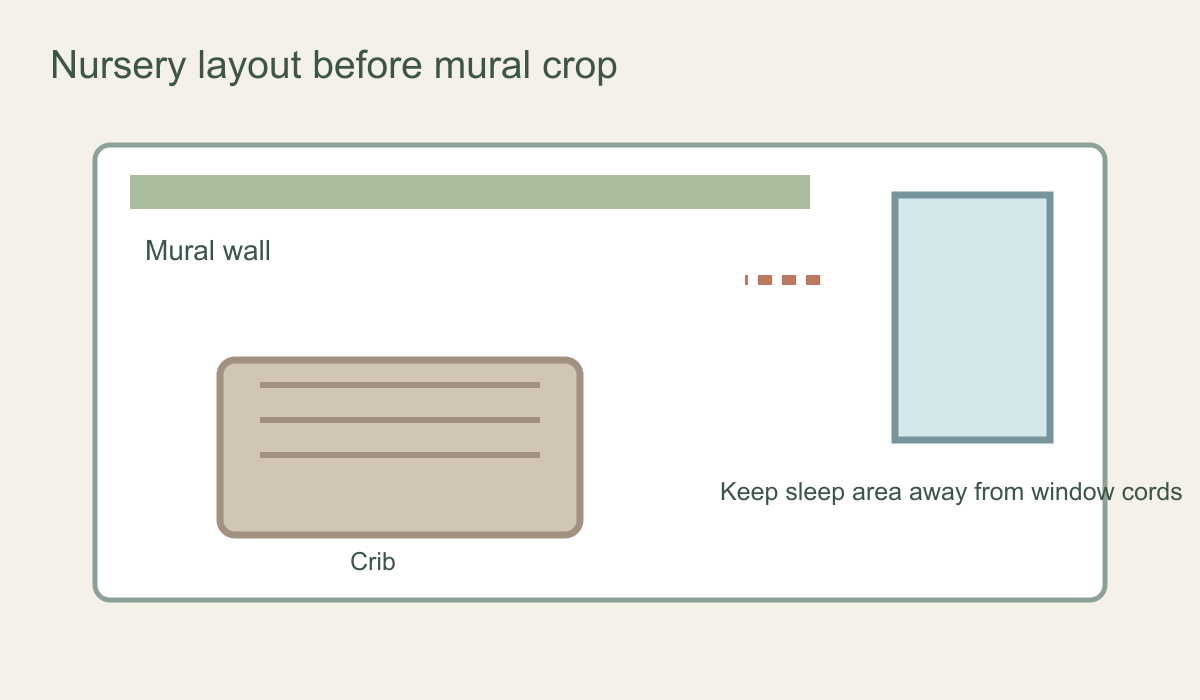 Plan the image around safe furniture placement, not the other way round.
Keep the crib wall visually simple
Wallpaper itself can provide the decoration above a crib without added framed art or mirrors. The American Academy of Pediatrics' crib-placement guidance suggests limiting over-crib wall decoration to paint or wallpaper and warns about frames and mirrors overhead. It also notes that reachable paper borders may not withstand curious fingers. Keep cords and dangling decorations away from the sleep space. The printed birds in a mural are decoration; suspended birds, mobiles or framed objects introduce separate placement questions.
With that layout settled, place the mural's main subject above or beside the crib silhouette rather than behind a wardrobe. In the feature scene, the largest tree and one deer remain visible to the right of the crib; the low printed plants are partly hidden. This is a crop decision, not a safety endorsement of the photographed furniture or the floor plant beside it. In a real nursery, move that plant and any other loose objects beyond the child's reach, including as the child grows and can stand. If the artwork contains animals, birds or stars, preview them at final print scale: a tiny screen figure can become a prominent wall-sized motif.
Safety instructions are not a substitute for checking the room itself. Secure furniture and manage cords according to applicable guidance. The US Consumer Product Safety Commission recommends cordless window coverings where young children are present and keeping cribs away from window-covering cords. Those risks concern the whole nursery layout, not just the mural.
Ask for the exact product information
Terms such as non-woven, vinyl or peel-and-stick describe broad material categories, not a complete safety or emissions assessment. Ask the seller for the exact wallcovering's specifications, any relevant test documents, recommended adhesive and installation conditions. If a particular certification matters to you, request its name and evidence for the product you will actually receive. Do not assume that an animal illustration or a product-page label saying “nursery” confers special safety properties. Follow the maker's instructions for preparation, ventilation and any curing time.
Review the care guidance too. Nurseries are working rooms: furniture may rub the wall, and splashes or marks may occur. Washability and abrasion resistance vary by product. Ask what can be cleaned, with what method, and what the supplier advises if an edge lifts. Do not promise that a printed mural is scrub-proof or waterproof unless that specific product has evidence for it.
Consider who will install the mural and when. Complete painting, repairs and wallpapering before the room is needed, following each manufacturer's instructions for drying and ventilation. The Wallcoverings Association's surface-preparation guidance calls for a clean, dry and sound surface. If the wall has dampness, loose paint or mould, address the underlying issue before covering it. A nursery mural should not conceal a building problem.
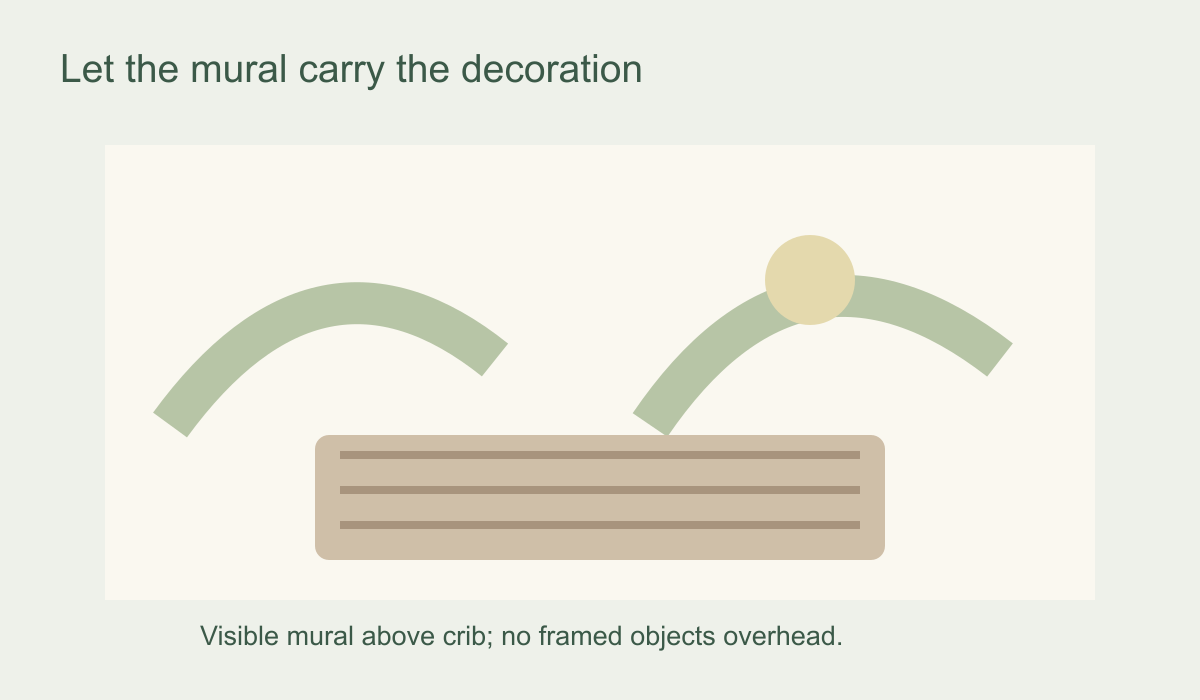 A mural can carry the decorative idea without extra objects over the crib.
Measure the wall as it will actually be used
Include the window, door, skirting, outlets, light switches and built-ins in a wall elevation. Mark the crib, dresser and chair as solid shapes at their actual heights. Compare that separate sketch with the mural's dimension-based crop preview; do not assume the ordering tool displays furniture for you. If its only focal animal disappears behind storage, shift the composition or select artwork with several points of interest. Do not shift the crib into an unsuitable position just to rescue the crop.
A wall with many interruptions may suit a loose pattern better than a panoramic story. If only a narrow vertical section is available, a large landscape can lose its horizon. Conversely, a broad wall behind a low dresser may support a calm woodland scene. Plan for furniture to change as the child grows; a mural with open areas is more forgiving than a scene that only works with one exact arrangement.
Check samples in the room's actual light. A warm ivory may look yellow under one lamp and gentle by daylight. A very pale line drawing might almost disappear on a strongly lit wall. Graham & Brown's sample guidance notes that light and surrounding furnishings influence wallpaper colour and pattern perception. A sample helps decide how the print will feel without relying on a phone image.
Keep the design useful beyond the photograph
The feeding chair needs comfortable access; a changing area needs practical storage; blackout blinds or other window treatments may matter more than a perfectly centred mural. Arrange the room for those tasks first. The wallcovering is the background to daily care, not the reason to compromise it. Leave walking space and avoid putting heavy, unstable décor in front of the printed wall solely to complete a styled scene.
Think about maintenance as the child becomes mobile. Small hands may explore reachable seams, so inspect the installation periodically and follow the supplier's instructions if a section loosens. Do not apply unapproved glue or coatings near the child to make a decorative fix. A professional installer or the manufacturer can advise on product-specific repairs.