Can Mural Wallpaper Work in a Salon?
Plan the mural around brand atmosphere, mirrors, seating, lighting, traffic and the practical use of the wall.
Article focus: pricing and measurement
Budgeting this wall with confidence
Start with accurate wall measurements; the final custom mural price depends on area, material and any finishing options.
Example application: Hallway or entryway · pricing and measurement
Yes, mural wallpaper can work in a salon, but the best wall is not necessarily the wall behind the styling chairs. A reception or waiting area can give the image room to be seen; a mirror wall breaks it into fragments and repeats whatever appears opposite. Wash basins, colour preparation and trolley routes introduce different demands again. Choose the wall by what clients see, what staff do there and what the specified wallcovering can actually tolerate.
Start with the client journey, not a sample book
Walk through a normal appointment: arrival, check-in, waiting, consultation, styling, washing and departure. At each point, note where the client looks and where a wall stays visible. A waiting-wall mural may set the tone from the entrance and remain readable from the seats. A graphic behind a row of mirrors may be reduced to narrow strips. A wall beside the wash chairs may be prominent to a reclined client yet exposed to splashes.
Photograph candidate walls from the doorway and from seated eye level. Include the shelving, product displays, plants and signs that will remain after installation. Then mark the usable wall area on the photograph. The useful question is not simply, “Is this wall large enough?” It is, “Will the principal shape, horizon or subject still be visible once the room is working?”
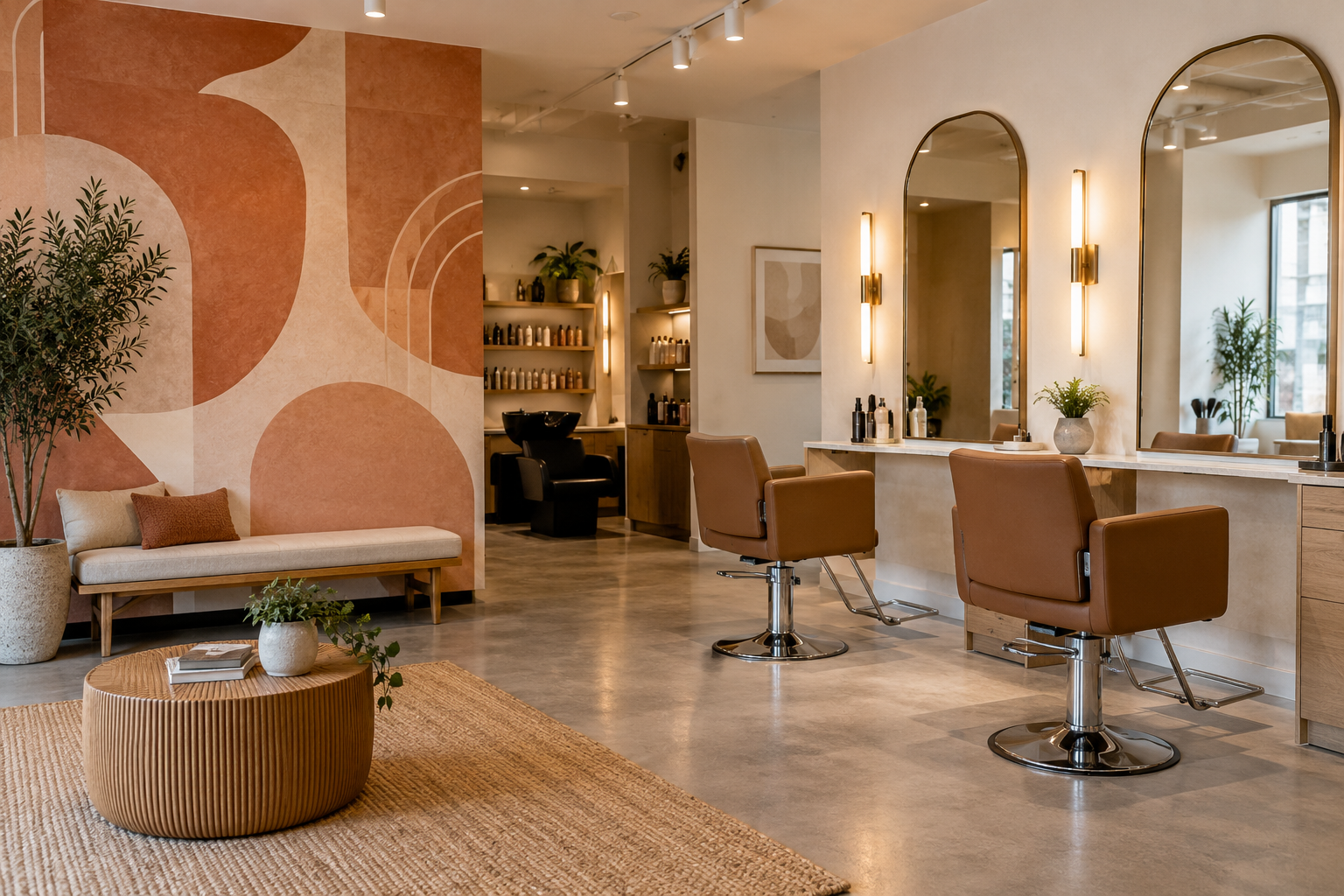
The warm terracotta abstract in the accompanying salon image succeeds as an example of a focal wall because its broad shapes remain legible beyond the bench and the potted tree. The adjacent styling stations have a different visual job: their mirrors, chairs and task lights need space to function. One mural does not have to cover every part of the salon to create a recognisable atmosphere.
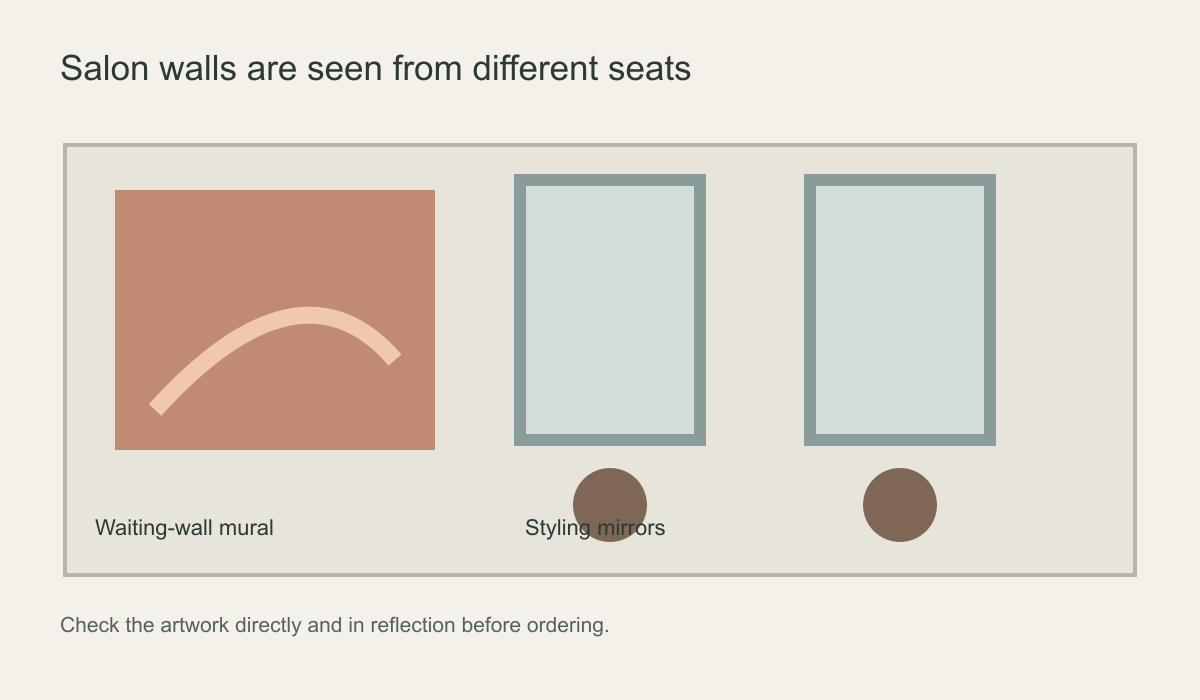 Compare the uninterrupted view with what remains visible around styling mirrors.
Test what the mirrors show
A mirror changes the mural's apparent position. A design installed opposite a styling station may appear beside the client's reflection even though it is nowhere near the chair. Repeated mirrors can also multiply a strong motif. One large curved form may become several competing forms across the room. Check the proposed artwork in the mirrors from each occupied seat, not just from the corridor.
Hair colour assessment needs dependable task lighting and an appropriate visual reference. A saturated green, red or orange background beside a reflection can change the impression of a finished colour without changing the hair itself. This is a reason to keep the immediate consultation and styling backdrop relatively restrained, especially in a colour-focused salon. It is not a reason to avoid expressive artwork entirely: move the expressive wall to reception, or place the strongest part of the composition away from the mirror view.
Test a large physical sample under the salon's actual daytime and evening lights. Look at it directly and in reflection, with the chairs and products in place. Screen previews cannot settle how a printed colour and its physical surface will look under a particular lamp. Nor should an image described as matte be taken as proof of the supplied wallcovering's finish; confirm the exact product with the supplier.
Separate decorative walls from working surfaces
Think in zones. A dry reception wall behind a bench is different from a wall beside colour bowls, wash basins or a busy trolley route. Hair products, water, bags, chair backs and routine wiping create distinct kinds of exposure. Observe a working day before choosing the location: where do clients rest their bags, where are sprays used, and where do carts repeatedly pass?
Do not assume that a decorative mural can be wiped with the salon's usual cleaning products. The Wallcoverings Association's cleaning guidance points back to the manufacturer's instructions for the specific wallcovering. Its ratings information likewise concerns documented product properties, not a design's appearance. A label such as vinyl or peel-and-stick does not, on its own, establish chemical resistance, washability, abrasion performance or suitability for a commercial premises.
Ask the supplier for the exact material specification, permitted cleaning method and any documentation required for the intended commercial use. Have the installer assess the wall, corners and likely impact points. Where frequent splashes or strong cleaners are unavoidable and the proposed finish has no supporting documentation, use an appropriate hard surface instead. The mural can still have a clear role on a lower-contact wall.
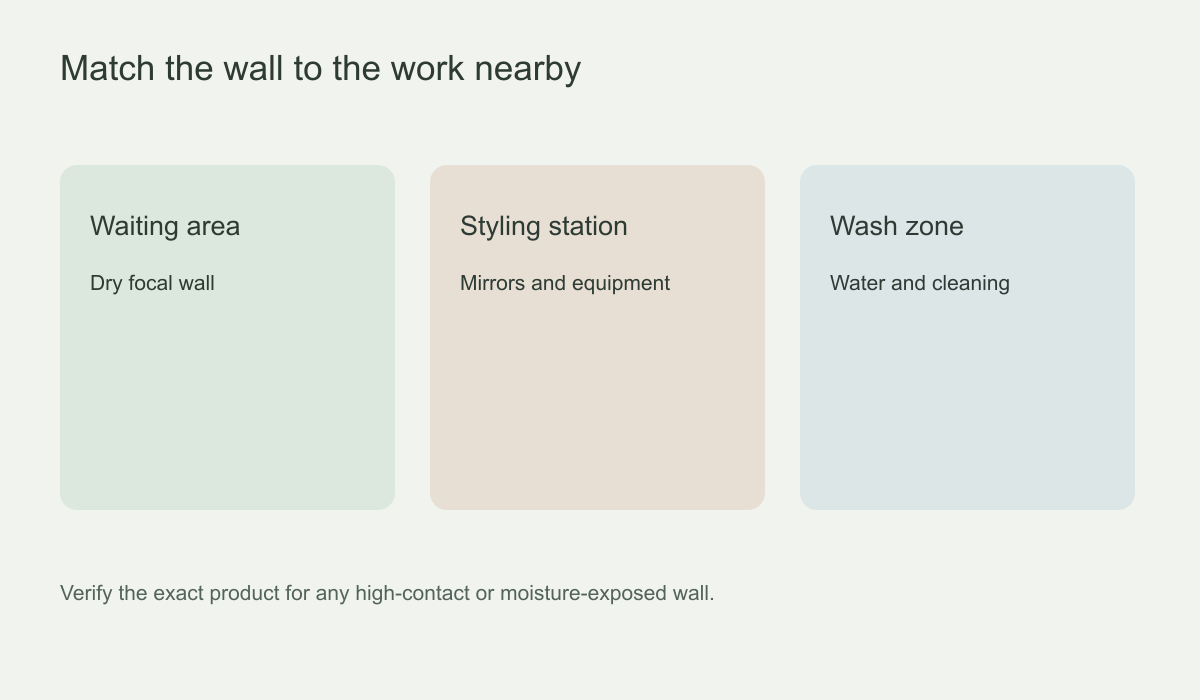 Waiting, styling and washing areas present different viewing and maintenance conditions.
Choose artwork for the room that exists
Bring a print sample into the furnished salon. Compare it with the floor, cabinetry, chair upholstery and product packaging rather than judging it against a white website background. Broad abstract forms can help a simple reception area feel composed; fine botanical lines may soften clean joinery; a detailed landscape needs a relatively uninterrupted wall to be appreciated. None of these is inherently a “salon pattern”. The better choice depends on what else already occupies the view.
If the mural shares a wall with the salon name, service menu or directional sign, reserve a quieter area for the text. Small lettering over dense foliage or a sharp colour transition may be difficult to read. Plan the crop around fixed fixtures as well as the wall dimensions. A striking motif cut in half by a product shelf will rarely look like the intended composition.
Consider the room when it is busy. Bright bottles, open storage, clients in patterned clothing and moving staff all add visual information. A salon with many colourful products might gain more from a calm tonal mural than a densely detailed one. In a spare, minimally furnished space, a bold focal wall may provide the missing visual character. A full-size printed section is a better test than a small swatch for judging the scale of shapes beside real furniture.
Give photography its own test
A beautiful waiting-area wall is not automatically a useful backdrop for finished-hair photographs. A large terracotta shape, for example, may establish the salon's identity behind a bench but compete with a client's face or hair when photographed close up. A separate plain photography position may serve the business better than asking the feature wall to do both jobs.
If the salon has only one possible backdrop, take test portraits with dark and light hair from the usual camera distance. Review them on the device used for client images. Look for a graphic edge crossing the head, strong reflected colour near the face and distracting shelves at the edge of the frame. Move the crop or portrait position if necessary. Keep photographic lighting and colour assessment independent of the mural's decorative effect.
Plan installation and aftercare around appointments
List the mirrors, signs, shelves and fixed displays on the selected wall before final measurement. Agree who will remove and refit them, and have the exposed surface assessed before the panels are ordered. Schedule wall preparation, installation and the specific product's required aftercare outside appointments where possible. If the salon stays open, keep the work area separate from clients and staff.
Record the approved crop, panel sequence, material sheet and cleaning instructions for future maintenance. Staff should know which method is approved for that wall rather than treating a stain with a stronger cleaner by default. A recorded panel position also makes any later damage easier to identify and discuss with the supplier or installer.
The practical answer is therefore conditional but useful: select a visible, relatively dry wall; test the artwork in real light and mirrors; verify the chosen finish for the way that wall will be used; and keep the styling and washing functions clear. A well-placed mural can give the salon a distinct visual identity without making its working areas harder to use.