What Mural Wallpaper Suits a Spa Interior?
Choose a calm composition, restrained contrast, practical wall position and atmosphere suited to a spa environment.
Article focus: pricing and measurement
The cost and measurement decision
Start with accurate wall measurements; the final custom mural price depends on area, material and any finishing options.
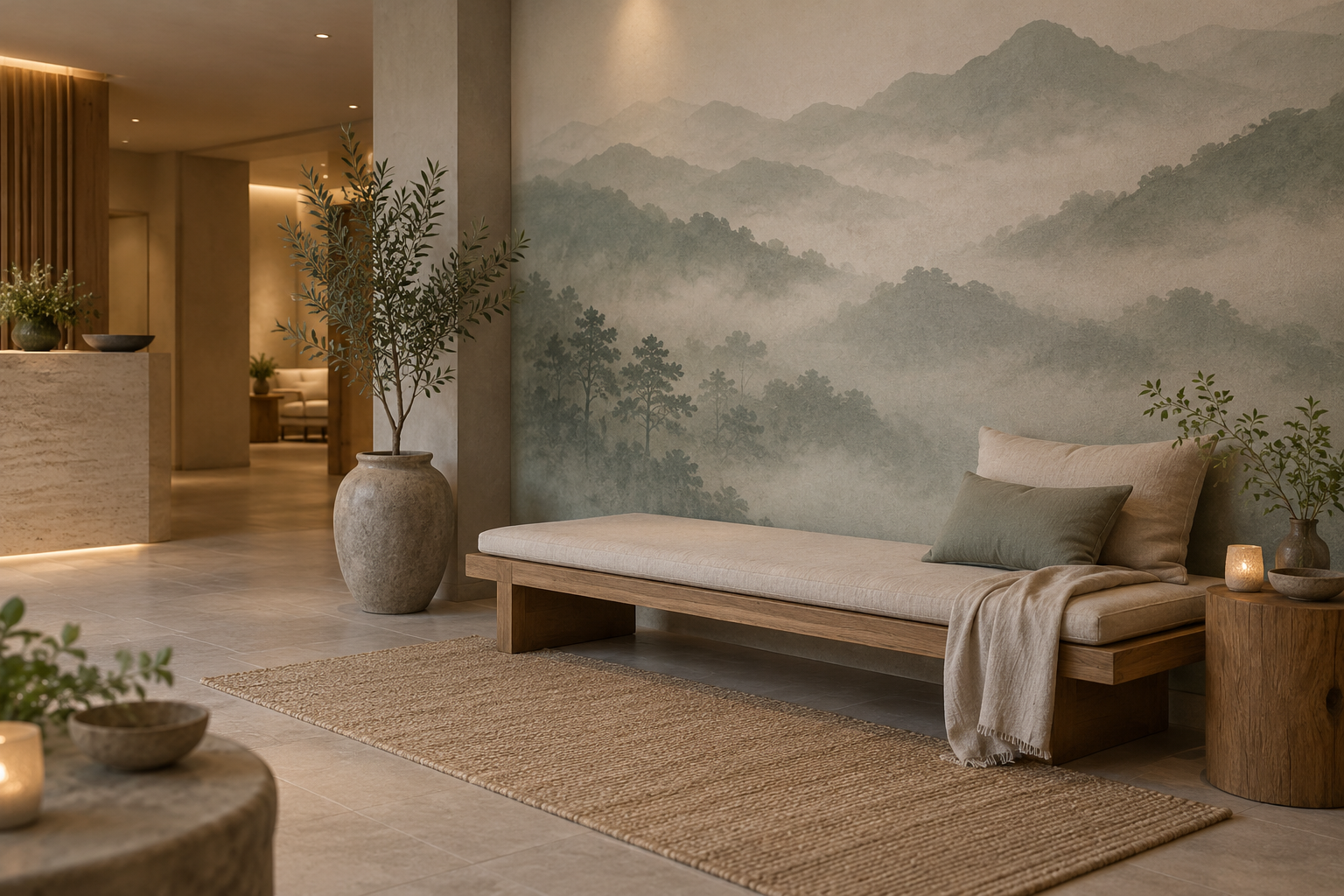
Example application: Living room · pricing and measurement
A spa mural should be chosen for the guest's view and the wall's actual use, not from a style label alone. Layered mountains can open up a lounge, widely spaced botanicals can soften a smaller room, and an abstract wash can leave quiet space for reception lettering. First decide where the image will be seen and at what distance; then verify the exact wallcovering's suitability for cleaning, contact and moisture. A calm-looking print is not automatically appropriate beside water.
Start with the wall's role, not a style label
Walk the guest route from entrance to desk, waiting seat and treatment bed. A reception image must read quickly behind signage; a lounge wall can reward a longer look; a treatment-room motif may be seen very close or mainly on entering. Mark the walls hidden by shelving, doors, towels and equipment. A single landscape needs an uninterrupted area for its key ridge or tree, whereas a loosely distributed pattern can tolerate more interruptions.
In the feature image, a misty ridge above a low daybed remains visible from the lounge, while reception sits off to the left. The broad, quiet upper area gives the eye somewhere to rest; the bench conceals part of the lower forest without erasing the main distant view. This is a better test of a proposed crop than judging the artwork on an empty rectangle. Overlay the actual daybed, counter or storage height before approving the printed composition.
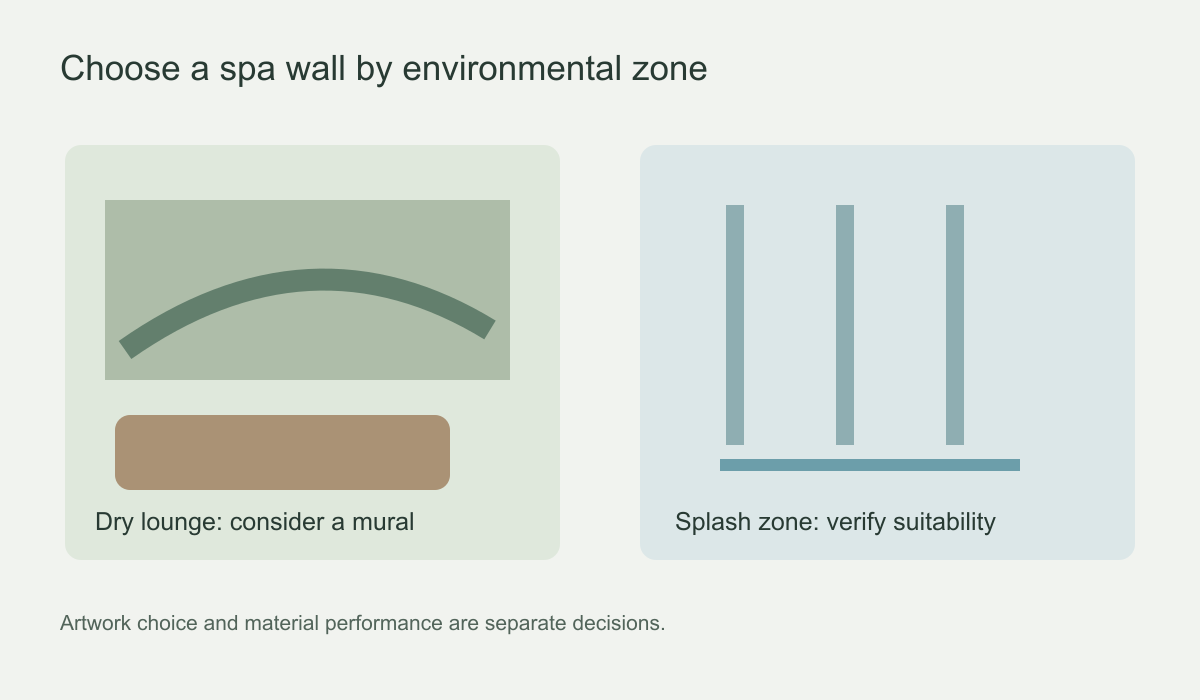 Design for each wall's environmental conditions before choosing artwork.
Choose calm through composition, not just pale colour
Muted sage, stone, warm ivory and blue-grey can support a calm room, but low saturation alone is not enough. A pale print full of tiny, sharp marks can feel busier than a darker scene with broad transitions. Look for an orderly hierarchy: one readable subject, open ground and detail that can be discovered rather than covering every centimetre. If the spa already has veined stone, gridded tile and patterned towels, the wall image may need fewer competing marks.
A low-contrast charcoal or deep green print is not automatically too dramatic. In a room with controlled lighting it may feel sheltered, but its fine detail can disappear under dim lamps. Conversely, a bright white ground may become the most visually dominant surface. Compare actual printed samples in daylight and under the evening lighting plan rather than choosing from a luminous screen.
Keep language precise: a printed wallcovering that looks like hand-painted plaster or linen is still a flat print unless its product specification confirms a physical texture. Select it for its visual effect, not an assumed tactile property.
Three visual directions worth comparing
Compare these three directions at the measured wall proportions. A misty mountain scene provides distance, provided enough sky remains above furniture. Widely spaced stems offer close detail without filling a narrow treatment wall. An abstract wash can sit behind a reception sign because no single tree or flower must be preserved around the lettering. The same sage-and-ivory palette can produce very different visual pacing in each case.
Separate dry walls from wet and frequently cleaned areas
A mural in a dry waiting room is a different specification from one exposed to steam, oil, frequent disinfecting or direct water. Do not describe a standard decorative print as waterproof or suitable behind a shower without product-specific evidence. The Wallcoverings Association's guidance on types and usage distinguishes materials by durability and intended setting; its cleaning guidance says to consult the manufacturer for the particular wallcovering.
Give the supplier the exact wall location and cleaning routine: a dry waiting wall, a corridor touched by laundry carts, a changing area wiped frequently, or a wall behind an oil shelf are not equivalent. Ask for the proposed finish's cleaning method, moisture limits, adhesive recommendation and any relevant commercial documentation. Local building requirements may also apply. A label such as “vinyl” or “heavy” is not evidence of a particular rating. If the material cannot be documented for that exposure, move the artwork to a protected dry wall or specify a verified alternative.
Plan for furniture and guest sightlines
Request a crop proof at the exact wall dimensions, with doors, sockets, mirrors, sconces and furniture silhouettes drawn over it. In a treatment room, inspect the view on entering, seated for consultation and from the bed. A motif centred at standing eye level may be invisible to a reclining guest; a very large leaf can become an unrecognisable fragment at close range. Across several rooms, compare proofs side by side so they share a visual language without forcing the same scale or panel layout everywhere.
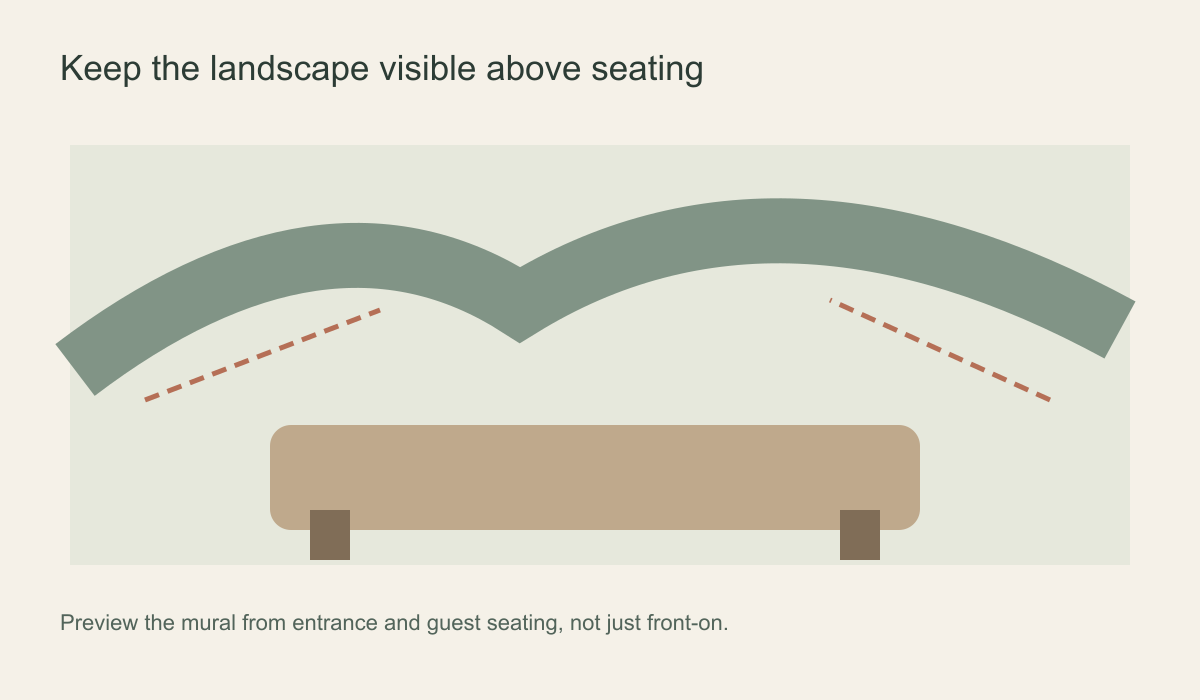 Keep the part of the image that creates calm visible from guest positions.
Use lighting to test the artwork honestly
Spa lighting is often warm and indirect. That can soften a mural, but it can also change the colour of a green, blue or cream print. View a sample under the actual lights and beside stone, timber and upholstery. Wall grazers may reveal surface irregularities and panel joins more than diffuse light does. A printed texture should not be used to disguise an unsound wall; preparation remains important.
A backlit reception sign or large mirror can compete with detailed imagery, so reserve a quiet area around lettering. Check the sign at its real size from the entrance and waiting seats, with the reception lights on and off; a bright halo or reflected motif may obscure small text. Directional light can also reveal panel joins or wall defects. Adjust the lighting plan or prepare the substrate rather than using a busier image to conceal them. These are design judgments, not promises of a measurable therapeutic effect.
A practical specification conversation
Before ordering, give the supplier the wall dimensions, room type, exposure to water or products, cleaning routine and any building requirements that must be documented. Ask which exact material is proposed and request its technical sheet rather than relying on a product-name shorthand. Confirm the crop, panel layout, installation method and maintenance instructions. For a commercial project, involve the installer and responsible building professional in suitability decisions.
When the treatment bed changes the answer
Check the room with the bed in its working position. A face-up guest may see mostly ceiling and upper wall; a face-down guest may barely see the mural. The artwork can still shape arrival and consultation, but then place its important subject where those views encounter it. Do not extend a wall print onto the ceiling without a separate product and installation specification.