What Mural Wallpaper Suits a Sunroom?
Review changing sunlight, glazing, plants, furniture and pale or atmospheric colour when planning a sunroom mural.
Article focus: pricing and measurement
The cost and measurement decision
Start with accurate wall measurements; the final custom mural price depends on area, material and any finishing options.
Example application: Any room with a suitable, prepared wall · pricing and measurement
For a sunroom, the most suitable mural is an interior design chosen only after its wall has passed an exposure check. A pale botanical can sit behind real plants without overwhelming them; an open landscape may give a sparsely furnished room a second view. But generous glazing can also mean strong light, cool nights and condensation. Establish whether there is a clean, dry, sound wall and whether the exact print and adhesive suit its usual conditions before falling in love with a scene.
Decide whether the space has a usable interior wall
Some sunrooms have one generous solid wall adjoining the house. Others are nearly all windows, doors and narrow structural strips. A panoramic mural needs enough uninterrupted width for its subject to read; a scene squeezed between two glazed openings can become an unexplained fragment. Measure the solid area rather than the room's overall width, and mark trim, vents, outlets, heaters and blind hardware on the crop proof.
The next question is what happens to that wall through the year. Inspect it on a bright afternoon and again on a cool morning. Look for recurring condensation, staining, soft paint or dampness near window returns. The Wallcoverings Association's preparation guidance calls for a clean, dry and sound surface. If moisture is recurring or its source is unclear, have the cause assessed and corrected before specifying wallpaper. A darker print or extra primer cannot make an active moisture problem disappear.
An enclosed room that remains dry and conditioned is a different proposition from a space that is partly open to rain or left cold and damp for long periods. Describe the room's normal heating, ventilation and shading to the supplier. Suitability needs to cover everyday use, not merely a mild installation afternoon.
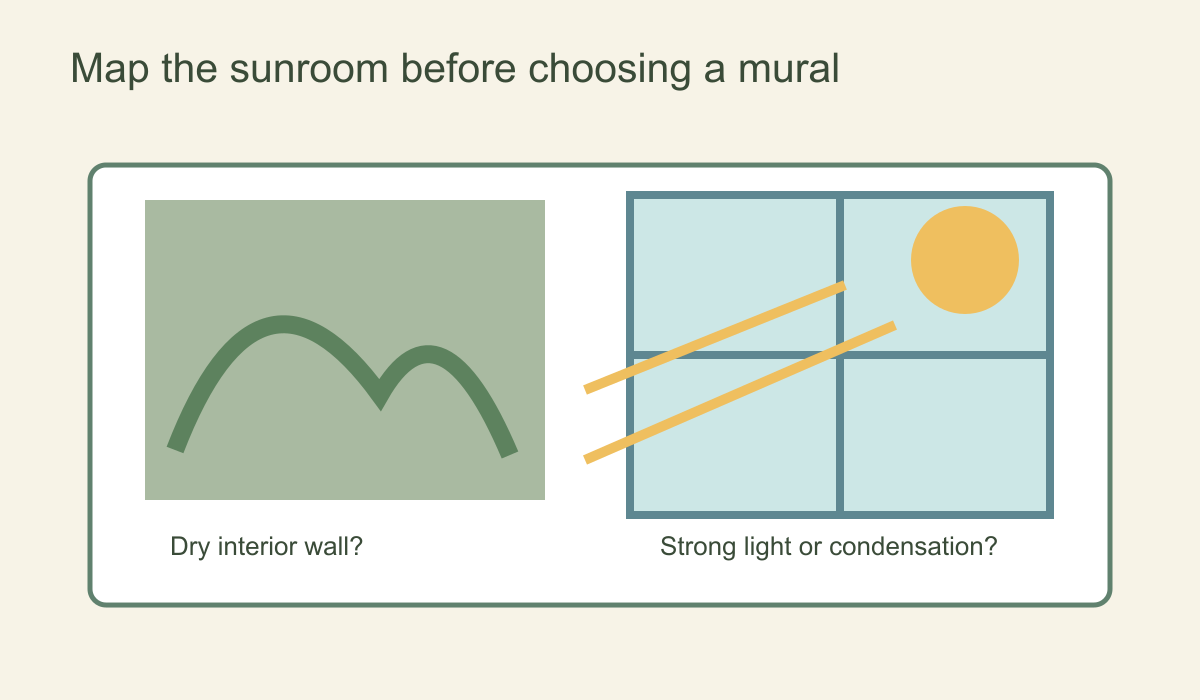 Check the solid wall and its year-round exposure before choosing a print.
Let the actual garden guide the image
The outdoor view is already one of the room's strongest design elements. If dense foliage fills the windows, a broad abstract wash or a quiet landscape can provide a contrast to all those small leaves. If a neighbouring wall blocks much of the view, an illustrated landscape on the solid wall may add a distinct focal scene. A botanical can echo plants, but it need not imitate them leaf for leaf.
Consider the room in more than one season. A print that appears to continue green summer trees will not match bare branches in winter. That may be perfectly acceptable if the mural is intended as an independent artwork. If visual continuity is the aim, a restrained branch study, broad hills or a neutral ground may depend less on matching a particular leaf colour.
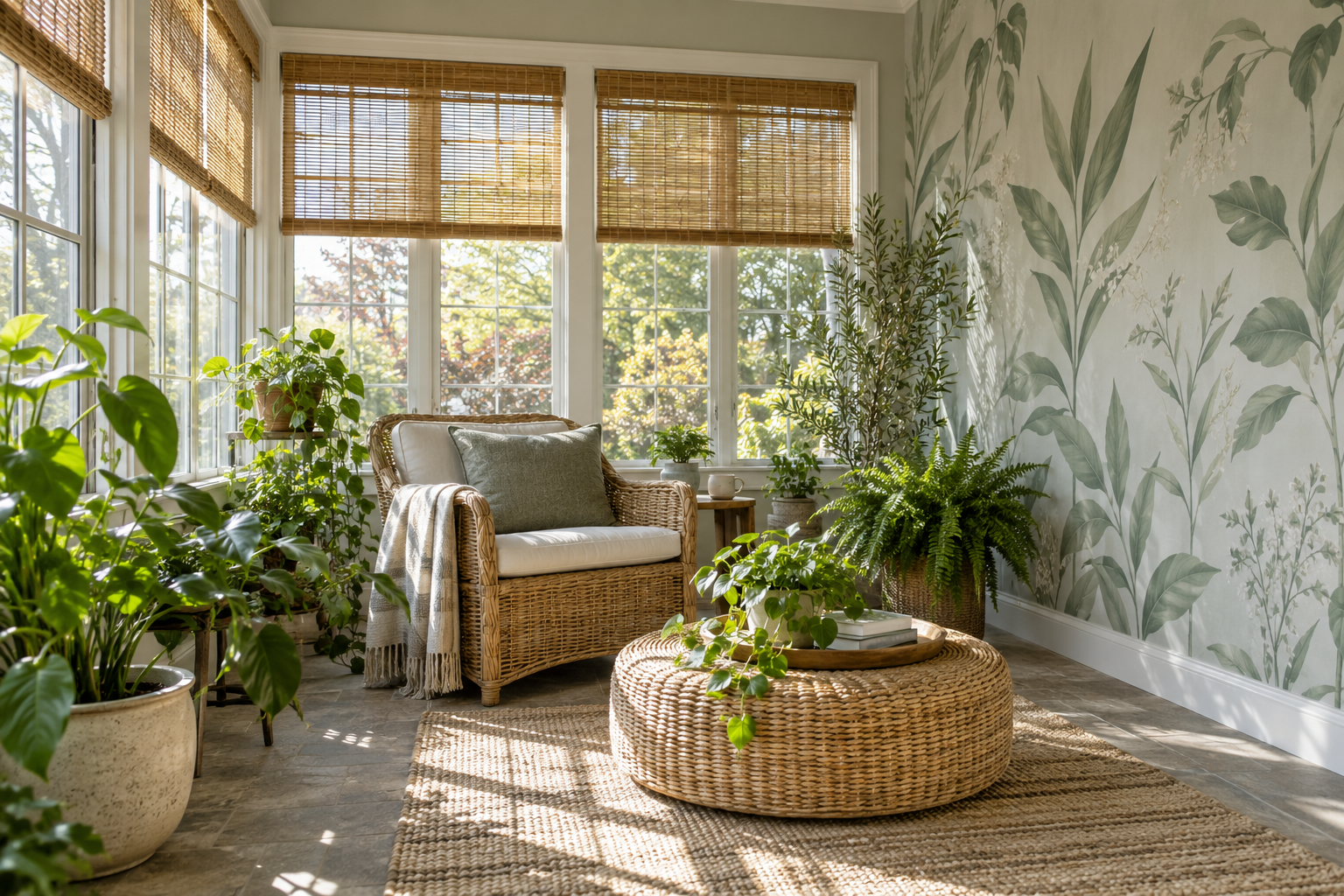
The accompanying photograph illustrates one balanced approach. Loose, pale green botanical forms cover a solid side wall while living plants cluster by the windows. Open ground between the printed leaves keeps the wall readable behind the plants and wicker furniture. The image is evidence of a composition, not evidence that the wall stays dry in winter or that the print has a particular lightfastness rating.
Match pattern density to the plants and glazing
Window frames, blinds, pot silhouettes and foliage already divide a sunroom into many shapes. A tiny all-over repeat can make that collection of lines feel more crowded. Broad leaves, distant hills or a softly layered wash can be easier to read from a chair. In a sparse room with only a few plants, a more detailed botanical may have space to become the main feature.
Put a full-wall preview into a photograph with the real plants and furniture in place. Stand where the room is used: at a breakfast table, a reading chair or a planting bench. The mural should be visible from that point, not merely from the camera angle that makes the room look widest. Check whether a tall plant will obscure the only recognisable flower or whether an image beside a bright window will appear comparatively faint.
If there is only a narrow wall strip, a carefully scaled repeat or a simpler finish may work better than a custom landscape with its horizon and focal subject cut away. The design choice should follow the usable shape of the wall.
Test the sample in changing light
Hold a physical print sample upright on the proposed wall during direct daylight, in shade and under evening light. Glass can create glare or strong contrast with the outdoor view; printed colours may also look different at each time. Confirm the actual product's surface finish rather than assuming that a watercolour-style image is physically matte or textured.
Long-term exposure is a separate question from how a sample looks today. The Wallcoverings Association defines colourfastness as resistance to colour change under measured light exposure. That definition does not establish the rating of every mural. If the wall receives prolonged strong sun, ask for product-specific light-exposure information and avoid a promise that its appearance will never change.
Blinds can affect the room's light, but a temporary shading arrangement is not a substitute for checking the stated use conditions of the print. Explain how the blinds are normally used, including when the room is vacant. The supplier needs the routine exposure, not an idealised version of it.
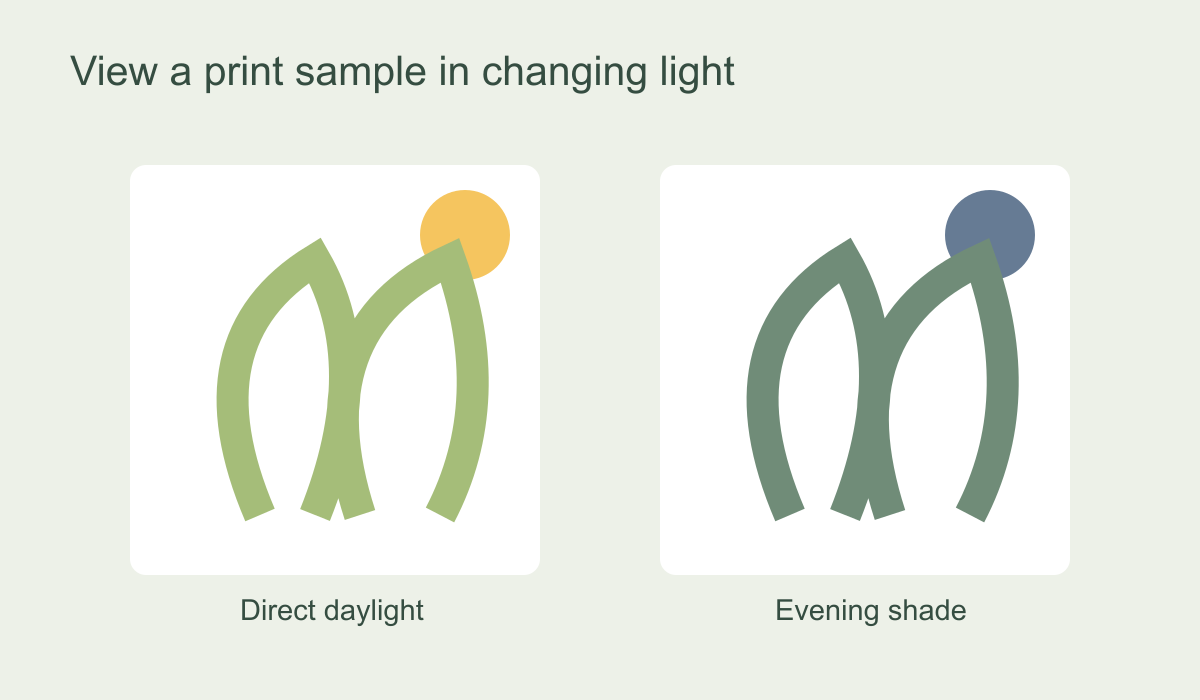 Compare the same sample in bright and shaded conditions.
Check temperature, watering and the exact material
A sunroom may heat quickly behind glass and cool after sunset. York Wallcoverings' instructions for one peel-and-stick product warn that rapid temperature shifts and high humidity can affect performance. That is a reason to check the instructions for the exact material under consideration, not to assume that every adhesive system behaves the same way. If the space is unheated or used only intermittently, make those conditions explicit before ordering.
Watering plants creates a more local exposure. Pots, damp leaves and a watering can may regularly touch the lower wall even if the room itself is dry. Move the mural away from that contact zone or verify the chosen finish's care guidance. A plant room with frequent splashes is not automatically equivalent to a dry reading corner merely because both are called sunrooms.
Plan installation for the product's required temperature, surface and paint-cure conditions. The wall's ordinary condition after installation matters just as much. A temporary heater used for hanging does not demonstrate that the covering will suit cold months when the room is left unheated.
Make the final crop around fixed features
Once the wall and product have passed those checks, finalise the image around window returns, lights, sockets, shelves and furniture. Place an important branch or horizon where it will not be split by blind fittings. Keep the focal form visible even if a plant grows or a pot is moved. Have the installer inspect the exposed surface before final measurement, and retain the approved crop and product instructions with the room records.
The useful answer is not simply “botanical for a sunroom”. It is a mural that relates to the real view, remains legible among living plants and is specified for a demonstrably suitable interior wall. If that wall is persistently damp or effectively outdoors, resolve the exposure question first and consider another finish rather than forcing a decorative mural into the wrong place.