Can Humidity Affect Mural Wallpaper Installation?
Consider damp surfaces, condensation, room ventilation and stable conditions before applying a mural to the wall.
Article focus: installation and removal
What the installer needs to know
The right installation method depends on the chosen material and wall condition, so prepare the wall before ordering and follow the material-specific instructions.
Example application: Bedroom · installation and removal
Yes, humidity can affect mural wallpaper installation, but a humid room and a damp wall require different decisions. Moist air may slow a pasted mural's drying; active moisture in the wall calls for investigation before anything is covered. A peel-and-stick product avoids wet paste but still needs a clean, dry, suitable substrate. Check the wall first, then the product's environmental instructions, then whether the room can stay within them during installation.
What humidity changes during a pasted installation
Water-based paste needs to set as moisture leaves the adhesive layer. Temperature, ventilation and humidity influence that process. The adhesive maker ROMAN states for its GH-34 product that drying time varies with all three. That does not provide a universal hour count for every mural, but it explains why an installation in a cool, humid room may take longer than one in stable, moderate conditions.
Look beyond the reading at the moment the installer arrives. A shower next door, indoor laundry or cooking steam can raise humidity later, just as fresh paste is setting. If you have a room hygrometer, note conditions at several times and record the steam source and usual ventilation. Those observations help compare the room with the specified product limits; a domestic air reading cannot diagnose moisture inside plaster. If suitable conditions cannot be maintained, change the schedule rather than trying to compensate with more paste or pressure.
For the separate question of how many hours to leave a pasted mural before another activity, see the adhesive drying-time guide. This article is about deciding whether the wall and room are suitable to begin and remain suitable while the installation settles.
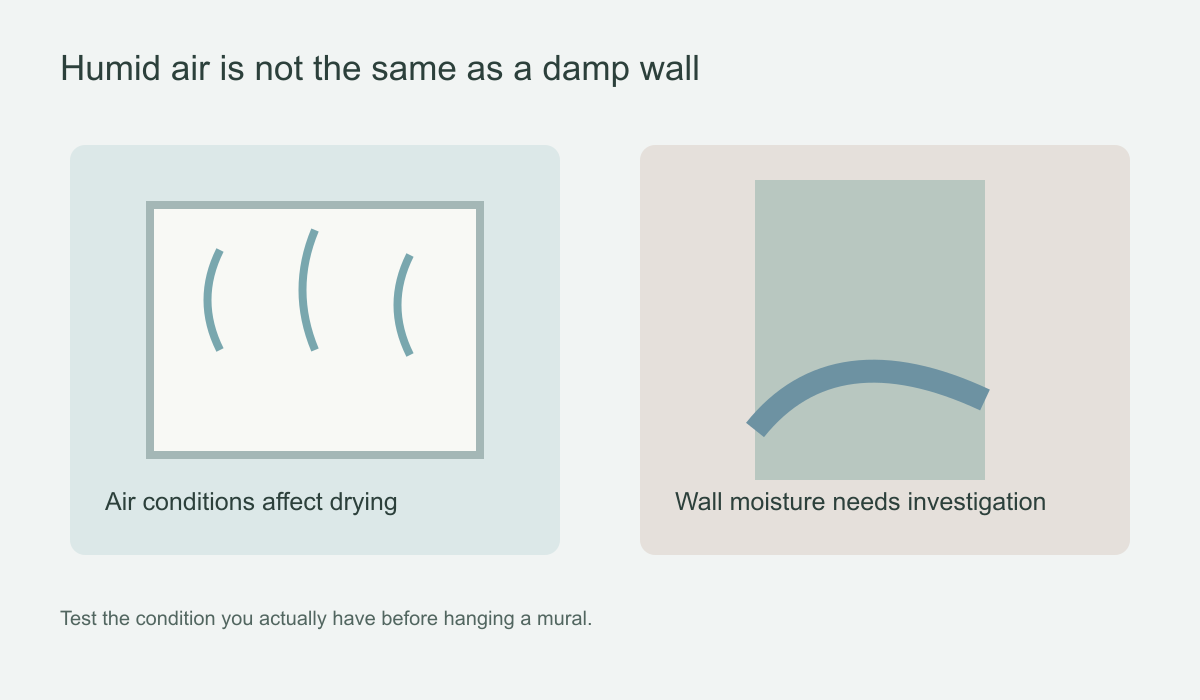 Humid air can slow drying; a wet wall requires its cause to be resolved.
Do not confuse air humidity with wall moisture
A bathroom used earlier may leave the air briefly humid while an adjoining wall remains dry and sound. Conversely, a wall beneath a window may show a returning stain, blistered paint, soft filler or a musty smell even when the room feels comfortable. These signs do not prove a particular leak, but they are reasons to pause and investigate. The Wallcoverings Association's preparation guidance requires a clean, dry, sound surface and the elimination of moisture sources before hanging.
A newly plastered or repaired area may also need to cure and dry according to the repair material's instructions. Do not judge readiness only by a pale surface colour or a quick touch. Ask the plaster, primer and wallcovering suppliers how the system should be prepared; if the wall condition is uncertain, use a qualified installer or building professional.
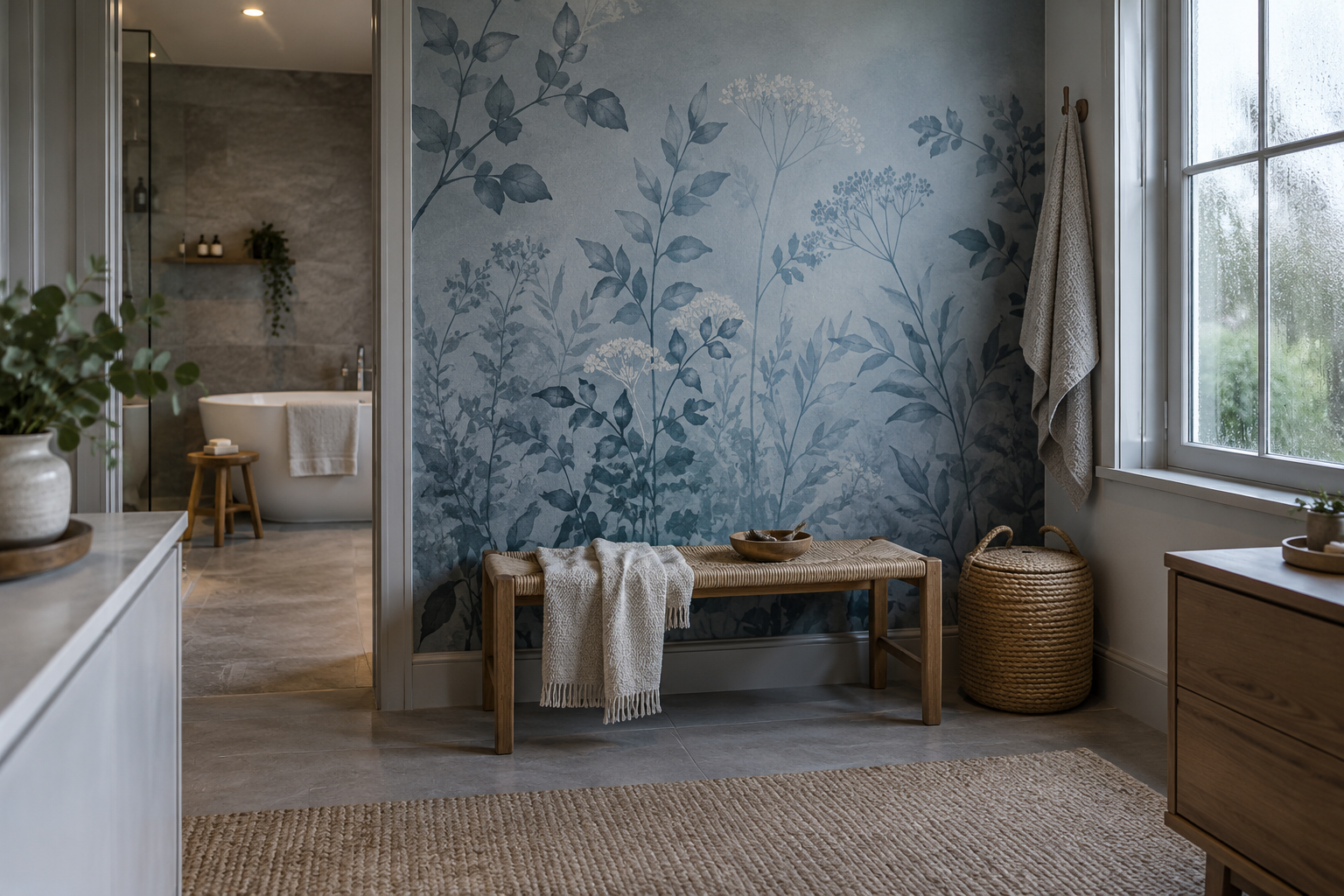
The feature image makes the distinction visible: a blue botanical mural sits beside a bathroom opening, and condensation is visible on the nearby window glass. The window suggests checking ventilation and neighbouring surfaces; it does not prove the mural wall is wet or that the pictured material is approved for this location. Nor can a dry-looking print prove that the substrate behind it is sound. The actual wall needs assessment before installation.
Peel-and-stick is not immune
A self-adhesive sheet has no wet-paste drying period, yet its pressure-sensitive adhesive still requires the surface and climate specified by its maker. York's instructions for one peel-and-stick range warn that high-humidity rooms are more prone to bubbling and seam separation and require newly painted surfaces to cure before application. Those are product-specific conditions, not universal promises or limits for every mural.
“Peel-and-stick” says how a sheet is applied, not that it tolerates wet plaster, continual steam or splashes. A dry feature wall outside a bathroom door, a wall by a basin and a shower enclosure face different exposure. Ask the supplier about the precise location and painted surface. Do not assume a vinyl-faced print is waterproof, or try to rescue an unsuitable wall with a hair dryer, stronger pressure or generic glue. Fresh paint has its own cure period before installation; that is separate from room humidity and from pasted wallpaper's later drying.
Ventilation should be steady, not extreme
Reasonable ventilation helps a wet installation dry without trapping humid air, but blasting one edge with a heater or fan can create uneven conditions. York Wallcoverings advises allowing an installation to dry naturally and avoiding excessive heat or rapid temperature changes. Maintain the environmental conditions specified by your product and adhesive makers, and avoid sudden changes just to accelerate the job.
Use an extractor or mechanical ventilation in a way compatible with the product guidance and ordinary room operation. Opening a window helps only when the incoming air improves conditions; very humid outdoor air may not. Move indoor laundry away from the work area and keep adjacent shower steam contained and extracted where practical. Choose an installation period when the room can realistically remain suitable, rather than depending on a window staying open through wet weather.
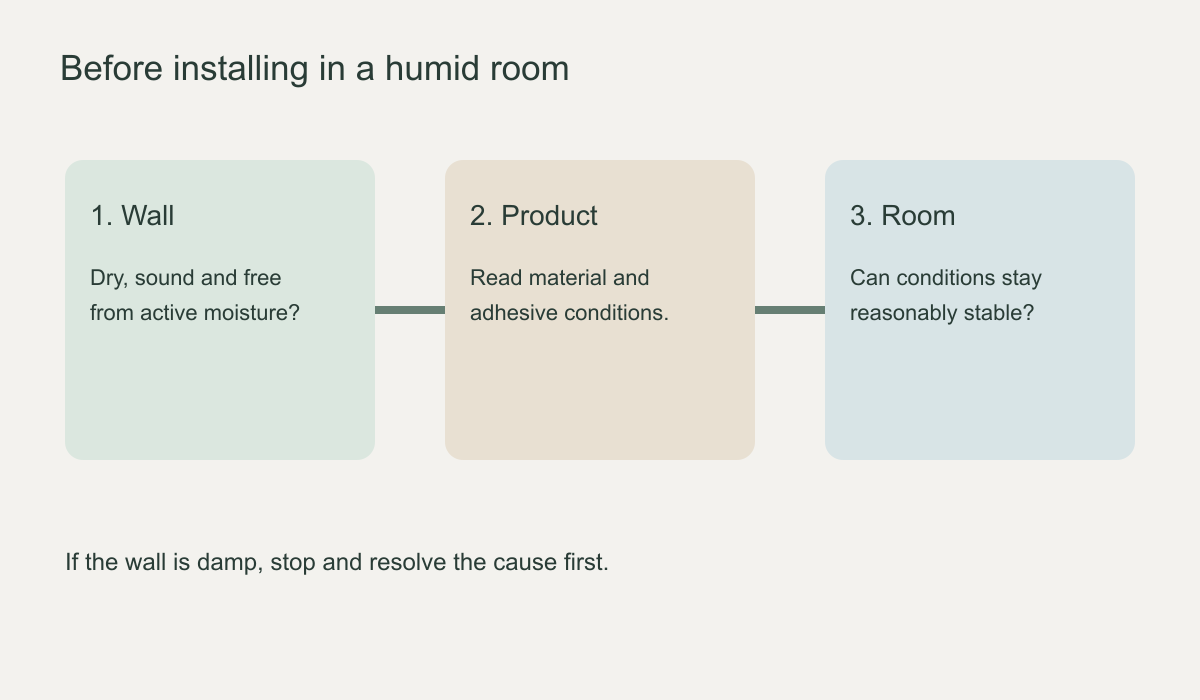 Check the substrate first, then the room conditions and material instructions.
What to do if humidity rises mid-installation
If a new steam source or sharp humidity rise interrupts the job, pause before hanging more numbered panels. Check the product's conditions and ask the installer how to protect unused panels and paste. A pasted or activated sheet may have a limited handling window; do not leave it folded indefinitely while waiting for the air to change. Record where the sequence stopped and keep unprepared panels separate.
Observe already hung strips for slipping, open seams or paste accumulation without repeatedly lifting them. Do not stretch a join to “correct” what may be a settling panel. Photograph persistent changes and consult the supplier or installer. In a kitchen or bathroom, also consider long-term daily steam or splash exposure; a room that briefly meets hanging conditions is not necessarily an approved location for the chosen wallcovering.
Three situations that lead to different decisions
In a dry bedroom during a muggy spell, compare room conditions with the product's limits and reschedule if they cannot be maintained; outdoor humidity alone does not prove a leak. In a hallway with a stain returning below a window, stop for a wall assessment even if the air reading is acceptable. Beside a shower, confirm that the exact mural and location are approved for ongoing exposure; waiting for one dry afternoon will not change how the room is used afterwards. These are three different decisions, not three versions of “wait longer”.