Which Mural Wallpaper Styles Suit Modern Interiors?
Compare restrained landscapes, abstract compositions, geometric designs and contemporary colour palettes for modern rooms.
Article focus: pricing and measurement
What to settle before pricing
Start with accurate wall measurements; the final custom mural price depends on area, material and any finishing options.
Example application: Dining room · pricing and measurement
“Modern” describes a room’s relationships, not one mural motif. A geometric wall can repeat the architecture’s arcs and straight lines; a stylised landscape can introduce distance behind low furniture; a painterly abstract can bring colour to a room with simple surfaces. The useful question is what the room lacks. Decide whether the mural should add structure, depth or softness before narrowing the design.
Start with the room’s geometry
Look at the lines that already define the space: long windows, built-in cabinetry, a low sofa, a staircase or strong ceiling beams. A geometric mural can reinforce these forms. Repeated arcs, blocks or lines may create rhythm across a simple wall, but too many competing grids can feel busy. If the room already has sharp cabinetry and a tiled floor, a softer painterly or botanical mural might provide more useful contrast.
Scale determines whether a design feels architectural or decorative. Broad shapes can read as part of the room from across a living area. Many small high-contrast marks may read as wallpaper texture and become visually active near a desk or dining table. Ask for the approximate printed size of a recognisable motif and view the crop from the room’s normal distance.
Do not assume a perfectly symmetrical design is required. An off-centre focal point can balance a sofa, large window or built-in shelf. Compare the measured-wall crop with your sketch of those elements so the composition belongs to the actual room rather than an empty digital rectangle.
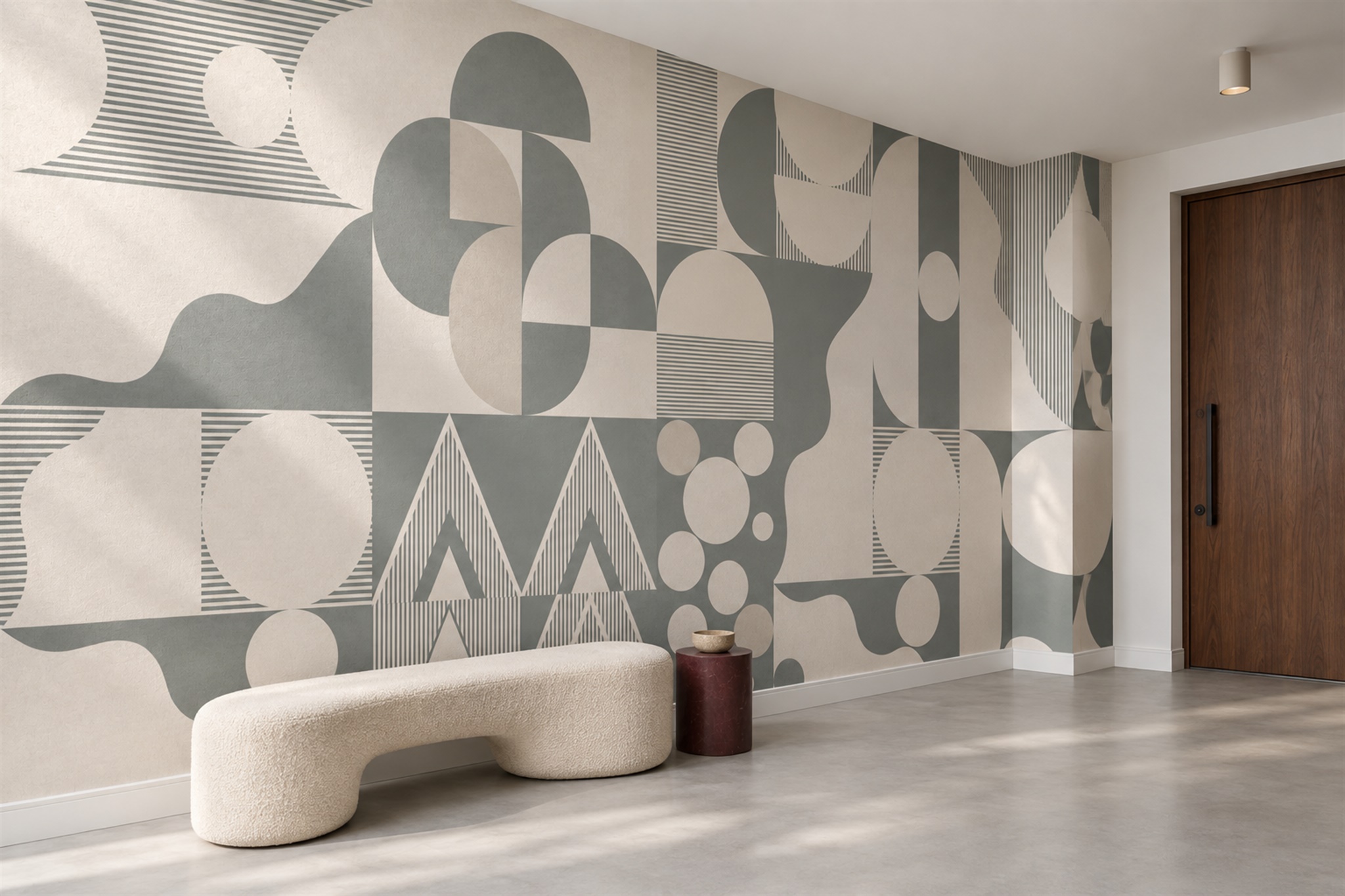
The grey geometric image used as this article’s feature shows circles, half-circles and fine stripes across a corner, with a curved bench in front. It is not a quiet background. Its value is the deliberate exchange between the mural’s arcs and the bench’s silhouette. In a room already full of patterned upholstery or exposed structural beams, that much graphic information might be excessive; in a sparse room it can become the organising element.
Use a stylised landscape for depth
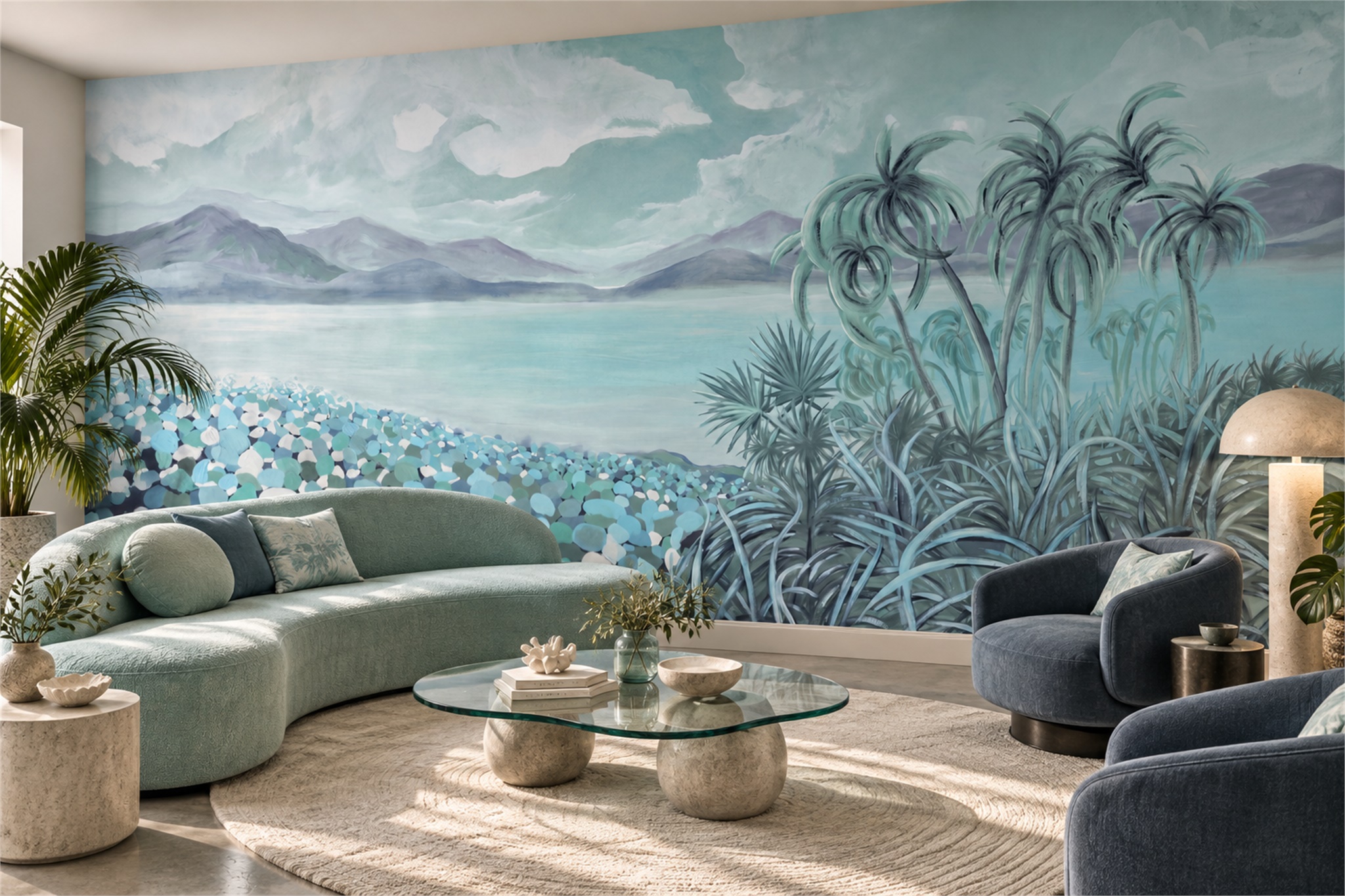
A hillside, sea or simplified woodland can give a modern room a view beyond its walls. The example below is not a literal photograph: aqua water, mauve hills and dark palm forms are interpreted as broad painted shapes. Its light middle distance sits above the curved sofa, while denser vegetation occupies one side. That distribution matters more than calling the image “scenic”. Place a candidate’s horizon relative to the sofa back or table before choosing the crop.
Painterly landscapes can introduce organic variation to rooms dominated by straight edges. A crisp photograph can create a different, more literal effect. Neither is inherently more modern. Choose according to how much realism and visual detail the room can carry. A broad background with a clear focal point may be easier to integrate than a crowded scene whose subject is hidden by cabinetry.
Check image quality at final print scale. A soft watercolour may be intentionally diffuse, but a photographic source should have enough detail for the chosen wall size. A small thumbnail does not reveal what a several-metre print will look like close up.
Use abstraction for colour and atmosphere
Abstract murals can supply movement through brushwork, layered forms or soft transitions without asking the viewer to recognise a scene. This can be useful in an open-plan room where several functions share one wall. A large colour field may unify seating and dining areas; a strong gestural mark can provide a focal point. Judge where the movement begins and ends after cropping. Enlarging an abstract image can remove the quiet space that made it balanced in the original.
Abstract does not mean random. Directional lines can lead the eye toward a door or window; large dark shapes can visually anchor one end of a wall. Consider the distribution of visual weight against furniture. If a heavy cabinet already sits on the left, placing the mural’s darkest block there may make that side feel overloaded. A crop adjustment can often resolve the balance before print.
Colour can be restrained or expressive. Muted stone, clay, olive and charcoal may relate easily to timber and natural textiles. A brighter accent can work in a modern room with plain furnishings. Use a physical print sample to compare undertones with the floor, paint and upholstery; digital screens can make subtle neutrals look deceptively similar.
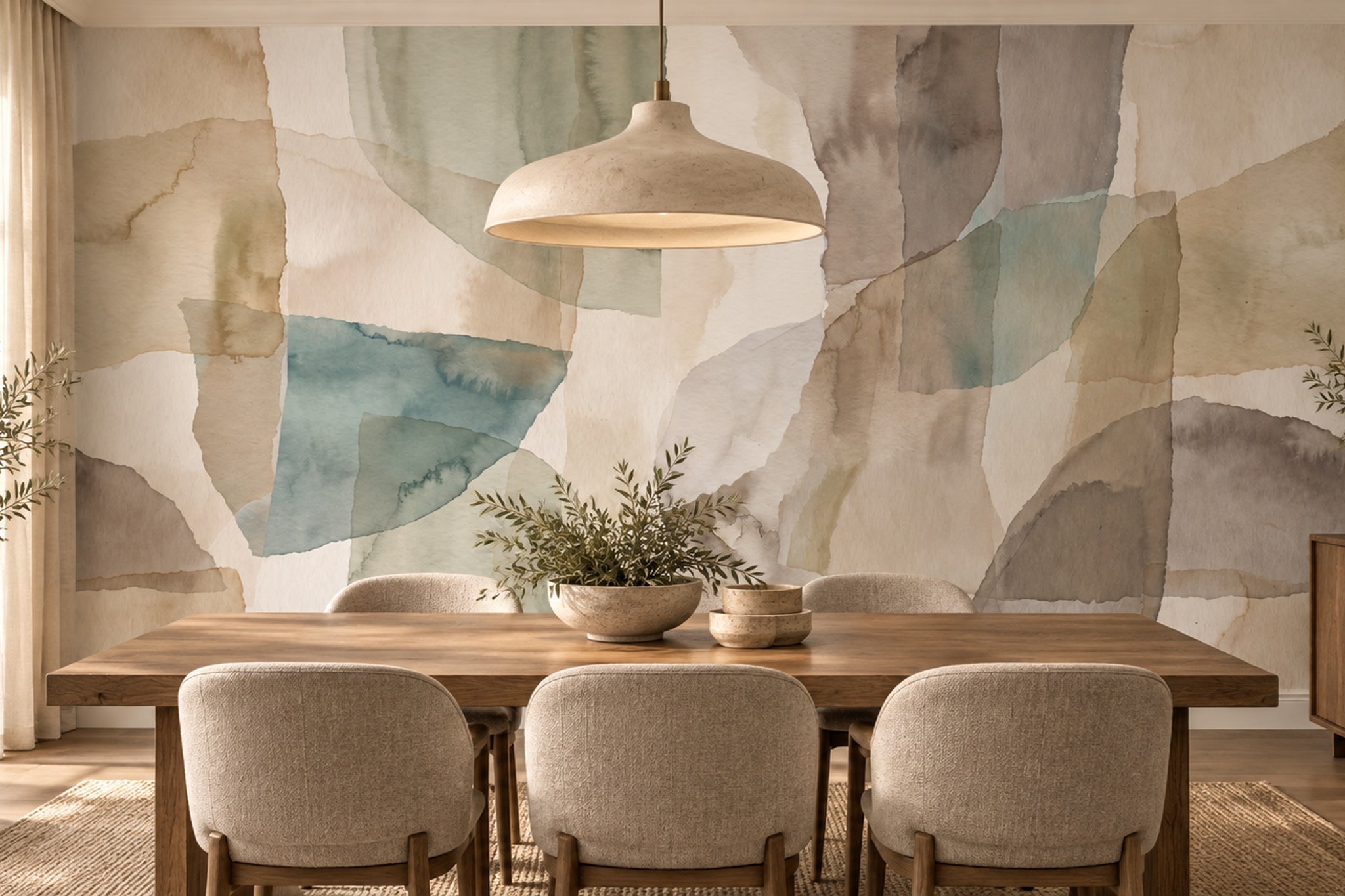
A painterly abstract can be less forceful than a crisp geometric repeat even when both use large shapes. In the dining-room example below, irregular washes in beige, stone, muted green and blue sit behind a plain timber table. The pendant light and chairs remain clearly legible because the mural has soft transitions rather than hard-edged outlines. A new crop that removes most of the pale intervals would change that balance, so compare the proposed wall-size crop with the room photograph.
Choose finish and wall placement together
A smooth matte finish may support crisp geometry, while a softly textured finish can suit painterly artwork, but these are visual preferences rather than performance rules. Ask for samples of the actual materials available for the design. Check how side light reveals texture and seams. Read the exact wall preparation, cleaning and installation guidance instead of assuming a material name guarantees a certain look.
Choose the wall that has a clear sightline. A mural interrupted by many doors can lose a precise geometric composition; an organic abstract design may tolerate those interruptions better. The wall should be sound, dry, smooth and measured at several points. Mark windows and furniture on a separate elevation, and ask about panel joins if a precise line makes them important.
If the room already has statement lighting, sculptural furniture and patterned textiles, a quieter mural may be the modern choice. If the furniture is restrained, stronger wall art can supply contrast. Modernity is a relationship among elements, not a keyword printed in the product title.
Choose the role the mural will play
Try one candidate from each role at the same measured wall size and with the real furniture outlined. Decide whether this modern room needs echoed geometry, depth or softer colour, then check the winning print sample against fixed finishes under actual room light. “Modern” is not a finish rating or a single motif category. The strongest choice is the image whose composition solves a specific visual problem in the space without forcing every other object to compete with it.