Can You Use a Mural Wallpaper on Two Adjoining Walls?
Plan corners, image continuity, panel direction and focal placement when a mural extends across two walls.
Article focus: pricing and measurement
What to settle before pricing
Start with accurate wall measurements; the final custom mural price depends on area, material and any finishing options.
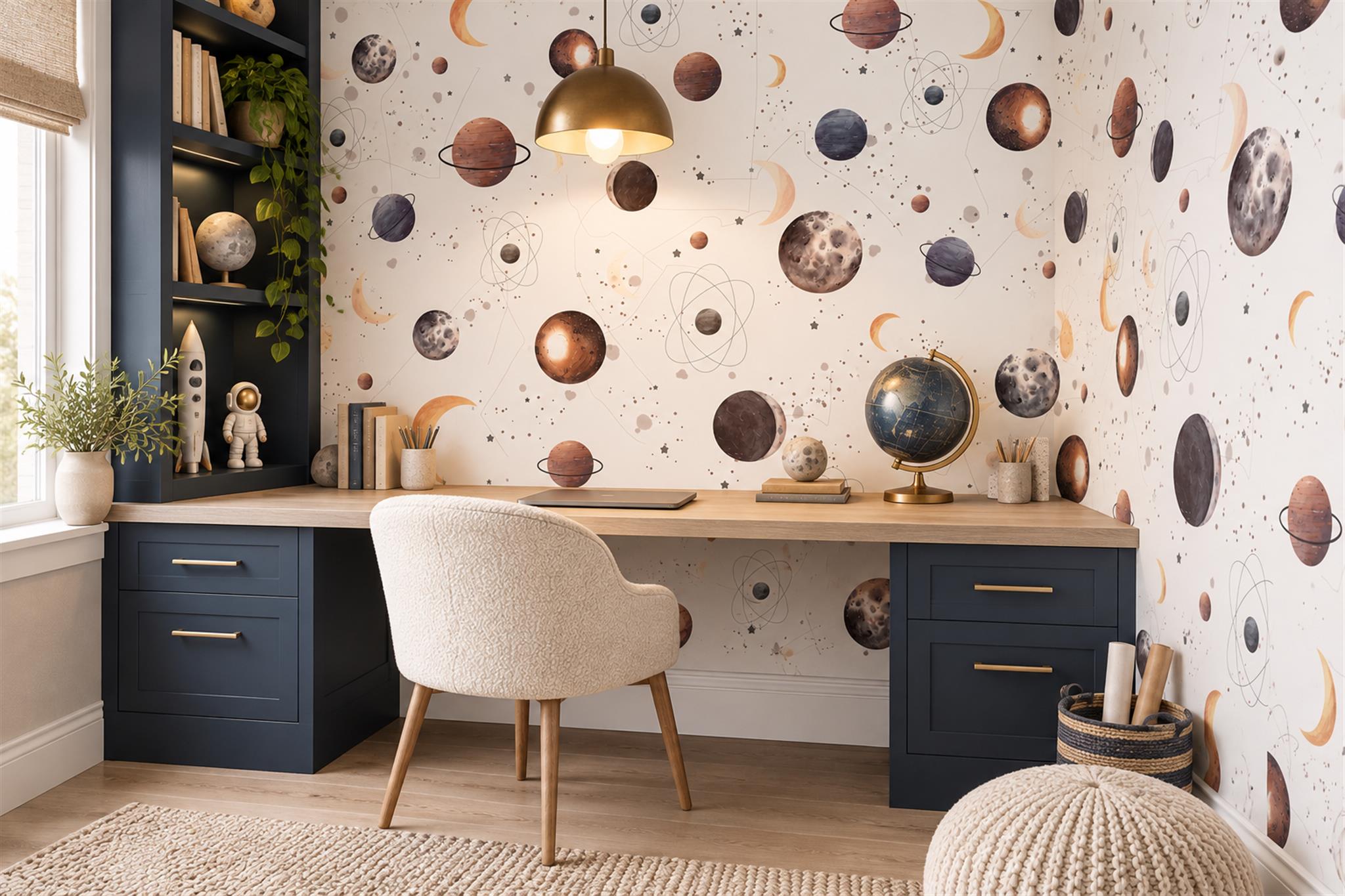
Example application: Any room with a suitable, prepared wall · pricing and measurement
Yes—a mural can cover two adjoining walls. The important decision is whether one continuous image should turn the corner or two coordinated images should meet there. A corner changes both the physical installation and the way artwork is seen: a round planet, animal or face can look broken when half of it is on each plane. Treat the project as an L-shaped composition with two measured surfaces, not as a single extra-wide rectangle.
Decide whether the image should continue or change at the corner
A continuous panorama lets a landscape, canopy or abstract composition move from the first wall through the turn. It needs enough usable artwork for both widths and a relatively quiet passage at the corner. A second approach uses two related compositions that share a palette or motif family but do not pretend to be one uninterrupted photograph. That is often more convincing when one wall is much narrower or contains a door. State which approach you want before a crop is prepared.
Ask what the design is meant to look like from the main viewpoint. From a sofa, the two walls may appear together. From the doorway, one wall may dominate and the other may be seen only obliquely. A subject can seem distorted when split across two planes even if the print file itself is correct. Keep faces, lettering, straight architectural forms and other sensitive details away from the corner unless the design specifically accounts for the change in plane.
Not every source image has enough usable content to span both walls. Enlarging a small central motif to fill a long L-shaped area can make it disproportionately large or cut away the supporting scene. Repeated stars or foliage may tolerate the turn visually, but even a repeat-like design should not be assumed seamless. The planetary room photograph used as this article's feature image illustrates a motif that could be considered for a corner; it does not establish that the pictured product was printed as a continuous two-wall order.
Measure two walls, not one total width
Record width and height for each wall separately, checking more than one point to reveal taper. Mark the inside or outside corner, skirting, ceiling, doors, windows and alcoves. State which wall is viewed first and where panel one should begin. For example, walls of 2.4 metres and 1.8 metres should be labelled Wall A: 2.4 m and Wall B: 1.8 m, not merely “4.2 metres across.” The combined width cannot tell the designer where the image changes plane.
Photograph the corner from more than one angle. An inside corner may be rounded or visibly crooked; an outside corner projects into the room and is more exposed to contact. Ask the installer how the chosen material should turn or terminate there. The Wallcoverings Association treats inside and outside corners as distinct installation cases, and notes that walls are often out of alignment. Those general techniques do not override the instructions for a particular custom mural and adhesive system.
Ask whether the supplier can provide a dedicated layout labelled Wall A, Wall B, the corner and the intended trim on each plane. Confirm how the fitting allowance is handled; do not count it twice. If two sets will be printed, compare the artwork at their intended meeting edges before production. A standard single-wall preview or one combined 4.2-metre rectangle cannot tell the installer which portion belongs on each side of the turn.

Request a layout that treats the corner as a boundary
For a bespoke two-wall plan, request two complementary views if the supplier can provide them: separate measured elevations showing the turn and panel positions, plus a room photograph or simple corner mock-up from the main sightline. Mark furniture on your own copy so the layout shows what will remain visible. This is an additional planning request, not an automatic feature of the site's single-wall crop tool.
Check the corner itself rather than only the two outer ends. If a planet, face or recognisable tree trunk is split at the fold, ask for a different placement before approving print. A design can preserve its subject on Wall A yet leave Wall B empty, or balance the two while hiding its best detail behind a cabinet. Compare both walls from the doorway and the main seat; a tidy physical corner cannot restore a subject that the planned crop has broken.
Check horizon lines, architectural edges and directional movement. A river or branch can appear to bend unexpectedly at the corner because the viewer sees each wall at a different angle. Sometimes that turn is an appealing part of the design; sometimes a calmer area of sky or foliage should occupy the fold. Compare the layout from the doorway and the primary seating position rather than approving it only as a flattened rectangle.
If the walls have different heights, as beneath a sloping ceiling, the bespoke plan should show the actual visible outlines. A rectangular online preview will not account for that cut-off. Include the height at each end of the slope and ask whether the artwork must be repositioned so its focal point survives trimming. Check that the proposed panel numbering follows the agreed start wall and continues logically through the turn.
Install in the planned direction
Panel order matters even more across a corner. Lay out the numbered drops and identify which one reaches the turn. Start from the agreed true vertical line, not automatically from the nearest corner, because corners can lean. The Wallcoverings Association recommends planning seam positions before installation. For a bespoke mural, the approved proof and its panel map should be checked against the actual room before the first strip goes up. Do not stretch a panel around the corner to force a match if the material’s instructions call for a separate cut or drop.
Outside corners are especially exposed to brushing and knocks. Ask whether the chosen wallcovering needs an approved edge or protective treatment. Do not improvise a sealant or extra glue that could alter appearance or complicate future removal. The installer should assess the real corner and finish it according to the supplier’s instructions.

When two walls are too much
If the artwork cannot span the turn coherently, choose one mural wall and a quieter related paint colour or separately planned motif on the next. This can preserve a panorama's focal subject without forcing it across a crooked fold or behind a cabinet. Compare that option with the proposed two-wall arrangement from the room's main seat, not just on a flattened drawing.
Make the choice with three side-by-side sketches: one panorama continuing through the corner, two separately cropped but related prints, and one mural wall with paint on the return. On the 2.4 m and 1.8 m example, keep the same furniture and viewing position in every sketch. If the continuous version splits a face at the fold, the paired prints may preserve both subjects; if the shorter wall is mostly occupied by a door, paint may keep the main mural legible. Ask the supplier which of these layouts can actually be produced, then have the installer confirm the corner treatment for that finish. Do not turn a single-wall order into a two-wall order on site.