Mural Wallpaper or Framed Wall Art: Which Should You Choose?
Consider coverage, focal impact, flexibility, furniture placement and the atmosphere created by each approach.
Article focus: pricing and measurement
What to settle before pricing
Start with accurate wall measurements; the final custom mural price depends on area, material and any finishing options.
Example application: Bedroom · pricing and measurement
Should a favourite image sit in a frame or spread across the wall? The answer depends less on the image's subject than on the job it must do in the room. Framed art is a contained object with a visible border and surrounding wall colour; a mural turns the wall itself into the image. Compare how much of the surface each treatment occupies, what furniture will hide, how close people will view it and what will happen when the room changes. The same landscape can succeed in both formats for different reasons.
Short answer: Choose framed art when you want a movable focal point, a smaller commitment or room for the wall colour to remain visible. Choose a mural when you want the image to define a whole wall and are prepared to measure, crop, install and eventually remove a wallcovering. A removable frame does not mean damage-free hanging, and a peel-and-stick mural does not guarantee damage-free removal.Ask what should lead the room
A frame draws the eye to one contained object. Its border, mount and surrounding blank wall all become part of the composition. That can be ideal when a room already has interesting architecture, layered furniture or several collected pieces. A mural makes the wall itself the main plane of colour and imagery. It can establish a view behind a sofa or carry an abstract movement across a broad dining wall. The question is whether the artwork should sit within the interior or become the interior's backdrop.
Try a simple doorway test. Stand where you normally enter and ask what you should notice first: a single object, such as a family photograph above a console, or an atmosphere that holds the whole room together. A frame can give a small image deliberate importance without filling the architecture. A mural can make a plain wall feel expansive, but it will also affect the colour balance of curtains, upholstery and adjacent paint. A dramatic image over a whole wall may leave little visual rest if the room already has busy surfaces.
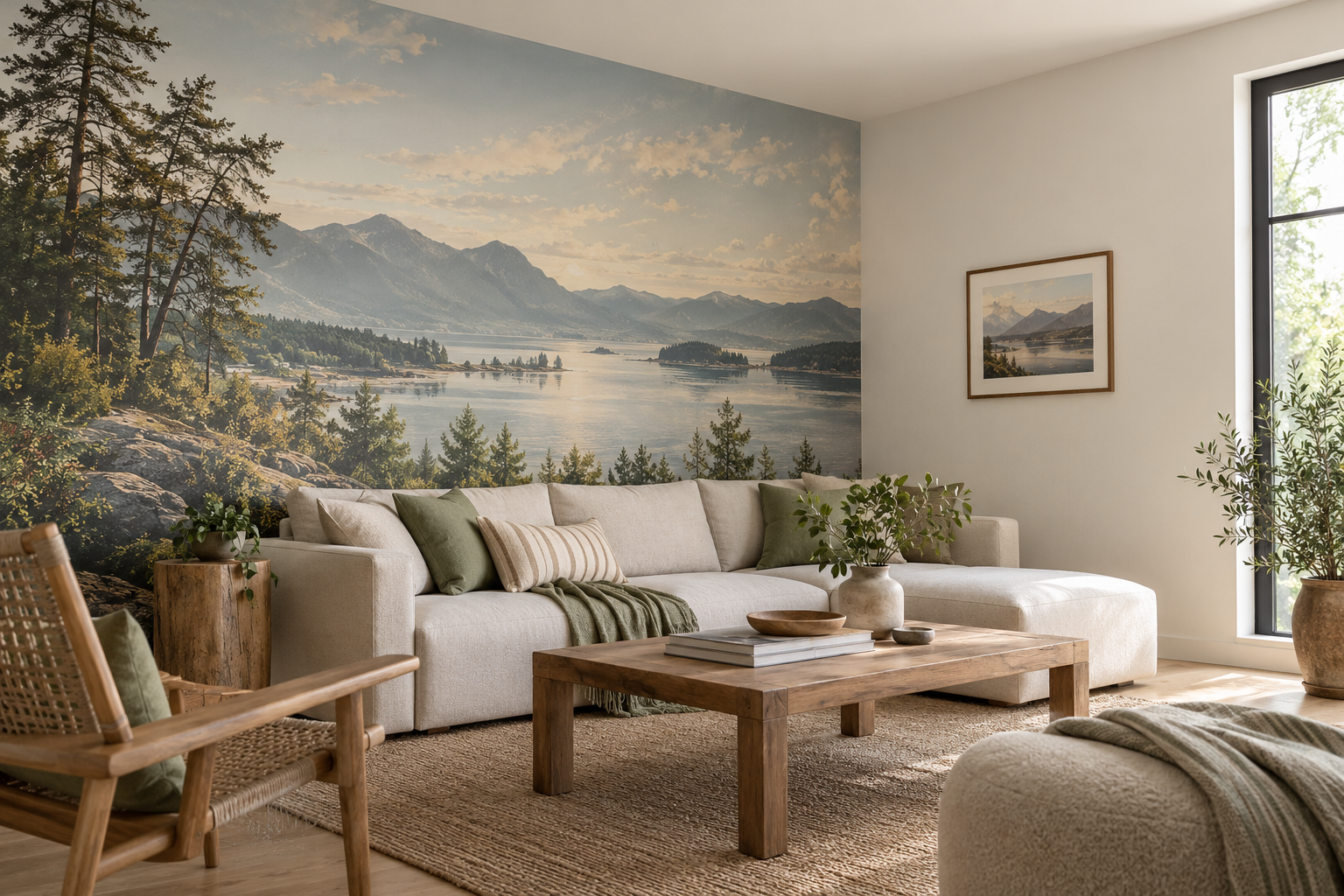
The article's feature image places a wall-sized landscape near a smaller framed image. It is an editorial visualisation, not a customer installation or a promise that both treatments will suit every room. Notice that the frame remains recognisable as an object on a pale wall, while the mural sets the mood behind the seating. Put a similar comparison into your own floor plan before buying. A thumbnail of a framed print and a full-wall mural may look equally prominent online despite their very different physical scale.
Use furniture to test the true visible area
Mark the bed, sofa, console or shelving on a simple wall elevation. A large framed work needs enough clear wall around it to feel intentional, and its centre should relate to the furniture rather than to an arbitrary ceiling midpoint. A mural can extend behind furniture, but its main subject should not vanish behind a headboard or bookcase. A horizon cut through the top of a sofa can look accidental. If the furniture is likely to move soon, a framed work offers more freedom to rebalance the room later.
Now add the permanent interruptions: a wall light, switch, thermostat, door swing or radiator. A frame can often be shifted a few inches to avoid one. A mural crop must be planned across all of them before printing; moving the central tree after installation is not the same as moving a picture hook. Check the scene from standing and seated viewpoints. A subject that is clear from the doorway may disappear once you sit on the sofa beneath it.
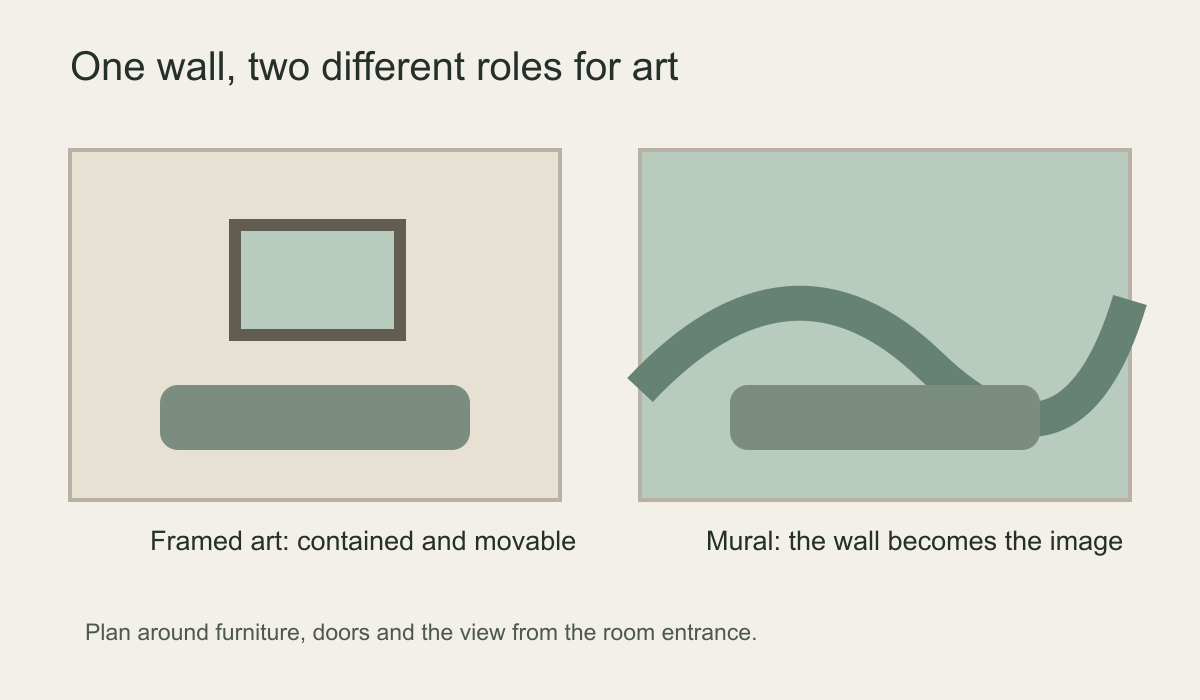
For example, an eight-foot sofa under a ten-foot wall leaves a broad zone for one large picture or a gallery grouping. A mural would fill the whole width and need a crop that works around the sofa's height and any side lamps. The diagram below is only a planning aid, not a hanging rule. It shows how the same wall can be organised as a contained art zone or as a continuous image field. Real rooms also need to account for windows, sockets, doors and wall lights.
Consider how often the room will change
If you move regularly, rotate your art or like to repaint each year, a frame is usually easier to reposition or take away. It still needs suitable fixings, and the holes may require filling; heavy pieces need anchors appropriate to the wall. A mural involves surface preparation, a measured order and a full installation. When removed later, paint condition, primer, adhesive, age and removal technique influence what happens to the wall. Do not assume every peel-and-stick product releases cleanly from every painted surface. Ask the supplier for its instructions and test the wall where appropriate.
Wall condition also affects the choice today, not just at removal. A small framed piece might conceal one cosmetic mark while leaving most of the wall visible; it cannot safely correct a damp or unstable surface. A wallcovering needs a suitably prepared, sound, clean and dry substrate according to its product instructions. If there are leaks, flaking paint or major irregularities, address those first. The mural's broad surface makes defects and uneven lighting harder to ignore, while an elaborate frame needs secure fixing in the actual wall construction.
For a long-term home, the mural's commitment may be exactly the point. It can carry a quiet scene through a bedroom without needing many separate objects on the wall. In a rented property, check the lease and obtain any required approval before covering a wall. Even a single large framed work may require permission for fixings. Think through the whole lifecycle: installation, likely changes to furniture, cleaning, eventual removal and making good afterward.
Artistic freedom comes in different forms
Frames allow a collection to grow. You can change a print without changing the wall, combine photographs with drawings or keep one original artwork as the sole focus. A mural allows spatial composition: a branch can frame a doorway, a coastline can stretch behind a bed, or colour can graduate from one end of a wall to the other. That requires a successful crop at the wall's exact ratio. A picture that works beautifully in a square frame may not survive being enlarged into a wide panoramic strip.
The two formats also reward different detail. An original painting may have physical brushwork and a frame that people inspect at close range. A photographed or printed reproduction of it on a mural is a different object; enlarging the image does not recreate the relief of paint. Conversely, a large scenic photograph can have space to unfold across a wall in a way a small frame cannot. Before converting the same artwork between formats, check its file quality, reproduction rights and whether the change of proportions leaves its subject intact.
Some rooms benefit from both, but give them different jobs. A low-contrast mural can act as atmosphere while one framed piece sits on an adjacent plain wall. Hanging multiple frames directly over a highly detailed mural risks visual competition and may put holes through a surface that is difficult to patch invisibly. Try a paper template or digital elevation first. If the mural already contains a distinct central subject, there may be no need for another picture above the furniture.
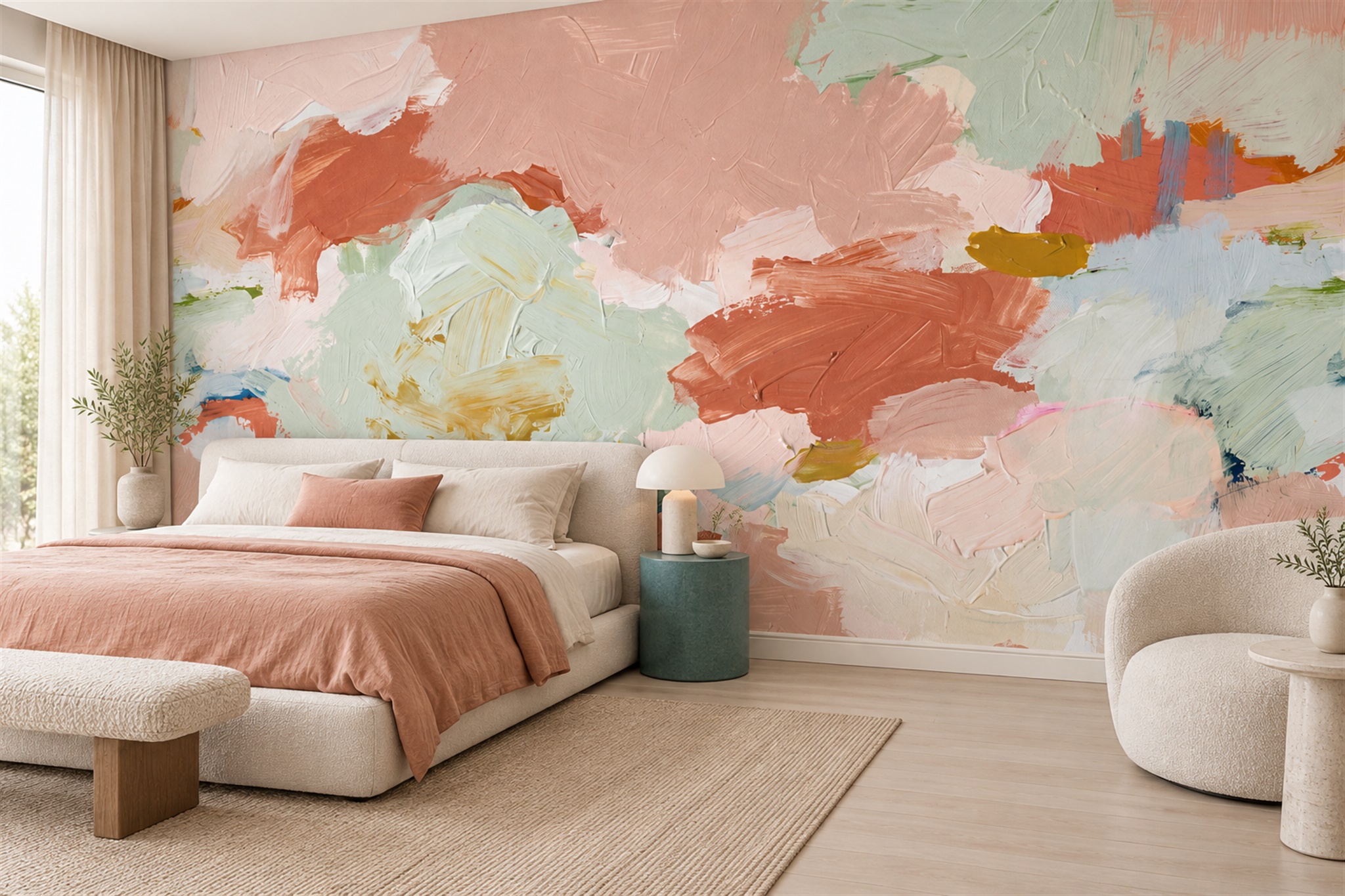
The bedroom application below uses broad abstract strokes as a whole-wall treatment. Its peach and pale green marks remain visible around the bed, although the headboard hides part of the lower design. A similarly coloured framed painting would leave much more plain wall in view. The styled scene is an example of composition, not evidence of a particular material or removal performance.
Compare the real project, not only the ticket price
A framed work involves the print or original, frame, glazing if used, fittings and appropriate installation. A mural involves printing for the measured wall, possible samples, wall preparation, tools and labour if you hire an installer. Neither is universally the cheaper option. A small poster may cost less than a bespoke mural, while a large original painting and custom frame may cost far more. Get comparable total quotations, including any preparation or professional help, rather than comparing one online product price with another.
Include the next change of room in the comparison. A frame can travel with you, but may need different fixings on the next wall; its glass or acrylic face may also need cleaning or replacement. A mural is ordered for the current wall’s dimensions, and later removal or a panel repair may involve making good the surface. Those costs are possibilities, not inevitable failures. If the space is temporary, portability may outweigh the difference in initial price. If the wall is meant to define a room for years, compare the mural’s whole-wall effect with the actual framed work rather than with a generic poster.
Also distinguish image ownership from decoration format. Buying a digital picture or finding it online does not necessarily allow you to reproduce it at mural size. A framed print sold by an artist is a physical object, not automatically permission to copy its image onto wallcovering. If using someone else's artwork, check the specific licence or obtain permission for the intended reproduction before ordering either format. The UK Intellectual Property Office's image guidance is useful background, though the applicable rights depend on jurisdiction and the work.
Make a full-size decision where possible
Tape out the proposed frame's outside dimensions on the wall. For a mural, tape the wall area, print a scaled crop or request a sample in the selected finish. View both arrangements from the doorway and from the main seat. Check the room at daytime and under evening lights. A frame's glass may reflect a window; a printed wall surface may show colour differently from a screen. Neither a small digital mock-up nor a thumbnail can substitute for seeing the intended scale in the room.
If you remain undecided, make two photographs of the same wall from the same camera position. Overlay the actual outside dimensions of the frame on one and the supplier's full mural crop on the other, with furniture left in place. Compare what remains visible, not merely which picture looks more appealing in isolation. This is particularly revealing in a bedroom, where a headboard can hide much of a mural's lower subject while leaving a well-positioned frame completely in view.