Mural Wallpaper vs Regular Wallpaper: What Is the Difference?
Compare mural wallpaper with regular wallpaper by design, repeat, sizing, installation, cost, and the type of room each option suits.
Article focus: pricing and measurement
What to settle before pricing
Start with accurate wall measurements; the final custom mural price depends on area, material and any finishing options.
Example application: Any room with a suitable, prepared wall · pricing and measurement
The main difference between mural wallpaper and regular wallpaper is the way the design continues across a wall. Regular wallpaper commonly repeats a motif at intervals, so additional strips carry the same pattern again. A mural is planned as one larger composition—perhaps a landscape, illustration or abstract field—whose panels join to form a complete image. Both are wallcoverings, and either can be printed on different substrates. The distinction changes how you measure, order, place focal details and handle a future repair.
Repeat versus whole-wall composition
Imagine a small leaf wallpaper. Each roll carries the same leaves, and the installer matches their edges and vertical repeat as strips go up. The amount of material needed depends on roll width, wall height and the pattern match. A mural of a woodland path behaves differently: each numbered panel shows a different part of the scene. Hang the panels in the wrong sequence, and the path no longer connects.
The Wallcoverings Association explains pattern repeats and notes that some murals do not have a conventional repeat. Its distinctions among random, straight and drop matches are important when calculating ordinary wallpaper. A mural buyer instead needs to inspect the full image crop at the ordered proportions and follow the supplied panel sequence on delivery. The technical overlap is real, but the design logic is different.
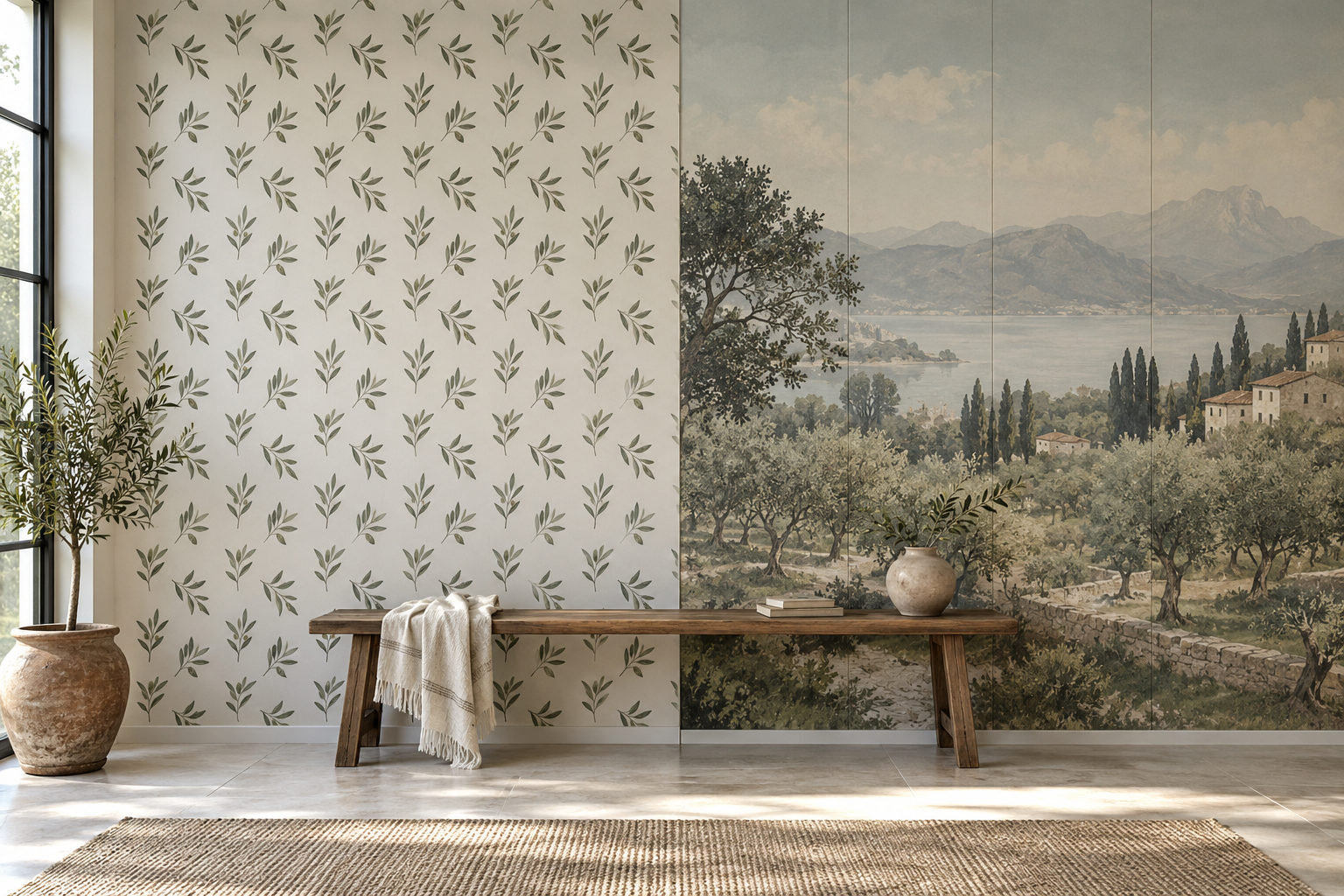
The feature photograph at the top makes that difference visible. On the left, the leaf sprigs recur at regular intervals, so a new width of wall can receive more of the same motif. On the right, the landscape moves from trees to a lake and buildings; each panel has a particular place in that progression. The diagram below simplifies the same distinction into repeated shapes and one continuous form; it is not a second photograph of the room. Adding another panel at the end would not automatically extend the landscape. The supplier would need to prepare an appropriate wider composition or crop.
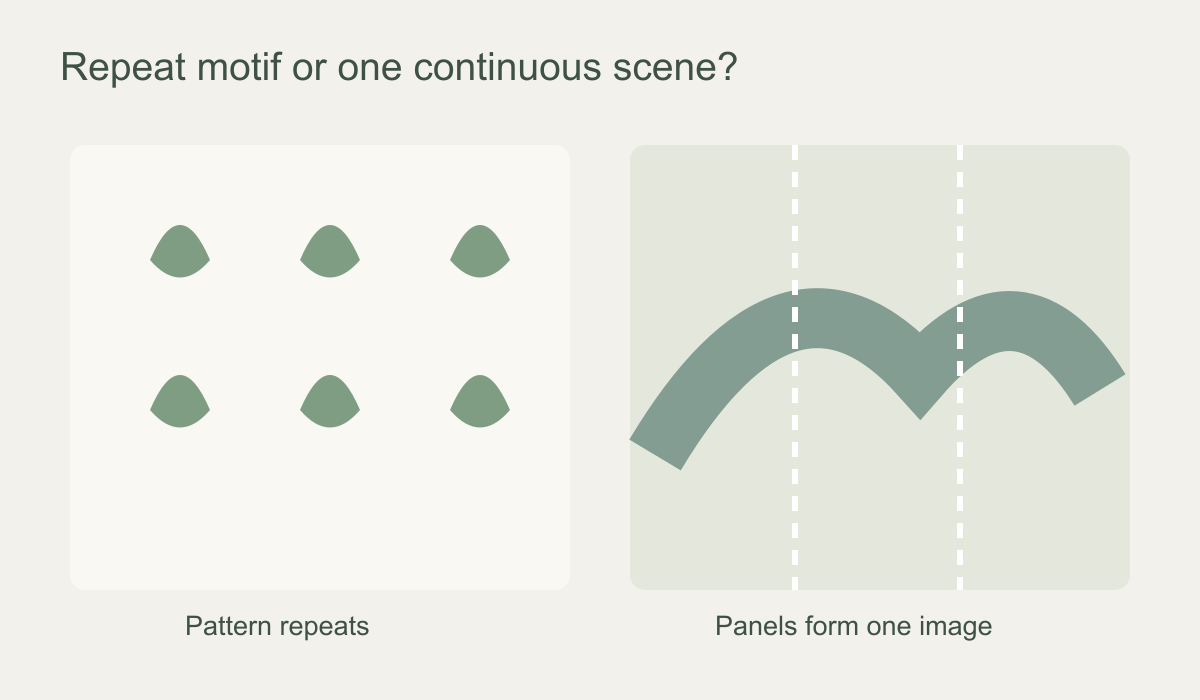 One pattern repeats; the other develops across the wall.
How ordering differs
Regular wallpaper is often ordered by roll or bolt, with enough extra material to allow pattern matching and trimming. A made-to-measure mural is generally ordered to a specified wall width and height, with an installation allowance according to the supplier's instructions. Some murals come in fixed standard sizes instead. Never assume one shop's measuring rule applies to another: check how the seller handles trim and whether it adds an allowance automatically.
Take a finished wall 300 centimetres wide and 240 centimetres high. Following Solowalls' approximate 10-centimetre total allowance on each dimension, a made-to-measure mural would be ordered at about 310 by 250 centimetres, with its scene cropped to that print rectangle. Regular wallpaper for the same wall is calculated differently: first determine how many full-height drops are needed at the chosen roll width, then account for the product's vertical pattern match and trimming when working out how many drops each roll supplies. The wall has not changed, but the ordering unit has.
At Solowalls, the published guidance is to measure the wall and add about 4 inches (10 centimetres) to both width and height for trimming. This is the total added to each dimension, not an extra amount on every edge. Keep the physical wall dimensions and order dimensions in separate notes so the allowance is not added twice. Use the product's crop preview to see what part of the scene will be printed.
With regular wallpaper, an extra roll from the same production run can be useful for repairs. With a custom mural, a replacement panel may need the original artwork file, crop, size, material and print-run information. Colour matching between separate runs cannot be assumed. Keep the order details, crop screenshot and panel labels, and ask the supplier what replacement is possible.
Compare quotes on the same completed wall, not by a roll price versus a mural price. Repeating wallpaper may need extra length to accommodate a drop match and trimming, while a mural price may depend on the final printed dimensions and material. Installation effort can also differ when a scene must align precisely across several panels. Request an itemised estimate for the actual wall and keep any allowance or waste calculation visible; the cheaper headline unit may not produce the cheaper finished project.
Focal points change the room plan
Many regular patterns look similar wherever furniture stands. A mural can have one key tree, mountain peak, animal or opening. That detail might disappear behind a wardrobe if the crop is not planned. Draw an elevation with furniture, sockets, doors and windows before choosing the scene. A low sofa may frame a landscape beautifully, but a large television could split the only important shape.
This does not mean a mural always has one central subject. An atmospheric colour wash may be as forgiving as a repeat; a regular wallpaper with oversized motifs may require careful placement. The useful question is how much of the artwork must stay visible for the design to make sense. If most of the wall will be concealed or interrupted, a flexible repeat may be the easier choice.
A stairwell, sloped ceiling or several small alcoves can complicate a continuous mural. A repeating pattern may carry more naturally around changes of direction. Conversely, one uninterrupted feature wall can give a mural room to become the main artwork without adding framed pictures. The architecture should guide the format rather than a rule that murals are always more dramatic.
Think about where the design stops. A leaf repeat can turn a corner and continue onto the next wall, although the installer still needs to handle alignment and cuts. A mural scene has an intentional left and right edge. If it wraps around a corner, an important horizon or building may disappear from the principal view. Sketch each wall face and ask whether the supplier can check a multi-wall crop; the ordinary single-wall preview cannot establish the transition.
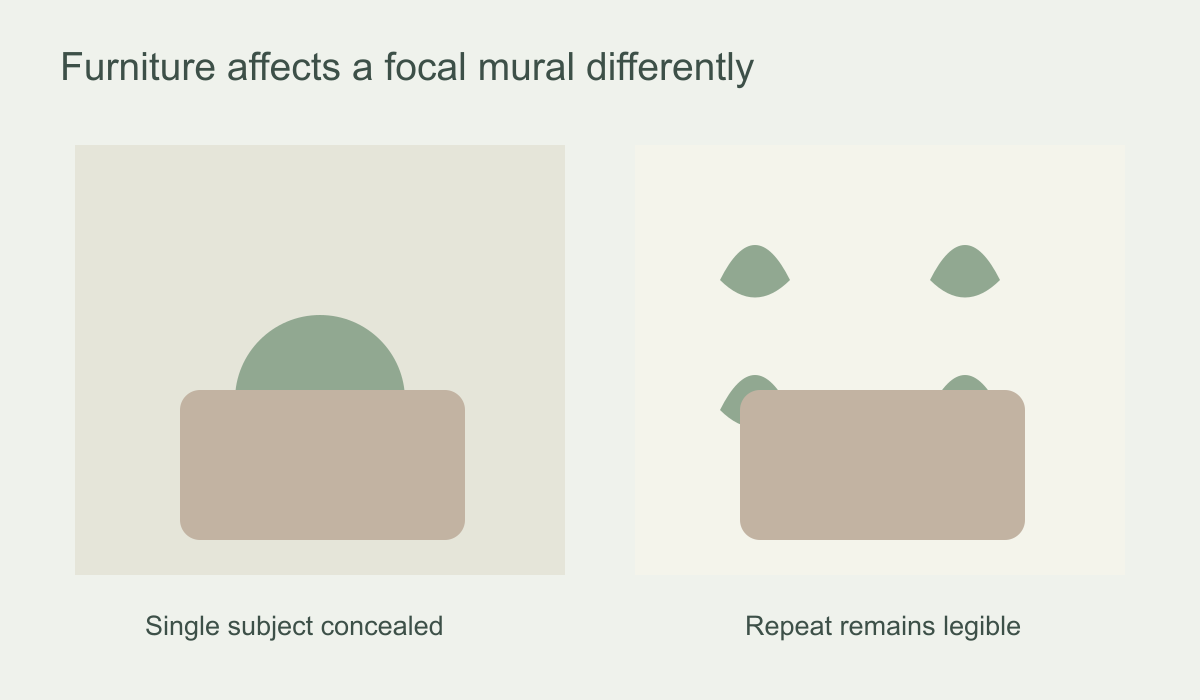 Furniture can interrupt a single scene more than an all-over repeat.
Material and installation are separate questions
Neither word—mural nor wallpaper—tells you whether the product is peel-and-stick, paste-the-wall, vinyl or non-woven. Those are different product characteristics. A mural can be printed on several substrates, and regular wallpaper can also use various installation methods. Read the exact label for adhesive, wall preparation, cleaning and removal. Do not assume a mural is harder to install solely because its image is larger; the difficulty depends on wall condition, panel size and alignment.
Numbered mural panels often need to be installed in order, with particular care at the first vertical guide line. Repeating wallpaper requires attention to pattern match, which can create its own waste and alignment challenges. Both need a clean, dry and sound wall; the Wallcoverings Association's preparation guidance applies regardless of the artwork. A printed landscape cannot compensate for loose paint or persistent dampness.
How they look from different distances
A mural often reads as one image from across a room and reveals brushwork or line detail up close. A repeat gives a more consistent rhythm as you move around the space. In a tiny room, a single large mural can feel expansive if the composition is open, while a small repeat can feel lively; the opposite can also be true. Compare the mural's size-specific crop preview with the repeat shown at its true scale, then inspect a physical sample if one is offered.
Do not judge only by a heavily styled product photograph. Look at the design on a blank wall, then overlay the real furniture. The mural's mood may depend on a horizon positioned above eye level; the regular wallpaper's visual density may change when four walls are covered instead of one. Decide whether you want a feature image or a surrounding pattern, not simply which thumbnail you prefer.
In the photographed comparison, a long console covers part of both designs. The leaf pattern still reads because the same sprigs remain visible above it. The landscape keeps its lake and mountain line, but a taller cabinet placed on the right could hide the small buildings that give that end of the scene its character. That difference is easy to miss in isolated product swatches. Test the actual furniture silhouette before choosing which type of design is more forgiving for the room.
Which should a first-time buyer choose?
Try two questions against the same room plan. Will one uninterrupted wall display the main subject above the furniture? If so, a mural may give you the composed view you want. Must the decoration continue around corners, behind tall storage or onto walls of uncertain future size? A repeat may be easier to extend without sacrificing a unique focal point. A diffuse abstract mural and an oversized repeat can blur that distinction, so compare actual wall-scale previews.
Before buying, ask the seller for different evidence for each format. For the mural, request the crop at your wall dimensions and check the position of its unique subjects behind furniture. For the repeating wallpaper, check the repeat size, match type and roll coverage so you can estimate material and waste. If the room may later extend around a corner, ask whether the mural artwork can be extended; a repeat can usually continue by matching its unit, but a composed scene needs a new layout. Material and adhesive choices remain separate from that image-layout decision. If a composed image suits your uninterrupted wall, compare designs in the mural collection at your wall's proportions rather than choosing from a thumbnail alone.