Mural Wallpaper vs Traditional Wallpaper: What Is the Difference?
Compare continuous artwork, repeat patterns, panel planning, scale and the way each format changes a room.
Article focus: pricing and measurement
The cost and measurement decision
Start with accurate wall measurements; the final custom mural price depends on area, material and any finishing options.
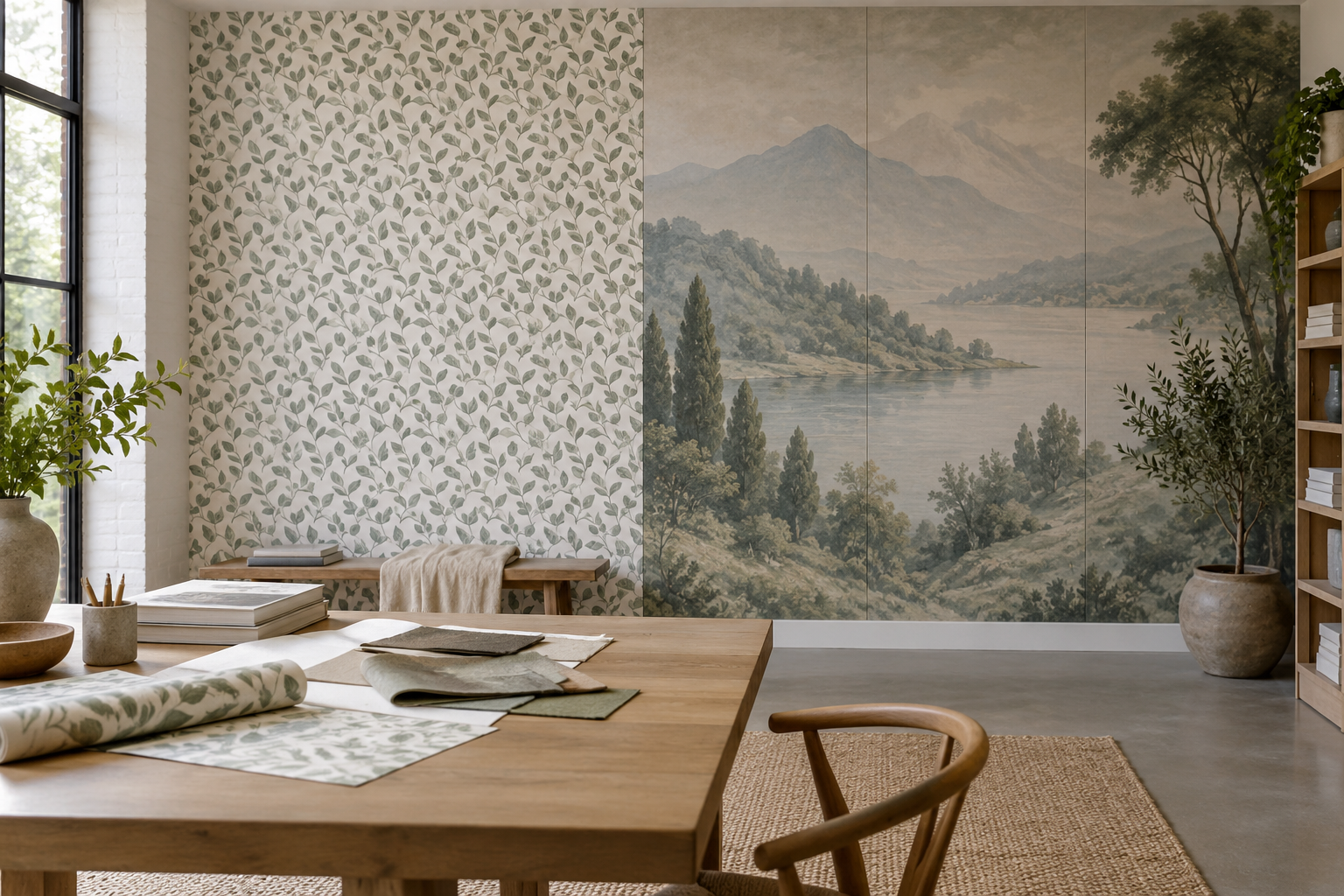
Example application: Living room · pricing and measurement
Mural wallpaper and traditional patterned wallpaper differ principally in how their artwork is organised. A mural is planned as a composition across a particular wall or set of panels; traditional patterned wallpaper repeats a motif according to its specified repeat and match. That changes how you measure, order, position and repair the design. It does not, by itself, tell you what material either product uses or whether one will last longer. The choice becomes clearer when tested against three real briefs: a doorway-filled hall, a single focal wall and a room whose furniture may move.
Start with a plan of the surfaces you can see
Sketch every wall you intend to cover and mark doors, windows, alcoves, radiators and built-in storage. Draw the normal route through the room and where people will first see the decorated surface. This exercise reveals whether the design must read as one image from a stable viewpoint or provide an even background as you move. A motif that merely looks distributed is not necessarily a seamless repeat: ask for the supplier's repeat measurement and match instructions before treating it as one.
Then request the information that fits the format. For a repeat, ask for its actual repeat size, roll width and match type; the Graham & Brown wallpaper guide explains free, straight and offset matches. For a mural, use the measured-wall crop preview and ask whether the supplier can show panel positions when those affect a doorway or return. A product thumbnail may make either design attractive, but it will not reveal where a branch, face or horizon meets the room's interruptions.
Brief one: a hallway broken by doors
Suppose the eye moves past three doorways and a shallow recess before reaching the end of a corridor. A repeating print can be planned separately for each remaining wall section; its overall effect does not depend on a single tree or horizon surviving the door cuts. That does not mean every length can be hung without matching or waste. A mural might still work on one uninterrupted stretch, but a room-wide panorama would need a precise plan for what disappears into each opening. In this brief, compare continuity first and visual drama second.
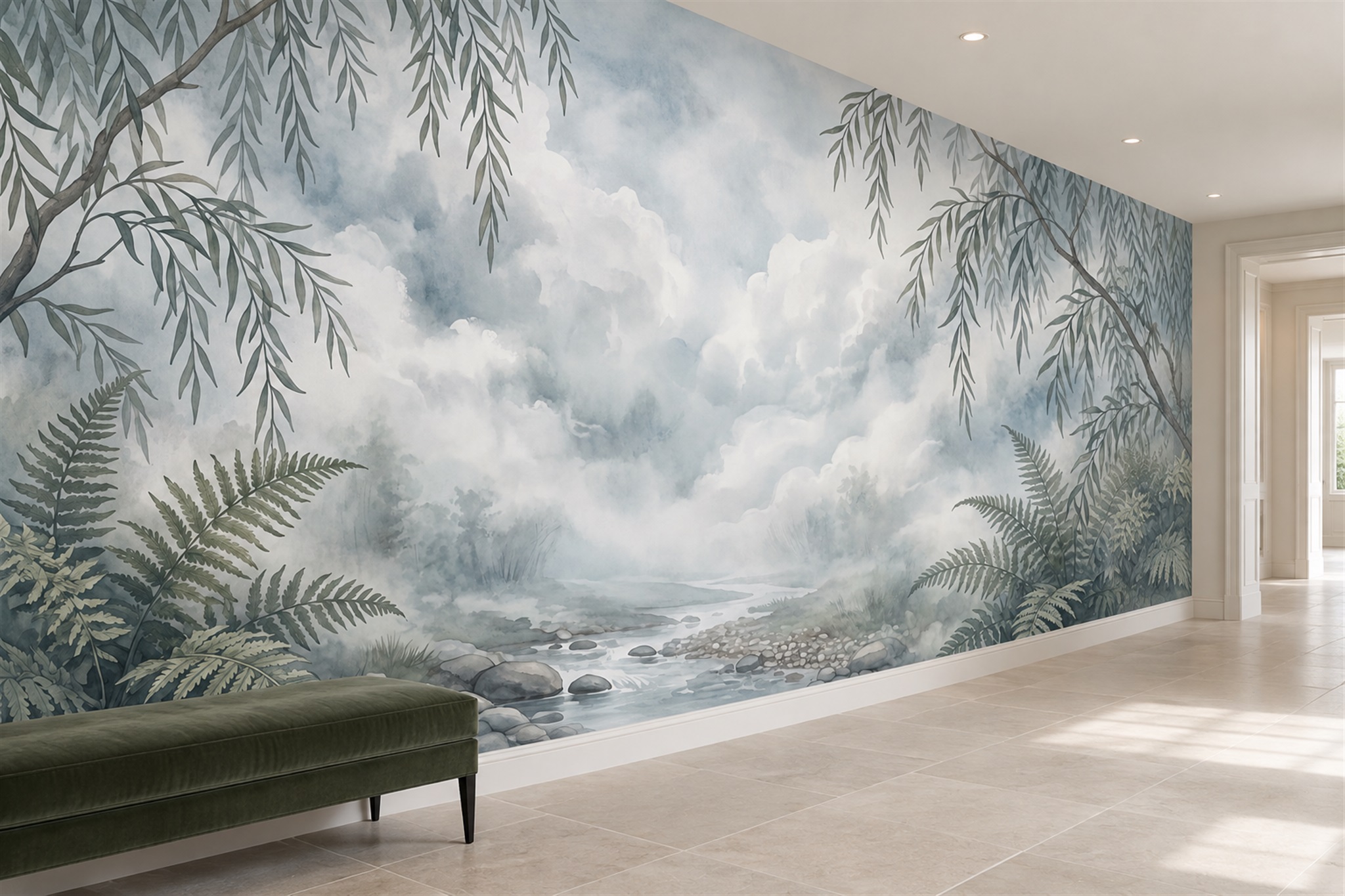
The editorial feature visualisation places a repeating leaf motif beside a panorama to show that difference; it does not compare material performance. The hallway image below shows branches and a pale central opening across a long unbroken wall. Try masking the proposed door positions on that image: if its defining subject vanishes, a repeat or a different mural composition is a better candidate than hoping the installer can rescue the crop.
Brief two: one complete focal wall
Now imagine a broad dining wall with few openings, a table positioned well below the main artwork and one clear view from the entry. This is where a planned landscape or botanical composition can use the full span rather than working as background texture. Mark the table, pendant lights and door sightline on a wall elevation. If the subject remains visible at normal viewing height, the mural earns its place; if it sits behind a tall cabinet, a distributed repeat may still serve the room better.
Check scale before deciding. A small swatch of a repeat may conceal how often its largest flower appears across a five-metre wall, while a mural thumbnail may make one bird or building look far larger than it will be once the scene is fitted to the room. Compare full-wall mock-ups at the same scale and mark the height of the table, sideboard and lights. The better result is the one whose subject and rhythm survive the real furnishing plan, not simply the one with the more striking sample.
The decision is not simply one wall versus four. An oversized regular repeat can also create a strong feature wall, and a low-contrast mural can be quiet. Ask what should remain recognisable at a distance: a particular scene, or an even rhythm of pattern and colour. View both options as whole-wall mock-ups at equal scale before choosing between them.
Measuring and ordering are different exercises
For either product, measure actual wall dimensions and follow the seller's allowance and installation guidance. With traditional wallpaper, you also need to know the roll width, roll length and pattern repeat to estimate how many lengths a wall requires. Matching a large drop repeat can create more offcuts than a random match. Buying enough rolls from the same production batch is often important for consistent colour. With a made-to-measure mural, the starting point is the specific wall width and height; the supplier plans a composition and panel count from that rectangle. Check where the crop falls and how much trim is included.
Do not compare orders by counting packages. For a repeat, note the usable roll width and length, the repeat distance and whether adjacent drops need a straight or offset match; those determine cutting waste. For a mural, note the overall printed size, numbered panel widths, crop and trim allowance. A window reduces the area finally visible but may not reduce the number of full-height lengths or panels needed around it. Give each seller the same dimensioned sketch, especially when ceiling heights differ, so the quotes describe the same surfaces.
A mural's numbered panels are not interchangeable simply because they are the same width. Each carries a different slice of the scene. Laying them out before installation can prevent a cliff, flower or horizon from appearing in the wrong place. Conventional repeat wallpaper may offer more flexibility in where the first length begins, but the pattern match and the wall's plumb line still matter. The Wallcoverings Association's residential installation guidance calls for checking goods and run numbers before cutting and establishing a vertical starting line; always defer to the instructions supplied for the particular wallcovering.
Think about corners, doors and repairs
If you plan to cover several walls, a repeat may be straightforward to carry around corners because the pattern can continue. A mural can also span more than one surface, but each corner changes the viewpoint and consumes part of the image. Get a layout showing exactly where the composition wraps, and consider what furniture will hide. Behind a bed or sofa, an image with its main subject in the concealed area may feel disappointing even if the print itself is correct.
Neither option makes a crooked corner disappear. With a straight or offset match, decide where any partial motif will fall and how the pattern will resume on the adjacent wall. With a mural, decide whether the view should visibly wrap, break cleanly at the corner or use a separate image on the return. Ask the installer to mark the planned start line and seam positions on the wall before the first cut; a small shift at the beginning changes every later placement.
Future repairs differ too. A spare roll of repeat wallpaper can be useful if a section is later damaged, provided its colour and pattern still match the installed batch. Replacing a single mural panel may be more difficult if the original crop, dimensions and print run are not recorded. Neither type guarantees a perfect match after years of light exposure or a later production run. Save order details, a labelled offcut and photographs of the installed layout for either choice.
Material is a separate decision
“Mural” does not specify whether a product is non-woven, vinyl, peel-and-stick or another substrate. “Traditional wallpaper” does not necessarily mean paste-the-paper installation. Compare the real finish options, surface requirements and manufacturer instructions for the products you are considering. A peel-and-stick mural and a paste-the-wall repeat can differ more in application than two paste-the-wall products with different artwork. Avoid assuming one is automatically washable, removable, fire-rated or suitable for a damp room because of its design category.
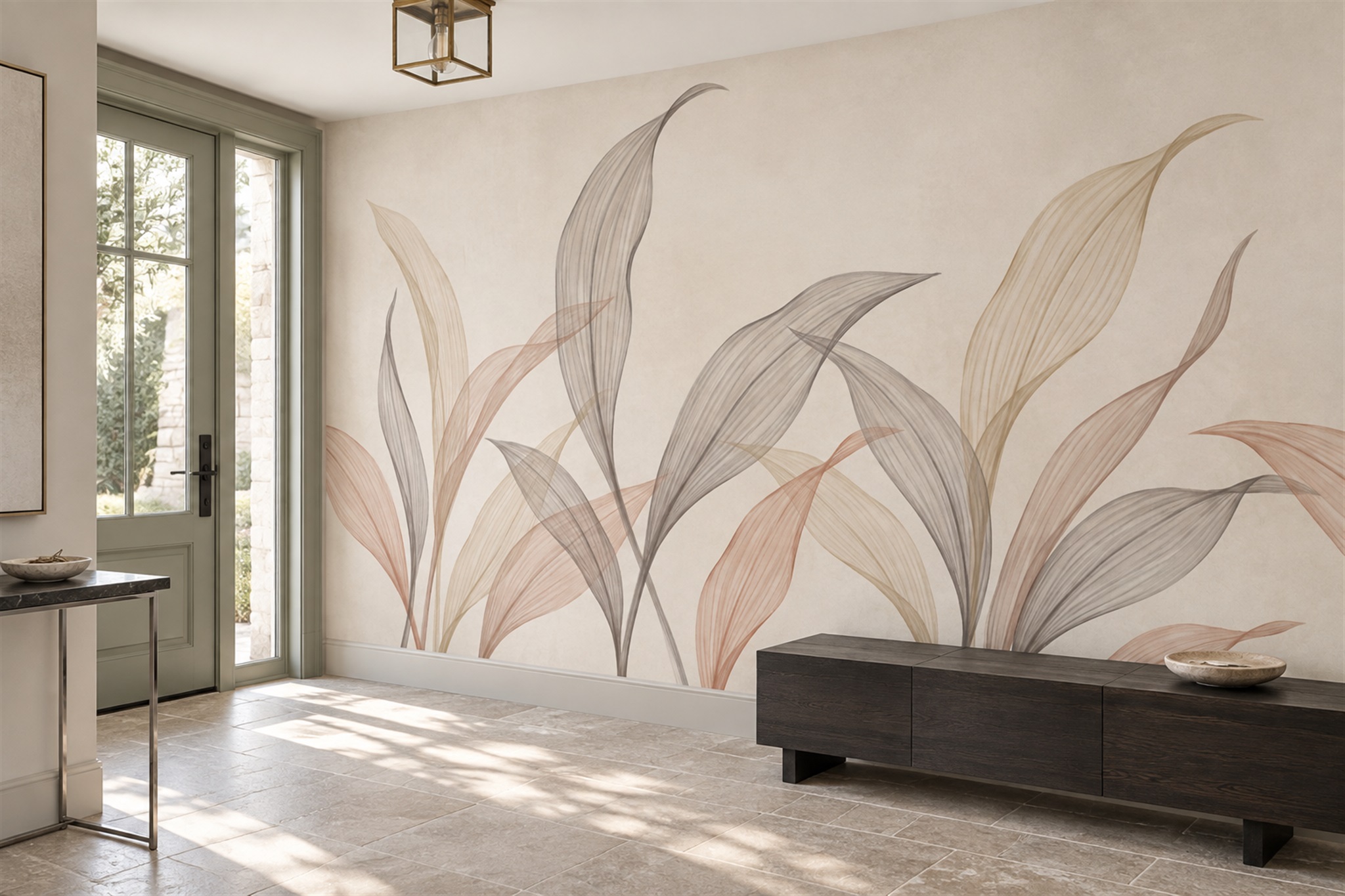
The second interior below shows oversized beige leaves distributed across an entry wall. It is a mural-style composition, not evidence of a technically seamless repeat. Its subjects occupy several areas rather than gathering at one centre, so it can feel more evenly balanced than a single landscape focal point. To order it as repeat wallpaper, however, you would need an actual repeat specification from the supplier; visual rhythm alone does not establish one.
Brief three: a layout likely to change
Finally, consider a living room where a bookcase may move, a larger television may be added or the sofa may switch walls. A mural fitted around today's furniture can lose its main subject after a rearrangement. A repeat is often more forgiving because an individual motif is not the only reason the design works. This is not an argument against murals in changing rooms: an all-over abstract field or a scene with several points of interest may adapt well. Preview both the current and plausible future furniture layout before deciding.
For a room that will change, keep a record of what makes the chosen design work: the repeat and match specification for patterned wallpaper, or the approved crop and panel layout for a mural. If a later bookcase, television or door alters the wall, those records make it possible to assess the remaining pattern or scene without guessing from a product name. A distributed mural can be flexible too, but only if its important areas are not tied to today's exact furniture position.