Peel-and-Stick vs Paste-the-Wall Mural Wallpaper: Which Is Better?
A practical comparison of peel-and-stick and paste-the-wall mural wallpaper, including removal, durability, moisture, wall preparation, and DIY difficulty.
Article focus: pricing and measurement
Budgeting this wall with confidence
Start with accurate wall measurements; the final custom mural price depends on area, material and any finishing options.
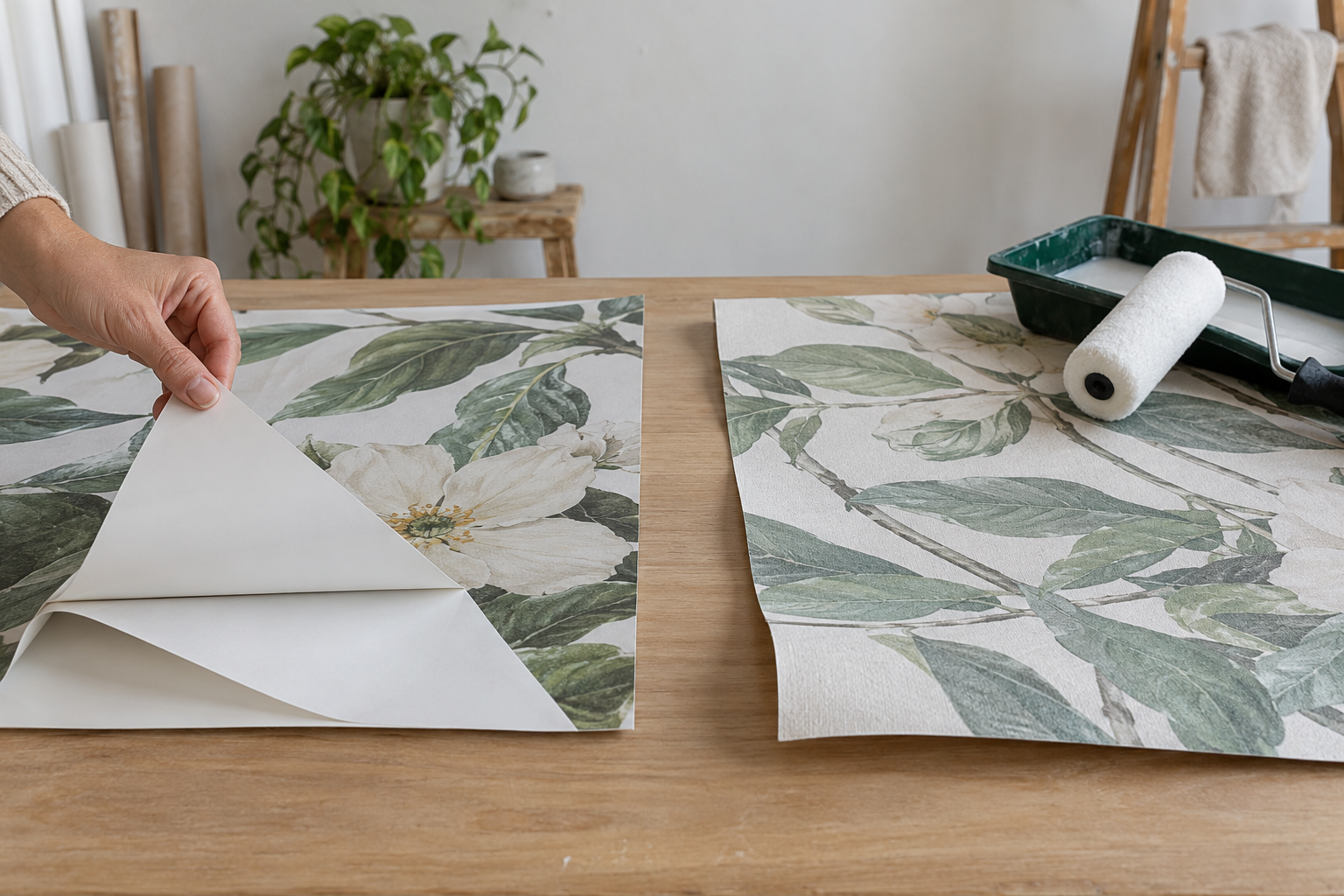
Example application: Any room with a suitable, prepared wall · pricing and measurement
Neither peel-and-stick nor paste-the-wall mural wallpaper is universally “better”. They describe different ways of attaching a print: one arrives with a pressure-sensitive adhesive and release liner; the other generally relies on separate paste applied to the prepared wall, according to the product instructions. The better choice depends on your wall condition, how you plan to hang the panels, how long the mural will stay, and what removal risk you can accept. Do not choose by the words “easy” or “removable” alone.
First, compare the right things
Peel-and-stick is an application system. Paste-the-wall is another application method, often used with suitable non-woven wallcoverings. “Vinyl”, “non-woven” and “heavy” may describe material options, but those names do not, by themselves, tell you the adhesive process or removal behaviour. Read the exact option and its installation sheet before purchase. The Wallcoverings Association's material definitions distinguish self-adhesive, unpasted, peelable and strippable products—terms that shoppers often mistakenly treat as interchangeable.
Solowalls lists Peel and Stick as a self-adhesive option, while its Wallpaper Installation guide describes the Non-Woven mural as paste-the-wall. That is a useful comparison of two options actually offered here, not a reason to assume that Vinyl or Heavy uses the same adhesive method. Check the instructions supplied for the exact finish before preparing paste or removing a release liner. Sellers can use the same material words for different constructions.
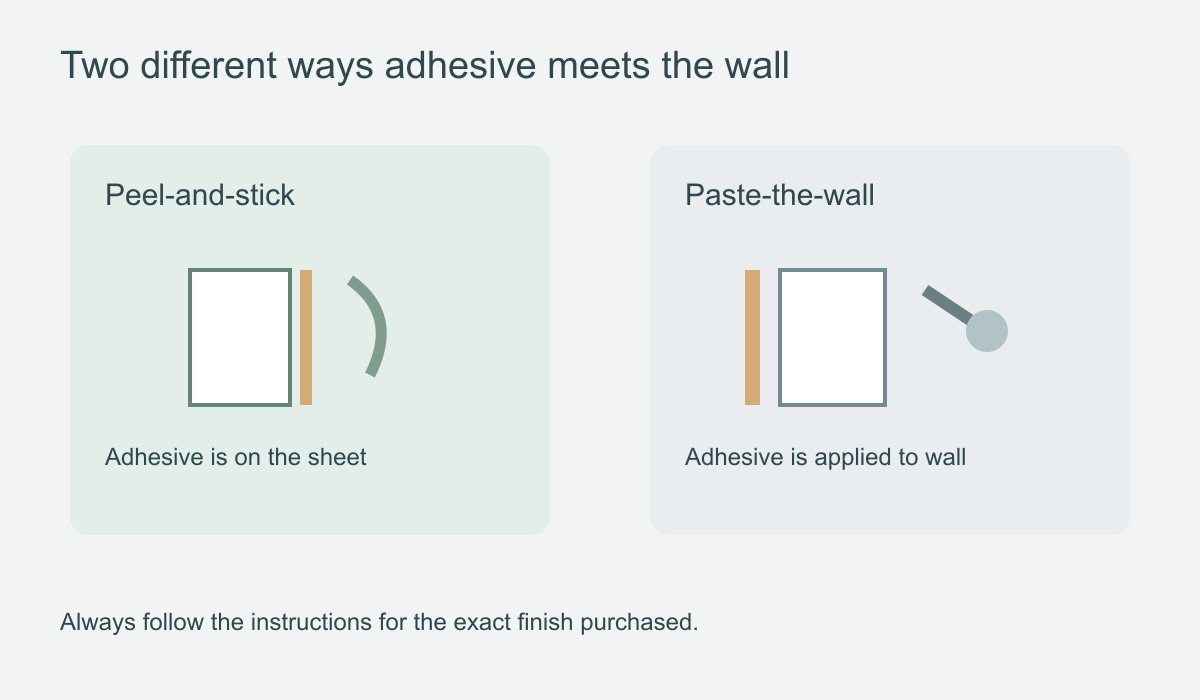 The main difference is where the adhesive comes from and when it becomes active.
How installation feels in practice
With peel-and-stick, you position the panel while removing its release liner in stages, then smooth the exposed adhesive onto the wall. There is no separate paste tray, but a large tacky sheet can grab the wrong place, fold onto itself or stretch if pulled aggressively. Keeping the unused backing attached until each section is aligned helps control it. The surface must meet the product's requirements, particularly around paint cure and smoothness.
With paste-the-wall, you apply the recommended adhesive to a section of the wall and hang the panel according to the maker's directions. Some systems allow a little working time for sliding the panel into alignment while the paste is wet. That can make a long seam easier to correct, but it also introduces paste preparation, cleanup and drying considerations. The Wallcoverings Association says to consult the wallcovering manufacturer's instructions for the appropriate adhesive and whether it belongs on the wall or the covering.
Neither process rescues a badly measured mural or an unprepared wall. A level first-panel line, panel sequence and deliberate smoothing are needed in both. A continuous landscape exposes even a small seam error because the horizon must meet across strips.
What is the wall like?
Every finish needs a clean, dry and sound wall. A fine self-adhesive sheet may reveal bumps, old paint ridges or filler edges. A pasted product may have different tolerance for slight surface variation, but it should not be used to conceal loose paint, active dampness or uneven plaster. Repair the substrate before deciding which installation method is easier. The Wallcoverings Association's preparation guidance is a useful starting point for testing sound paint and dealing with porous or previously papered surfaces.
Fresh paint deserves special attention. “Dry to the touch” is not the same as fully cured for adhesive contact, and cure periods differ by paint and conditions. Follow both the wallpaper and paint makers' guidance before applying either system. A test sample of the selected material in an inconspicuous location can reveal weak paint adhesion or unexpected residue, although it cannot guarantee the behaviour of every square metre years later.
What about a rental or future redesign?
Peel-and-stick is often marketed to people who expect to redecorate. It can be removed by peeling under appropriate conditions, but the process may lift weak paint, leave adhesive or tear the panel. Pasted wallcoverings also vary: some are labelled strippable, while others require soaking or other removal work. Do not assume that every pasted mural is permanent or that every self-adhesive mural leaves no trace. The exact product, primer, paint condition, installation age and removal method all matter.
If you rent, read the lease and obtain permission where required. Decide how the wall must be left at move-out and whether repainting is acceptable. A controlled test on the actual wall is more useful than a generic “renter-friendly” slogan. Budget for patching or repainting if damage would be costly, regardless of which finish you select.
Consider the design as well as the adhesive
A mural with a long straight architectural line or a face across a seam has little tolerance for placement error. In that case, choose the material and method that you or your installer can position most accurately on that wall. A softly layered foliage design is less visually unforgiving, though it still needs correctly joined panels. Ask for the panel width and joining method if these will influence your choice.
Colour and finish also need physical evaluation. A website preview cannot fully convey surface texture, sheen or how a dark area reads in your room. If samples are offered, view the same motif in the finishes you are deciding between, against the intended wall in daylight and lamplight. Do not infer that one adhesive method automatically means a matte, glossy, thick or thin print; those are properties of the specific material.
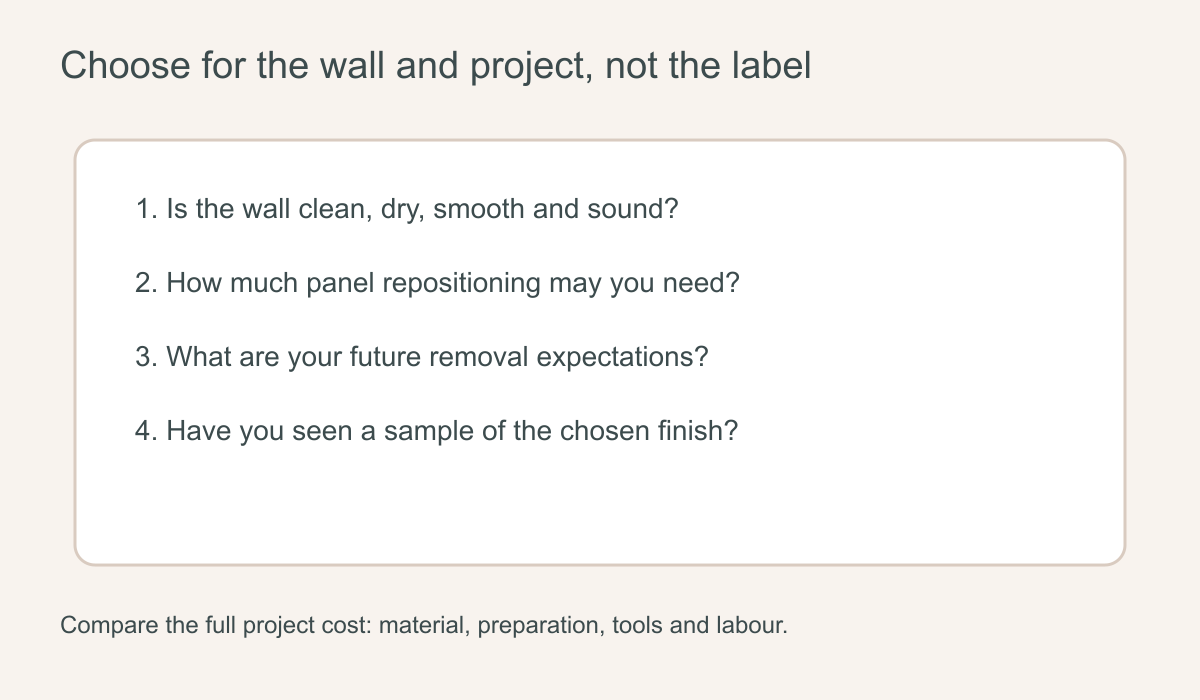 A short set of project questions gives a better answer than a universal winner.
What does each choice add to the budget?
Compare the total project, not only a headline price per square foot. Peel-and-stick may avoid separate paste but can carry a different material price. Paste-the-wall may require adhesive, tools and extra cleanup. Either may benefit from professional installation on a high or complicated wall. The required wall repair and primer can cost more than the difference between finishes.
On the Solowalls product options described for these murals, Peel and Stick has a relative material price addition while the other listed choices do not. The live price shown after entering dimensions and choosing a finish is the useful figure for that order; do not assume an old blog's price statement overrides checkout. Delivery, taxes or professional labour are separate considerations where applicable.
Choose the workflow you can control
On a modest, smooth wall with well-cured paint, peel-and-stick may suit someone who wants to avoid mixing paste and can control a tacky panel with a helper. It is still worth applying a sample to that actual wall and checking removal before treating it as a rental solution. If the paint lifts during the test, choosing a larger self-adhesive print will not make the surface safer.
For a wide panorama with a horizon crossing several joins, the deciding factor may be alignment time. Ask the installer whether the specific paste-the-wall finish permits enough adjustment to match the image, and confirm its seam method before ordering. If the wall is rough, damp or weakly painted, postpone either option until the surface is repaired. Compare the live product total, any required paste or primer, and the installation quote for the same dimensions. That gives a defensible answer for your room instead of declaring one adhesive system better everywhere.