Should You Hire a Professional Mural Wallpaper Installer?
Decide when specialist experience may help with large walls, complex architecture, valuable surfaces or detailed alignment.
Article focus: pricing and measurement
What to settle before pricing
Start with accurate wall measurements; the final custom mural price depends on area, material and any finishing options.
Example application: Bedroom · pricing and measurement
Should you hire a professional mural wallpaper installer? The answer turns on the wall, access and artwork rather than on a blanket rule that murals are too difficult for homeowners. A sound, reachable bedroom wall with a manageable panel sequence may suit an organised two-person DIY team. A stairwell, unstable paint, several door recesses or a long high-contrast panorama raises different risks. A specialist can assess preparation and control placement, but hiring one does not transform a defective print or an unsuitable wall into an acceptable installation.
Separate the artwork challenge from the wall challenge
Some murals are visually demanding even on a sound wall. A line drawing, a horizon crossing several panels or a detailed building makes small alignment errors obvious. A design with soft clouds may be more forgiving. The wall itself has a separate set of issues: uneven plaster, new paint, residual adhesive, dampness, glossy coatings or a corner that leans. An installer can help identify preparation needs, but may not be the right person to repair structural moisture or electrical problems. Resolve those with the appropriate trades before any decorative work begins.
Use two separate questions on the site visit. First, what must be fixed before any wallpaper can go up? Second, how will this particular printed scene be positioned once the wall is ready? A contractor who discusses only adhesive but never looks at the selected crop may be well versed in ordinary repeats yet miss the mural's focal point. Conversely, someone who loves the artwork but cannot explain how they will check a repaired wall has not addressed the substrate risk.
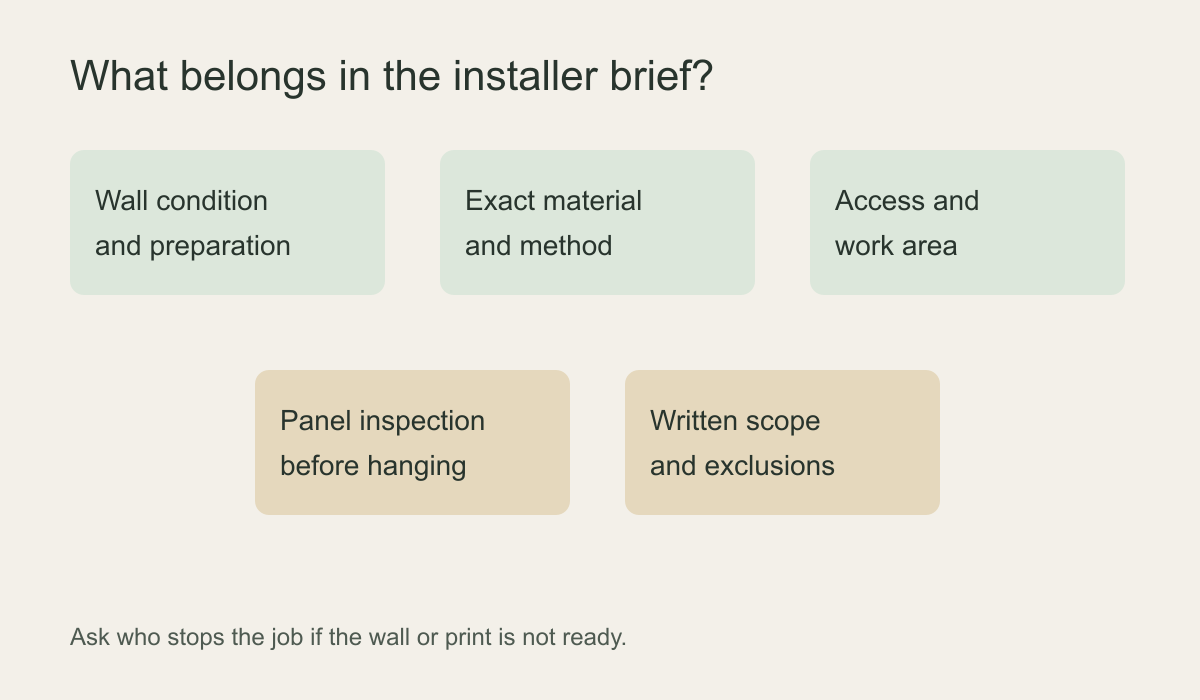
The Wallcoverings Association's surface-preparation guidance emphasises clean, dry, sound surfaces and following the product maker's instructions. Ask a prospective installer how they will assess your particular substrate and which steps are included in their price. “Wall preparation” can mean anything from a light clean to filling, sanding and priming; a quotation should say which. Do not assume a smooth photograph of the finished product reveals how the original wall was prepared.
When the room raises the difficulty
A high stair landing may require specialist access equipment. A wall behind fixed kitchen units has awkward edges and limited hand space. An alcove, sloping ceiling or multiple doors breaks a panoramic image into short sections that must still line up. Even a large, plain wall can be challenging when the panels are unusually tall. If you cannot safely hold a length, reach the top and check a seam at the same time, the project has moved beyond a comfortable solo installation.
Make the access issue explicit in the brief. State ceiling height, available floor space, stair geometry, fixed furniture and whether the room can be cleared. A quote based only on wall width and height can omit the time or equipment needed to reach an awkward upper corner. Do not plan on balancing a long panel while leaning from a household ladder. Ask how the installer intends to work safely in the actual room and whether specialised access is included or must be arranged separately.
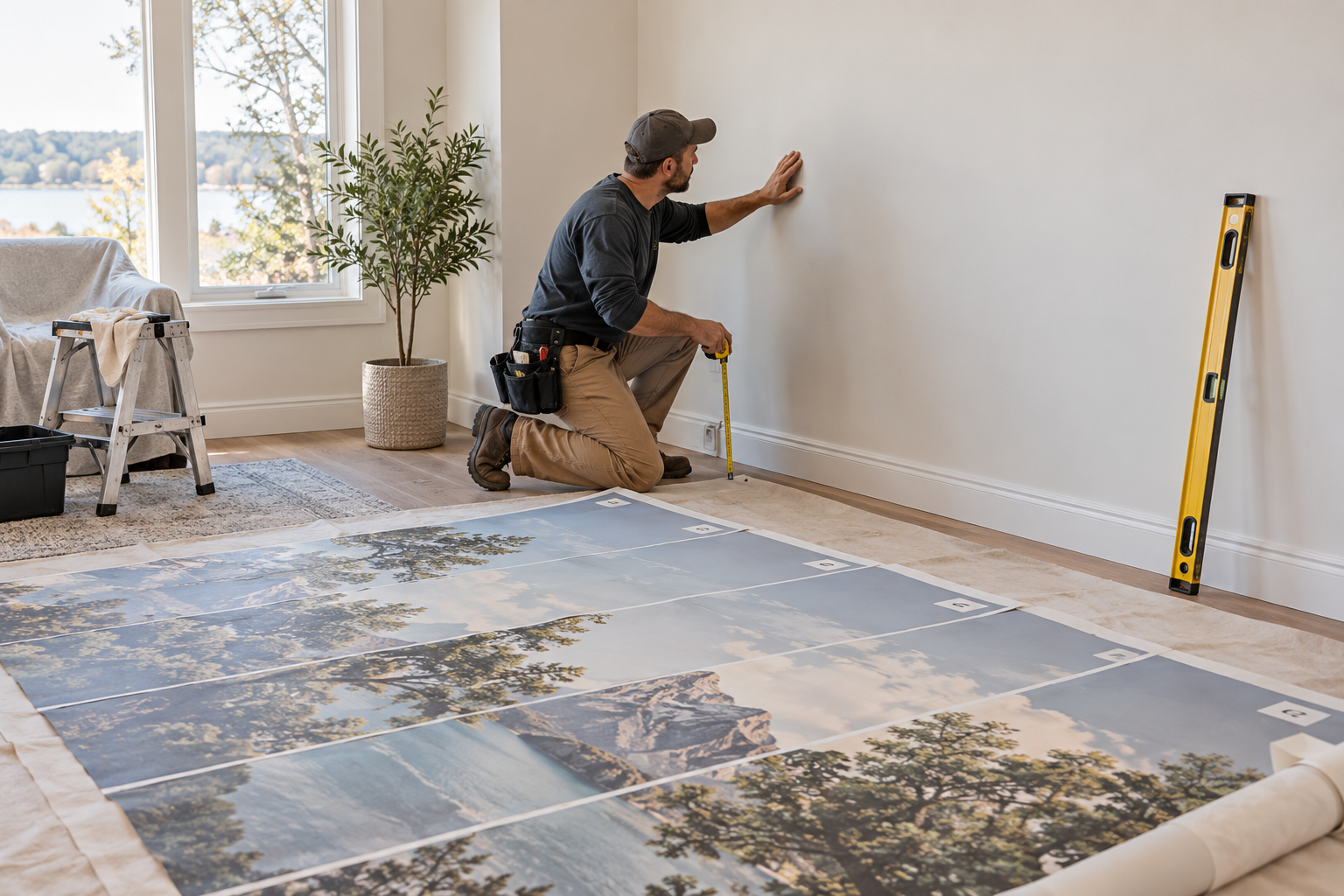
The editorial feature image shows a worker measuring a wall while panels are laid out on a protected floor. It illustrates the pre-installation inspection stage, not a record of a Solowalls contractor or evidence that the pictured wall is ready to cover. An installer should verify the ordered dimensions and the panel sequence before applying anything. The first plumb line and any planned crop around fittings deserve a conversation while changes are still possible.
Make a hire-or-DIY decision before requesting quotes
Use three separate tests. Can you reach every part of the wall from safe, stable access? Is the surface sound and ready under the selected material's instructions? Can your team support the largest panel while checking its vertical line and image joins? If any answer is no, identify the missing capability before scheduling the job. An extra friend cannot replace suitable stairwell access, and an experienced hanger cannot make damp plaster ready by covering it.
Consider what an error would cost to correct. A small, forgiving scene on a prepared, reachable wall leaves more room to pause and learn than a panoramic design with faces or straight architecture across several tall panels. If the ordered print is expensive to replace or the wall has only narrow strips beside openings, professional fitting may be worthwhile even when the area in square metres looks modest. This is a risk judgement, not a claim that a professional will guarantee an invisible join.
Hiring need not be all or nothing. A competent installer might measure the wall and assess its preparation before you place the print order, while you decide separately who will hang it. Conversely, a decorator may need to repair the substrate before a specialist mural fitter can begin. Separate those tasks and costs. If your only uncertainty is the artwork crop, ask the supplier about a layout review; paying a fitter cannot restore a subject already cropped out of the manufactured panels.
Know where a DIY attempt must stop
If the wall powders under a light check, the access plan requires overreaching, or the first dry panel layout does not match the approved crop, do not treat hanging as a way to discover the answer. Resolve the surface, equipment or print discrepancy first. The Wallcoverings Association's standard installation guidance advises stopping when material discrepancies appear. A pause before adhesive or cutting preserves more options than a correction attempted several panels later.
A homeowner can still contribute without taking on the fitting risk: provide the measured wall drawing, select the crop, clear the room and review the delivered panel sequence with the installer. Decide who has authority to approve an unexpected change before the first cut. That division leaves the aesthetic choice with the person who uses the room and the technical handling with the person equipped to carry it out.
Why a complex image deserves planning
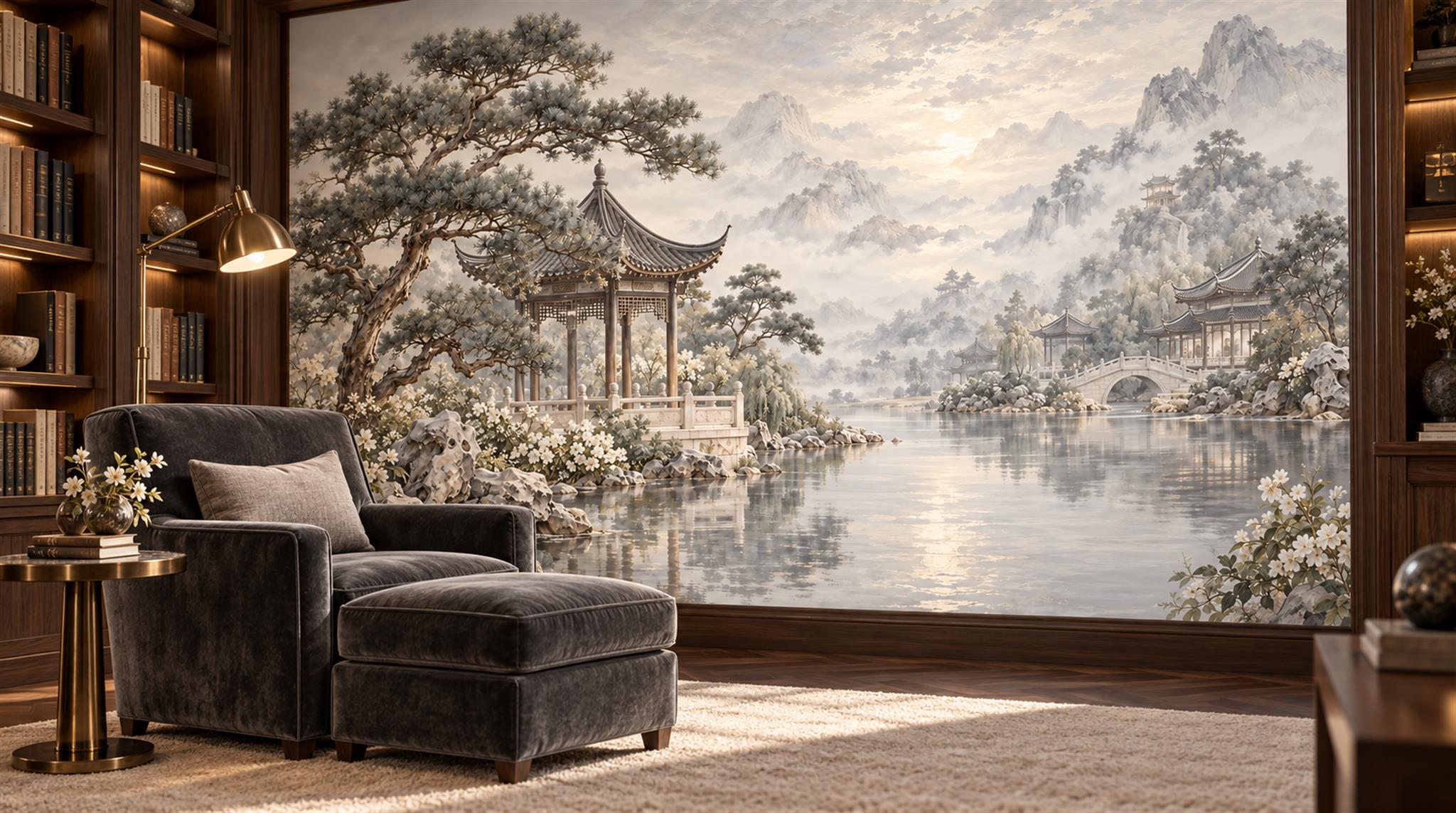
The library application below contains trees, pavilions, mountains and a bridge spread across a wide wall. Those distinct subjects make the overall image easy to read, but they also make a poorly chosen start point obvious. The bookcases frame the wallpaper and the chair obscures part of the lower left. It is an image-placement example, not evidence of how the pictured wall was installed or what a particular contractor achieved.
Clarify responsibility for preparation and aftercare
Ask who checks whether paint has cured, who fills and primes repairs, and who confirms the wall is clean and dry. If the wall later develops a problem caused by moisture or unstable paint, the installer cannot necessarily remedy the underlying issue. Request the installation method and any care instructions for the exact printed material, not a generic statement that all murals can be wiped or peeled away. Keep leftover material and the order record, including the approved crop and product finish, in case you need to discuss a later repair.
At handover, walk the wall under its normal lighting. Check that the scene matches the order, main subjects have not been cut off unexpectedly, adjacent image edges align, and trim around fittings is complete. Ask the installer to identify any issue they noticed and record it before furniture is returned to the wall. Retain the material label, batch information if supplied, the installer invoice and photographs of the finished layout. A simple handover record helps distinguish an installation concern from later damage without pretending that every seam will be invisible at all viewing distances.