How Does Sunlight Affect the Look of Mural Wallpaper?
Understand how daylight direction, artificial lighting, colour perception and the selected print specification influence the finished wall.
Article focus: pricing and measurement
The cost and measurement decision
Start with accurate wall measurements; the final custom mural price depends on area, material and any finishing options.
Example application: Any room with a suitable, prepared wall · pricing and measurement
The same mural can look softly golden in afternoon sun, cooler on a cloudy morning and much darker under an evening lamp, although nothing has happened to the print. That short-term shift in perceived colour and contrast is not the same as a lasting change caused by prolonged exposure. Sunlight also moves across a wall, altering which part of a scene catches the eye and how clearly surface joins are seen. To choose confidently, inspect a physical sample in the intended room and ask for information about the exact print finish before assuming a long-term fade guarantee.
Map the direct-sun path across the proposed print
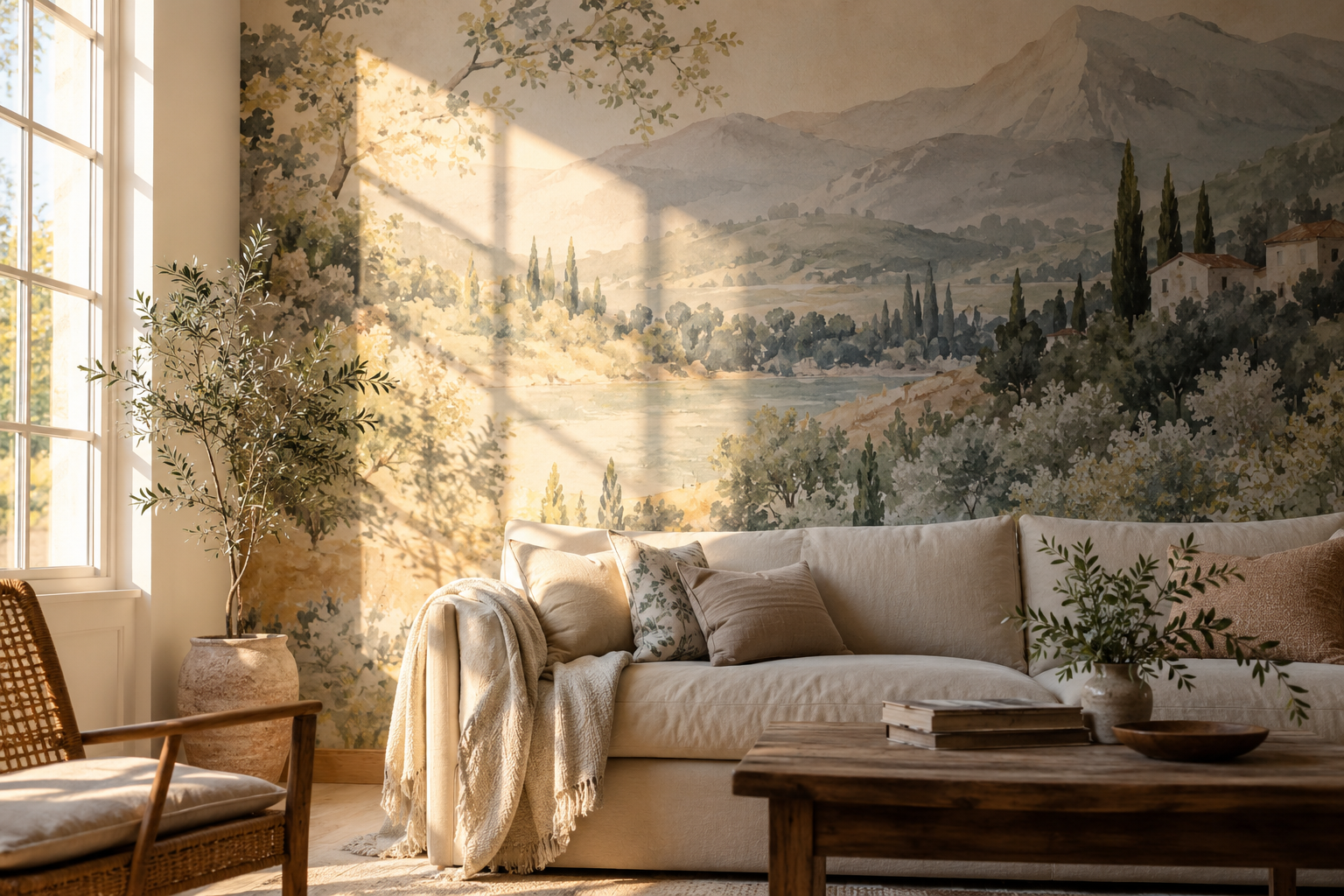
On the intended wall, mark where direct sun first enters, the widest area it covers and where the bright patch ends later in the day. Note the season and whether blinds or nearby buildings affect the path; one winter afternoon is not a complete year-round exposure map. Place those marks on the wall-sized crop. A narrow beam crossing the only face or mountain peak can change what reads as the focal point, while a beam over an open ground may change the mood without hiding the subject.
The feature photograph shows a band of sun across a landscape and a shaded area beside it. That is a difference in current illumination, not evidence of uneven printing or lasting fade. Record the viewing position and whether the same part of the mural returns to its ordinary appearance after the beam passes. The general lighting-effects guide explains how daylight and lamps alter perceived colour and surface detail. This article asks the more specific question of what repeated direct-sun exposure may mean for the chosen wall and print.
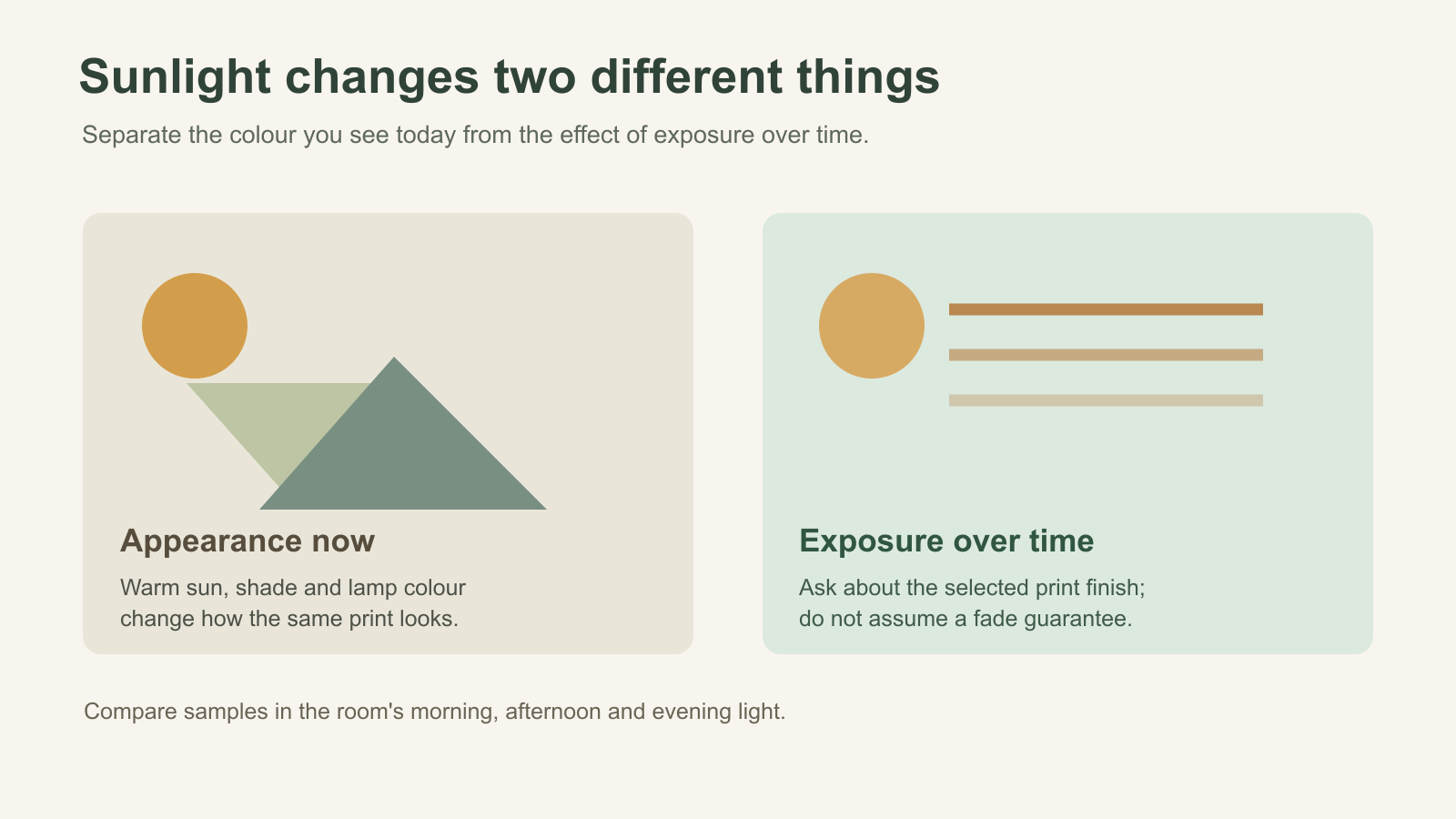
The diagram below distinguishes a temporary appearance shift from cumulative exposure. It is qualitative, not a forecast of years before fading or a substitute for product-specific lightfastness information. The useful first record is simply which area of the proposed mural will be in direct sun, how often it occurs under normal room use, and whether furniture will shade a section while the rest remains exposed.
Contrast and texture can shift even when hue does not
Light from a window near the end of a wall travels across the surface at a shallow angle. That “raking” light can pick out a slightly raised seam, a ridge in the plaster or a change in surface sheen. In softer frontal light, the same area may look nearly seamless. Inspect the wall preparation and panel joins under the room's normal daylight before deciding that the printed artwork is uneven. A low lamp can create a similar effect at night. Moving the lamp or using a softer shade changes perception without changing the mural.
If a seam appears only during one hour of low-angle sun, record that hour and view the same section after the beam has passed. A persistent lifted edge calls for installation advice; a temporary line of shadow may simply reveal the wall's relief. Do not try to rub away a perceived colour difference or re-paste a join based on one photograph. Compare the surface in diffuse daylight as well as the dramatic side light, and separate a physical change from a change in visibility.
Some images depend heavily on contrast. A dark forest may look restful in a bright room but much darker in an unlit corner; a misty landscape may look washed out when direct sun strikes its pale centre. This is a design decision rather than a fault. Think about where people sit and which part of the scene they will see most often. If the main subject is near a window, a changing beam may give it attention at one hour and leave it quiet at another.
Compare sunlit and shaded areas without mistaking either for a rating
Place a sample of the intended printed finish on the wall, then view it once in the direct beam and once in ordinary shade from the same position. Keep the usual blinds and furniture arrangement rather than creating a showroom condition. This reveals an immediate visual difference, not how the material will age. A sample cannot establish a fade rate; only relevant product-specific test information can support a claim about lightfastness. Use the wall-sized crop separately to see whether the actual focal subject falls in the high-exposure zone.
The botanical detail below has deep green, muted sage and a pale ground. It illustrates why different parts of one design may respond visually to the same moving beam in different ways, but it is not a physical sample or a light-exposure test of Solowalls print stock. Ask for the actual finish and any documented lightfastness result for that finish if direct sun is a significant condition of the room.

What about fading from prolonged sun?
Visible light and ultraviolet exposure can affect colourants over time. The Library of Congress guidance on limiting light damage describes fading and colour change among possible effects of exposure on collection materials. That is general conservation evidence, not a test result for a particular wallpaper. Different inks, surfaces, window glazing, orientation and hours of direct sun can all change the outcome. It would be misleading to infer a fixed lifespan, “UV-proof” status or a guarantee from the mural's appearance in a product photograph.
If your intended wall is flooded with direct sun for much of the day, ask the supplier whether lightfastness information is available for the exact printed finish. Curtains, blinds or shade may reduce exposure when the room is not in use, but they should be chosen for the room rather than presented as a guaranteed cure. Also remember that furniture placed in front of part of a mural may shade one section while another receives more light. If the arrangement changes years later, the difference may become more noticeable.
Ask a precise question: which material and print combination is being supplied, and is there documented lightfastness information for that combination under a stated test method? If a result is provided, ask what was tested and under which conditions before applying it to a sunny room. A material name alone does not establish the behaviour of its printed image, and a photograph of a sunlit interior says nothing about years of exposure. Without product-specific evidence, treat a wall with intense direct sun as a higher-uncertainty choice rather than inventing a lifespan.
Choose composition with light in mind
A bold, high-contrast mural can remain legible across a range of lighting conditions, although its mood will change. A very pale, low-contrast scene may need more even light if its delicate details are important to you. For a wall with one strong shaft of afternoon sun, consider whether the focal point should sit inside that highlight or outside it. Neither choice is universally better: one creates a dramatic daily moment, the other gives a steadier appearance.
Also look at the wall after the sun has gone. A scene chosen only for its midday glow may appear flatter in ordinary evening use, especially if the room has a single warm lamp. Conversely, darker artwork that seems heavy in a sample photograph may feel balanced in the brightest part of a room. Judge the mural in the conditions in which you will live with it most often, not the conditions that make one marketing image look its best.
To separate a lighting effect from a lasting change, photograph the same section twice from one position: once in diffuse daylight and once when the direct beam crosses it. Repeat the diffuse-light view later with the same curtains and lamp settings. A colour shift that follows the moving beam is an appearance change; one that persists under comparable light deserves a closer look at the print and its exposure history. This simple comparison cannot measure lightfastness, but it prevents an afternoon shadow from being mistaken for fading.