What Is Mural Wallpaper? A Practical Guide for First-Time Buyers
A clear first-time buyer guide explaining mural wallpaper, printed panels, custom sizing, materials, installation, care, and realistic expectations.
Article focus: pricing and measurement
Budgeting this wall with confidence
Start with accurate wall measurements; the final custom mural price depends on area, material and any finishing options.
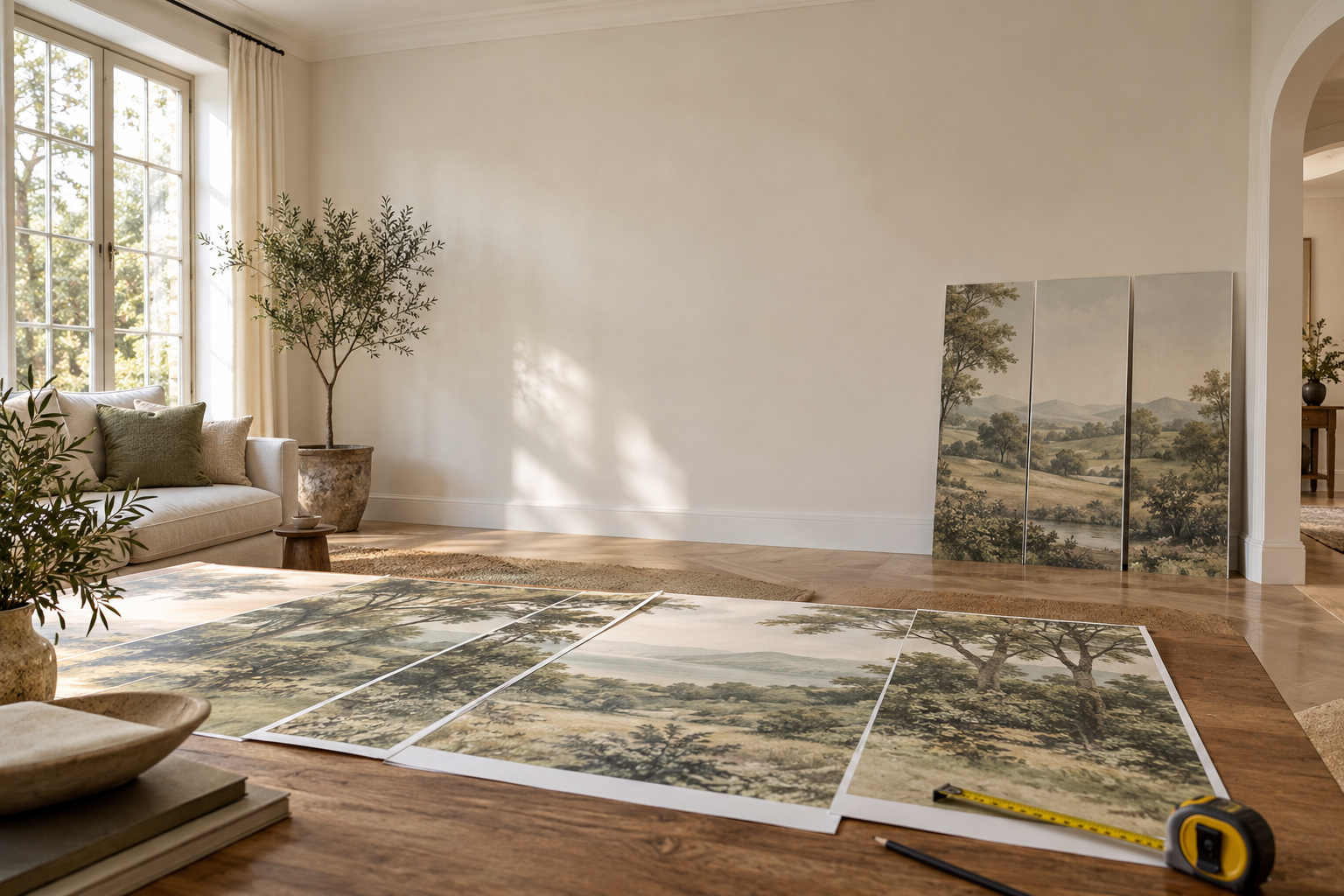
Example application: Living room · pricing and measurement
Mural wallpaper is a wallcovering printed as one large composition rather than a small motif that repeats at regular intervals. The artwork may be a landscape, botanical painting, abstract design or photograph, and it is normally supplied in numbered panels that align to form a continuous image. For a first-time buyer, the important distinction is practical: you choose the scene, decide where it should sit on a particular wall and order dimensions that allow for installation trim. It is not simply an oversized poster or a roll of conventional patterned paper.
What arrives when you order a mural?
The exact package depends on the supplier and product, but a made-to-measure mural is usually divided into vertical panels that are installed in a specified order. The printed image extends across those panels. Some products use paste applied to the wall, some require paste on the paper, and some have a self-adhesive backing. Do not choose the method from the artwork's appearance; read the instructions for the exact material you order.
When the package arrives, identify the starting panel, the printed sequence and the installation guide before opening any adhesive. Lay the panels out in order on a clean floor and look for consistent colour, complete edges and an image that joins correctly. The online crop preview describes the overall artwork, but it may not reveal the production panel widths or seam positions. If a seam through a face or fine architectural line matters to you, ask for a panel layout before purchase rather than trying to rearrange numbered pieces later.
Imagine a landscape divided across four panels. The river leaving panel one has to enter panel two at the same point; panel three cannot be swapped into its place simply because the widths match. That is why checking the order before installation matters. The illustrative feature image shows a landscape laid out in sections before fitting. It demonstrates how you can check continuity and panel sequence while every piece is still accessible; it is not a photograph of a particular customer's delivered order.
The wallcovering's surface also varies. A design described as watercolour may be a flat print; that word refers to the image style, not a raised paper texture. Ask for a physical sample if colour, sheen or feel matters. The Wallcoverings Association explains that substrates and decorative layers vary and that a product's specific performance should be checked on its label or specification.
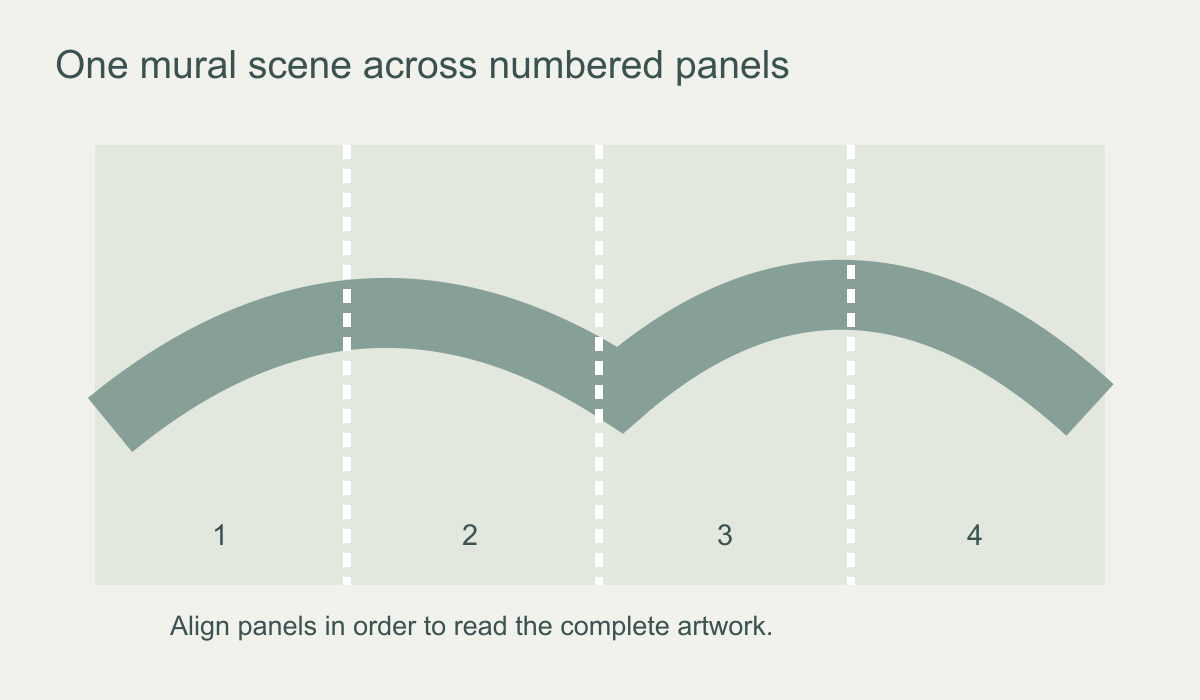 One composition is printed across a sequence of panels.
Is a mural the format you actually need?
Ask whether you want one composed image on a defined wall, a motif that can continue around several walls, or a smaller graphic with paint left visible around it. Those are usually a mural, a repeating wallpaper and a wall decal respectively, although shop labels are not always consistent. Check the supplied dimensions and whether the design has a planned beginning and end. A continuous scene calls for a deliberate crop; a repeat is easier to extend if the room layout changes.
This is a format decision, not a ranking of quality or an installation-method choice. A soft abstract mural may have no single focal point, while an oversized repeat may need careful positioning. If your wall has several openings or you expect to add built-in storage, compare both formats against a sketch of that wall. The mural versus regular wallpaper comparison works through furniture, corners, ordering and future repairs in detail; here, settle the basic format before browsing images.
Choose the wall before choosing the image
Stand in the room and identify the wall most often seen. Mark doors, windows, radiators, switches and permanent furniture. A broad landscape works best when enough of it remains visible to read as a view. A small, interrupted section may suit a loose botanical or abstract composition. The best subject is not only the one you like online; it is the one that survives the room's openings and everyday layout.
Consider viewing distance. An intricate map may invite close inspection in a study, while a bold landscape reads from across a living room. A soft mural behind a bed can create atmosphere without competing with bedding, but its lower details may disappear behind the headboard. Use the exact wall proportions when previewing the art, not a generic mock-up with ideal furniture placement.
Rooms with frequent moisture or heavy contact require more careful product selection. A mural on a dry dining wall is a different proposition from one behind a sink or in a shower. Do not assume that vinyl, non-woven or peel-and-stick labels alone establish suitability. Request the manufacturer's approved uses, cleaning instructions and any relevant performance information for the specific product.
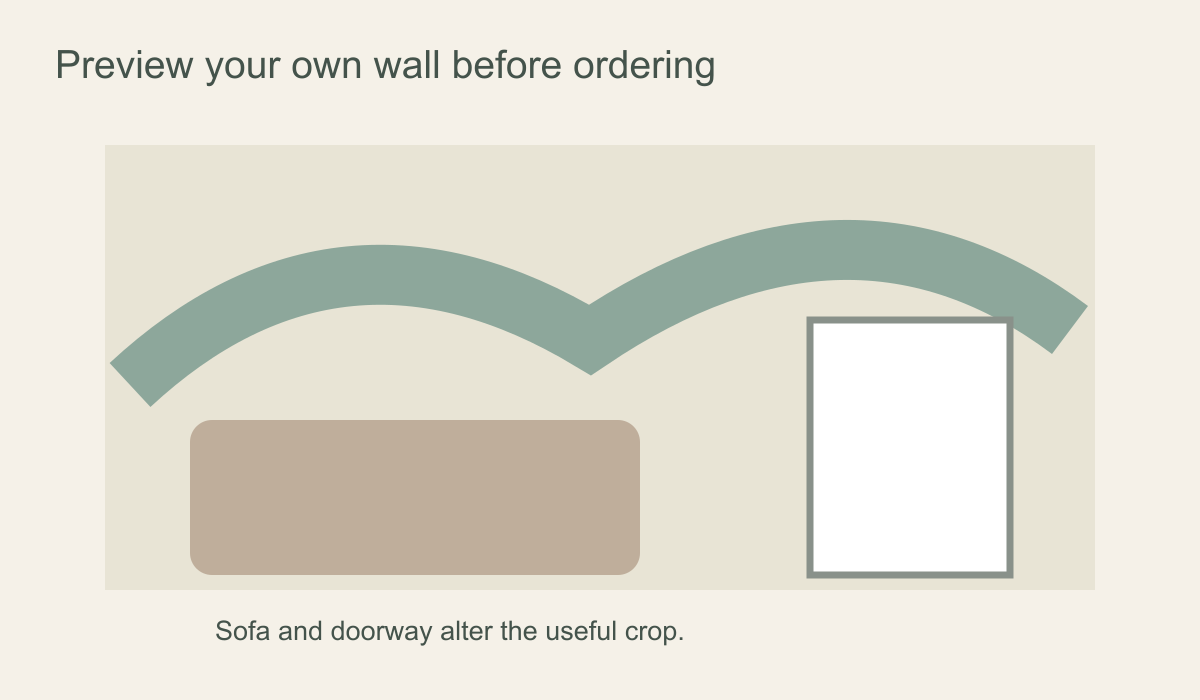 Preview the actual wall, furniture and openings before approving the crop.
Measure for the finished wall
Measure the full width and height in more than one place because walls are not always perfectly square. Follow the seller's measurement method and recommended installation allowance; where the site asks you to add roughly 4 inches or 10 centimetres, add it to both width and height for trimming rather than to only one dimension. Record the wall measurements separately from the order dimensions so you do not add the allowance twice. The wall-measurement guide shows where to take readings and works through the trim calculation.
Mark a sloped ceiling, alcove, doorway or built-in on your own wall sketch; the standard online preview may show only a rectangle. Decide whether the image continues behind furniture or should be cropped above it. Use the crop tool to place the focal point, then ask the supplier about a separate layout if an opening or potential panel join could interrupt an important detail.
If you are renovating, wait until the final wall exists before ordering. Drawings can differ from the as-built dimensions, and newly applied paint or plaster needs to be ready according to product instructions. A mural printed for a wall that later gains a door or tall cabinet may no longer make visual sense.
Check wall and material before paying
The wall should be clean, dry, smooth enough for the chosen product and structurally sound. Loose paint, persistent dampness and rough texture need attention first. The Wallcoverings Association's surface-preparation guidance emphasises the condition of the wall and following the manufacturer instructions. A mural does not hide a moisture problem or make weak paint suitable for adhesion.
Compare materials by their actual installation and care requirements. A peel-and-stick option may avoid paste but can be sensitive to certain surfaces or conditions; a paste-the-wall product has different preparation and removal steps. “Removable” is not a promise that every painted wall will remain undamaged. Ask for a sample, read the exact product guide and consider a discreet test if the supplier recommends one.
If a physical sample is offered, look at it where the mural will hang, in daylight and under evening lamps. Images on a screen vary with device settings, and a small swatch may not show the full mural scale. Graham & Brown's sample guidance notes that natural light, artificial light and surrounding furniture influence wallpaper appearance. A sample answers colour and surface questions; the size-specific online preview answers a different question about composition.
Check whether the preview keeps the horizon, tree or abstract movement visible on your measured wall. A beautiful sample can still belong to a crop hidden behind a headboard, while a convincing digital room view cannot establish how the material feels under your lamps. A separate production proof is not necessarily part of a standard order. If your wall is unusually complex or the image placement is critical, ask whether one is available and what it covers.
What installation generally involves
Read the instructions supplied with the specific material before starting. Installation typically means preparing the wall, establishing a straight starting line, placing numbered panels in order, aligning the image and seams, smoothing carefully and trimming excess at the edges. The details differ by adhesive and substrate. A large or difficult wall may justify a professional installer, especially where access, sockets or architectural interruptions complicate alignment.
A buyer's final checklist
Keep one page with the measured wall, the larger order dimensions, a photograph showing furniture and a screenshot of the chosen crop. Save the selected material's installation instructions. When the panels arrive, check their numbering, continuity and print before applying anything to the wall. If the supplied artwork or material differs from the order, pause and contact the seller. The preview, the delivered panels and the prepared wall are separate checks; none can be replaced by a styled product photograph.